The 2026 Guide to Cyber Security Assessment Services (Without the Overwhelm)
Cyber security assessment services are structured evaluations that identify vulnerabilities, measure your security maturity, and give you a prioritized roadmap to reduce risk — before attackers find the gaps first.
Here’s what to know at a glance:
| What You Need | What an Assessment Delivers |
|---|---|
| Know your weaknesses | Vulnerability scanning + penetration testing |
| Meet compliance requirements | HIPAA, GDPR, NIST gap analysis |
| Understand your real risk level | Risk prioritization by impact and likelihood |
| Prove security posture to leadership | Executive summary + maturity benchmarking |
| Respond faster to threats | Incident response readiness evaluation |
If you’re an IT leader in a regulated industry, you already know the pressure. Alerts are piling up. Your team is stretched thin. And somewhere in your infrastructure, there’s a gap you haven’t found yet — but someone else might.
That feeling is more than intuition. In 2024, the average data breach cost $4.88 million. Over 40,000 new vulnerabilities were reported in that same year. And cyberattacks increased 44% year over year. These aren’t abstract statistics — they’re the environment your organization operates in right now, in 2026.
The hard part isn’t deciding whether to get a cybersecurity assessment. It’s figuring out which type you need, what a good one looks like, and how to choose a provider you can actually trust.
That’s exactly what this guide covers.
Understanding Modern Cyber Security Assessment Services

In the past, many organizations treated security like a one-time “flu shot.” You’d run a scan, patch a few things, and hope for the best. In May 2026, that approach is the digital equivalent of leaving your front door wide open while you sleep. Modern cyber security assessment services have evolved into comprehensive, threat-informed evaluations that look at your organization from every angle.
Think of an assessment as a full-body health check for your digital infrastructure. It isn’t just about finding a missing patch; it’s about evaluating your security maturity. This means looking at how your people, processes, and technology work together to defend the fort. Are your employees trained to spot a sophisticated AI-generated phishing attempt? Do your cloud configurations match industry best practices?
A thorough Security Health Check goes beyond the surface. It uses risk-based analysis to determine not just what is broken, but how much it matters to your specific business mission. After all, a vulnerability in a public-facing web server is a much bigger deal than a glitch in a disconnected printer.
Defining the Scope of Cyber Security Assessment Services
When we talk about scope, we’re defining the boundaries of the “digital territory” being inspected. This usually begins with asset awareness. You cannot protect what you cannot see. A modern assessment will identify all internet-searchable assets, including those you might have forgotten about—like that old marketing microsite or a forgotten development server.
From there, we move into Vulnerability Assessment. This involves automated scanning to find known weaknesses, but it also requires a human touch to filter out the noise. The goal is to move from basic awareness to daily, risk-informed decision-making.
The Difference Between an Audit and an Assessment
This is a point of confusion for many executives in Santa Clara and across Silicon Valley.
- A Security Audit is typically a “tick-the-box” exercise. It’s checklist-based and high-level, usually designed to prove you meet a specific compliance standard.
- A Security Assessment is risk-based and in-depth. It simulates real attacker actions to uncover complex logic flaws and “chained exploits”—where an attacker uses three minor bugs to create one massive breach.
While an audit tells you if you have a lock on the door, a CISO Assessment tells you if the door frame is rotten and if an intruder could just climb through the window instead.
Why Your Organization Needs a Proactive Evaluation

If you’re wondering if you’re a target, the answer is almost certainly “yes.” Nearly 68% of executives surveyed in recent years expected unauthorized users to attempt a breach of their systems. For businesses in the Bay Area, the stakes are even higher due to the concentration of valuable intellectual property.
If you are Uncertain of Your Security Posture?, you are essentially playing a high-stakes game of “wait and see.” And seeing a breach after it happens is an expensive way to learn a lesson. Small businesses (SMBs) are particularly at risk, as 43% of cyberattacks target them specifically because they often lack the robust frameworks found in larger enterprises.
Reducing Risk and Exposure in 2026
The good news is that proactive measures work. Organizations typically reduce their risk and exposure by 40% within the first 12 months of implementing consistent security hygiene. Most see significant improvements in their first 90 days. By identifying “termites” (vulnerabilities) quietly gnawing at your foundation, you can fix them before the whole house comes down. Our Security and Compliance Expertise is designed to provide this exact type of early warning.
Meeting Regulatory and Compliance Demands
Whether it’s GDPR for your European customers, HIPAA for healthcare data, or the NIST framework for federal standards, compliance is no longer optional. A Data Risk Health Check helps you navigate these “alphabet soup” regulations by aligning your technical controls with legal requirements. This not only avoids heavy fines but also builds trust with your clients and partners.
The Core Types of Cyber Security Assessment Services
Not all assessments are created equal. Depending on your industry and your tech stack, you might need a specialized approach.
| Service Type | Focus Area | Best For |
|---|---|---|
| Vulnerability Scan | Automated detection of known bugs | Frequent, baseline hygiene |
| Penetration Test | Manual “ethical hacking” to find gaps | Testing defenses against human ingenuity |
| Cloud Assessment | Misconfigurations in AWS, Azure, or M365 | Remote and hybrid workforces |
| Network Assessment | Hardware, firewalls, and traffic flow | Hardening the perimeter and internal movement |
For those moving heavily into the cloud, a Cloud Security Assessment is vital. It’s easy to accidentally leave a storage bucket open to the public or grant too much permission to a third-party app.
Vulnerability Management and Penetration Testing
A Vulnerability Assessment is your first line of defense, identifying the “low-hanging fruit” that attackers love. However, to truly understand your resilience, you need Penetration Testing. This is where experts simulate a real-world attack—using the same tools and tactics as the bad guys—to see how far they can get. This reveals how chained exploits can bypass standard security measures.
Specialized Cyber Security Assessment Services for Infrastructure
Modern infrastructure is complex. It includes everything from M365 email security to IoT devices on the factory floor. A Network Assessment looks for deficiencies in your architecture, while a Cloud Health Check ensures your virtual environment is as secure as your physical one. These specialized services address specific threats like ransomware and unauthorized lateral movement within your network.
The Methodology: What a Real Assessment Looks Like
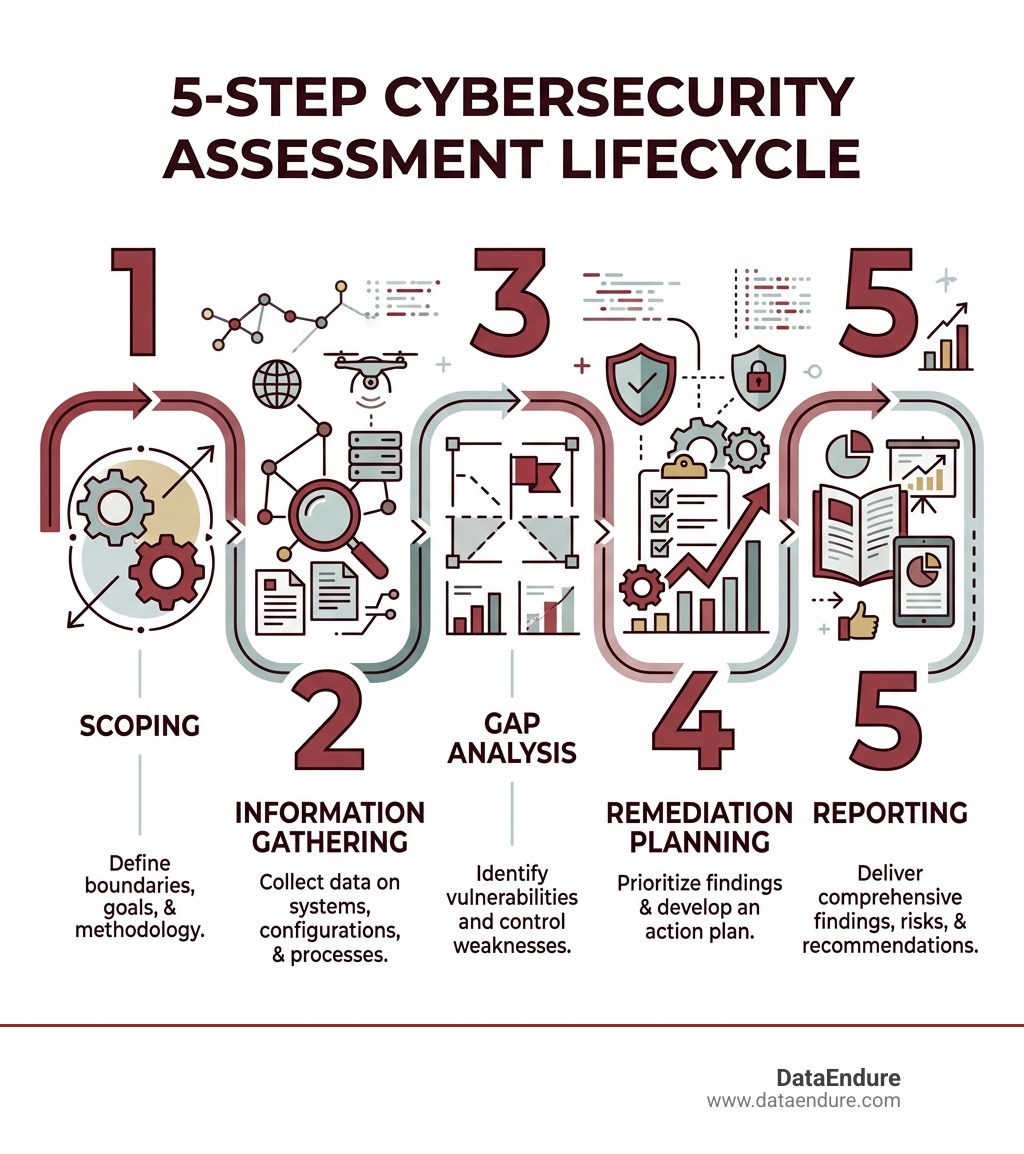
A professional assessment follows a structured methodology. It’s not just a guy with a laptop running a scan; it’s a collaborative process.
- Scoping: We define what’s being tested (and what’s off-limits).
- Information Mining: We gather context through documentation and stakeholder interviews. We want to know how your business actually uses its data.
- Technical Validation: This is the “testing” phase. We verify your controls using both automated tools and manual analysis.
- Gap Analysis: We compare your current state to your target state (e.g., NIST or ISO standards).
- Reporting: We provide a clear, prioritized roadmap for remediation.
This process is often part of a Network Health Check, ensuring your foundation is solid before you build more complexity on top of it.
From Gap Analysis to Prioritized Remediation
The most important deliverable is the prioritized action plan. You can’t fix 1,000 vulnerabilities in one day. We help you rank them by effort and criticality. An executive summary allows leadership to understand the risk, while a technical report gives your IT team the exact steps to fix the issues. For those using specific platforms, a Security Health Check Veritas can provide tailored insights for data protection environments.
The Role of AI and Advanced Threat Intelligence
In 2026, we use AI to fight AI. Advanced cyber security assessment services now incorporate machine-speed response and dark web monitoring. Since nearly all stolen data eventually ends up on the dark web, we use specialized intelligence to see if your credentials are already for sale. These Managed Security Services provide total visibility across your digital environment, detecting hidden risks that traditional tools might miss.
Choosing the Right Partner for Your Security Journey
Choosing a provider in Silicon Valley can feel overwhelming. Every company claims to be “the best.” To keep your sanity, look for a partner that offers more than just a report. You need someone with deep industry expertise and a track record of handling real-world incidents.
The right partner should understand the local landscape—from the unique threats facing Santa Clara tech firms to the regulatory requirements of California’s privacy laws. They should be more than a vendor; they should be a part of your extended team, helping you navigate our DataEndure Expertise to find the right fit for your budget and risk tolerance.
Key Factors to Evaluate in a Provider
When comparing providers, ask these questions:
- Do they use a recognized framework? (NIST, CIS, ISO)
- What is their threat response capability? Can they help you after the assessment?
- Do they evaluate “non-technical” risks? (Governance, policies, and employee training)
- Are their tools up to date? (AI-driven detection and automated vulnerability scanning)
Even something as specific as a Backup Health Check can be a major differentiator. If your backups are compromised, your recovery time from ransomware goes from hours to weeks.
Implementation and Deployment Timelines
In cybersecurity, speed is a feature. You don’t want an assessment that takes six months to deliver results. Look for providers who offer rapid deployment—ideally within 30 days. This reduces “alert fatigue” by giving your team clear, actionable data quickly. Services like NBUhealthcheck are designed for this kind of efficiency, ensuring your data protection environment is optimized without long delays.
Frequently Asked Questions about Cyber Security Assessments
How frequently should we conduct an assessment?
At a minimum, you should perform a comprehensive assessment annually. However, you should also trigger one after any major infrastructure change (like a cloud migration) or if you enter a new, highly regulated market. For high-risk environments, continuous monitoring is the gold standard in 2026.
Are there free assessment options available?
Yes. For U.S.-based critical infrastructure (including some private sector organizations), CISA offers free “Cyber Hygiene” services, including vulnerability scanning. You can learn more directly from the CISA Cyber Hygiene program. While these are excellent for a baseline, they often lack the depth and customized remediation planning that private cyber security assessment services provide.
How do assessments address ransomware threats?
Assessments address ransomware by testing your readiness framework. This includes verifying that your backups are “immutable” (cannot be deleted by an attacker), testing your incident response plan through tabletop exercises, and identifying the common entry points (like weak RDP credentials or unpatched VPNs) that ransomware groups exploit.
Conclusion
Navigating cyber security assessment services doesn’t have to be a nightmare. By focusing on a risk-based approach and choosing a partner that understands the 2026 threat landscape, you can transform your security from a source of anxiety into a competitive advantage.
At DataEndure, we specialize in helping organizations in Santa Clara and Silicon Valley stay ahead of the curve. We don’t just find problems; we provide the experts to help you solve them. With our ability to detect breaches in minutes and deploy comprehensive solutions in 30 days, we help you reduce alert fatigue and focus on growing your business.
Ready to see where you stand? Secure your future with a comprehensive Network Assessment