What Is a Cyber Risk Assessment? (Quick Answer)
Risk assessment in cyber security is the process of identifying, analyzing, and prioritizing the threats and vulnerabilities that could harm your organization’s digital assets — so you can act on the most critical risks first.
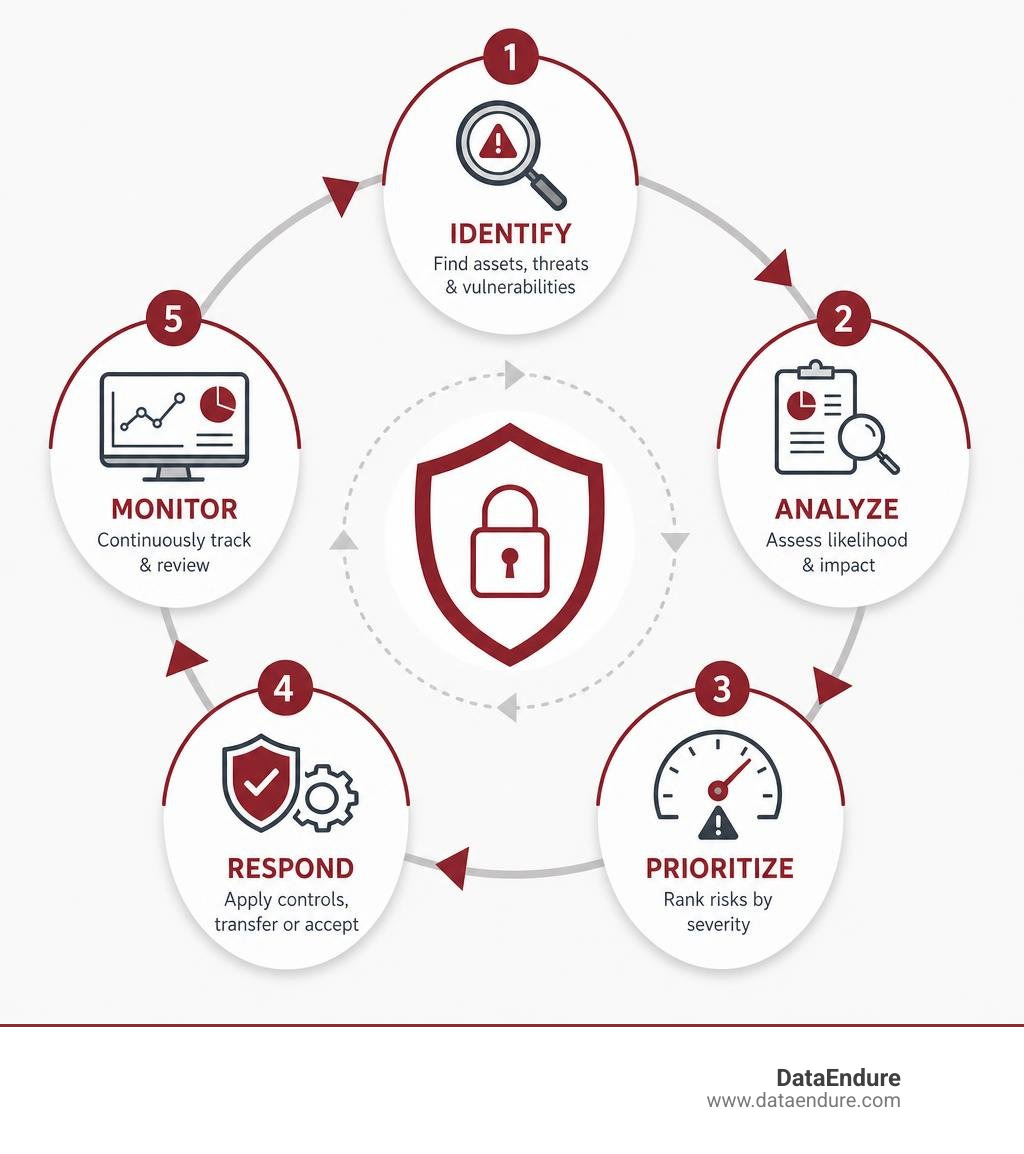
Here’s what a cybersecurity risk assessment covers at a glance:
- Identify assets – Know what data, systems, and infrastructure you need to protect
- Find threats and vulnerabilities – Discover what could go wrong and where your gaps are
- Analyze risk – Estimate the likelihood and business impact of each threat
- Prioritize – Rank risks so you focus resources where they matter most
- Respond – Apply controls, transfer risk, or accept it based on your risk appetite
- Monitor – Continuously track changes in your threat environment
For CISOs and IT directors at mid-sized organizations, managing security alerts, staffing constraints, and compliance deadlines is a constant challenge. The global average cost of a data breach reached USD 4.88 million in 2024 — a figure that highlights the importance of addressing potential reputational damage, regulatory penalties, and operational downtime.
The threat landscape continues to evolve. Only 24% of generative AI initiatives are properly secured, and 62% of network intrusions trace back to a third party. The operational perimeter has expanded, making defense more complex than in previous years.
A structured cyber risk assessment helps manage this complexity. Instead of reacting to every alert or vulnerability, it provides an evidence-based picture of where exposure lies and how to prioritize remediation.
This guide walks you through exactly how to do that.
Related content about risk assessment cyber security:
Why a Risk Assessment Cyber Security Protocol Is Essential in 2026
As we navigate 2026, the digital playground has become vastly more complex. Traditional defensive perimeters are gone. Between multi-cloud environments, remote workforces, and the rapid deployment of artificial intelligence, security teams are facing a massive explosion of operational surface area.
Without a formal risk assessment cyber security protocol, organizations often struggle to manage vulnerabilities effectively. You cannot protect what you do not know exists. A structured risk assessment serves as an operational guide, helping align security investments directly with actual business risks.
Beyond basic security hygiene, regulatory pressure in California has reached an all-time high. For organizations operating in Silicon Valley and across the state, compliance is no longer a check-the-box exercise. The California Privacy Regulations Requiring Cybersecurity Audits and Risk Assessments mandate that covered businesses conduct thorough, regular assessments to safeguard consumer data. Non-compliance can result in regulatory enforcement and statutory fines.
Identifying threats before they impact operations is key to staying ahead. If you’re wondering where to start, you can read our deep dive on How Can I Identify Potential Cybersecurity Risks? to kickstart your discovery process.
The Cost of Inaction and the Rise of AI Threats
The financial implications of ignoring security posture are significant. When the average cost of a breach hovers near the $5 million mark, a single major incident can severely impact a mid-market company.
To make matters more challenging, the rapid adoption of generative AI has introduced entirely new threat vectors. While business units rush to adopt AI tools to boost productivity, security teams are left playing catch-up. Because only 24% of generative AI initiatives are secured, organizations are inadvertently leaking proprietary code, customer data, and intellectual property into public LLMs. Furthermore, threat actors are now leveraging AI to build highly sophisticated, automated phishing campaigns and polymorphic malware.
To defend against these modern tactics, your risk assessment must account for these new tools and the infrastructure supporting them. Understanding the intersection of new technology and emerging threat vectors is critical to designing modern defenses. For a comprehensive overview of how to counter these modern threats, check out our guide on Cybersecurity Threats and Solutions.
The Third-Party Risk Factor
You are only as secure as the weakest link in your digital ecosystem. Today, 62% of network intrusions that organizations experience originate with a third-party vendor, partner, or contractor.
Modern enterprises rely on vast webs of SaaS applications, external APIs, and outsourced services. When you grant a third-party vendor access to your network or share sensitive data with them, their risk profile becomes your risk profile. A robust risk assessment cyber security program must look outward, evaluating vendor security controls, continuous compliance states, and data-sharing policies. Without rigorous third-party risk management (TPRM), organizations remain exposed to supply chain vulnerabilities.
Industry Frameworks to Guide Your Strategy
You don’t have to build your risk assessment methodology from scratch. Standardized industry frameworks provide structured, repeatable blueprints that ensure your assessment is thorough, defensible, and aligned with global best practices.
Aligning with the NIST Risk Assessment Cyber Security Standards
The National Institute of Standards and Technology (NIST) provides some of the most respected and widely adopted security guidance in the world. Specifically, The NIST Cybersecurity Framework (CSF) 2.0 offers a comprehensive taxonomy of security outcomes that is sector- and technology-neutral.
NIST CSF 2.0 introduces the GOVERN function as a central pillar, emphasizing that cybersecurity risk management must be integrated directly into broader enterprise risk management (ERM). It bridges the gap between technical practitioners and executive leadership, making security a business-enabling conversation.
To support this integration, NIST provides detailed documentation in Identifying and Estimating Cybersecurity Risk for Enterprise Risk Management | NIST. This framework guides organizations in translating technical vulnerabilities into risk scenarios that can be documented in a Cybersecurity Risk Register (CSRR). By using standard definitions for threat events, likelihood, and business impact, organizations can systematically prioritize their remediation efforts.
ISO 27001 and Other Global Standards
For organizations seeking a globally recognized certification, ISO/IEC 27001 is the gold standard. It mandates a risk-based approach to information security, requiring organizations to establish, implement, maintain, and continually improve an Information Security Management System (ISMS).
To guide the risk assessment portion of this standard, organizations turn to ISO/IEC 27005, which provides guidelines for information security risk assessments. Other frameworks, such as the CIS (Center for Internet Security) Controls—comprising 18 prioritized defensive actions—and PCI DSS (for payment card processing), also mandate formal risk assessments as core compliance requirements. Aligning your strategy with these standards ensures your security controls are validated globally.
Methodologies: Qualitative, Quantitative, and Dynamic Approaches
How do you actually calculate and express risk? Depending on your organization’s maturity, data availability, and business goals, you can choose from three primary risk assessment methodologies.

Comparing Qualitative and Quantitative Approaches
Historically, organizations have relied on qualitative risk assessments because they are relatively simple to execute. However, as security has become a board-level concern, quantitative methods have surged in popularity.
| Methodology | Description | Pros | Cons |
|---|---|---|---|
| Qualitative | Uses descriptive scales (e.g., Low, Medium, High) based on expert judgment to rate likelihood and impact. | Easy to set up; doesn’t require complex mathematical models or extensive historical data. | Subjective; can lead to inconsistent ratings; difficult to use for ROI calculations. |
| Quantitative | Assigns numeric and monetary values to risk (e.g., calculating Annualized Loss Expectancy). | Highly objective; speaks the language of business (dollars and cents); enables clear cost-benefit analysis. | Requires specialized tools, high-quality data, and significant time and expertise to implement. |
| Hybrid | Combines qualitative categorization with targeted quantitative modeling for critical assets. | Balanced approach; prioritizes resources while providing hard numbers where they matter most. | Requires careful coordination to maintain consistency across different asset classes. |
Many organizations adopting quantitative risk modeling leverage the FAIR (Factor Analysis of Information Risk) model. FAIR breaks down risk into concrete factors, such as Threat Event Frequency and Loss Magnitude, allowing security leaders to run Monte Carlo simulations and present risk exposure in exact dollar amounts.
The Shift Toward Dynamic Risk Assessment
While traditional static assessments provide a valuable snapshot of your security posture, they suffer from a major limitation: they are outdated the moment they are completed. In a cloud-first world where new vulnerabilities are disclosed daily, organizations are shifting toward real-time models.
According to research in Dynamic Risk Assessment in Cybersecurity: A Systematic Literature Review, dynamic risk assessment (DRA) models continuously calculate risk by combining offline vulnerability data with real-time environmental telemetry, such as Intrusion Detection System (IDS) alerts and threat intelligence feeds.
Many of these advanced DRA models leverage Bayesian networks to model the complex, interconnected dependencies between different assets and vulnerabilities. This allows security teams to visualize potential attack paths in real time and adapt their defenses dynamically as new threats emerge.
How to Perform a Cyber Risk Assessment
Ready to build your assessment? A successful assessment requires a systematic approach that bridges the gap between your technical infrastructure and your business objectives.

Executing Your Risk Assessment Cyber Security Step-by-Step
To conduct a comprehensive risk assessment cyber security process, follow these six fundamental steps:
- Determine the Scope: Define what is being assessed. Is it the entire enterprise, a specific business unit, a cloud environment, or a newly acquired third-party system?
- Identify and Prioritize Assets: Catalog all hardware, software, data, and intellectual property within your scope. Prioritize them based on their criticality to business operations.
- Identify Threats and Vulnerabilities: Use automated tools and threat intelligence to identify weaknesses. This is where a formal Vulnerability Assessment is crucial to uncover missing patches, misconfigurations, and weak access controls.
- Analyze Likelihood and Impact: For each identified vulnerability, estimate how likely it is to be exploited and what the financial, operational, and reputational impact would be.
- Calculate and Prioritize Risk: Map your findings to determine which risks require immediate attention.
- Implement Controls and Monitor: Deploy security controls to mitigate high-priority risks, and establish continuous monitoring to track your risk posture over time.
If managing this process internally is challenging, resources like the guide on How to Choose a Cyber Security Assessment Service Without Losing Your Mind can help identify a partner to assist with the process.
Translating Assessment Results into Actionable Security Controls
Once your risks are identified and prioritized, you must decide how to respond to each threat scenario. In cybersecurity risk management, you have four primary options:
- Treat: Apply security controls to mitigate the risk (e.g., implementing multi-factor authentication, segmenting networks, or deploying automated endpoint protection).
- Tolerate: Accept the risk if it falls within your organization’s accepted risk appetite and the cost of mitigation outweighs the potential impact.
- Terminate: Eliminate the risk entirely by changing your business processes (e.g., shutting down an insecure legacy application).
- Transfer: Share the risk with a third party, typically by purchasing cyber insurance or outsourcing operations to a managed security services provider.
To understand where a defense-in-depth strategy stands before making these decisions, starting with a Security Health Check can help evaluate existing controls against industry benchmarks.
Integrating Cyber Risk with Enterprise Risk Management (ERM)
Cybersecurity can no longer exist in a silo. To be truly effective, cyber risk management must be treated as a core component of your broader Enterprise Risk Management (ERM) strategy.
When cyber risks are translated into business risks—such as operational downtime, lost revenue, or regulatory penalties—they can be integrated directly into the Enterprise Risk Register (ERR). This integration allows executive leadership and board members to make informed, risk-adjusted decisions regarding capital allocation, business continuity planning, and strategic growth.
To bridge this communication gap, security leaders must learn to speak the language of the board. Instead of discussing technical CVE scores, frame the conversation around business resilience, operational impact, and strategic readiness. For a practical guide on how to facilitate these discussions, review the resource on Cyber Risk Questions Boards Should Be Asking.
Frequently Asked Questions about Cyber Risk Assessments
How often should a cybersecurity risk assessment be conducted?
At a minimum, organizations should conduct a comprehensive risk assessment annually. However, assessments should also be triggered whenever significant changes occur in your IT environment—such as migrating workloads to the cloud, deploying major software updates, opening new office locations, or acquiring another company.
What is the difference between a vulnerability assessment and a risk assessment?
A vulnerability assessment is a technical process focused on identifying and cataloging known security weaknesses (like unpatched software or open ports) in your systems. A risk assessment is a broader business-centric process that takes those vulnerabilities, combines them with threat likelihood, and analyzes the potential business impact to determine overall risk.
What role do stakeholders play in the risk assessment process?
Stakeholders from across the organization—including IT, finance, legal, HR, and business unit leaders—are vital. They provide critical context regarding asset value, operational dependencies, and regulatory requirements. Their involvement ensures that security decisions align with business objectives and that risk mitigation efforts receive the necessary executive buy-in and funding.
Conclusion
A successful risk assessment cyber security strategy isn’t about achieving perfect, zero-risk security—which is practically impossible. It’s about building digital resilience: the ability to anticipate threats, absorb impacts, and recover quickly without disrupting business operations.
Achieving this resilience requires alignment over complexity. Rather than adding unnecessary tools, organizations benefit from structured, layered approaches that address visibility gaps and reduce operational burdens.
For those who are Uncertain of Your Security Posture?, taking proactive steps can provide clarity. Initiating a comprehensive Network Assessment or requesting a Complimentary Security Review can help establish a baseline and secure your digital future.