
Contact

DataEndure | Cybersecurity & IT Resilience Experts

Under Attack?
  • Services
    • Managed Services

      • Cloud Security
      • Email Security
      • Endpoint Security
      • Network Security
      • N-SOC

      Compliance

      • GRC
      • Readiness Assessments
      • Risk Management

      Complimentary Health Checks

      • Network Health Check
      • Resiliency Workshop
      • Security Health Check

      In-Depth Assessments

      • Application Dependency Mapping
      • CISO Assessment
      • Dark Data Assessment
      • Network Assessment
      • Penetration Testing

      Why Layered Defense is Critical

      Layered security is about protecting all vectors that have access into your network, and the network is no longer just inside your datacenter. It's wherever your endpoints, people, data, and assets reside.

      View the Video >>

  • Expertise
    • Security & Compliance

      • Layered Defense Strategy
      • Cyber Threats & Solutions

      Information Management

      • Data Resilience

      Cloud & Data Science

      • Digital Transformation

      Infrastructure

      • Scale and Efficiency

      Network

      • Network Resilience
      What does "good" cybersecurity look like?

      What does "Good" Cybersecurity look like?

      Discover key insights for robust cybersecurity, addressing critical gaps and navigating evolving threats.

      Read the Blog >>

  • Industries
  • Company
    • About Us

      • Leadership
      • News
      • In the Community
      • Careers
      • Contact Us

      Partners

      • Strategic Partners
      • Technology Partners
      • Partner Program
      securing data 40 years since 1984

      Leading the Way Through Change

      Explore over 40 years of industry leadership and lasting impact as we delve into the remarkable history of Data Endure. 

      Learn More >> 

  • Resources
    • Learn

      • Security Advisories
      • Blog
      • Case Studies
      • Podcast
      • Events
      • Videos
      • White Papers

      Connect

      • Contact Us
      • Newsletter Sign Up
      • Partner Program
      The AI Gold Rush: How to Build a Winning On-Prem Strategy

      Watch our Tech Talk Series

      Stay up to date on the latest in cybersecurity with our monthly Tech talk series.

      Watch the Series >>

Home > Security & Compliance > Why 80% of Ransomware Victims Suffer Repeat Attacks

Why 80% of Ransomware Victims Suffer Repeat Attacks

April 23, 2024

Kirstin Burke, DataEndure
Kirstin Burke

Chief Marketing Officer

In the realm of cybersecurity, the adage “lightning never strikes the same place twice” doesn’t apply. Organizations that have suffered one cyberattack are commonly targeted again, regardless of company size or industry.

Ransomware by the Numbers
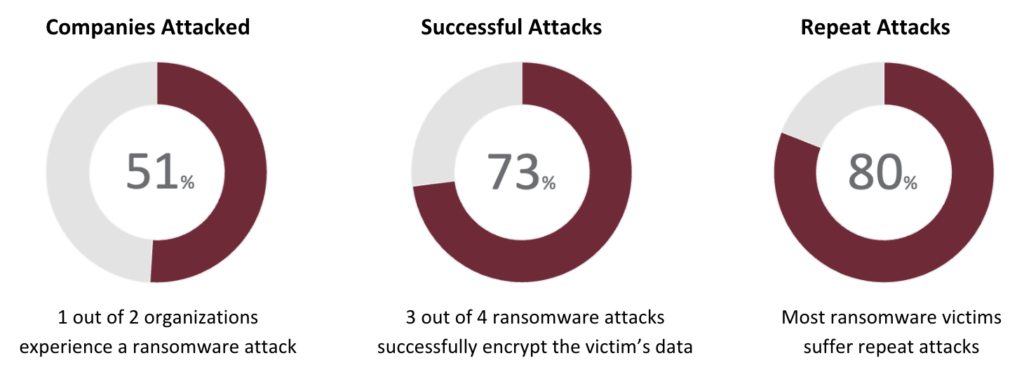
Ransomware stats

Why Do Attackers Repeatedly Target the Same Company?

The first cyberattack yields detailed insights into a company’s security architecture and response protocols. This intel becomes invaluable for orchestrating subsequent attacks that are often more tailored and potentially more damaging.

The longer attackers linger within a network, and the more lateral movement they are allowed, the more entrenched they become, making them exceedingly difficult to eradicate completely. This persistence not only allows them to execute the initial attack more effectively but also lays the groundwork for future breaches.

Moreover, if the initial response to a breach is inadequate, it signals to the broader cybercriminal community that the organization remains vulnerable.

Adversaries Exploit Remaining Gaps Aggressively

Whether it’s insufficient updates to security measures, poor incident response, or simply the lucrative nature of the stolen data, all these factors can contribute to unwanted attention from cybercriminals.

The recent ransomware attack on Change Healthcare serves as a prime example. After suffering an initial attack by ALPHV/BlackCat, the company was quickly hit again by a second criminal group, RansomHub.

How to Break the Breach Cycle

To prevent recurrent breaches, organizations need to adopt a multifaceted approach to cybersecurity.

Proactive Measures to Take Post-Breach

  • Thorough Incident Analysis: After a breach, conduct a detailed incident analysis to understand how the breach occurred and identify all affected systems and data.
  • Enhance Detection and Response: Improve your threat detection and response across all threat vectors and update your incident response plan.
  • Strengthen Access Controls: Reinforce access control measures. Multi-factor authentication, strict access policies, and adopting the principle of least privilege (also known as zero trust) can all help reduce the risk of a data breach.
  • Ongoing Penetration Testing: Continuously test your security controls to look for chinks in your armor. An annual pen test isn’t enough in today’s threat landscape.
  • 24×7 Security Operations Center (SOC): Ensure you have human experts monitoring for suspicious activities, actively threat hunting, and ready to respond swiftly.
  • Employee Training: Keep employees current on social engineering techniques used by adversaries.

Why a Layered Defense is Vital
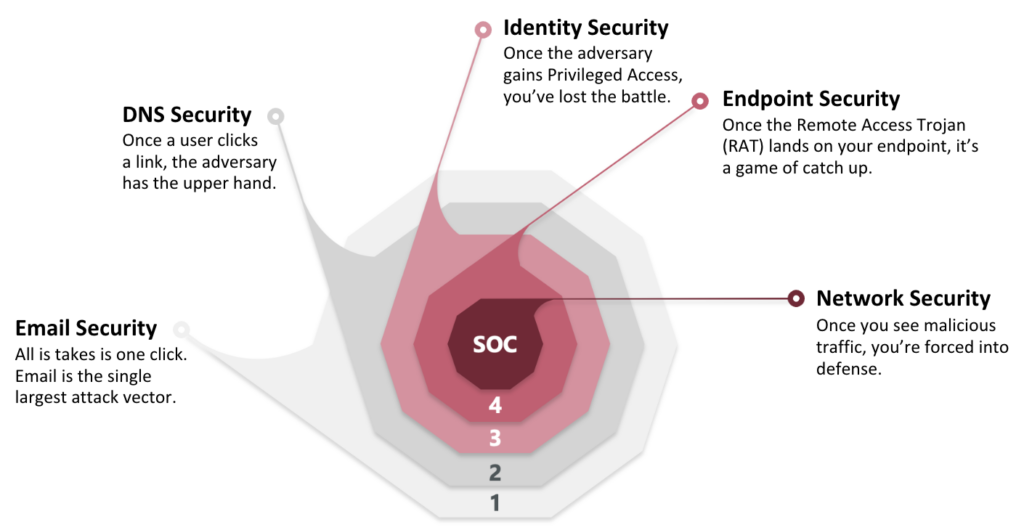
Why a layered defense is critical for cybersecurity
A cohesive, comprehensive defense is needed. Deploying multiple, specialized tools at each security layer provides a response tactic tuned for each type of attack.

Moving Forward with Resilience

Before an adversary strikes, companies must be prepared across all fronts to protect their business operations. This includes resiliency planning—updating your incident response plan, testing that plan, and fortifying your network and devices to make every attack surface as inhospitable as possible.

When an attack does occur, the primary business goal is to have a swift response, contain the damage, and prevent it from spreading. By implementing a robust cybersecurity framework and learning from past incidents, companies can greatly reduce their chances of falling victim to recurrent cyberattacks.

Post-breach, it’s crucial to conduct a root cause analysis to not only repair the immediate damage but also to identify and mitigate any backdoors left by attackers.

You Don’t Have to Face Threats Alone

In the world of cybersecurity, staying still means falling behind. Most companies want (and need) to do cybersecurity well, but given the complexity and pace of change, they simply don’t know where to start.

DataEndure has been around for four decades, and security has been foundational to who we are since day one. This experience informs how we build, manage, and evolve our security services.

We can work with you to strengthen your security posture in manageable, incremental steps, so you don’t become a statistic. Schedule a call today and move forward with resilience.

Search

Blog Categories

  • Cloud & Data Science
  • Information Management
  • Infrastructure
  • Network
  • Podcasts
  • Security & Compliance
  • Security Advisories

Get started today!

We're here to help. Talk to us to learn more about how we can help your organization achieve digital resilience with solutions custom-built to meet the needs of your business.

SCHEDULE A MEETING

DataEndure
590 Laurelwood Drive
Santa Clara, CA 95054
800.969.4268

DataEndure © 2026. All Rights Reserved.  Privacy Policy

Follow Us

This website uses cookies to improve your experience. We'll assume you're ok with this, but you can opt-out if you wish. Accept Reject
Privacy & Cookies Policy

Privacy Overview

This website uses cookies to improve your experience while you navigate through the website. Out of these, the cookies that are categorized as necessary are stored on your browser as they are essential for the working of basic functionalities of the website. We also use third-party cookies that help us analyze and understand how you use this website. These cookies will be stored in your browser only with your consent. You also have the option to opt-out of these cookies. But opting out of some of these cookies may affect your browsing experience.
Necessary
Always Enabled
Necessary cookies are absolutely essential for the website to function properly. This category only includes cookies that ensures basic functionalities and security features of the website. These cookies do not store any personal information.
Non-necessary
Any cookies that may not be particularly necessary for the website to function and is used specifically to collect user personal data via analytics, ads, other embedded contents are termed as non-necessary cookies. It is mandatory to procure user consent prior to running these cookies on your website.
SAVE & ACCEPT