
Chief Revenue Officer
Artificial intelligence is advancing at a remarkable pace.
New models emerge seemingly every week. Agentic AI is becoming more capable. Organizations are moving from experimentation to implementation. And every technology conference seems to bring a fresh wave of predictions about what comes next.
One of the more interesting themes emerging from the recent Gartner summit takeaways was that organizations are beginning to move beyond questions about AI capability and toward questions about AI responsibility.
The conversation is shifting.
Less attention is being paid to what AI can do.
More attention is being paid to how organizations govern it, integrate it into existing processes, measure its impact, and maintain accountability as its influence grows.
That’s an important shift.
Because many of the challenges leaders are wrestling with today are not really technology challenges.
They’re organizational challenges.
And ultimately, they’re resiliency challenges.
The Technology Is Moving Faster Than the Organization
For decades, organizations have focused on adopting new technologies. The challenge today is different.
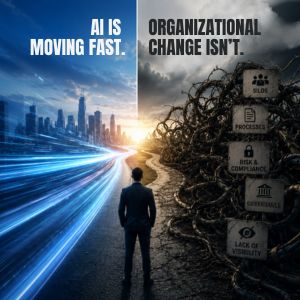 AI is not simply another application to deploy or platform to implement. It’s a capability that has the potential to influence decision-making, automate processes, generate content, analyze information, and increasingly take action on behalf of users.
The technology is advancing quickly.
Processes, governance models, operating procedures, and organizational structures often are not.
This creates a growing gap between what technology can do and what organizations are prepared to manage responsibly.
It is within that gap that operational, security, and compliance risks begin to emerge.
Governance Starts with Visibility
Many organizations are rushing to establish AI governance programs.
Governance is important. But effective governance depends on visibility.
Organizations first need to understand:
- What AI systems are being used
- What data those systems access
- Who can interact with them
- How outputs are being generated
- Where AI is influencing business decisions
Without that visibility, leaders find themselves accountable for systems they cannot fully observe, validate, or explain.
Human Judgment Still Matters
Gartner also highlighted something that often gets lost amid discussions of automation: the continuing importance of human ingenuity and judgment.
The reality is that AI excels at processing information, identifying patterns, and accelerating routine work.
What it does not provide is context.
It does not understand organizational priorities.
It does not own business outcomes.
It does not carry accountability.
This is particularly important in areas such as cybersecurity, compliance, operations, and risk management, where technology can accelerate decisions but accountability for outcomes still rests with people.
The organizations creating the most value from AI are not replacing human expertise—they’re augmenting it and enabling employees to make better decisions, work more efficiently, and focus their time on higher-value activities.
Digital Resilience in the Age of AI
At DataEndure, we believe digital resilience is about more than protecting systems. It’s about enabling organizations to adapt as technology, business requirements, and market conditions evolve.
AI is creating new opportunities, but it’s also introducing new complexity. The challenge extends beyond the technology itself.
Success will depend on more than selecting the right models or deploying the latest tools. As AI becomes increasingly integrated into business operations, organizations must develop the capabilities to continuously observe, govern, validate, and adapt these systems at scale.
The question is no longer whether AI will change the business. It already is.
The question is whether the organization has the visibility, governance, and resilience required to keep pace.