The Business Risk Behind Cloud Security in 2026
Cloud security is the set of policies, controls, and technologies that protect your data, applications, and infrastructure in cloud environments — covering everything from who can access what, to how threats are detected and stopped.
Quick answer: What is cloud security?
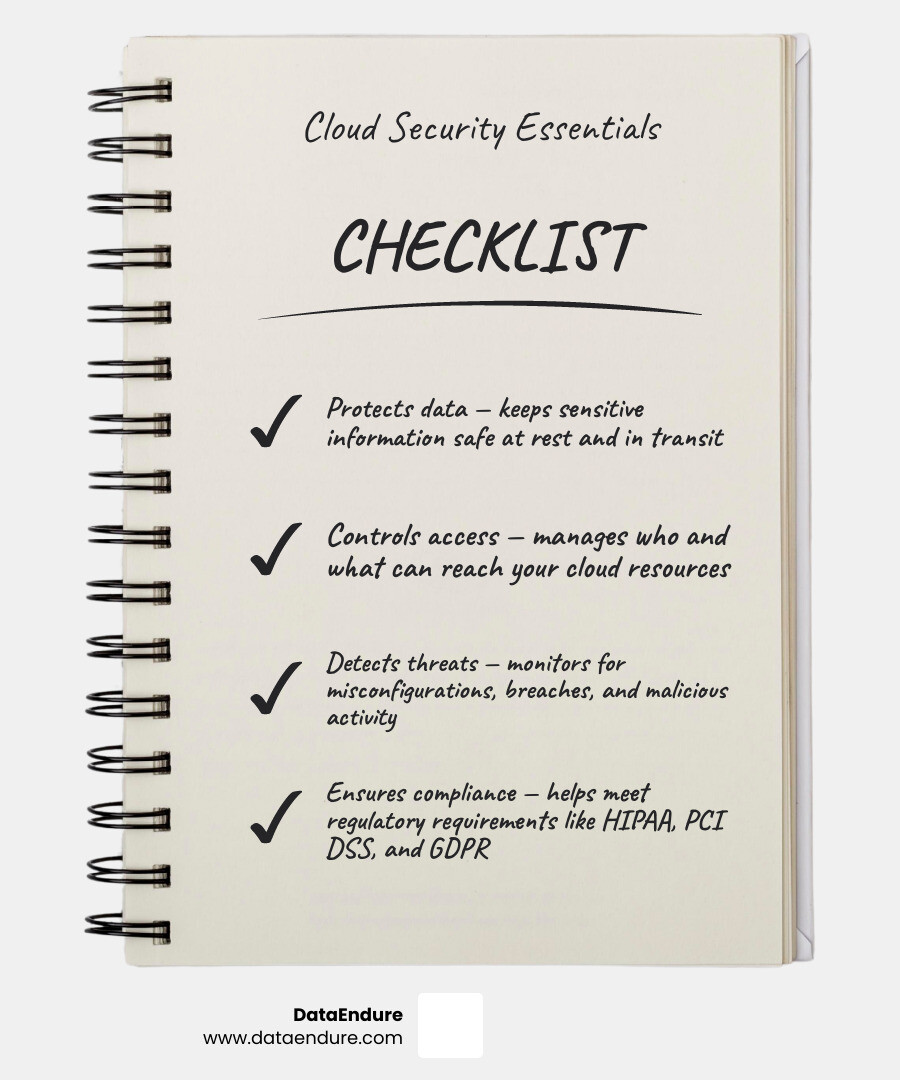
- Protects data — keeps sensitive information safe at rest and in transit
- Controls access — manages who and what can reach your cloud resources
- Detects threats — monitors for misconfigurations, breaches, and malicious activity
- Ensures compliance — helps meet regulatory requirements like HIPAA, PCI DSS, and GDPR
- Maintains resilience — keeps systems running even when attacks occur
The scale of what’s at stake is hard to ignore. The global cloud security market is on track to grow from $40 billion in 2025 to more than $124 billion by 2034. That growth reflects a hard truth: as organizations move more workloads to the cloud, the attack surface expands fast.
And the gaps are real. Nearly a third of all cloud assets remain unpatched, each carrying an average of 115 vulnerabilities. More than a third of organizations leave sensitive databases publicly accessible. Meanwhile, 84% of organizations now use AI in the cloud — yet 62% have at least one vulnerable AI package exposed.
For IT leaders in regulated industries, this isn’t an abstract problem. A breach, a compliance failure, or a neglected cloud asset can mean downtime, regulatory penalties, and damaged customer trust. The challenge isn’t just securing the cloud — it’s doing it without adding more tool sprawl, more alerts, and more burden on already stretched teams.
That’s exactly what this guide is designed to help with. Whether you’re reassessing your current posture or building a cloud security program from the ground up, you’ll find clear, practical answers here.
What Is Cloud Security and Why It Matters in 2026
When we talk about cloud security, we are talking about a specialized branch of cybersecurity designed to address the unique architecture of cloud computing. It isn’t just one tool; it is a collection of procedures and technologies designed to address both external and internal threats.
In 2026, the cloud is no longer just “someone else’s computer.” It is the engine of digital transformation. Whether your organization relies on Software as a Service (SaaS) for productivity, Platform as a Service (PaaS) for development, or Infrastructure as a Service (IaaS) for raw computing power, cloud security is the framework that ensures these services remain available and uncompromised.
What cloud security means for modern organizations
For a modern organization, particularly those in the tech-heavy corridors of Santa Clara and Silicon Valley, cloud security is synonymous with business continuity. It involves securing cloud workloads—the programs and services running in the cloud—and the sensitive data they process.
As remote and hybrid work models have become permanent fixtures, the “perimeter” of the office has vanished. We now have to secure users, devices, and applications across thousands of miles. This requires a shift in mindset: moving away from “securing the walls” to “securing the data and the identity” regardless of where they reside.
Why cloud security is now a business priority
If you look at the numbers, the “Defender’s Paradox” is more visible than ever: an attacker only needs to be right once, but we have to be right every single time.
- Attack Paths: 13% of organizations have a single cloud asset responsible for more than 1,000 potential attack paths.
- Neglected Assets: Nearly 33% of cloud assets are unpatched or neglected, creating easy entry points for ransomware.
- Trust as Currency: When GDPR and HIPAA violations can cost millions, security is no longer a “cost center”—it is a trust builder.
Cloud security vs. traditional cybersecurity
Traditional cybersecurity often focuses on physical hardware and a defined network perimeter. Cloud security is different because it handles:
- Multitenancy: Your data might live on the same physical server as another company’s data.
- Ephemeral Assets: Cloud resources (like containers) might only exist for minutes or seconds.
- API Exposure: Cloud services communicate via APIs, which can be vulnerable if not properly managed.
- Identity-First Security: In the cloud, identity (who you are) is the new perimeter, not the IP address of your office.

Core Cloud Security Risks, Challenges, and the Shared Responsibility Model
Moving to the cloud offers agility, but it also introduces specific risks that can catch even seasoned IT directors off guard. The biggest hurdle we often see isn’t the technology itself, but the “ambiguity of the cloud”—knowing exactly who is responsible for what.
The biggest cloud security risks organizations face
The most common cause of cloud breaches isn’t a sophisticated hacker using a zero-day exploit; it’s a simple human error.
- Misconfigurations: Leaving a storage bucket or database publicly accessible is the leading cause of data exposure.
- Vulnerable AI Packages: With 84% of organizations adopting AI, we’ve seen a surge in vulnerable AI-specific packages that attackers can exploit to gain access to proprietary models.
- Excessive Permissions: Many organizations grant “admin-level” access to users who don’t need it, increasing the blast radius of a single compromised account.
- Shadow IT: Employees using unauthorized cloud apps without the knowledge of the IT department, creating massive visibility gaps.
How the shared responsibility model works across IaaS, PaaS, and SaaS
One of the most important concepts to master is the shared responsibility model. It’s a division of labor between the Cloud Service Provider (CSP) and you, the customer.
- IaaS (Infrastructure): The provider secures the physical hardware and virtualization. You are responsible for the operating system, applications, and data.
- PaaS (Platform): The provider secures the OS and middleware. You secure the applications and data.
- SaaS (Software): The provider secures almost everything, but you are always responsible for your data and who has access to it.
Essentially, the provider is responsible for the “security of the cloud,” while you are responsible for “security in the cloud.” Some modern providers are moving toward a “shared fate” model, offering more active tools to help you fulfill your end of the bargain. You can read more about who shares the responsibility for cloud security to ensure your team isn’t leaving a gap in coverage.
Why public, private, hybrid, and multicloud environments require different controls
Different cloud models require different security approaches. With 55% of organizations now using two or more cloud providers, managing this complexity is a major challenge.
| Environment | Security Focus | Primary Challenge |
|---|---|---|
| Public Cloud | Identity & Configuration | Multitenancy risks & public exposure |
| Private Cloud | Physical & Hypervisor security | Higher operational burden for the owner |
| Hybrid Cloud | Secure connectivity & Data flow | Complexity of bridging on-prem and cloud |
| Multicloud | Policy consistency | Tool sprawl and identity fragmentation |
Network blind spots that weaken cloud security strategies
A common mistake is assuming that cloud-native security covers the network layer perfectly. Many strategies break down because they lack visibility into “east-west” traffic—traffic moving between servers within the cloud environment. If an attacker gets into one workload, they can often move laterally because of a lack of internal segmentation. Understanding why cloud strategies break down at the network layer is critical for preventing lateral movement during a breach.
Key Components of an Effective Cloud Security Program
To build a resilient cloud posture, we focus on a layered approach. This eliminates “blind spots” and ensures that if one control fails, another is there to catch the threat.
Identity, access, and zero-trust foundations
In the cloud, we must assume that no one is trustworthy by default. This is the core of Zero Trust.
- IAM (Identity and Access Management): Centralizes who can access what.
- Principle of Least Privilege (PoLP): Users get the minimum access needed to do their jobs.
- Just-in-Time (JIT) Access: Permissions are granted only when needed and revoked immediately after.
- Non-Human Identities: We must also secure the “identities” of the machines and apps that talk to each other.
Data protection, monitoring, and response
Protecting the “crown jewels” (your data) requires a mix of encryption and active monitoring.
- DLP (Data Loss Prevention): Tools that identify and block sensitive data from being uploaded or shared inappropriately.
- Encryption: Using advanced methods like Fully Homomorphic Encryption (FHE) allows us to compute data without ever decrypting it, keeping it safe even while in use.
- SIEM (Security Information and Event Management): Collects logs from across your cloud to spot anomalies.
Modern cloud security platforms: CSPM, CNAPP, CASB, and beyond
The alphabet soup of cloud security can be confusing, but these tools are essential:
- CSPM (Cloud Security Posture Management): Automatically scans for misconfigurations and compliance drift.
- CASB (Cloud Access Security Broker): Sits between your users and cloud apps to enforce security policies. You can explore how a Cloud Access Security Broker provides visibility into SaaS usage.
- CNAPP (Cloud-Native Application Protection Platform): A unified tool that combines several functions (like container security and posture management) into one dashboard to reduce tool sprawl.
Before deploying these, it is often wise to perform a Cloud Security Assessment to see where your current gaps lie.
Securing AI and emerging cloud-native technologies
As we move further into 2026, securing AI is paramount. This includes “Model Armor” to prevent prompt injection and ensuring that the open-source packages used in your AI models are free of vulnerabilities. We also look at “Agentic AI” security—ensuring that AI agents acting on your behalf don’t accidentally overstep their permissions.
Cloud Security Best Practices for Implementation and Operations
Building a cloud security program isn’t a one-time project; it’s an ongoing operational discipline. We recommend a “resilience-as-an-enabler” approach that supports business growth rather than slowing it down.
How to build a cloud security roadmap that reduces complexity
Start by identifying your most critical assets. Don’t try to boil the ocean. A vendor-agnostic strategy allows you to choose the best tools for your specific needs without being locked into a single provider’s ecosystem. Focus on “Alignment Over Complexity”—ensure your security tools actually talk to each other.
Best practices for configuration, patching, and continuous monitoring
- Baseline Hardening: Use industry standards (like CIS Benchmarks) to set a “secure by default” configuration for every new resource.
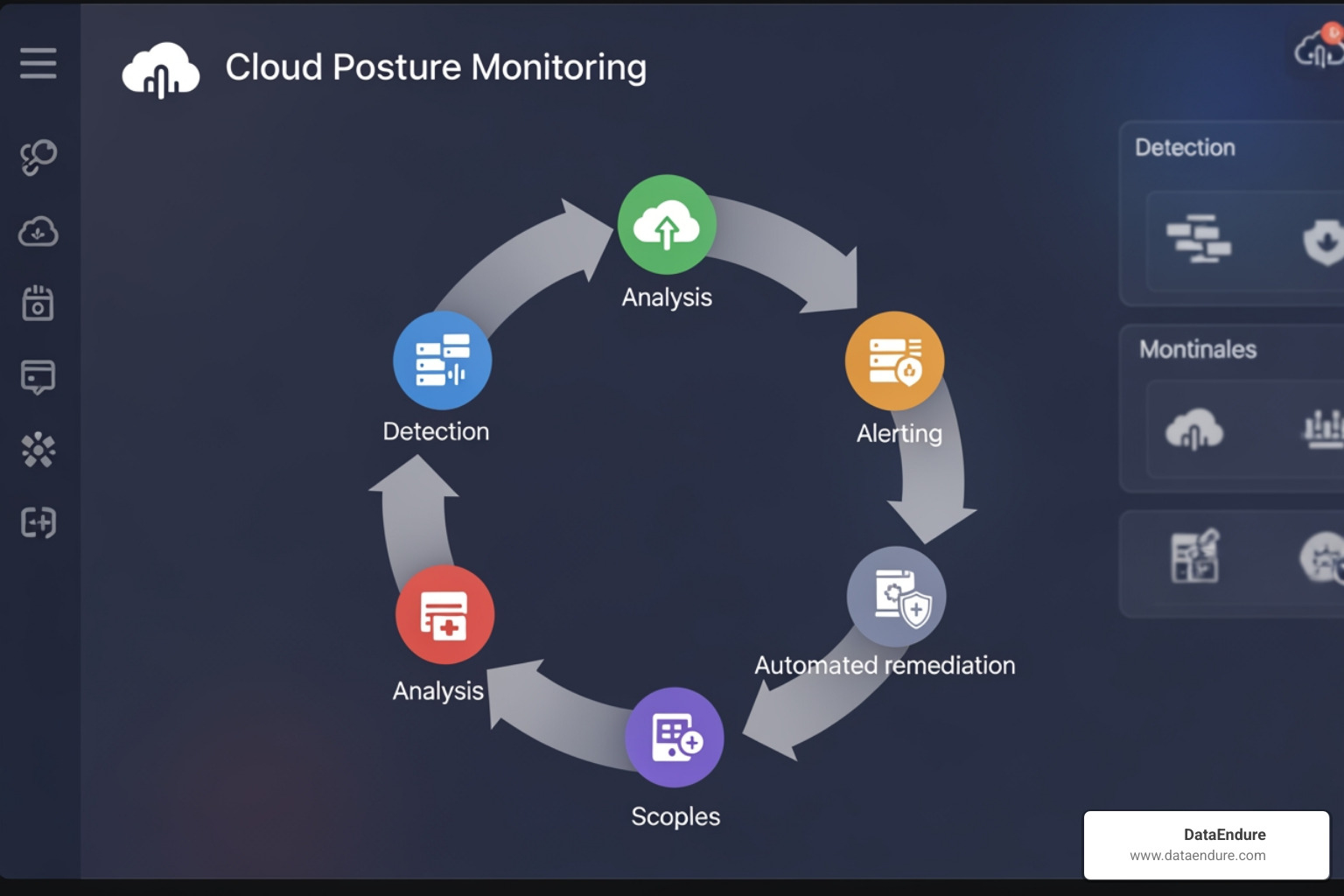
- Drift Detection: Use automation to alert you the second a configuration changes from its secure baseline.
- Patch Prioritization: You can’t patch everything at once. Focus on vulnerabilities that are actually exploitable in your specific environment.
How to embed cloud security into daily operations
Security should be part of the developer workflow, not a hurdle at the end of it.
- Shift Left: Scan your “Infrastructure as Code” (IaC) for security flaws before it is even deployed.
- Reduce Alert Fatigue: Use managed solutions that triage alerts so your team only sees the ones that matter.
- 30-Day Deployment Mindset: We believe in getting security foundations in place quickly—aiming for full deployment in 30 days to close the window of opportunity for attackers.
To stay on top of your environment, regular check-ups are vital. A Cloud Health Check can help identify inefficiencies, while Cost Containment strategies ensure you aren’t overspending on unused or unoptimized security resources.
Compliance, Governance, and Choosing the Right Cloud Security Solution
For organizations in Silicon Valley, compliance isn’t just a checkbox; it’s a legal requirement. Whether you are dealing with patient data in healthcare or financial records, your cloud must be an audit-ready environment.
Which compliance and regulatory standards matter most
- GDPR: Essential for any company with European customers, focusing on data privacy.
- HIPAA: The gold standard for healthcare data.
- PCI DSS: Required for anyone processing credit card payments.
- NIST CSF: A framework that helps organizations manage and reduce cybersecurity risk. You can find more technical details on Cloud computing security standards to see how they apply to your specific architecture.
How governance frameworks strengthen cloud security
Governance is about setting the rules of the road. Using the Cloud Security Alliance (CSA) tools like the Cloud Controls Matrix (CCM) helps you map your security controls to various global regulations. The CSA STAR Registry, which has over 2,500 entries, is a great place to verify the security claims of the cloud providers you use.
How to evaluate cloud security tools and providers
When choosing a solution, look for:
- Integration: Does it work with your existing stack?
- Automation: Can it remediate simple threats without human intervention?
- Multicloud Support: Does it provide a single pane of glass for all your cloud providers?
- Time to Value: How long will it take to see a reduction in risk?
For a deeper dive into the fundamental definitions, you might review What Is Cloud Security? | Google Cloud to compare different provider perspectives.
Frequently Asked Questions About Cloud Security
What are the main benefits of cloud security for businesses?
The primary benefit is risk reduction without sacrificing the speed of the cloud. Effective cloud security provides faster threat detection, automated compliance reporting, and lower operational overhead by offloading infrastructure security to the provider.
Is cloud security different in multicloud environments?
Yes. The biggest challenge in multicloud is “identity sprawl” and inconsistent policies. You need a centralized way to view and manage security across all providers to ensure that a security rule in AWS is also being followed in Azure or Google Cloud.
How does AI impact cloud security?
AI is a double-edged sword. We use it for faster triage of alerts and finding hidden patterns in data breaches. However, it also creates a new attack surface, such as “prompt injection” or the accidental exposure of sensitive data through AI training models.
Conclusion
As we look toward the future of cloud security in 2026, the complexity of our digital environments will only continue to grow. But complexity doesn’t have to mean vulnerability.
At DataEndure, we bring over 40 years of experience in digital resilience to the table. We understand that true security isn’t about buying more tools—it’s about holistic, interconnected solutions that eliminate blind spots across security, data, cloud, and network layers. Our goal is to reduce your operational burden and deliver real business outcomes, detecting breaches in minutes rather than months.
By focusing on alignment, vendor-agnosticism, and a “resilience-as-enabler” mindset, we help organizations in Santa Clara and across the globe grow securely. If you’re ready to move beyond basic settings and toward a unified, AI-ready defense, we invite you to explore our approach to Cloud Security and see how we can help you secure what’s next.