The Managed EDR vs MDR Debate Could Be Costing You More Than You Think
Managed EDR vs MDR is one of the most important security decisions your organization will face in 2026 — and getting it wrong leaves real gaps in your defenses.
Here’s the quick answer:
| Managed EDR | MDR | |
|---|---|---|
| What it is | EDR software managed by an external provider | Fully outsourced security service with human analysts |
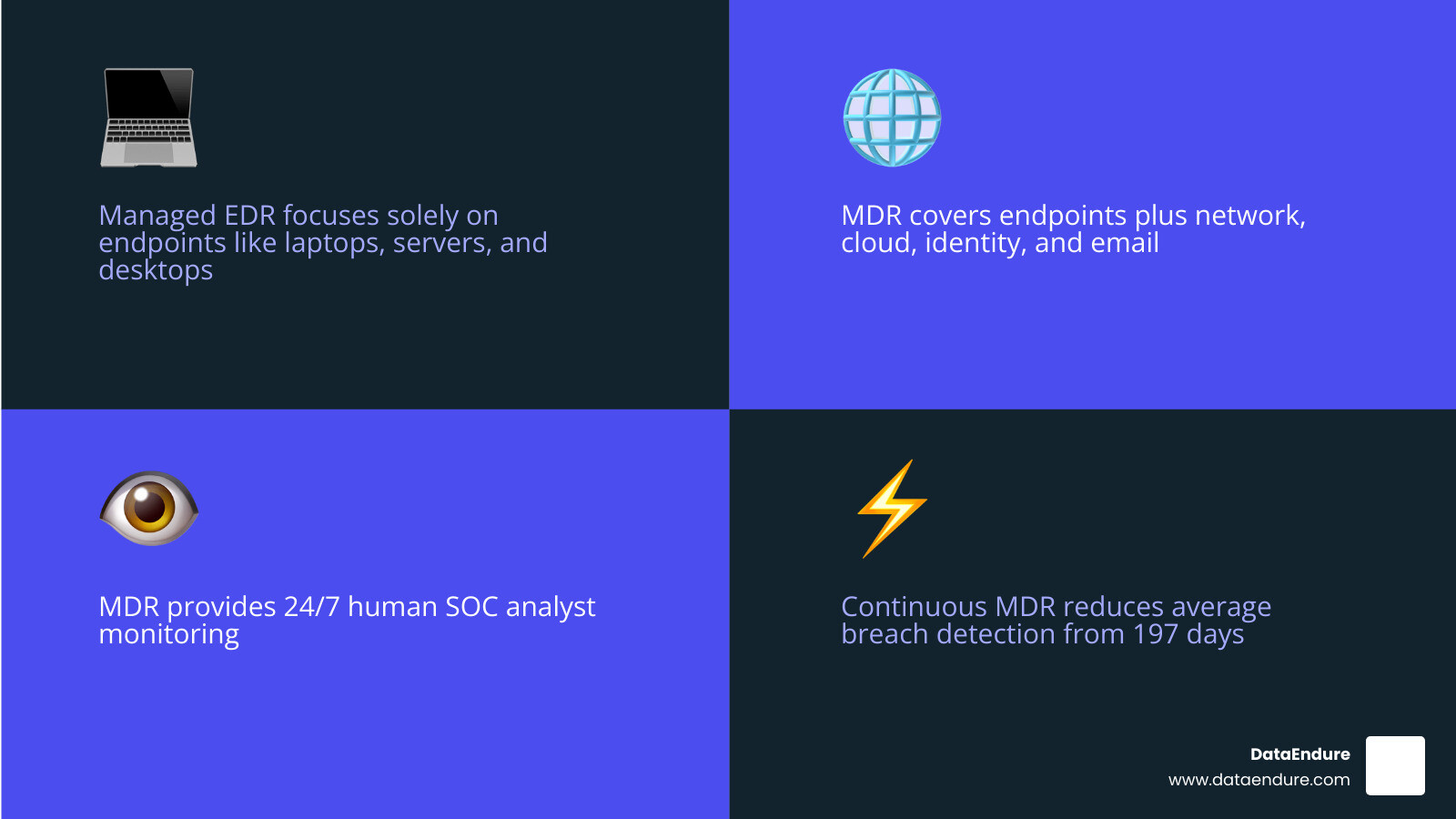
| Scope | Endpoints only (laptops, servers, desktops) | Endpoints + network, cloud, identity, email |
| Who monitors it | Provider manages the tool; your team still involved | Provider’s SOC analysts handle everything 24/7 |
| Best for | Teams with some security maturity needing endpoint coverage | Organizations without in-house security expertise |
| Cost | Lower upfront; hidden staffing costs | Higher per-endpoint fee; lower total cost of ownership |
| Threat hunting | Limited | Proactive, continuous |
If you’re an IT leader in a regulated industry, you already know the pressure. Alerts are piling up. Staff are stretched thin. And threats don’t wait for business hours.
The average breach goes undetected for 197 days without continuous monitoring. That’s not a technology problem — it’s a coverage problem.
The difference between managed EDR and MDR isn’t just about features. It’s about who is watching, what they can see, and how fast they can act when something goes wrong.
Defining the Core Technologies: EDR and MDR
To understand the managed edr vs mdr landscape, we first have to look at the building blocks. In the early days of cybersecurity, we relied on simple “walls” to keep people out. Today, the walls have ears, eyes, and the ability to fight back.

Endpoint Detection and Response (EDR)
EDR is a host-based security solution. Think of it as a flight data recorder for your laptops, servers, and mobile devices. It continuously monitors these “endpoints” to detect, investigate, and remediate malicious activity. Unlike older tools, EDR doesn’t just look for “bad files”; it looks for “bad behavior” using telemetry and behavioral analysis.
If you’re wondering exactly what goes into these platforms, you can explore what tools are used for EDR? to see the technical stack behind the curtain. At its heart, Endpoint Security is about visibility—knowing exactly what is happening on every device in your fleet at all times.
Managed Detection and Response (MDR)
MDR isn’t just a tool; it’s a service. It combines advanced technology (often including EDR) with a fully outsourced, 24/7 Security Operations Center (SOC). While EDR gives you the data, MDR provides the experts to interpret that data, hunt for threats, and respond to incidents on your behalf.
The Evolution of Endpoint Security in 2026
As we move through 2026, the stakes have never been higher. Statistics show that 77% of security experts believe data leaks will increase due to the widespread use of Generative AI tools. Hackers are now using AI to craft more convincing phishing emails and develop polymorphic malware that changes its shape to avoid detection.
This shift has made Endpoint Detection and Response foundational. Over 50% of security leaders are now investing in EDR, MDR, and XDR solutions to keep up with this automated onslaught.
Why Traditional Antivirus is No Longer Enough
If you are still relying on traditional antivirus (AV), you are essentially using a “Wanted” poster to catch a shapeshifter. Traditional AV relies on signature-based detection—it only catches what it has seen before.
Modern threats use “fileless” malware and living-off-the-land techniques that don’t leave a traditional footprint. This is why proactive threat hunting has replaced reactive scanning. You need a system that assumes a breach is possible and looks for the subtle signs of lateral movement or privilege escalation.
Managed EDR vs MDR: Understanding the Management Gap
The “Managed” part of managed edr vs mdr is where most organizations get confused. Both involve third-party help, but the depth of that help varies wildly.

What is Managed EDR?
Managed EDR is essentially “tool management.” A provider helps you deploy the EDR software, ensures the agents are healthy, and perhaps tunes the alerts so you aren’t drowning in noise. However, the ultimate responsibility for “what do we do now?” often stays with your internal team. It bridges the skills gap by taking the technical maintenance off your plate, but it doesn’t always provide the 24/7 “eyes-on-glass” response that a full MDR service offers.
For many, this is a middle ground between DIY and full outsourcing. You can learn more about the benefits of using an EDR platform to see how this visibility empowers your team.
How Managed EDR Differs from Traditional EDR
The difference is the “management burden.” Traditional EDR is a powerful sports car that you have to drive, maintain, and fuel yourself. Managed EDR is like having a mechanic who keeps the car running, but you still have to be the driver.
In today’s market, the cybersecurity talent shortage is a massive hurdle. Finding experts who can interpret complex telemetry is hard; keeping them is harder. This is why the conversation often shifts to MSPs vs MSSPs, as organizations look for partners who can handle the heavy lifting of security operations.
The Role of Human Expertise in Modern Detection
Technology can flag an anomaly, but a human understands context. Is a login from Santa Clara at 2:00 AM a breach, or is it just your lead developer working late?
Managed services, specifically Managed Security MDR, provide the human expertise needed for alert triage and incident validation. This drastically improves the Mean Time to Respond (MTTR). When ransomware can encrypt a drive in minutes, having a team that can record a 30-minute MTTR—as some top-tier MDR services do—is the difference between a “non-event” and a business-ending catastrophe.
Strategic Benefits and Limitations of Each Approach
When we weigh managed edr vs mdr, we have to look at the “Total Defense” picture.
| Feature | Managed EDR | MDR |
|---|---|---|
| Visibility | Endpoint only | Full Stack (Network, Cloud, Identity) |
| Response | Guided / Automated | Active / Human-led |
| Threat Hunting | Reactive to alerts | Proactive / 24/7 |
| Staffing | Requires internal oversight | Fully managed SOC |
| Implementation | Fast (Tools focus) | Comprehensive (Process focus) |
Key Advantages of a Managed EDR Strategy
Managed EDR is excellent for organizations that have a small, capable IT team but lack the specialized tools to see deep into their endpoints. It provides deep forensic data that is vital for compliance and post-incident investigation. It’s a cost-effective way to get specialized protection for your most vulnerable assets: the devices your employees use every day.
Why Organizations are Moving Toward Full MDR
The shift toward full MDR is driven by the reality of modern attacks. Hackers don’t just hit an endpoint; they compromise a cloud identity, move through the network, and exfiltrate data from a database. If you are only looking at the endpoint, you have a massive visibility gap.
MDR provides 24/7 coverage and cross-domain visibility. It reduces alert fatigue by filtering out the 90% of “noise” that plagues internal teams, allowing you to focus on your business. This is why many are looking at EDR as a Service as a component of a larger managed strategy. When comparing MSPs and MSSPs, it really comes down to whether you want someone to manage your computers or someone to manage your security.
Choosing the Right Fit: Cost, Implementation, and Use Cases
Deciding between managed edr vs mdr often comes down to the “Three Cs”: Cost, Capability, and Compliance.
Use Cases for Managed EDR and MDR
- Small Businesses: Often lean toward MDR because they have zero internal security staff. Spending $15,000–$45,000 a year on a service is much cheaper than hiring a single analyst for $100,000+.
- Distributed Networks: Organizations with remote workers in Silicon Valley and beyond need the 24/7 monitoring of MDR to handle threats across different time zones.
- Regulated Industries: If you are subject to HIPAA, SOC2, or CMMC, you likely need the documented 24/7 response and threat hunting that MDR provides.
Total Cost of Ownership (TCO)
Don’t be fooled by the sticker price. EDR software might cost $5–$15 per endpoint, but the “hidden” costs of staffing, training, and alert fatigue add up. Managing EDR internally can take 10–20 hours a week for even a small environment. When you factor in the cost of EDR plus the salary of an analyst, MDR often emerges as the more economical choice for SMBs.
Evaluating Your Internal Security Maturity
At DataEndure, we see many organizations struggle with the “30-day goal.” Can you deploy, tune, and operationalize a security solution in a month? Our experts specialize in rapid deployment because we know that every day you spend “configuring” is a day an attacker can spend “exploiting.” If your internal team is already facing burnout, adding another complex tool like EDR without managed support is a recipe for disaster.
Integration and the Future of Detection: XDR and SIEM
The future of cybersecurity isn’t about choosing one tool; it’s about how they talk to each other.
Extended Detection and Response (XDR)
XDR is the natural evolution of EDR. It takes the endpoint data and integrates it with network, email, and cloud telemetry. This creates a unified “storyline” of an attack. While XDR can’t necessarily replace EDR (since it relies on those endpoint sensors), it certainly makes the data more useful.
SIEM Integration
A SIEM (Security Information and Event Management) is a giant bucket for logs. Many organizations wonder about the difference between EDR and SIEM. Essentially, EDR is the specialist that knows everything about the endpoint, while the SIEM is the generalist that collects data from everywhere. In a mature environment, your MDR provider will use both to ensure nothing slips through the cracks.
Can Managed EDR and MDR Work Together?
Absolutely. In fact, they often do. Many MDR providers use a managed EDR tool as their primary source of truth on the ground. It’s a layered defense strategy. The EDR provides the “how,” and the MDR provides the “who” and “when.”
Frequently Asked Questions about Managed EDR vs MDR
What is the primary difference between Managed EDR vs MDR?
The primary difference is the scope and the human element. Managed EDR focuses on the health and alerts of the endpoint tool itself. MDR is a holistic service that monitors your entire environment (endpoints, network, cloud) 24/7 and takes active steps to stop threats using a team of human experts.
How do I choose between Managed EDR vs MDR for my organization?
Look at your internal team. If you have at least two dedicated security analysts who can handle 24/7 alerts, Managed EDR might be enough. If your “security team” is actually a busy IT Manager in Santa Clara who wears five different hats, you need the full support of MDR.
Does Managed EDR vs MDR provide better protection against ransomware?
MDR generally provides superior ransomware protection. Why? Because ransomware often starts with a compromised credential or a lateral move that EDR might miss if it doesn’t look like “malware.” MDR analysts can spot the suspicious login at 3:00 AM and isolate the host before the encryption begins.
Conclusion: Don’t Wait for the Breach to Decide
In the managed edr vs mdr debate, the biggest risk is indecision. As we’ve seen, hackers are getting faster, using AI to bypass traditional defenses in minutes.
At DataEndure, we believe you shouldn’t have to choose between deep visibility and expert management. Our approach focuses on rapid breach detection—detecting threats in minutes, not months—and reducing the alert fatigue that kills productivity. We can help you deploy a robust defense in as little as 30 days, ensuring your business stays protected while you focus on growth.
Whether you need the surgical precision of endpoint tools or the comprehensive shield of a 24/7 SOC, we have the expertise to guide you. Protect your business with EDR as a Service and ensure that when the next threat arrives, you aren’t just watching it happen—you’re stopping it in its tracks.