Core Architectural Approaches in Endpoint Security
Modern endpoint defense relies on building multiple checkpoints before, during, and after process execution. Organizations must evaluate how each security layer contributes to stopping compromise, preserving system performance, and giving defenders visibility without administrative overload.
Prevention-First vs Detection-First Endpoint Security Models
The core architectural debate centers on when an intervention takes place. Prevention-first architectures focus on blocking malicious techniques, unauthorized binaries, and exploit delivery mechanisms before execution occurs. Detection-first approaches allow suspicious code to launch in a monitored environment, recording activity to alert analysts or trigger automated containment playbooks.
While post-compromise investigation tools remain indispensable, relying solely on detection introduces unnecessary dwell time. Once an attacker establishes memory residency or executes script-based reconnaissance, the incident response scope multiplies. Integrating pre-execution deep learning models and exploit mitigations drastically limits how many events ever escalate to an active threat. Understanding the difference between threat protection and threat detection clarifies how proactive boundaries reduce remediation cycles, while recognizing the difference between antivirus and EDR helps teams choose between basic file inspection and behavioral telemetry.
| Feature Area | Prevention-First Architecture | Detection-First Architecture |
|---|---|---|
| Primary Objective | Stop execution before initial compromise | Observe behavior to detect active breach |
| Intervention Point | Pre-execution and memory staging | Runtime execution and post-execution |
| Core Mechanisms | Exploit mitigations, attack surface reduction, deep learning classifiers | Behavioral heuristics, telemetry logging, post-execution sandboxing |
| Dwell Time Impact | Minimized; threats stopped at entry | Variable; depends on triage speed and rule triggers |
| Analyst Workload | Lower alert volume; routine threats blocked automatically | Higher triage overhead; requires constant log evaluation |
| Failure Mode | Potential false positives on novel proprietary software | Malware execution before host isolation or intervention occurs |
Low-Level OS Integration and Kernel-Alternative APIs
Effective endpoint monitoring requires low-level system access without compromising operating system stability. Operating system vendors have moved away from third-party kernel extensions (KEXTs) in favor of secure, user-space system extension frameworks.
A primary example is Apple’s Endpoint Security C API on macOS. Part of the broader SystemExtensions architecture, this interface allows security clients to monitor and authorize sensitive system events—such as process execution, process forking, file system mounts, and signal generation—without running unstable code in kernel space.
To function, an application must hold the com.apple.developer.endpoint-security.client entitlement. When an event triggers, the system extension intercepts the call and can deny authorization before the binary runs, preventing unauthorized execution while keeping the system stable. Following systematic endpoint security status verification processes ensures that these system extensions and security entitlements remain active across your fleet without degrading user productivity.
Advanced Exploit Mitigation and Behavioral Analysis
Attackers frequently bypass signature controls using zero-day vulnerabilities, fileless living-off-the-land binaries (LotLBs), or memory-injection techniques. Defending against these vectors requires deep memory protection, runtime behavioral heuristics, and integration with native system hooks like Microsoft’s Antimalware Scan Interface (AMSI).
Technique-based exploit mitigations block the underlying actions that exploits require—such as heap spraying, return-oriented programming (ROP) chains, and process hollowing—regardless of whether the software vulnerability has a public CVE identifier. In tandem, modern ransomware protections detect unauthorized mass encryption in real time, terminate the malicious process, and revert modified files to their original state via local tracking caches.
However, device-level protections must be integrated into a larger architecture. As highlighted in discussions on why endpoint security isn’t nearly enough on its own, securing the host addresses only one link in the attack chain. Endpoint signals must correlate with identity, email, and cloud telemetry to prevent lateral movement. For organizations examining engineering ecosystems across tech hubs, cybersecurity companies in Silicon Valley continue to emphasize this convergence between host defenses and distributed identity infrastructure.
Key Evaluation Criteria for Choosing the Right Protection Strategy

Selecting an endpoint platform requires balancing defense strength, operational overhead, and long-term organizational fit. A tool with extensive capabilities provides little value if managing it overwhelms your administrators.
Layered Attack Surface Reduction and Device Control
The most direct way to stop an intrusion is to eliminate unnecessary avenues of exposure. Attack surface reduction (ASR) limits the capabilities available to untrusted processes and external hardware:
- Peripheral Device Control: Restrict or block unauthorized USB mass storage devices to prevent physical data exfiltration and untrusted payload delivery.
- Application Control and Whitelisting: Ensure only cryptographically verified, approved software can execute on critical servers and user endpoints.
- Web Protection and Filtering: Inspect outbound web traffic at the endpoint layer to prevent connections to known malicious infrastructure, command-and-control (C2) domains, and phishing gateways.
- Download Reputation Services: Block unvalidated files and scripts based on community trust scores, age, and binary structure before users launch them.
- Host-Based Network Isolation: Restrict peer-to-peer endpoint communications to prevent adversaries from pivoting across local network subnets.
Comparing EDR, XDR, and Managed Defense for Endpoint Security
When preventative layers encounter an unknown threat, detection and response capabilities take over. Endpoint detection and response platforms record granular telemetry—process trees, registry modifications, network sockets, and file changes—and map them against the MITRE ATT&CK framework. This allows analysts to conduct rapid root cause analysis, isolate compromised hosts with a single action, and eradicate artifacts.
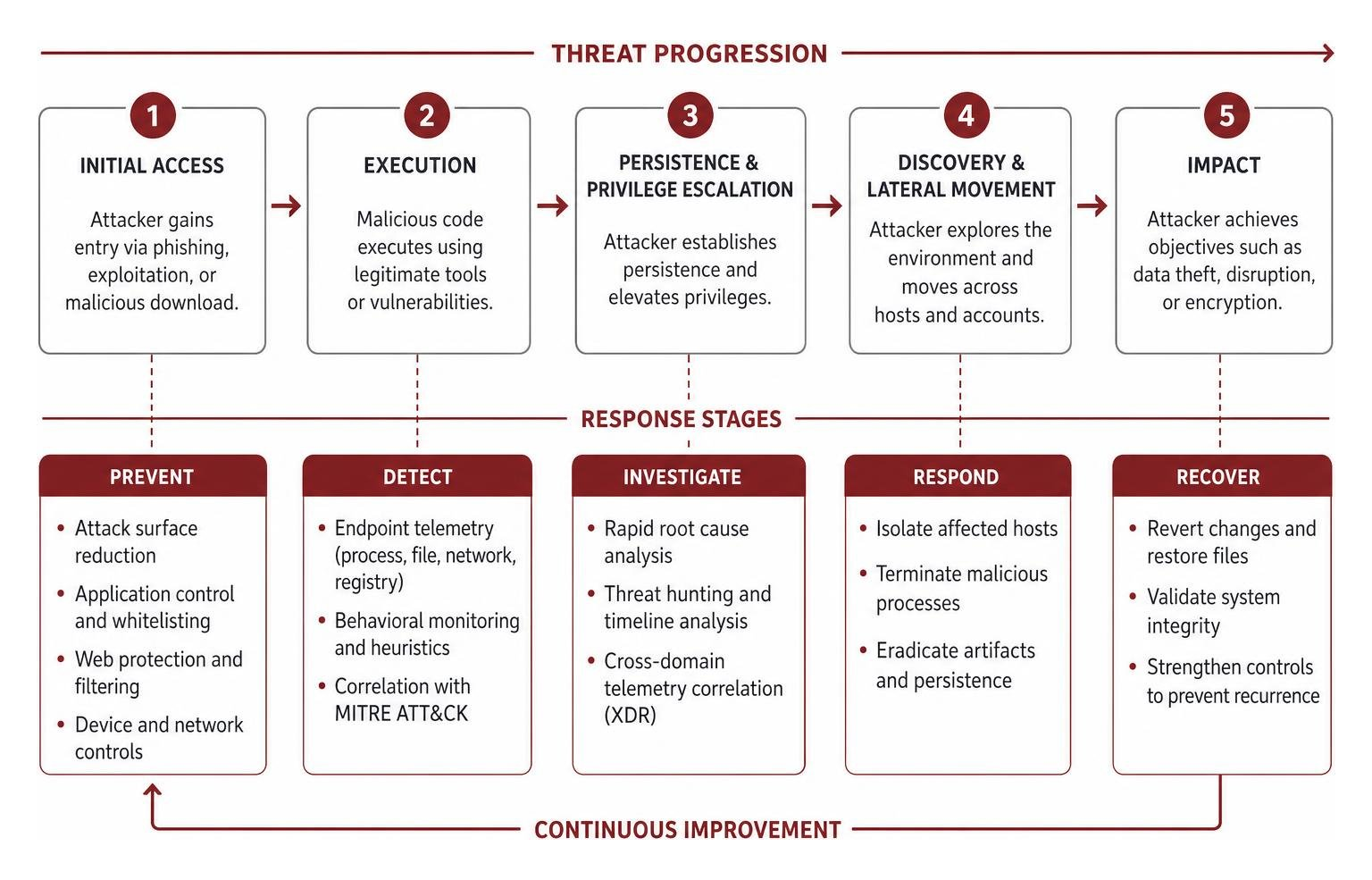
Extended detection and response platforms build upon this foundation by correlating endpoint telemetry with telemetry from identity providers, cloud workloads, email gateways, and firewalls. Evaluating essential features in a complete XDR solution involves looking for automated playbooks, normalized data schemas, and centralized cross-domain investigation consoles.
For mid-sized and enterprise teams facing resource constraints, Managed Detection and Response (MDR) pairs these toolsets with external security operations centers (SOCs) to handle 24/7 monitoring, alert triage, and active containment.
Mitigating Operational Drag, Tuning Overhead, and Driver Vulnerabilities
Security platforms that demand continuous policy tuning or introduce host latency often result in alert fatigue and configuration drift. When administrators become overwhelmed, they risk disabling essential rules or ignoring critical detections.
Modern solutions prioritize single-agent consolidation—combining antivirus, exploit mitigation, ASR, and detection capabilities into a single lightweight client. Additionally, modern solutions must feature resilient tamper protection to defend against “Bring Your Own Vulnerable Driver” (BYOVD) attacks and malware designed to terminate security processes. Tamper protection ensures that even if an attacker acquires administrative privileges, the underlying security services, registry keys, and local drivers cannot be modified or suspended.
Navigating these architectural choices requires matching protection capabilities to operational capacity. Evaluating endpoint protection solutions through DataEndure allows organizations to align prevention, detection, and continuous response with their specific business goals and operational capabilities.
Advancing Your Endpoint Defense Architecture
Selecting an endpoint strategy is not simply a matter of choosing between prevention and detection. Resilient organizations implement a prevention-first model to minimize unnecessary alerts, while maintaining rich telemetry and response capabilities across endpoints, identity, network, and cloud layers.
DataEndure’s Delta Detection & Response (DeltaDR) has no comparable solution on the market. DeltaDR is a white-labeled version of the WhiteDog cybersecurity platform, delivering a fully managed, unified Security-as-a-Service platform. It combines a curated, composable security stack with a 24×7 team of security experts providing continuous incident response.
Rather than centering operations around a traditional SIEM, DeltaDR provides cross-layer correlation, an evergreen stack, adaptive protection, and multi-layered defense across email, DNS, identity, endpoint, network, and cloud. Supporting environments from 5 to 50,000 endpoints with a 30-day onboarding timeline, DeltaDR enables organizations to achieve rapid detection, containment, and recovery while minimizing administrative complexity.
When evaluating your current architecture, consider where your defenders spend the majority of their time: actively managing threats across the enterprise, or tuning disjointed alerts from fragmented consoles. Aligning your defensive stack around unified prevention, continuous validation, and comprehensive cross-domain visibility is the most reliable path to lasting operational resilience.