Why Cybersecurity Solutions for Enterprises Can’t Wait
Cybersecurity solutions for enterprises are the tools, platforms, and managed services that protect large organizations from data breaches, ransomware, insider threats, and compliance failures.
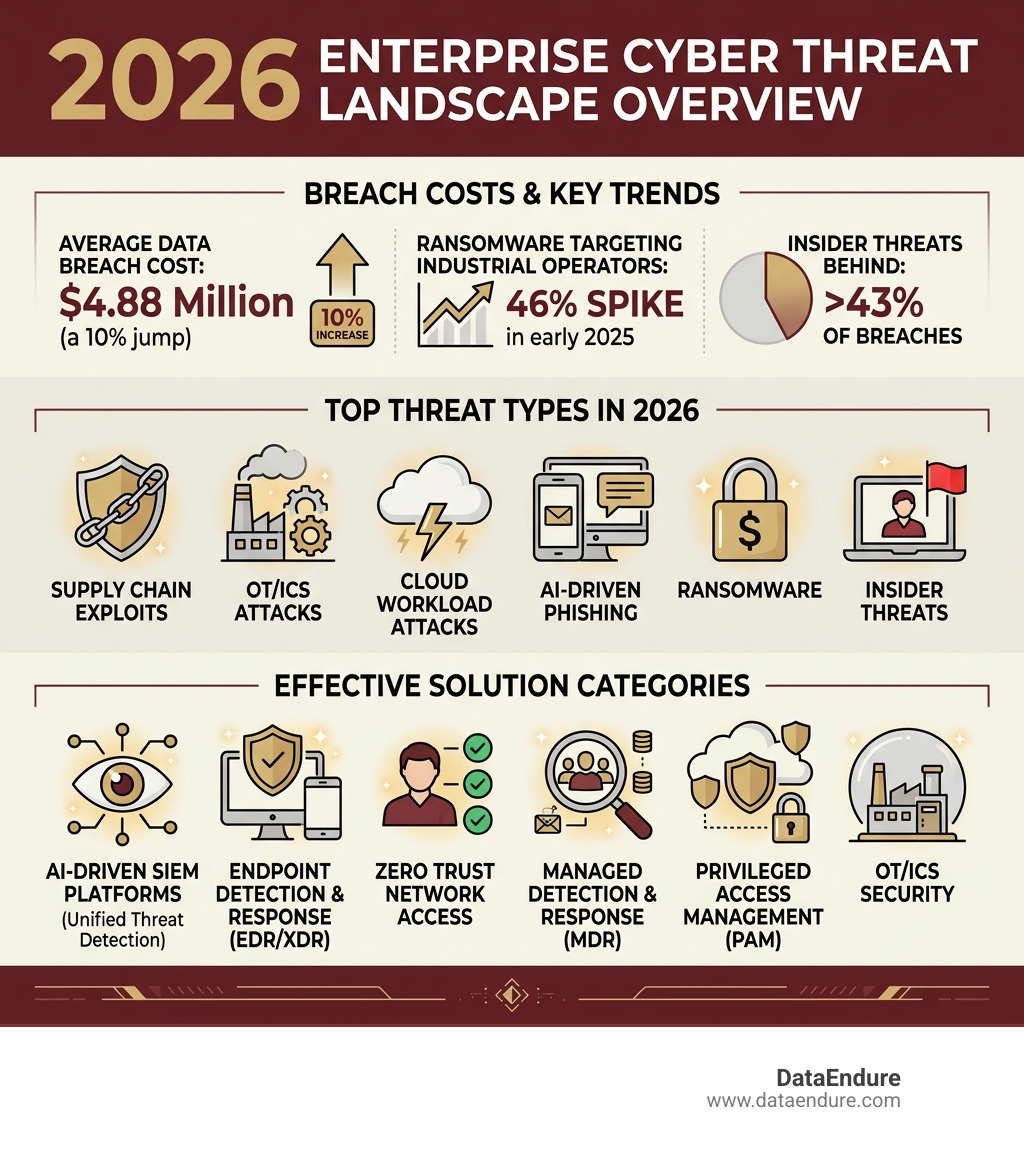
Here are the most effective enterprise cybersecurity solutions in 2026:
- AI-driven SIEM platforms — unified threat detection across your entire environment
- Endpoint Detection and Response (EDR/XDR) — stops attacks at the device level before they spread
- Zero Trust Network Access — denies access by default, verifying every user and device
- Managed Detection and Response (MDR) — 24/7 expert monitoring when your team is stretched thin
- Email Security — blocks phishing and malicious attachments at the entry point
- Cloud Security (CNAPP) — protects workloads, storage, and SaaS applications
- Privileged Access Management (PAM) — limits what insiders and compromised accounts can reach
- OT/ICS Security — specialized protection for industrial and operational systems
If you’re leading IT security at a mid-sized company in a regulated industry, the stakes have never been higher. The average data breach now costs $4.88 million — a 10% jump from the prior year. Ransomware targeting industrial operators spiked 46% in early 2025. And insider threats are behind more than 43% of all data breaches.
The hard truth? Basic antivirus and perimeter firewalls aren’t enough anymore.
Attackers move faster, use AI to craft more convincing phishing campaigns, and exploit everything from unpatched IoT devices to your software supply chain. Meanwhile, your security team is buried in alerts, short-staffed, and under pressure from compliance auditors.
This guide breaks down the enterprise cybersecurity landscape in 2026 — what threats you’re actually facing, which solutions address them, and how to choose the right fit for your organization.
The Evolution of Cybersecurity Solutions for Enterprises in 2026
In 2026, the “castle and moat” strategy of the past is officially a relic. As we navigate the digital landscape from our headquarters in Silicon Valley, we’ve seen a massive shift toward predictive security. It’s no longer about waiting for an alarm to go off; it’s about using machine-speed defense to neutralize threats before they even manifest.
The modern enterprise is a sprawling web of remote workers, cloud workloads, and IoT sensors. This complexity has made DataEndure: Silicon Valley’s Managed Security Leader a critical partner for businesses that need to scale without leaving the back door open. We’ve moved into an era where IT (Information Technology) and OT (Operational Technology) have converged. Your office Wi-Fi and your factory floor’s HVAC system are now on the same radar for attackers.
Furthermore, cybersecurity has finally graduated to a board-level priority. About 73% of organizations now report that their boards view security as a high-stakes business function rather than just an IT expense. This shift is necessary because “good” security today looks very different than it did five years ago. To understand the benchmark, you can explore What does good cybersecurity look like? to see how high the bar has been raised.

Core Components of Cybersecurity Solutions for Enterprises
To build a resilient defense, you need a stack that talks to itself. The days of “silent” tools are over.
- AI-driven SIEM: Advanced platforms use intelligent reasoning to sift through billions of signals, finding the “needle in the haystack” that indicates a breach.
- Unified Data Lakes: Instead of siloed logs, enterprises now use a single data lake to store every security event, allowing for “infinite” analysis and historical threat hunting.
- Managed Detection and Response (MDR): Because most teams can’t monitor 24/7, Managed Detection and Response provides the human expertise needed to validate and contain threats in minutes, not days.
- Email Security: With phishing remaining the top entry point, advanced Email Security is essential to strip away malicious intent before a user ever clicks.
- Behavioral Analytics: By using UEBA (User and Entity Behavior Analytics), we can spot an insider threat or a compromised account simply because it’s acting “weird”—like an accountant suddenly accessing engineering files at 3 AM.
Critical Threats and the Rising Cost of Inaction
The cost of doing nothing-or doing the bare minimum-is skyrocketing. In 2024, the average cost of a data breach hit $4.88 million. By May 2026, that number continues to climb as hackers become more organized and data exfiltration happens at higher speeds. For broader industry context, organizations often track guidance and breach trends from CISA alongside their internal risk data.
We are seeing a massive escalation in insider threats. According to recent reports, 83% of organizations experienced at least one insider attack recently, and large-scale internal breaches have increased fivefold year-over-year. Whether it’s a disgruntled employee or a well-meaning staffer who falls for a deepfake, the result is the same: lost data and a tarnished reputation.
Ransomware hasn’t gone away; it’s just evolved. It now targets the heart of production. Ransomware attacks on industrial operators jumped 46% in early 2025, proving that if you control the physical process, you have the ultimate leverage. If you’re wondering where your specific vulnerabilities might lie, it’s worth asking: What are the most common cyber threats? and more importantly, How can I identify potential cybersecurity risks? before they are exploited.
Essential Features of Modern Enterprise Defense
When evaluating cybersecurity solutions for enterprises, look for features that provide visibility across the entire kill chain.
EDR vs. Antivirus: The Great Divide
Many businesses still ask, What is the difference between antivirus and EDR?. Simply put, antivirus is like a “Wanted” poster—it only catches criminals it already knows about. Endpoint Detection and Response (EDR) is like a private investigator who watches the behavior of everyone in the building. Even if a threat is brand new (a “zero-day”), EDR catches it because it’s acting suspiciously.
Network and Automated Response
Network Security has moved beyond simple firewalls to include “micro-segmentation,” which prevents an attacker from moving laterally through your systems. If they get into a printer, they shouldn’t be able to hop into your payroll database.
Furthermore, “Automated Incident Response” is no longer a luxury. When a breach is detected at 2 AM, your system should be able to automatically isolate the infected laptop without waiting for a human to wake up. This is where threat hunting comes in—proactively searching your environment for hidden attackers who might be lurking silently for months.
Strategic Implementation: From Zero Trust to AI Defenses
The most successful enterprises in Santa Clara and beyond have moved to a Zero Trust architecture. This isn’t just a buzzword; it’s a rigorous “never trust, always verify” philosophy.
| Feature | Legacy Perimeter Security | Zero Trust Model |
|---|---|---|
| Access Logic | Trust anyone inside the network | Trust no one; verify every request |
| Verification | Password-based (often static) | Multi-factor (MFA) + Device Health |
| Lateral Movement | Easy once “inside” | Blocked via micro-segmentation |
| Default State | Allow all, block known bad | Deny-by-default, allow specific |
The Power of “Deny-by-Default”
One of the most effective cybersecurity solutions for enterprises is the “deny-by-default” model. Instead of trying to keep up with millions of new malware variants, you simply tell your computers to only run the software you’ve explicitly approved. Everything else—including that new ransomware strain—is blocked by default.
To validate these defenses, we recommend regular Penetration Testing. It’s better to have our “white hat” hackers find your flaws than to have an attacker find them. When combined with Cloud Security and robust employee awareness training (which can reduce incidents by up to 67%), you create a multi-layered shield that is incredibly difficult to pierce.
Selecting the Right Cybersecurity Solutions for Enterprises
Choosing the right partner is about more than just buying software. You need to ensure the solution fits your specific compliance needs and scalability goals. For instance, many of our clients in Silicon Valley must adhere to the NIS2 Directive or GDPR. Automated reporting and audit-ready dashboards aren’t just “nice to have”—they are essential for staying out of legal trouble.
When selecting a tool, consider:
- Integration APIs: Does it play well with your existing SIEM and IAM (Identity and Access Management) systems?
- Scalability: Can it handle 500 employees today and 5,000 next year without a total overhaul?
- User Experience: If the security is too hard to use, your employees will find workarounds that create even bigger holes.
- Expertise: Check our Expertise: Security and Compliance to see how we map tools to specific regulatory frameworks.
For a deeper dive into the specific “must-haves,” see What cybersecurity tools are essential for my business?.
Future-Proofing with Scalable Cybersecurity Solutions for Enterprises
As we look toward the latter half of 2026, the focus is shifting to “Non-Human Identity Governance.” With APIs and service accounts now outnumbering human users, managing who—or what—has access to your data is the new frontier.
We are also seeing the rise of quantum-resistant encryption. While quantum computers aren’t yet ubiquitous, the “harvest now, decrypt later” strategy used by nation-state actors means we need to protect our data with tomorrow’s math today.
Finally, Managed Security is becoming the standard for enterprises that want to avoid “alert fatigue.” At DataEndure, we focus on cutting through the noise. We don’t just send you a list of 1,000 alerts; we provide the one that actually matters, with a plan to fix it.
Frequently Asked Questions
What is the average cost of a data breach in 2026?
The average cost has surpassed $4.88 million, reflecting a steady 10% annual increase. This includes not just the ransom or the immediate IT fix, but the long-term costs of legal fees, regulatory fines, and the loss of customer trust.
How does Zero Trust differ from traditional network security?
Traditional security is like a bouncer at the front door of a club; once you’re in, you can go anywhere. Zero Trust is like having a bouncer at every single VIP booth, the bar, and the restroom. You have to show your ID and prove you’re allowed to be there every single time you move.
Why is AI-driven threat detection necessary for modern enterprises?
Human analysts simply cannot keep up with the volume of data generated by a modern enterprise. Attackers are using AI to automate their strikes; we must use AI to automate our defense. AI can correlate events across email, cloud, and endpoints in milliseconds—something that would take a human team hours or days.
Conclusion
Navigating cybersecurity solutions for enterprises can feel like trying to change the tires on a car while it’s going 80 mph down the 101. But you don’t have to do it alone.
At DataEndure, we specialize in making the complex simple. Our managed security services are designed for the high-pressure environment of Silicon Valley. We pride ourselves on rapid breach detection—finding the bad guys in minutes, not months. We know your team is tired of “alert fatigue,” so we do the heavy lifting for you.
Perhaps most importantly, we move at the speed of business. We can deploy a comprehensive defense strategy in as little as 30 days, ensuring you’re protected before the next threat cycle begins.
Ready to see how your current defenses stack up? More info about managed security services is just a click away. Let’s make your enterprise’s future more secure, together.