Core Lifecycle and Prioritization in Vulnerability Management Cybersecurity
A functional vulnerability management program is not a one-time project. It is an operational discipline that loops continuously through discovery, assessment, prioritization, remediation, and verification. Without a structured cadence, security teams find themselves reacting to alerts rather than systematically shrinking their attack surface. Frameworks such as the OWASP Vulnerability Management Guide emphasize that establishing a repeatable lifecycle is the most reliable way to maintain baseline security hygiene across complex environments.
Deconstructing Weaknesses: Vulnerability vs. Threat vs. Risk
Security conversations often treat vulnerabilities, threats, and risks as interchangeable terms, but distinguishing between them is critical for allocating budget and engineering hours effectively.
- Vulnerability: A flaw, misconfiguration, or weakness in software, hardware, or process design. A vulnerability is an open door; it represents exposure, but on its own, it does not execute malicious activity.
- Threat: An external or internal entity with the capability and intent to exploit a weakness. Threat actors range from opportunistic automated botnets to sophisticated ransomware groups.
- Risk: The intersection of a vulnerability, an active threat, and the operational or financial impact on the organization if that vulnerability is exploited. Risk measures what happens to business operations, customer data, or regulatory standing when a flaw meets an adversary.
Understanding this distinction helps organizations conduct an effective cyber risk assessment rather than simply generating massive, uncontextualized lists of bugs.
It is equally important to clarify the operational boundaries between vulnerability management, vulnerability assessments, and patch management:
| Dimension | Vulnerability Assessment | Patch Management | Vulnerability Management |
|---|---|---|---|
| Primary Scope | Point-in-time evaluation of specific systems | Applying software updates and configuration changes | Ongoing program covering discovery, prioritization, remediation, and governance |
| Operational Goal | Identify known weaknesses at a specific moment | Deploy patches to operating systems and software | Continuously reduce business risk across the entire technology estate |
| Key Output | Vulnerability scan reports and technical findings | Update verification logs and deployment metrics | Risk reduction metrics, remediation SLAs, and architectural hardening |
| Frequency | Periodic (e.g., quarterly or monthly) | Scheduled maintenance cycles (e.g., monthly) | Continuous, real-time operational workflow |
Implementing the End-to-End Vulnerability Management Cybersecurity Lifecycle
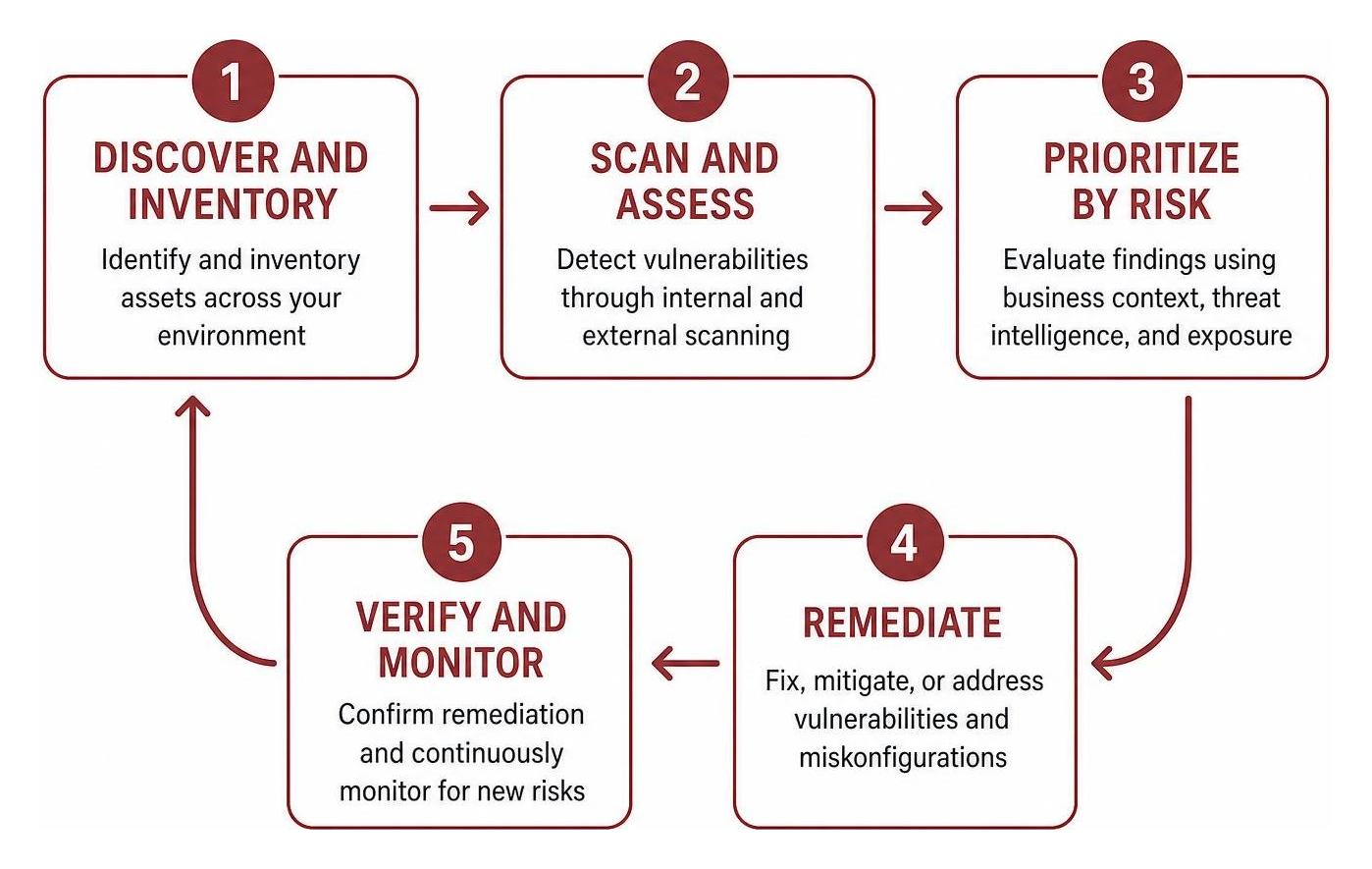
Building an effective program requires a reliable execution model. The five core stages of the lifecycle turn discovery data into measurable operational improvements:
- Discover and Inventory: You cannot protect an asset you do not know exists. Dynamic discovery must identify managed hardware, virtual instances, cloud workloads, containers, APIs, and connected third-party tools.
- Scan and Assess: Run authenticated scans across internal systems and external scans against public-facing assets. Regular vulnerability assessment mechanisms detect missing patches, insecure protocols, and configuration drift.
- Prioritize by Risk: Filter raw technical findings through business context, exploit intelligence, and asset exposure to determine which items require immediate intervention.
- Remediate and Mitigate: Apply patches, adjust configurations, implement network microsegmentation, or deploy virtual patching rules to neutralize the identified exposure within defined service level agreements (SLAs).
- Verify, Report, and Improve: Perform automated follow-up scans to confirm that fixes were applied without breaking application dependencies. Report mean time to remediate (MTTR) trends to leadership.
Organizations looking for an implementation baseline can turn to CIS Control 7: Continuous Vulnerability Management, which recommends establishing clear operational metrics, maintaining automated patch processes, and conducting frequent internal and external scans.
Modern Risk-Based Prioritization with CVSS, EPSS, and CISA KEV
In 2026, vulnerability management faces a surplus problem rather than a shortage. Tens of thousands of Common Vulnerabilities and Exposures (CVEs) are published annually. In large environments with thousands of servers and endpoints, patching every high or critical score in the Common Vulnerability Scoring System (CVSS) is mathematically impossible and operationally inefficient.
CVSS measures the theoretical, static severity of a flaw under laboratory conditions, but it does not account for real-world adversary behavior. Approximately only 2.7% of CVEs are ever exploited in the wild. Chasing every CVSS 7.0+ flaw wastes engineering cycles on vulnerabilities that no attacker is targeting.
Risk-Based Vulnerability Management (RBVM) solves this by combining three distinct prioritization layers:
- Exploit Prediction Scoring System (EPSS): A data-driven model that generates a daily probability score (from 0 to 1) predicting whether a software flaw will be exploited in the wild over the next 30 days.
- CISA Known Exploited Vulnerabilities (KEV) Catalog: An authoritative registry of flaws that security agencies have confirmed are actively being exploited by threat actors in real-world attacks.
- Asset Criticality and Network Exposure: A business rating that accounts for whether the vulnerable system is directly exposed to the public internet, handles sensitive financial data, or runs an isolated back-office function.
By filtering findings through these criteria, teams can focus remediation efforts on the roughly 1.6% of vulnerabilities that pose the greatest risk to the enterprise.
Building a Resilient, Exposure-Driven Security Program

Sustained risk reduction requires integrating vulnerability data with daily IT operations and overall business resilience. Treating security as an isolated department that delivers static spreadsheets of vulnerabilities to infrastructure teams creates operational friction and slows remediation.
Navigating Tooling, Cloud Posture, and Zero-Day Exceptions
Modern architectures require a balanced tooling strategy that spans endpoints, networks, and multi-cloud environments.
In cloud-native environments, teams often deploy Cloud Security Posture Management (CSPM) and Cloud-Native Application Protection Platforms (CNAPP) to identify misconfigurations, over-permissive identity policies, and vulnerable container images before workloads reach production. For traditional endpoints and on-premises servers, organizations frequently balance lightweight agent-based monitoring (which provides real-time visibility without heavy network scanning) with agentless scanning for rapid discovery across ephemeral cloud instances.
Vulnerability programs also need clear procedures for zero-day vulnerabilities, where software vendors have not yet released a patch:
- Compensating Controls: When a patch is unavailable, isolate vulnerable systems through strict network access control lists (ACLs) or web application firewall (WAF) virtual patching rules.
- Validation: Verify that existing security controls can withstand active attack techniques by using targeted penetration testing to test exposure paths.
- Detection and Containment: Ensure internal teams and incident response workflows have specific detection signatures configured to spot early exploitation attempts.
Elevating Vulnerability Management Cybersecurity into Continuous Exposure Strategy
Vulnerability management is increasingly converging with Attack Surface Management (ASM) and Continuous Threat Exposure Management (CTEM). While classic vulnerability management centers primarily on known software CVEs, CTEM expands visibility to include exposed credentials, open cloud storage buckets, shadow IT assets, and configuration drift.
Integrating vulnerability data with active defense capabilities such as Managed Detection and Response (MDR) ensures that if an attacker attempts to exploit an unpatched system, security operations centers can detect and isolate the threat immediately.
Establishing accurate visibility into asset exposure, architecture, and network dependencies is a critical early step in this journey. Conducting a structured network assessment helps organizations evaluate how underlying infrastructure is configured and interconnected, providing the foundational context needed to prioritize remediation and maintain a sustainable vulnerability management program.