What Penetration Testing Is — and Why It Matters Right Now
Penetration testing is a controlled, simulated cyberattack carried out by security experts to find and exploit weaknesses in your systems before real attackers do.
Quick answer:
- What it is: A hands-on security exercise where ethical hackers attempt to breach your defenses using the same techniques real attackers use
- What it finds: Vulnerabilities that automated scans miss — including logical flaws, misconfigurations, and exploitable attack chains
- Who does it: Certified third-party experts with no prior knowledge of your environment (for the most realistic results)
- Why it matters: It proves which vulnerabilities are actually exploitable — and shows the real business impact if they are
- When it’s required: PCI DSS 4.0 (section 11.4), HIPAA, GDPR, and ISO/IEC 27001 all reference or mandate it
For organizations managing regulated data, maintaining robust security is a continuous requirement. While automated tools provide a baseline, they often have limitations in identifying complex vulnerabilities.
The reality is that vulnerability scanners generate lists of potential issues — many of them false positives — but they cannot always determine which weaknesses an attacker could chain together to breach a network. That is where penetration testing provides value.
Think of it like hiring a skilled locksmith to check a building’s physical security. Not to cause damage — but to identify exactly which doors, windows, and back entrances require additional reinforcement.
In 2021, the U.S. federal government urged organizations to adopt penetration testing as a frontline defense against ransomware. Since then, the infrastructure landscape has continued to evolve — spanning on-premises systems, cloud environments, APIs, and remote workforces.
This guide walks you through everything you need to know: how penetration testing works, what types exist, which phases testers follow, how it maps to compliance requirements, and how to get the most out of every engagement.
What is Penetration Testing?
At its core, penetration testing (or pen testing) is an authorized, simulated attack designed to evaluate the security of an IT infrastructure. Rather than relying solely on automated scripts, a human tester uses creativity, specialized tools, and an analytical mindset to actively exploit vulnerabilities.
The ultimate goal of this exercise is risk reduction. By identifying exploitable paths before malicious actors do, organizations can proactively patch security gaps, optimize defensive controls, and align cybersecurity investments with actual business risks. A key principle of effective security is ensuring that existing defenses actually work when tested, rather than simply acquiring additional tools.
To evaluate an organization’s current posture, exploring professional Penetration Testing Services is a practical step toward establishing digital resilience.
Penetration Testing vs. Vulnerability Scanning and Ethical Hacking
It is common to hear these terms used interchangeably, but they represent entirely different levels of depth and methodology:
- Vulnerability Scanning is an automated, high-level tool that scans your network for known technical vulnerabilities. It is excellent for broad, regular checks, but it lacks human context. It cannot detect complex logical vulnerabilities, and it often generates false positives that require manual verification.
- Penetration Testing goes several steps further. It is a manual, human-driven process. The tester takes the results of automated scans and attempts to actively exploit those weaknesses. For example, while a scanner might note an unpatched service, a pen tester will write an exploit to breach that service, harvest credentials, and attempt to escalate privileges. This demonstrates the real-world business impact of a vulnerability.
- Ethical Hacking is a broad, overarching discipline that includes any authorized hacking activity designed to improve security. Penetration testing is just one specific methodology used under the larger ethical hacking umbrella.
By understanding these differences, organizations can optimize their security investments and focus on addressing actual vulnerabilities. To determine which assessment is right for a specific maturity level, the guide on How to Choose a Cyber Security Assessment Service Without Losing Your Mind offers a practical roadmap.
Who Performs These Tests and What Certifications Matter?
Because a pen test involves simulated attacks on live corporate networks, it requires a high degree of trust, skill, and professionalism. Many organizations outsource these assessments to specialized third-party experts. Third-party testing ensures an unbiased perspective; internal developers and security teams can sometimes overlook flaws in systems they built themselves.
When evaluating a penetration testing partner, look for industry-recognized certifications. These validate that the testers possess both the technical skill and the ethical framework required to handle sensitive data:
- OSCP (Offensive Security Certified Professional): Widely considered a standard for practical, hands-on penetration testing.
- GPEN (GIAC Penetration Tester): Focuses on enterprise-scale testing methodologies, including cloud and hybrid environments.
- CompTIA PenTest+: Validates testing skills across diverse attack surfaces like cloud, mobile, and APIs. You can learn more about this standard through the PenTest+ Certification V3 (New Version) | CompTIA Global resource.
A vendor-agnostic approach ensures that testing is tailored to the unique hybrid architecture of the organization, rather than focusing on specific hardware or software solutions.
Core Methodologies and Testing Approaches
To get the most out of your security investments, you must select the right approach for your testing goals. Different scenarios require different levels of information disclosure.

Black-Box, White-Box, and Gray-Box Approaches
These three methodologies represent a spectrum of information provided to the testing team before the engagement begins:
| Testing Type | Information Provided | Real-World Simulation | Best Used For |
|---|---|---|---|
| Black-Box | None (Zero-Knowledge) | High (Simulates an external, unprivileged hacker) | Testing external perimeter defenses, remote access portals, and initial access controls. |
| Gray-Box | Limited (e.g., standard user credentials, basic network map) | Medium (Simulates a rogue insider or compromised partner) | Maximizing testing efficiency; bypassing the time-consuming initial access phase to test internal security. |
| White-Box | Full (Architecture diagrams, source code, admin credentials) | Low (Focuses on exhaustive verification rather than stealth) | Deep-dive application security testing, code reviews, and critical host hardening. |
Each of these approaches has distinct advantages depending on whether you are verifying your external perimeter or testing internal lateral movement. For historical context on how these methodologies evolved from early military “tiger teams,” you can read the Penetration test – Wikipedia entry.
External, Internal, and Hybrid Cloud Environments
Modern IT environments are highly interconnected, meaning a flaw in one area can quickly compromise another. Effective testing must address all layers of your infrastructure:
- External Pen Testing: Targets your public-facing assets, such as web applications, email servers, and VPN endpoints. The goal is to see if an attacker can gain an initial foothold.
- Internal Pen Testing: Assumes the perimeter has already been breached. The tester attempts to move laterally across the network, exploit Active Directory misconfigurations, and access sensitive databases.
- Hybrid Cloud Testing (Azure, Entra ID, AWS): Focuses on cloud-specific misconfigurations, such as overly permissive IAM roles, exposed API keys, and tenant-to-tenant lateral movement.
As organizations adopt AI tools and complex integrations, cloud boundaries blur. A comprehensive approach ensures that you evaluate these interconnected environments holistically. To understand how your network architecture impacts your overall risk posture, read The Ultimate Guide to Network Assessment.
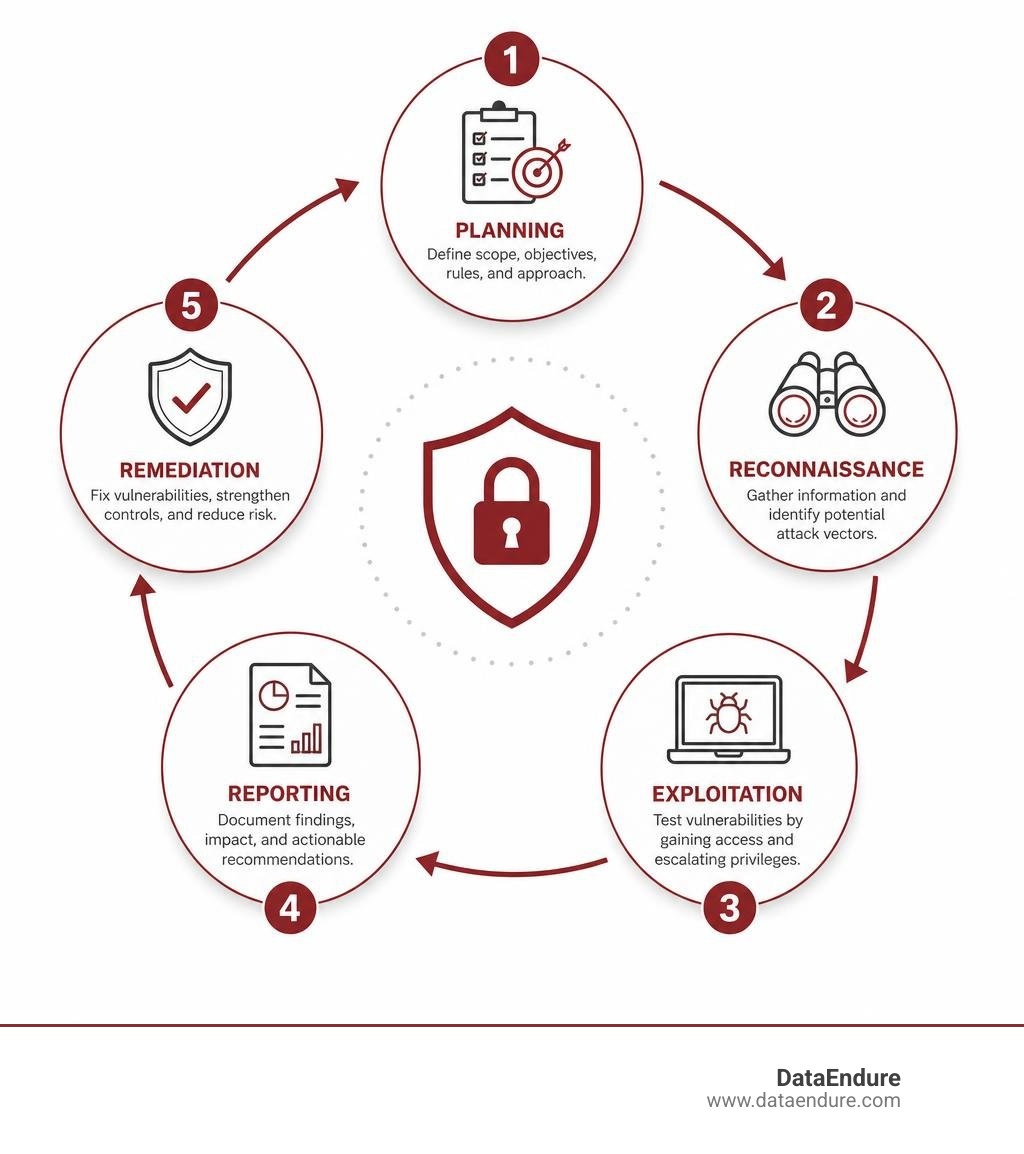
The Five Phases of a Simulated Attack
A professional penetration testing engagement is not a chaotic series of random hacks. It is a highly structured process that mirrors the lifecycle of a real-world cyberattack.

1. Passive, Semi-Passive, and Active Intelligence Gathering
Before launching an attack, a tester must map the target. According to the Penetration Testing Execution Standard (PTES), intelligence gathering (reconnaissance) is divided into three distinct maturity levels:
- Passive Reconnaissance: The tester gathers information from publicly available sources without interacting with the target systems directly. This includes scraping Open Source Intelligence (OSINT), harvesting email addresses, searching public breach databases, and analyzing corporate job postings (which often reveal internal technologies, such as “CCNA preferred” or “Solaris administrator required”).
- Semi-Passive Reconnaissance: The tester interacts with the target in a way that mimics normal business traffic. For example, they might look up DNS records or perform basic website navigation to passively fingerprint defensive technologies without triggering security alerts.
- Active Reconnaissance: The tester directly probes target systems. This includes port scanning, vulnerability scanning, and network mapping. This phase is highly visible and should trigger alerts on mature security systems.
For an exhaustive breakdown of these reconnaissance methodologies, refer to the intelligence_gathering.rst at master · pentest-standard/docs documentation.
2. Target Discovery and Vulnerability Analysis
Once the reconnaissance data is gathered, the tester analyzes the target’s attack surface to identify potential entry points. This involves identifying open ports, mapping web application structures, and checking for outdated software. Testers use frameworks like the OWASP Web Security Testing Guide to identify potential application flaws, such as SQL injection, cross-site scripting (XSS), or broken access control. You can explore these standardized testing techniques in the WSTG – Stable | OWASP Foundation guide.
3. Exploitation (Gaining Access)
This is where the simulated attack occurs. The tester attempts to bypass security controls by exploiting the vulnerabilities identified in the previous phase. This could involve sending a targeted phishing email (social engineering), exploiting an unpatched web application vulnerability, or using credential stuffing attacks against public-facing login portals.
4. Post-Exploitation and Lateral Movement (Burrowing)
Gaining initial access is rarely the attacker’s ultimate goal. In this phase, the tester attempts to establish persistence (ensuring they don’t lose access if a system reboots) and move laterally through the network. Common techniques include:
- Kerberoasting: Exploiting the Kerberos protocol in Windows Active Directory to harvest offline password hashes for service accounts.
- BloodHound Analysis: Using specialized tools to graph privilege escalation paths and find hidden relationships within Active Directory.
- Credential Harvesting: Extracting cleartext passwords or hashes from system memory to compromise higher-privileged accounts.
5. Reporting, Cleanup, and Remediation
At the end of the engagement, the tester must clean up their environment — removing any installed backdoors, temporary user accounts, or testing tools to ensure the network is left in a secure state.
The most critical deliverable of any pen test is the final report. This document should translate complex technical findings into actionable business intelligence, featuring an executive summary for leadership and detailed technical remediation steps for your IT team.
Compliance, Risk Reduction, and Governance
For many organizations, penetration testing is not just a best practice; it is a regulatory requirement. However, compliance should be the baseline, not the ultimate goal. Viewing security assessments through the lens of governance, risk, and compliance (GRC) allows organizations to manage operational risks and build digital resilience. Learn more about aligning security with business goals on the Services – Governance, Risk, Compliance page.
Meeting PCI DSS, HIPAA, and GDPR Requirements
Major regulatory frameworks recognize that automated scanning is insufficient for securing sensitive data:
- PCI DSS 4.0 (Section 11.4): Specifically mandates regular internal and external penetration testing for any organization that handles payment card data. This testing must be conducted at least annually and after any significant infrastructure or application upgrades.
- HIPAA: Requires healthcare organizations to conduct regular security evaluations. Security experts agree that penetration testing is an essential component of a comprehensive HIPAA risk analysis.
- GDPR: Mandates that organizations implement a process for regularly testing, assessing, and evaluating the effectiveness of technical and organizational measures for ensuring the security of data processing.
By leveraging pen testing to validate security controls, organizations can satisfy auditors while actively reducing exposure. Discover how these initiatives are supported through Expertise in Security and Compliance – Penetration Testing solutions.
Best Practices for Scoping and Executing a Penetration Testing Engagement
To ensure a successful testing engagement, organizations should follow these best practices:
- Define Clear Rules of Engagement (RoE): Document exactly which systems are in scope, the allowed testing hours, and any restricted activities (such as disruptive Denial of Service testing).
- Use Non-Production Environments When Possible: To minimize business disruption, perform intensive application-level testing in staging or QA environments that mirror production.
- Mask Sensitive Data: Ensure that any test data containing personally identifiable information (PII) or classified records is masked or synthetic.
- Notify Security Monitoring Providers: Unless you are specifically testing your security operations team’s detection capabilities, notify your Managed Detection and Response (MDR) provider beforehand to avoid unnecessary emergency escalations.
If you are unsure where to start with scoping, a comprehensive Security Health Check can help identify your most critical assets and establish a baseline for your testing program.
Frequently Asked Questions
How often should our organization conduct these assessments?
At a minimum, organizations should conduct a penetration test annually to satisfy compliance requirements. However, you should also schedule tests after any major infrastructure changes, such as migrating to a new cloud provider, deploying a major web application update, or opening a new physical office.
What is the difference between red teaming and a standard assessment?
A standard penetration test focuses on finding as many vulnerabilities as possible within a defined scope and timeframe. A red teaming engagement is an adversarial simulation designed to test your organization’s detection and response capabilities (your “blue team”). Red teams operate with high stealth, using custom exploits and social engineering over an extended period, without the blue team’s prior knowledge.
How do we handle remediation and re-testing?
Once you receive your pen test report, prioritize remediation based on the risk classification (Critical, High, Medium, Low). Focus on addressing critical vulnerabilities first — especially those that are easily exploitable from the internet. Once your team has applied patches or implemented compensating controls, always perform validation testing (re-testing) to verify that the fixes were successful and did not introduce new security gaps.
Conclusion: Building Digital Resilience
In the modern security landscape, maintaining robust defenses is an ongoing practice. Relying solely on automated scanners can create gaps, leaving organizations exposed to complex, multi-stage tactics that manual testing is designed to uncover.
Developing a comprehensive security strategy involves aligning technical assessments with broader business objectives. By adopting a structured, vendor-agnostic approach to security architecture, organizations can streamline compliance, reduce operational risks, and ensure that defensive controls perform as expected under real-world conditions.
Proactive validation of security controls is a key component of a mature risk management program. To learn more about structuring these assessments, explore professional Penetration Testing options to help identify and address potential vulnerabilities systematically.