What Is a Network Assessment — and Why It Matters Right Now
A network assessment is a structured evaluation of your organization’s IT infrastructure — covering performance, security posture, device inventory, and compliance readiness — to give IT leaders a clear, current picture of what’s actually running on their network.
Here’s what you need to know at a glance:
- What it is: A comprehensive review of your network’s hardware, software, configurations, and security controls
- What it finds: Vulnerabilities, performance bottlenecks, compliance gaps, and undocumented or outdated assets
- Who needs it: Any organization running critical infrastructure — especially in regulated industries
- How often: At minimum annually, or after any major IT change
- What you get: A prioritized remediation plan, executive summary, and a clear baseline for ongoing monitoring
Most IT leaders assume they know what’s on their network. Many don’t — at least not fully.
Devices get added. Configurations drift. Former employees leave accounts active. Vendors make changes that never get documented. Over time, the gap between what you think your network looks like and what it actually looks like quietly grows.
This gap can lead to security vulnerabilities, compliance oversights, and performance issues that impact availability. Industry research indicates that network downtime can result in significant costs, averaging $336,000 per hour for many organizations. In our experience conducting assessments across organizations of all sizes, the most impactful issues are often foundational: an unpatched device, an open management interface, or active credentials for a former employee.
The problem isn’t that IT teams are careless. It’s that modern networks are genuinely complex. On-premises infrastructure, cloud environments, hybrid setups, remote endpoints, IoT devices — keeping a complete, accurate picture of all of it, all the time, is a real operational challenge.
That’s exactly what a network assessment is designed to solve.
At DataEndure, with 40+ years of experience in digital resilience across security, data, cloud, network, and infrastructure, we’ve seen how a well-executed assessment cuts through the complexity and gives IT leaders something they can actually act on.
Defining the Network Assessment: More Than Just an Audit

To the uninitiated, a Network Assessment might sound like a fancy way of saying “inventory check.” In reality, it is a deep-tissue massage for your IT infrastructure. It involves evaluating your current management processes, security protocols, and performance metrics to gain a comprehensive view of how your digital house is standing.
In May 2026, the stakes for operational visibility have never been higher. We aren’t just looking at routers and switches; we are looking at the stability of the entire ecosystem. A thorough Network Health Check uncovers whether your infrastructure is actually supporting your business goals or impacting their effectiveness.
Network Assessment vs. Network Audit
While the terms are often used interchangeably, they serve different masters. Think of a network audit as a “pass/fail” test. It is a systematic process of gathering data to determine compliance with specific regulations or to troubleshoot a very specific technical failure.
A network assessment, by contrast, is a strategic roadmap. It doesn’t just ask, “Are we compliant?” it asks, “Is this network optimized for our growth?”
| Feature | Network Audit | Network Assessment |
|---|---|---|
| Primary Goal | Compliance & Verification | Optimization & Risk Reduction |
| Scope | Narrow (Specific controls/logs) | Broad (Entire infrastructure) |
| Outcome | Pass/Fail report | Prioritized Remediation Plan |
| Frequency | Often reactive or scheduled | Proactive and strategic |
A Comprehensive Network & Infrastructure Assessment Blueprint allows us to move beyond “fixing what’s broken” and toward “building what’s resilient.”
The Role of Automation in Modern Discovery
Manual discovery is a relic of the past. Today’s networks are too fluid for a technician with a spreadsheet to keep up. Modern automated discovery tools allow for non-intrusive, agentless scanning that identifies every node on the network without causing a performance dip.
This automation provides a “Network Source of Truth.” It discovers multi-vendor hardware, identifies underpowered devices, and flags equipment that has reached end-of-life (EoL) or end-of-service (EoS), ensuring your inventory is accurate down to the last serial number.
Why Regular Network Assessments are Critical in 2026

If you need a business case for a network assessment, look no further than the potential for operational disruption. Industry research currently puts the average cost of network downtime at roughly $5,600 per minute. For a large enterprise, that hourly average climbs to $336,000.
In the current landscape of May 2026, the line between Network Resiliency vs Network Security has blurred. Resilience isn’t just about staying upright; it’s about the ability to absorb a shock—be it a cyberattack or a hardware failure—and keep moving. Ensuring Network Resilience starts with knowing exactly where your vulnerabilities lie.
Establishing a Baseline for Network Assessment
One of the most overlooked benefits of an assessment is the “baseline.” You cannot identify “abnormal” behavior if you don’t know what “normal” looks like.
Companies that establish a baseline of network behavior spot abnormal patterns 73% faster than those relying solely on security tools. By understanding the typical flow of traffic, our Expertise: Network teams can help you identify a security incident simply because a performance metric looked “off.”
Driving Compliance and Security Readiness
Security is not a static state; it is a constant pursuit. A network assessment identifies exposed management interfaces, default credentials, and missing segmentation that could lead to a security breach.
By aligning findings with the Common Vulnerability Scoring System (CVSS), we help IT leaders prioritize remediation. This is why we believe in Network Security Priorities—because a secure network is the foundation upon which all other digital resilience is built.
Key Components of a Comprehensive Assessment
A truly comprehensive assessment doesn’t leave stones unturned. It covers the physical, the logical, and the virtual. At DataEndure, we focus on Infrastructure: Network health as part of a broader Tag: Network Resilience strategy.
A standard assessment checklist should include:
- Hardware Inventory: Every router, switch, firewall, and endpoint.
- Software & Firmware: Current versions and patch status.
- Cybersecurity Posture: Review of access controls, password policies, and firewall rules.
- Logical Topology: How data actually moves through the system.
Performance and Security Optimization through Network Assessment
Is your network slow, or is it just poorly configured? Many organizations experience latency and assume they need more bandwidth. Often, network assessment software reveals that the issue is actually inadequate hardware, faulty configurations, or “noisy” devices hogging resources.
We look at critical metrics like VoIP Mean Opinion Scores (MOS). If your VoIP quality falls below a 3.0, it’s an indicator that your network isn’t handling real-time traffic correctly. By identifying these bottlenecks, we can optimize the path for your most critical data.
Cloud and Hybrid Environment Visibility
In Silicon Valley and Santa Clara, we see a heavy reliance on hybrid environments. However, cloud setups like Microsoft 365 (Teams, SharePoint, OneDrive) and Azure AD often create “inventory blind spots.”
A modern assessment must include these cloud services and any virtual appliances running in Silicon Valley Colocation Data Centers. If you don’t have visibility into your cloud-managed services or IoT devices, you have a hole in your security perimeter.
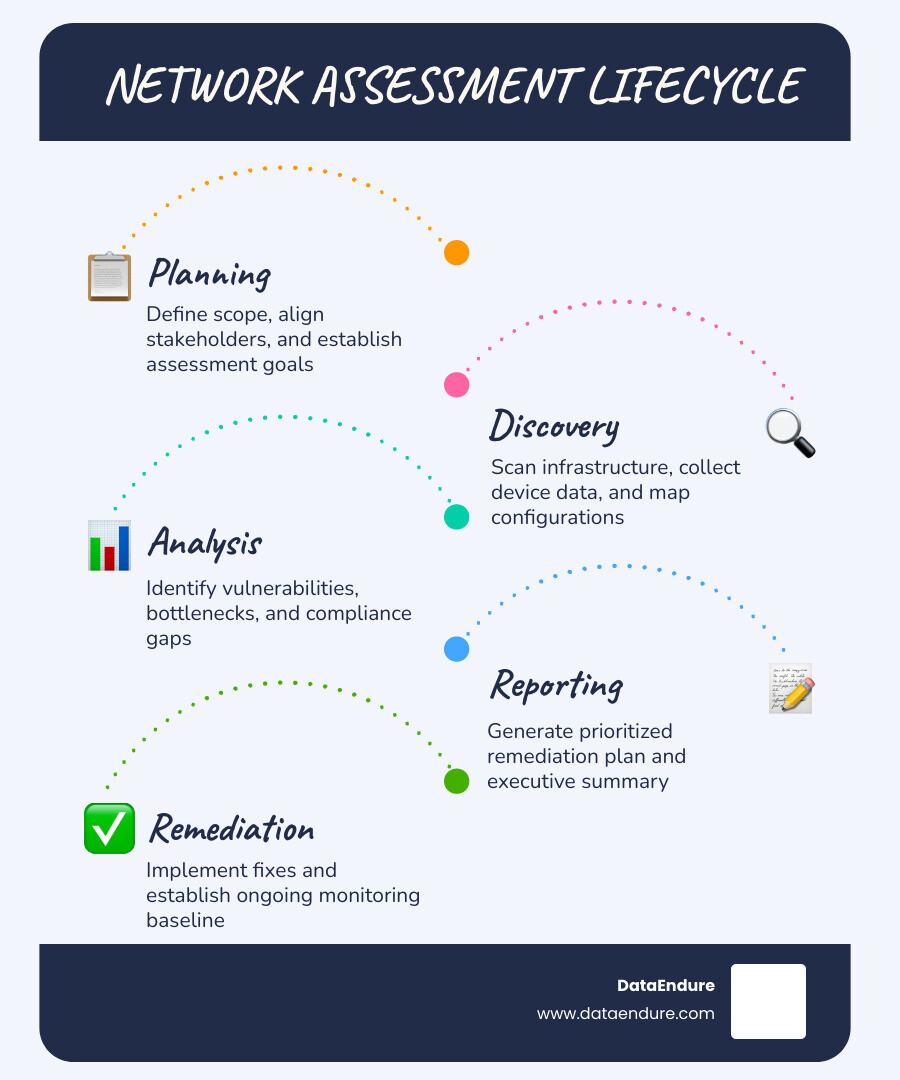
The Process: How to Conduct a Professional Assessment
Performing a network assessment is a phased journey. It typically takes 2 to 4 weeks to complete a deep dive, though “quick wins” are often identified within the first few days.
- Planning & Scoping: Defining what is (and isn’t) being tested.
- Data Gathering: Running automated scans and conducting stakeholder interviews.
- Analysis: Comparing findings against industry best practices and baselines.
- Reporting: Delivering a clear, actionable set of documents.
- Remediation: Fixing the holes identified during the process.
Preparing for the Deep Dive
Preparation is half the battle. Before the first scan runs, you need stakeholder alignment. This means getting IT, security, and business owners in the same room to confirm priorities.
You’ll need to negotiate access, manage credentials (often using 1-click injection tools to maintain security), and review existing documentation. For those in our local service areas, you can find more about localized requirements in the FAQ – Silicon Valley Assessment.
Generating Actionable Insights and Reports
The end product of an assessment shouldn’t be a 500-page PDF that collects dust. It should be a set of executive-ready reports that translate technical jargon into business risk.
We provide a SWOT analysis (Strengths, Weaknesses, Opportunities, Threats) and a prioritized remediation plan. Just as an Equity Assessment of Bike Infrastructure in San José, CA identifies where resources are most needed for public safety, a network report identifies where your IT budget will have the biggest impact on resilience.
Frequently Asked Questions about Network Assessments
How often should my organization perform an assessment?
We recommend a full network assessment at least once a year. However, you should also trigger one after any major infrastructure change, such as a cloud migration, a merger, or the deployment of a significant new application. Monthly vulnerability scans and quarterly firewall reviews should supplement these annual deep dives.
What are the primary outcomes of a network assessment report?
You should walk away with a complete hardware/software inventory, a gap analysis against compliance frameworks (like PCI DSS or HIPAA), a performance baseline, and a prioritized list of security risks. Most importantly, you get a “Remediation Roadmap” that tells you exactly what to fix first.
How do automated tools improve the assessment process?
Automation eliminates human error and drastically reduces the time required for data collection. Instead of taking weeks to manually map a network, automated tools can discover thousands of devices in minutes. This allows your team to focus on strategy and remediation rather than data entry.
Conclusion: Building a Resilient Future
At DataEndure, we don’t believe in “point-in-time” security. We believe in digital resilience. With over 40 years of experience, we’ve learned that the most successful organizations are those that choose Alignment Over Complexity.
Our approach is vendor-agnostic—we leverage over 50 partners to find the right fit for your specific environment—but our goal is always the same: supporting operational efficiency and organizational goals. Whether you are operating out of Santa Clara or across the global digital landscape, a network assessment is a significant step toward ensuring your infrastructure is ready for the challenges of tomorrow.
Addressing undocumented risks is a proactive step toward infrastructure stability. Get your Network Assessment today and start building a more resilient, predictable, and secure network.