Fundamentals of Enterprise Email Security: Threat Landscape and Risk Management
When Simple Mail Transfer Protocol (SMTP) was established in 1982, the internet was a small community of trusted research institutions. Security mechanisms like identity verification, message integrity checks, and encryption were not built into the foundational protocol. Today, enterprise communication relies heavily on this legacy infrastructure, making robust email security an absolute operational necessity.
Modern threat actors exploit these inherent protocol gaps using social engineering sophistication. Generative AI allows adversaries to compose flawlessly written, context-aware phishing emails at scale—completely eliminating the telltale grammatical errors that once gave away malicious messages. These hyper-targeted attacks bypass simple text filters and trick employees into revealing enterprise credentials or executing unauthorized financial transfers.
When an attacker compromises a corporate inbox, the business risk cascades quickly across the organization. Beyond immediate financial loss, organizations face severe operational downtime, contractual liabilities, regulatory fines, and long-term brand damage. Understanding why email security is important requires recognizing that your inbox is no longer just a messaging application—it is the central gateway to your enterprise identity, data repositories, and financial workflows.
Primary Attack Vectors: Phishing, BEC, and Ransomware
Threat actors utilize a wide array of sophisticated email tactics to penetrate corporate networks. Understanding these primary attack vectors is essential for building an effective defense:
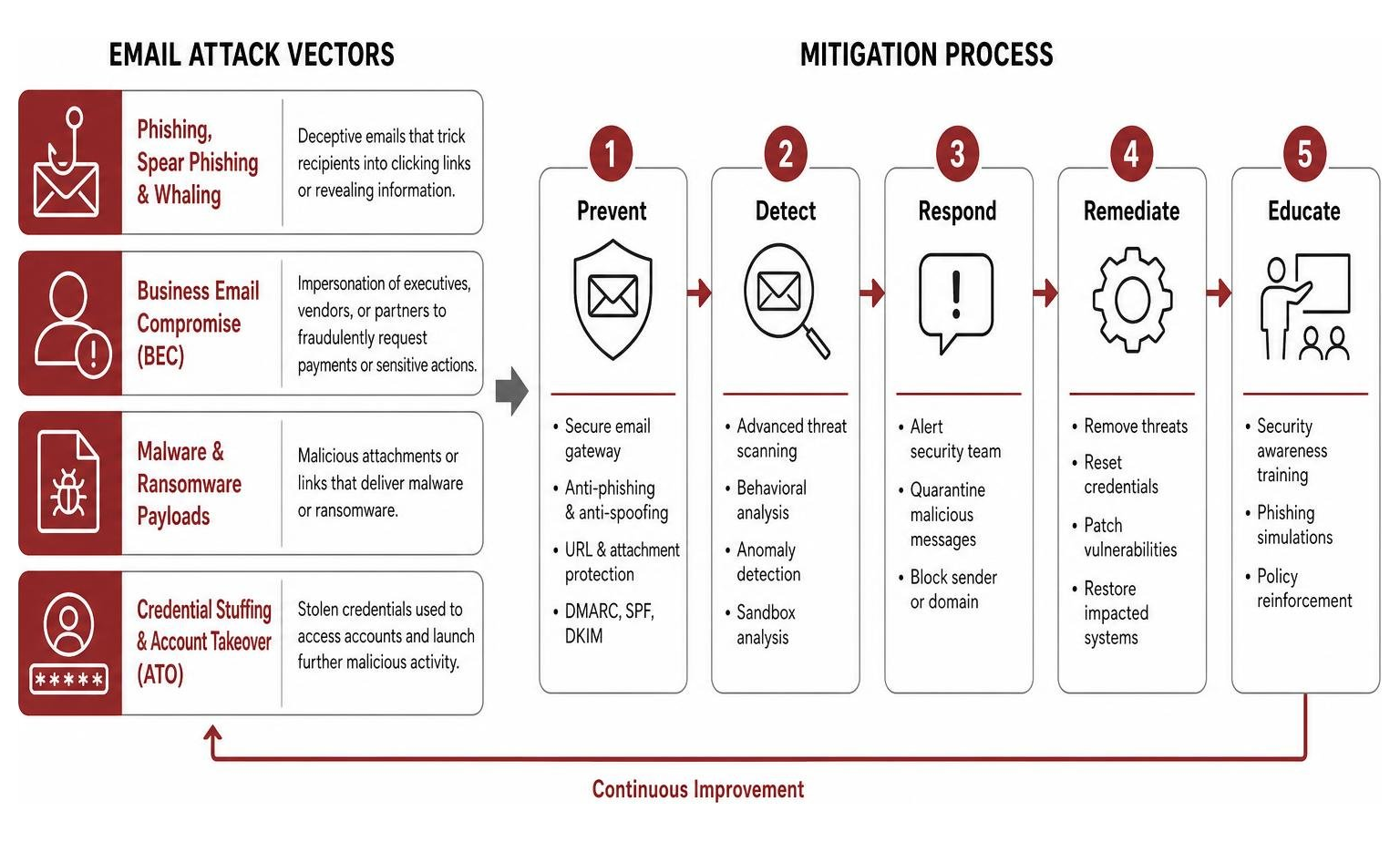
- Phishing, Spear Phishing, and Whaling: Standard phishing broadcasts generic bulk messages to thousands of recipients. Spear phishing targets specific individuals using gathered intelligence about their job roles. Whaling elevates this focus to high-profile executive targets, attempting to steal high-level credentials or approve sensitive actions.
- Business Email Compromise (BEC) and Executive Impersonation: Attackers impersonate senior executives, vendor partners, or legal counsel using domain spoofing or lookalike domains. These messages rarely contain malicious attachments or links, relying purely on social engineering to trick finance teams into executing fraudulent wire transfers. Learning how to spot American Express phishing scams highlights how convincingly attackers mimic established corporate identities.
- Malware and Ransomware Payloads: Attackers frequently hide malicious code inside apparently harmless email attachments—such as macro-enabled documents, password-protected archives, or weaponized PDF files. Notorious ransomware strains like Ryuk often gain initial access through secondary infection droppers spread via email attachments.
- Credential Stuffing and Account Takeover (ATO): By harvesting login details through malicious credential-harvesting landing pages, attackers gain direct access to corporate mailboxes. Once inside, they use the compromised legitimate account to launch internal phishing campaigns, manipulate email rules, and exfiltrate corporate data without raising immediate alarms.
Core Pillars of Modern Email Security
Defending against modern email threats requires moving past simple spam filtering toward a comprehensive, multi-layered security architecture:
- Inbound Threat Filtering: Continuously inspecting incoming messages for malicious URLs, weaponized attachments, known bad sender IPs, and social engineering indicators before delivery.
- Outbound Data Loss Prevention (DLP): Monitoring outgoing emails to inspect sensitive data—such as financial records, personally identifiable information (PII), or intellectual property—preventing unauthorized exfiltration.
- Inbox Behavioral Analysis: Monitoring user interaction baselines, communication graphs, and login behaviors using artificial intelligence to flag unusual anomalies indicative of account compromise.
- Identity Verification and Domain Protection: Enforcing robust domain authentication standards to ensure receiving servers can verify the legitimate origin of every outgoing message.
- Automated Threat Containment: Automatically quarantining suspicious emails, rewriting dangerous links, and pulling malicious messages out of user inboxes in real time across the entire organization.
- Continuous Posture Management: Regularly auditing email configurations, DNS records, and user permissions to close security gaps before attackers exploit them.
Core Protocols for Protecting Domain Authenticity and Data Confidentiality
Establishing trust in email communications requires proving that the sender is who they claim to be and protecting message content while in transit across public networks.

Without DNS-based domain verification and transport encryption, email servers accept incoming messages on face value, leaving your domain open to widespread impersonation. Comprehensive technical standards outlined in the NIST SP 800-177 Trustworthy Email publication detail how combining identity alignment with strong encryption creates a reliable baseline for message integrity.
Domain Authentication Stack: SPF, DKIM, and DMARC
To eliminate domain spoofing and preserve sender reputation, organizations must deploy three complementary DNS authentication mechanisms:
- Sender Policy Framework (SPF): Allows a domain owner to publish a record in DNS specifying exactly which IP addresses and mail servers are authorized to send email on behalf of that domain. Receiving servers check this record during the SMTP connection to verify the sending server’s IP address.
- DomainKeys Identified Mail (DKIM): Adds a cryptographic digital signature to outbound emails. The sending mail server signs the email header and body using a private key, and the receiving mail server uses the sender’s public key (published in DNS) to verify that the message was not altered during transit.
- Domain-based Message Authentication, Reporting and Conformance (DMARC): Bridges SPF and DKIM by establishing domain alignment—ensuring the “From” header domain visible to the end user matches the domains authenticated by SPF and DKIM. DMARC lets domain owners instruct receiving mail servers on how to handle unauthenticated emails using three policy levels:
p=none: Monitors mail flow and sends aggregate abuse reports without affecting delivery.p=quarantine: Directs unauthenticated messages straight to the recipient’s spam folder.p=reject: Instructs receiving servers to block unauthenticated emails entirely, stopping spoofed messages before they reach the inbox.
To maximize the trustworthiness of these records, organizations should back their DNS infrastructure with DNS Security Extensions (DNSSEC), which prevents attackers from tampering with DNS lookups. Furthermore, non-mail-enabled domains and subdomains should be secured with an explicit SPF hardfail record (v=spf1 -all) and a p=reject DMARC policy to prevent unauthorized domain spoofing.
Data Encryption Standards: TLS, S/MIME, and OpenPGP
Securing email confidentiality involves two distinct challenges: protecting data in transit across public networks and securing message contents end-to-end between individual mailboxes. The Canadian Centre for Cyber Security’s email security best practices guide provides vital context on how these encryption standards operate across different stages of transmission:
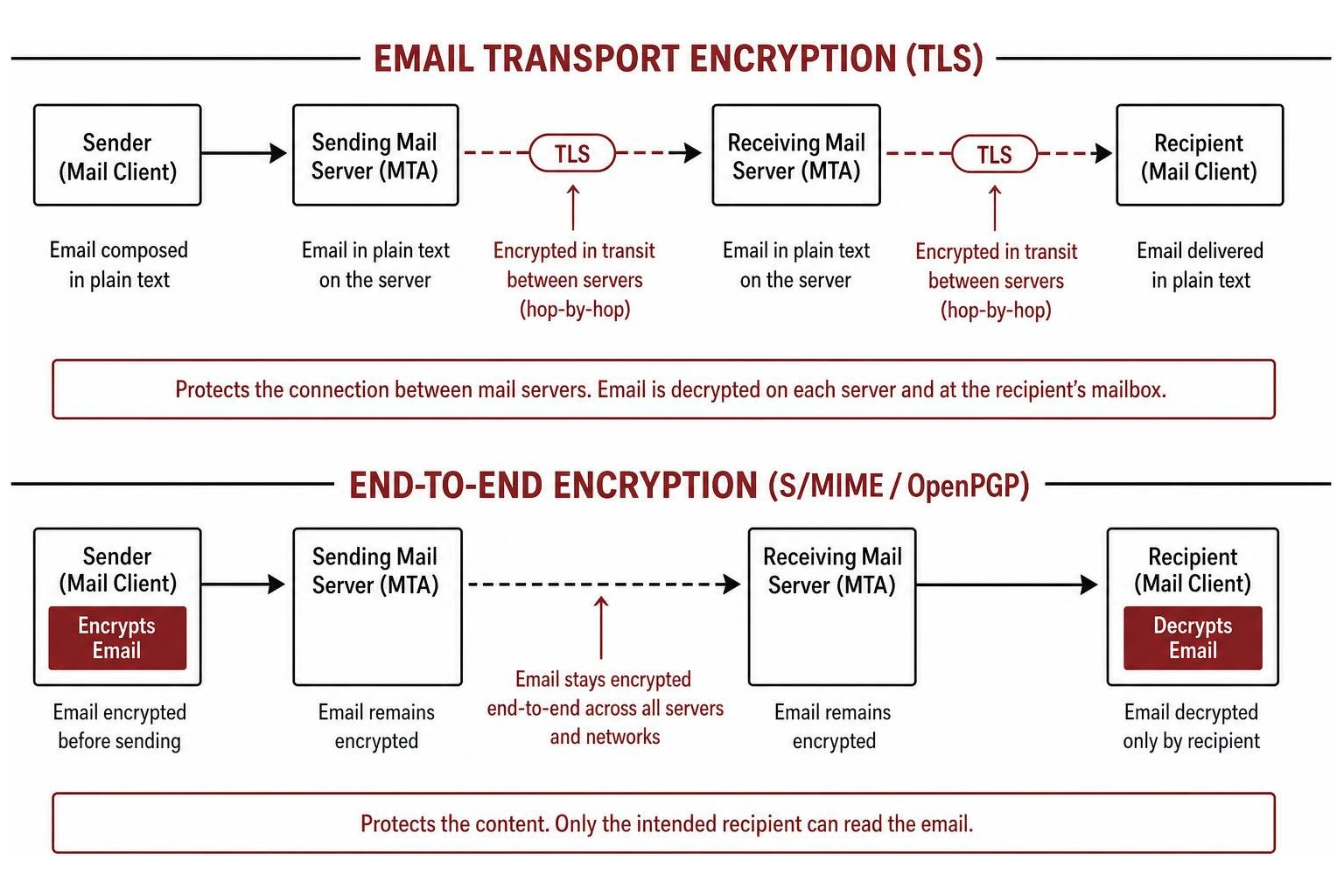
- Transport Layer Security (TLS): Encrypts the connection between mail servers (hop-by-hop) to prevent packet sniffing on local and transit networks. Standard opportunistic TLS (STARTTLS) can be upgraded using MTA-STS (Mail Transfer Agent Strict Transport Security) or DANE (DNS-based Authentication of Named Entities), forcing encrypted connections and preventing man-in-the-middle downgrade attacks. However, TLS only encrypts the transit pipe—messages are decrypted into plaintext on intermediate servers and destination mailboxes.
- S/MIME (Secure/Multipurpose Internet Mail Extensions): Provides end-to-end encryption and digital signatures directly at the mailbox level. Relying on a centralized Public Key Infrastructure (PKI) with trusted Certificate Authorities (CAs), S/MIME encrypts the email body and attachments so only the recipient holding the private key can read them. Centralized key management makes S/MIME ideal for enterprise compliance, policy auditing, and swift key revocation when an employee leaves.
- OpenPGP (Pretty Good Privacy): Offers mailbox-to-mailbox end-to-end encryption based on a decentralized “web of trust” model or direct public key exchanges. While highly secure, OpenPGP requires manual key creation, distribution, and management by individual users, making enterprise-wide deployment and administrative key recovery significantly more challenging than S/MIME.
Technology Capabilities and Deployment Architecture
The shift from on-premises mail servers to cloud-based productivity suites like Microsoft 365 has transformed enterprise email architecture.

Traditional Secure Email Gateways (SEGs) originally designed for perimeter defense are often ill-equipped to handle native cloud messaging dynamics. Examining insights from a June 2023 Tech Talk on modern email security challenges demonstrates why defense mechanisms must evolve past static perimeter rules.
API Integration vs. Legacy Secure Email Gateways
Historically, organizations routed all email traffic through an external MX (Mail Exchanger) record gateway before delivering messages to the mail server. Modern cloud security solutions leverage direct API integrations to inspect mailboxes natively from within the cloud environment.
| Capability | Legacy Secure Email Gateway (SEG) | Modern API Cloud Integration |
|---|---|---|
| Deployment Mechanism | Requires MX record changes and complex mail routing | Connects directly via cloud APIs (e.g., Microsoft Graph API) |
| Setup Time | Days to weeks; requires DNS propagation and testing | Fast setup (often completed in under 15 minutes) |
| Internal Email Scanning | Blind to internal mailbox-to-mailbox communication | Full visibility into internal, cross-tenant messaging |
| Post-Delivery Remediation | Limited ability to recall messages once delivered | Instant, automated clawback of malicious emails across all inboxes |
| Collaboration Tool Protection | Strictly limited to standard email traffic | Extends protection to Teams, Slack, and cloud storage |
| User Experience Impact | Mail delivery delays; complex false positive management | Zero delivery latency; frictionless background operation |
Evaluating architectural options as part of a structured vendor assessment—as outlined in a guide on how to compare email gateway vendors—shows why direct API models are increasingly favored over static MX gateways. API solutions scan emails after primary platform filters complete their initial checks, providing a powerful secondary defense layer that catches evasive social engineering threats without adding delivery friction.
Behavioral AI and Automated Incident Remediation
Modern email protection relies on advanced machine learning to analyze the full context of communication rather than relying solely on static threat signatures or bad domain lists.
- Natural Language Processing (NLP) & Social Graphs: Behavioral engines construct detailed models of normal organizational behavior. By analyzing historical communication frequencies, typical sender-recipient relationships, writing styles, and tone, NLP algorithms flag anomalous requests—such as sudden demands for emergency gift cards or sudden bank account details changes—even when sent from legitimate, uncompromised domains.
- Deepfake and Impersonation Detection: Advanced algorithms analyze message headers, display names, and language markers to detect subtle homograph spoofing (such as replacing Latin letters with lookalike Cyrillic characters) and AI-synthesized executive impersonation.
- Automated Message Clawback & Quarantine: When a post-delivery threat is identified, API-based platforms instantly execute automated remediation workflows, pulling the malicious email out of every affected inbox across the enterprise within seconds.
- Zero-Hour Link Rewriting and Sandbox Inspection: Dynamic URL inspection rewrites links contained within incoming emails, re-checking the destination web page at the exact moment a user clicks it to neutralize delayed “time-of-click” redirect attacks. Meanwhile, incoming attachments undergo isolated sandboxing and Content Disarm and Reconstruction (CDR) to strip away active macro scripts while delivering safe, flat files to end users.
Roadmap for Implementation and Ecosystem Integration
Deploying robust email security requires a clear, step-by-step strategy that aligns technical capabilities, organizational workflows, and employee awareness.
Implementing an Enterprise Email Security Strategy
Building an effective email security architecture requires a systematic implementation strategy:
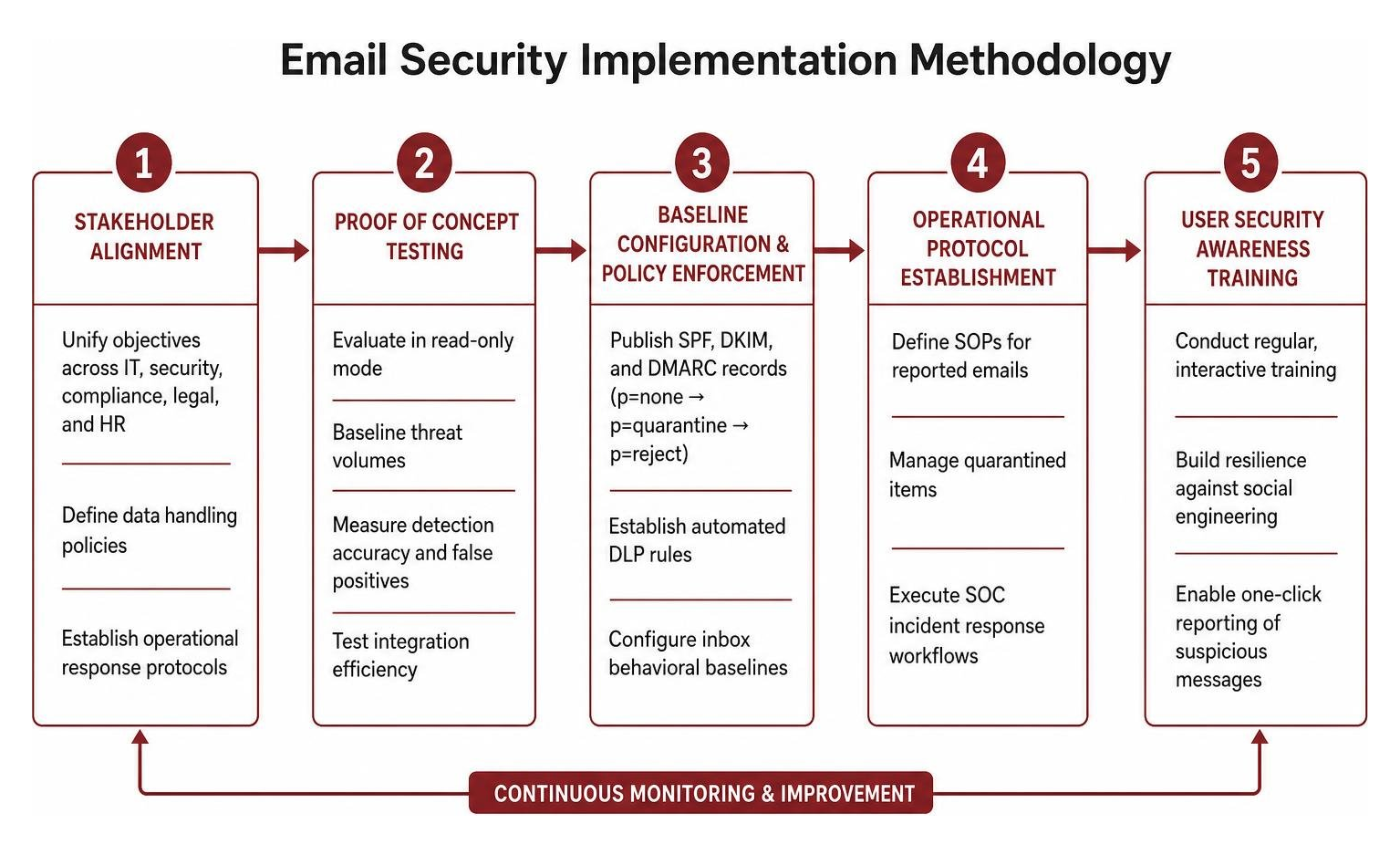
- Stakeholder Alignment: Engage key leaders across IT, security, compliance, legal, and HR to establish unified objectives, define data handling policies, and establish clear operational response protocols.
- Proof of Concept (POC) Testing: Conduct real-world POC evaluations in read-only mode to baseline current email threat volumes, evaluate detection accuracy, measure false-positive rates, and test integration efficiency without disrupting user workflows.
- Baseline Configuration & Policy Enforcement: Publish precise SPF, DKIM, and DMARC records (progressing deliberately from
p=nonetop=quarantineand ultimatelyp=reject). Establish automated DLP rules and configure inbox behavioral baselines. - Operational Protocol Establishment: Define standard operating procedures (SOPs) for handling reported emails, managing quarantined items, and executing SOC incident response workflows.
- User Security Awareness Training: Build human resilience by conducting regular, interactive training sessions. Pairing technical controls with specialized security awareness programs, such as advanced phishing protection services, trains employees to recognize sophisticated social engineering triggers and seamlessly report suspicious messages using one-click reporting add-ins.
Integrating Email Controls with Identity, Endpoint, and XDR
Email cannot exist as a isolated security silo. Unifying email security telemetry with broader identity management, endpoint defense, and Extended Detection and Response (XDR) frameworks eliminates blind spots and drastically accelerates incident response.
Connecting email alerts to your Identity Access Management (IAM) suite allows suspicious mailbox logins or flagged phishing clicks to immediately trigger Multi-Factor Authentication (MFA) step-up challenges or temporary account lockouts. Similarly, correlating an email alert with endpoint protection tools enables immediate automated isolation of a workstation if a user executes an unverified attachment download.
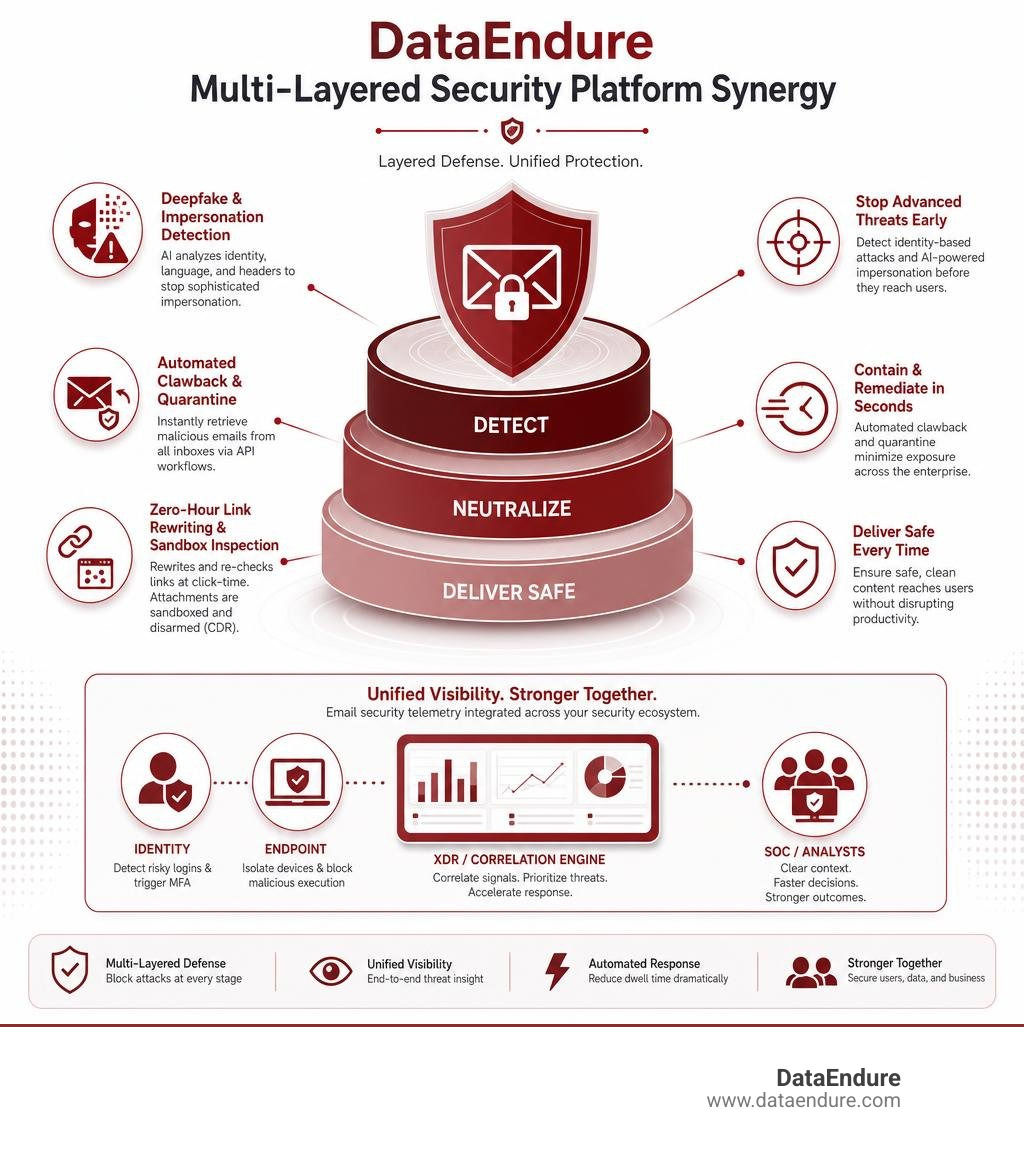
By feeding rich email telemetry directly into cross-layer correlation engines, security operation center (SOC) analysts gain a clear, end-to-end timeline of every attack vector—reducing alert fatigue, streamlining investigations, and stopping multi-stage threats long before they cause operational harm.
Frequently Asked Questions
How do domain authentication protocols prevent spoofing?
SPF, DKIM, and DMARC work in concert to validate sender identity. SPF publishes authorized sending IP addresses in DNS, while DKIM applies a cryptographic signature to outbound messages to prevent content tampering. DMARC ensures domain alignment between the “From” header and these underlying protocols. Receiving servers execute the domain owner’s DMARC policy (p=reject or p=quarantine), automatically blocking or quarantining unauthenticated emails that attempt to fake your domain identity.
Why is TLS transport encryption insufficient for full data privacy?
TLS operates strictly on a hop-by-hop basis, encrypting traffic only as it moves across the active network connection between mail servers. Once the email reaches an intermediate relay or destination server, it is decrypted into plaintext. If an intermediate server operator, system administrator, or malicious actor has unauthorized access to that server, they can view the message contents. Complete end-to-end message privacy requires mailbox-level encryption standards like S/MIME or OpenPGP, which keep content encrypted at rest and in transit until opened by the recipient’s private key.
How can organizations mitigate spam while maintaining email deliverability?
Managing spam while maintaining high deliverability requires deploying multi-layered inbound spam filters alongside strict outbound domain hygiene. Organizations must maintain aligned SPF, DKIM, and DMARC records, manage IP sender reputation by warming up new sending domains, handle opt-outs cleanly, and monitor bounce rates. Ensuring that outgoing emails originate from clean, authenticated infrastructure prevents internet service providers (ISPs) and enterprise mail receivers from downgrading your domain reputation or routing legitimate business communications directly to spam folders.
Conclusion: Achieving Integrated Resilience Across Cloud Ecosystems
Securing enterprise communication in an era of AI-driven social engineering and complex cloud workloads requires moving past disjointed, single-purpose security tools toward a unified, multi-layered defense architecture. Integrating email protection with DNS, identity management, endpoint defense, and cross-layer telemetry provides continuous visibility and reduces operational silos across enterprise environments.
By adopting an adaptive, vendor-agnostic strategy that combines robust protocol enforcement, behavioral AI, and ongoing monitoring, organizations can effectively mitigate email-borne risks. Aligning technical controls with continuous incident response workflows and security awareness empowers enterprises to maintain operational continuity and protect critical digital assets.
Learn more about strengthening resilience through comprehensive email security solutions.