Why a 30 Day MDR Rollout Changes Everything for Busy Security Teams
DataEndure helps organizations turn complex IT environments into resilient, high-performing foundations for AI, security, and growth. We recognize that most IT challenges aren’t isolated—they’re interconnected. A 30 day MDR rollout is a structured, phased approach to deploying Managed Detection and Response across your most critical endpoints — fast enough to reduce real risk before your next audit, breach, or board meeting.
Here’s what a rapid MDR rollout delivers in the first 30 days:
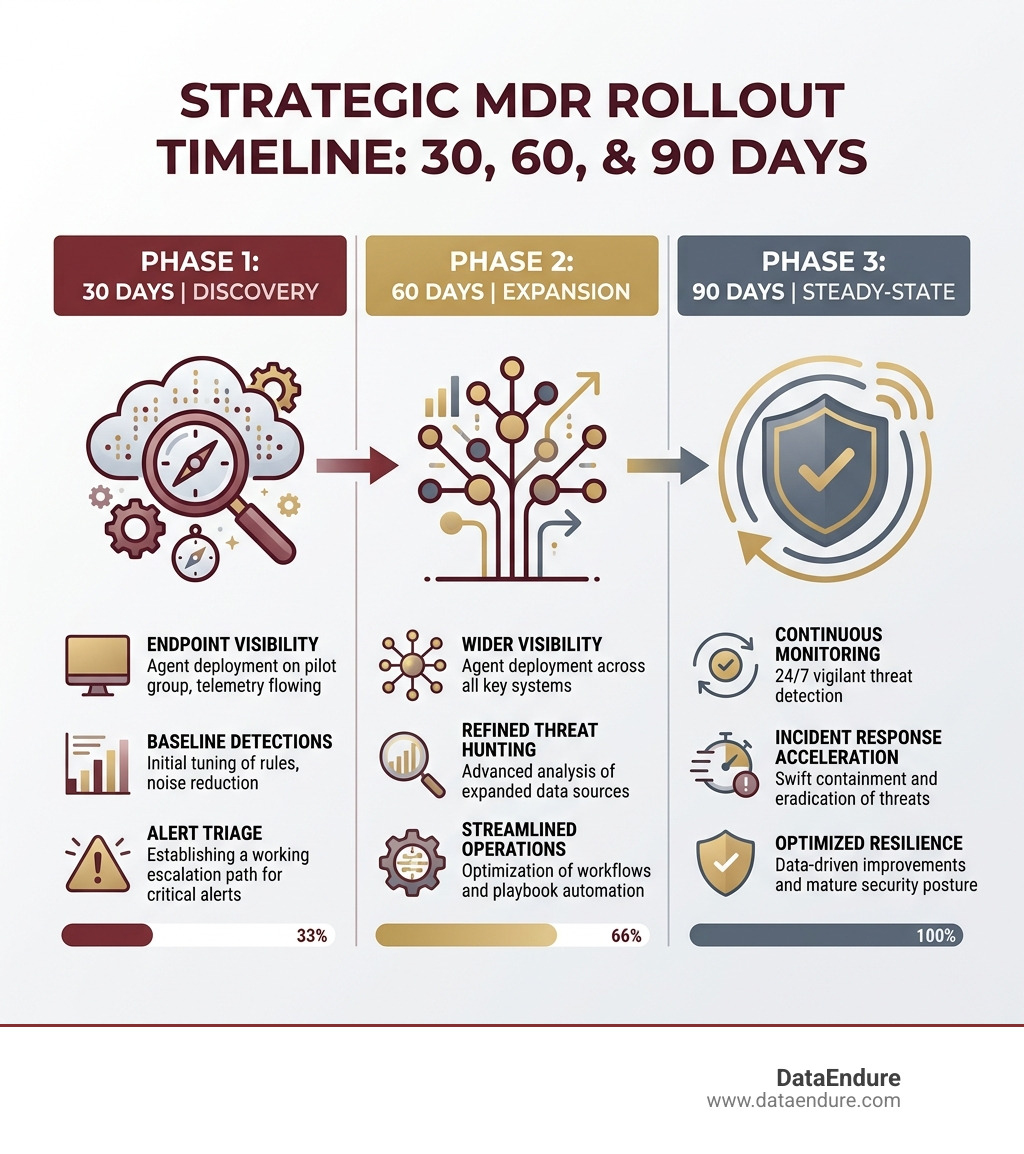
- Endpoint visibility — agents deployed across your pilot group, telemetry flowing, blind spots identified
- Baseline detections — initial rules tuned to your environment, noise reduced from day one
- Alert triage — a working escalation path so critical alerts don’t get buried
- Measurable progress — pilot coverage validated, false positive rate tracked, MTTD benchmarked
The stakes are real. According to IBM’s 2024 Cost of a Data Breach Report, the average time to identify and contain a breach is 258 days. That’s not a security gap — it’s a business liability.
For mid-sized organizations in regulated industries, the problem is rarely a lack of tools. It’s that those tools aren’t working together. DataEndure brings a multi-disciplinary approach across security, data, cloud, network, and infrastructure to design environments that work together—reducing complexity, closing gaps, and accelerating outcomes.
The Strategic Value of a 30 Day MDR Rollout
In the environment of Silicon Valley and Santa Clara, where we are currently navigating the tech landscape of May 2026, business speed is everything. We’ve seen that resilience isn’t just a defensive posture; it’s a business enabler. Resilience isn’t just protection—it’s what allows your business to move faster, scale confidently, and adapt without disruption.
The primary goal of a 30 day MDR rollout is alignment over complexity. Technology works best when it works together. Most organizations suffer from “tool sprawl”—a collection of expensive software that doesn’t talk to each other. By focusing on a rapid, integrated rollout, we align your environment across disciplines to eliminate friction and hidden risk. We aren’t just “installing software”; we are building a foundation that allows your security, data, and cloud infrastructure to work together.
The financial justification is clear. IBM’s research shows that breach costs rise materially the longer a threat goes undetected. By reducing the Mean Time to Detect (MTTD) from months to hours, and the Mean Time to Contain (MTTC) from days to minutes, organizations can save hundreds of thousands of dollars in recovery costs. For instance, according to the Amtrak Fiscal Year 2026 Grant and Legislative Request, large-scale infrastructure projects require disciplined timelines to ensure safety and efficiency—and your digital infrastructure is no different.
To learn more about how this fits into a broader strategy, you can explore our Managed Security Services.
Phase 1: Discovery and Pilot (Days 1-30)
The first month of a 30 day MDR rollout is about setting the stage for an outcome-driven security posture. We don’t believe in “boiling the ocean” on day one. Instead, we take a vendor-agnostic, outcome-driven approach, focusing on what works best for your specific environment. We’re not tied to a single technology; our only stake is in what works best for your environment and your outcomes.

The focus here is on the “Discovery and Pilot” phase. We start by appointing a project lead, a security lead, and an IT lead. We then perform a thorough asset inventory. You cannot protect what you cannot see. This includes identifying your “crown jewels”—the business-critical endpoints that, if compromised, would cause the most damage.
In this phase, we select a pilot group of 50 to 200 endpoints. This group should be representative of your entire environment, including different operating systems and departments (e.g., Finance, Engineering, and HR). This mirrors the best practices found in other technology deployments, such as the MFA Deployment Guide: 30-Day Enterprise Rollout Playbook | NonaSec, which emphasizes starting with “champions” to build internal support.
For more technical details on the tools involved, learn about Endpoint Security solutions that form the backbone of this phase.
Critical Tasks for a Successful 30 Day MDR Rollout
During these first 30 days, we focus on four critical pillars:
- Baseline Telemetry: We begin collecting data from the pilot group to understand what “normal” looks like in your network.
- Agent Deployment: We roll out the detection agents to the pilot group. This isn’t just about installation; it’s about ensuring they are checking in and communicating correctly.
- Initial Detection Tuning: Every environment has unique “noise.” We start tuning detections immediately to ensure that when an alert fires, it’s meaningful.
- Communication Protocols: We establish exactly who gets called at 2:00 AM on a Saturday. This includes setting up escalation paths and decision-making authority for containment actions.
Our Expertise in Endpoint Detection and Response ensures that these tasks are handled with precision, reducing the burden on your internal team.
Scaling for Resilience: Days 31 to 90
Once the pilot is successful, we move into the “Expansion and Tuning” phase. This is where we scale the deployment from the initial 200 endpoints to 90% or more of your total environment.

We roll this out in waves. Wave 1 might be your local Santa Clara office, while Wave 2 covers your remote workforce across Silicon Valley. This staggered approach allows us to manage network bandwidth and catch any site-specific issues before they become widespread.
A key focus during days 31-60 is alert fatigue reduction. Security teams are known to ignore up to 75% of alerts because they are often false positives. By the 60-day mark, our goal is to have a false positive rate for Tier 1 alerts of less than 20%. This is similar to how a CRM Implementation Plan: 90-Day Rollout Framework for Growing Businesses focuses on data hygiene and stability before turning on complex automations.
To support this scale, many organizations Explore SOC as a Service to provide the 24/7 “eyes on glass” required for a mature security posture.
Achieving Steady State After the 30 Day MDR Rollout
By day 90, the goal is “Steady State.” This means your MDR solution is fully operational, integrated, and hardening your environment.
One of the most significant achievements in this phase is automated containment. For high-confidence threats, like a known ransomware strain, we enable the system to automatically isolate the affected device from the network. This can reduce containment time from multiple business hours to under 2 hours, potentially saving your organization tens of thousands in recovery costs.
We also conduct “handoff” sessions where our analysts work closely with your internal IT and security teams. This ensures that everyone understands the runbooks and playbooks. You can find more about N-SOC expertise and how we bridge the gap between detection and action.
Measuring Success: KPIs and ROI of Rapid Deployment
How do you know if your 30 day MDR rollout was a success? We measure it through specific Key Performance Indicators (KPIs).
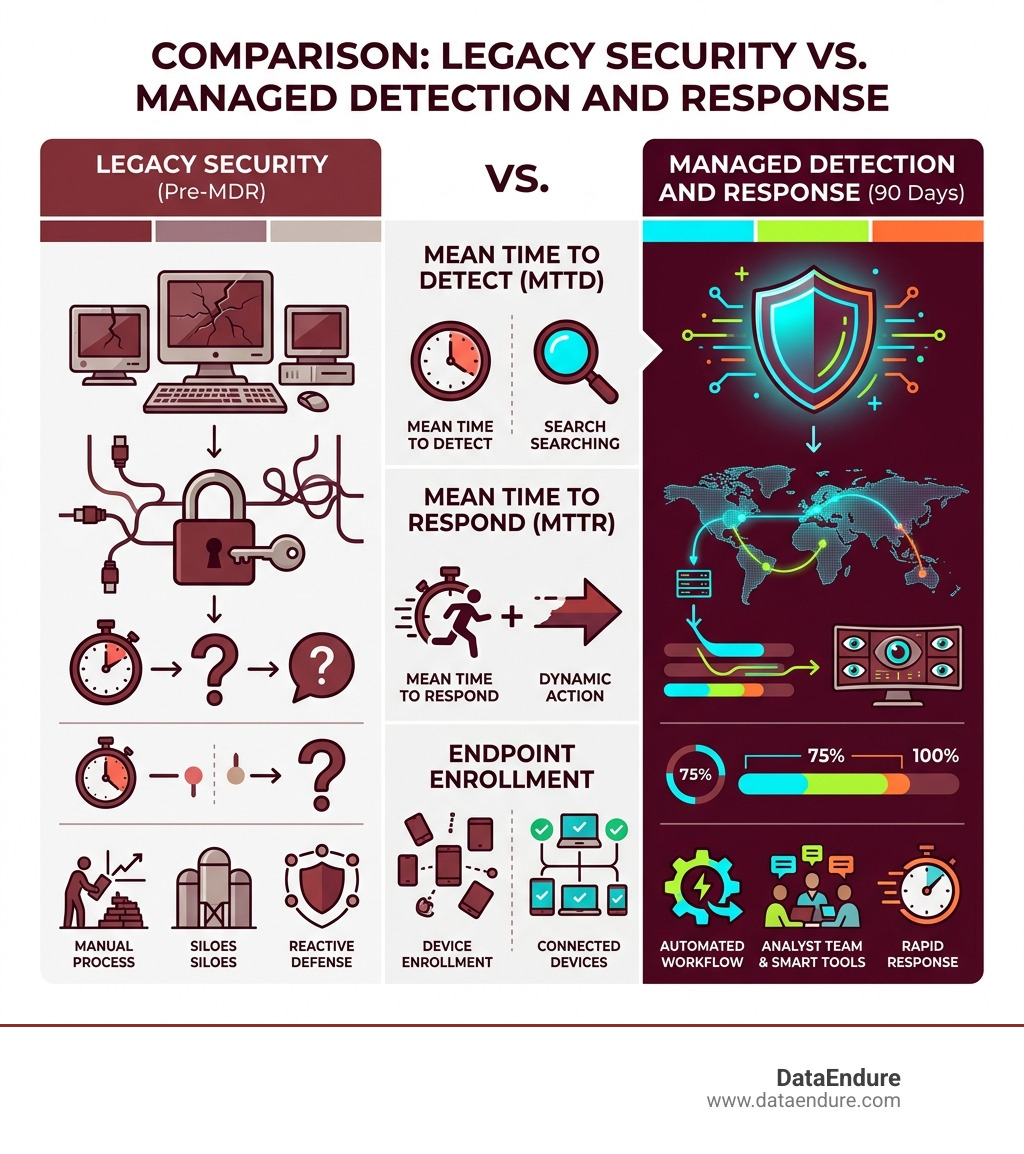
| Metric | Legacy Security (Pre-MDR) | Managed Detection & Response (90 Days) |
|---|---|---|
| Mean Time to Detect (MTTD) | 258 Days (Average) | < 8 Hours (Critical Alerts) |
| Mean Time to Respond (MTTR) | Days to Weeks | < 4 Hours (Containable Incidents) |
| Endpoint Enrollment | Fragmented / Unknown | > 90% |
| False Positive Rate | > 75% | < 20% |
| Analyst Time per Alert | High (Manual) | 30% Reduction (via Automation) |
Beyond these numbers, a successful rollout prepares you for the future. AI Readiness Starts at the Foundation. AI success depends on what’s underneath it—trusted data, scalable infrastructure, efficient networks, and secure environments. By cleaning up your data, securing your endpoints, and aligning your infrastructure now, you are building the foundation for AI-driven growth.
Our Advanced Phishing Protection services are a great example of how these integrated layers work together to provide a holistic defense.
Frequently Asked Questions about MDR Rollouts
How does MDR differ from EDR alone?
Think of Endpoint Detection and Response (EDR) as the “smoke detector” and Managed Detection and Response (MDR) as the “fire department.” EDR provides the telemetry and the tools to see what’s happening on an endpoint. However, without 24/7 human expertise to watch the alerts, investigate the noise, and take action, the smoke detector just rings in an empty house. MDR provides that expert layer, including proactive threat hunting. For those who want the tool but need the help, we offer EDR as a Service.
Can organizations run an MDR rollout without an MSSP?
Technically, yes—but it’s expensive and difficult. Building an in-house Security Operations Center (SOC) can cost between $2 million and $5 million annually when you factor in 24/7 staffing, training, and software licenses. In contrast, an MDR service typically costs a fraction of that ($50k – $300k). Beyond the cost, there is a massive talent gap. Finding and keeping skilled security analysts in Silicon Valley is a constant challenge. Partnering with us allows you to solve problems holistically across your entire environment without the overhead of building it from scratch.
What are the most common pitfalls in rapid deployment?
The most common mistake is skipping the pilot phase. Organizations get excited and try to push the agent to every machine at once, only to find that a legacy application crashes or a critical server reboots. Another pitfall is “siloed teams”—where the security team deploys a tool without talking to the IT team that manages the endpoints. Finally, a lack of executive sponsorship can stall a rollout. Leadership needs to understand that a 30 day MDR rollout is a business priority, not just an IT project.
Conclusion
At DataEndure, we believe that technology works best when it works together. We aren’t just a vendor; we are a multi-disciplinary partner with a deep bench of expertise across five critical disciplines. We solve problems holistically—so your solutions don’t compete, they compound.
By following a disciplined 30 day MDR rollout, you can move from a reactive, fragmented state to a proactive, integrated posture that enables your business to scale without disruption. Most providers solve within a domain; DataEndure solves across the environment. Resilience isn’t just about stopping the “bad guys”—it’s about giving your organization the confidence to move faster than the competition.
Ready to close the gaps in your security? Transform your security with DataEndure Managed MDR and let us help you build a more resilient future.