When Every Alert Screams “Wolf”: The Case for Reducing SOC Alert Fatigue
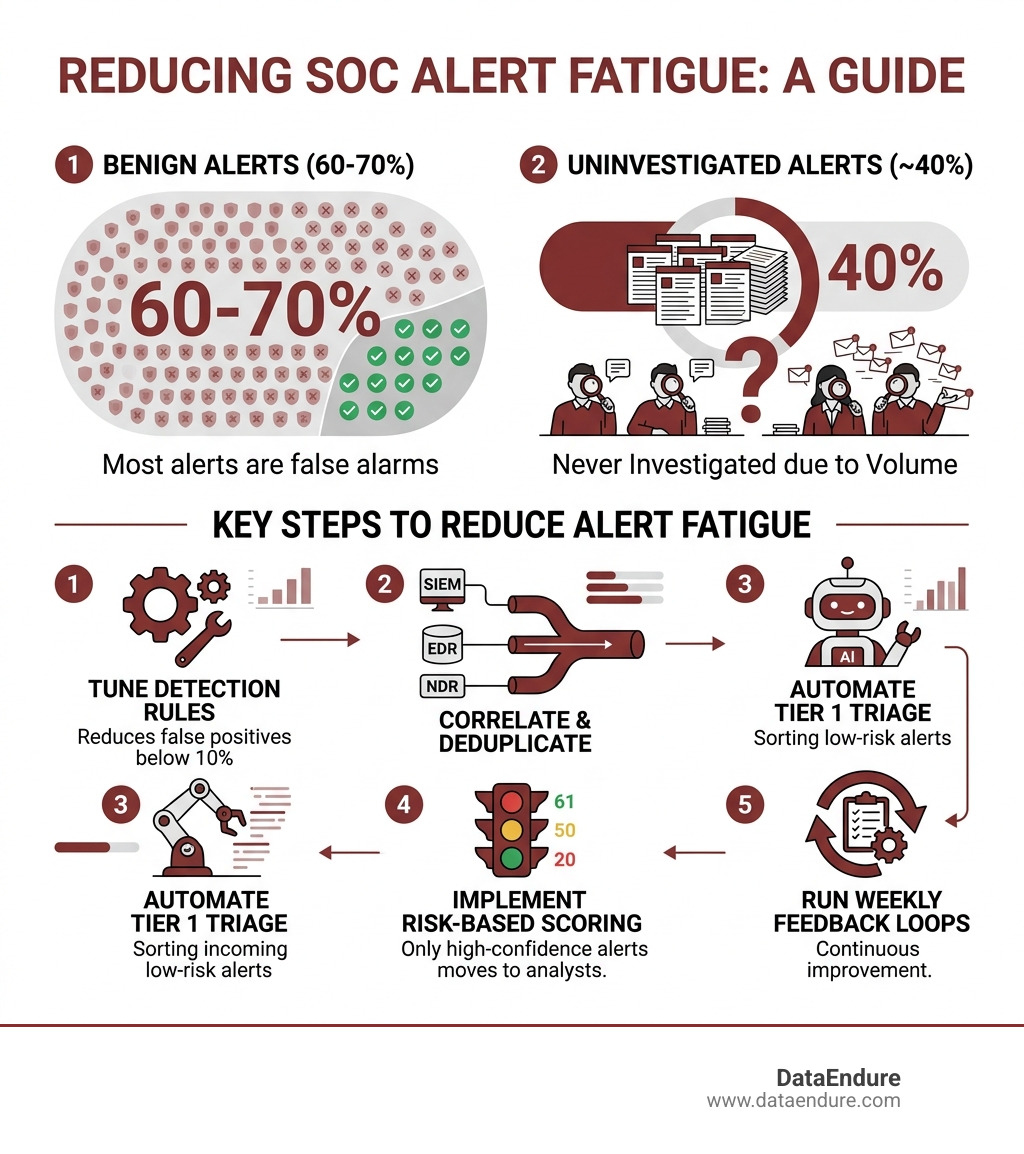
Reduce SOC alert fatigue by focusing on these core actions:
- Tune detection rules to cut false positives below 10%
- Correlate and deduplicate alerts across your SIEM, EDR, and NDR tools
- Automate Tier 1 triage using AI to handle low-risk, repetitive alerts
- Implement risk-based scoring to route only high-confidence alerts to analysts
- Run weekly feedback loops to continuously improve detection quality
If your security team feels like they are drowning, they probably are.
The average SOC team processes around 4,484 alerts every single day. Analysts spend nearly three hours on manual triage alone. And yet, roughly 60–70% of those alerts turn out to be benign — with about 40% never investigated at all.
That is not a people problem. It is a design problem.
The sheer volume of low-value alerts does something predictable to human attention: it erodes it. Analysts stop trusting their tools. They start skipping alerts. And somewhere in that pile of noise, a real threat quietly slips through.
This is alert fatigue — and it is one of the most dangerous vulnerabilities in modern security operations.
For IT leaders in regulated industries, the stakes are especially high. A missed alert is not just an operational inconvenience. It can be the difference between catching a breach in minutes and discovering it after millions of dollars in damage have already been done.
The good news: alert fatigue is not inevitable. With the right strategies — smarter detection, better tooling, and intelligent automation — your team can stop chasing noise and start catching what actually matters.
The High Cost of Noise: Why You Must Reduce SOC Alert Fatigue
In cybersecurity, we often talk about “The Cry Wolf” effect. In the classic fable, the villagers eventually stopped running when the boy cried “wolf” because they had been burned by too many false alarms. In a modern Security Operations Center (SOC), the “villagers” are your highly skilled analysts, and the “wolf” is a ransomware actor hiding behind a sea of benign login notifications.
Analyst Burnout and the 70% Turnover Rate
We are seeing a staggering human toll. Research from the Ponemon Institute shows that 35% of analysts agree that manual processes have “absolutely increased their burnout.” Even more concerning is the impact on retention: roughly 70% of SOC analysts with five years or less of experience leave their positions within three years. When we lose these professionals, we aren’t just losing headcount; we are losing the institutional knowledge required to defend the business.
The Psychological Impact of the “River of Red”
Imagine walking into work and seeing a “river of red and orange” on your screen every single day. This constant state of high-alert leads to cognitive desensitization. The brain, in an effort to protect itself from overstimulation, begins to treat every alert as “probably a false positive.”
This is exactly what attackers want. In fact, 13% of social engineering incidents in recent years were traced back to ignored or untriaged security alerts. Attackers are now using subtle tactics like SEO poisoning and malvertising specifically because they generate low-level alerts that are likely to be buried on page three of a busy analyst’s queue.
The Financial and Business Risk
The financial consequences are no longer just “theoretical.” By May 2026, the average cost of a data breach has climbed to approximately $4.9M, a trend consistent with findings in the IBM Cost of a Data Breach Report. When an organization suffers from alert fatigue, their Mean Time to Detect (MTTD) and Mean Time to Respond (MTTR) skyrocket.
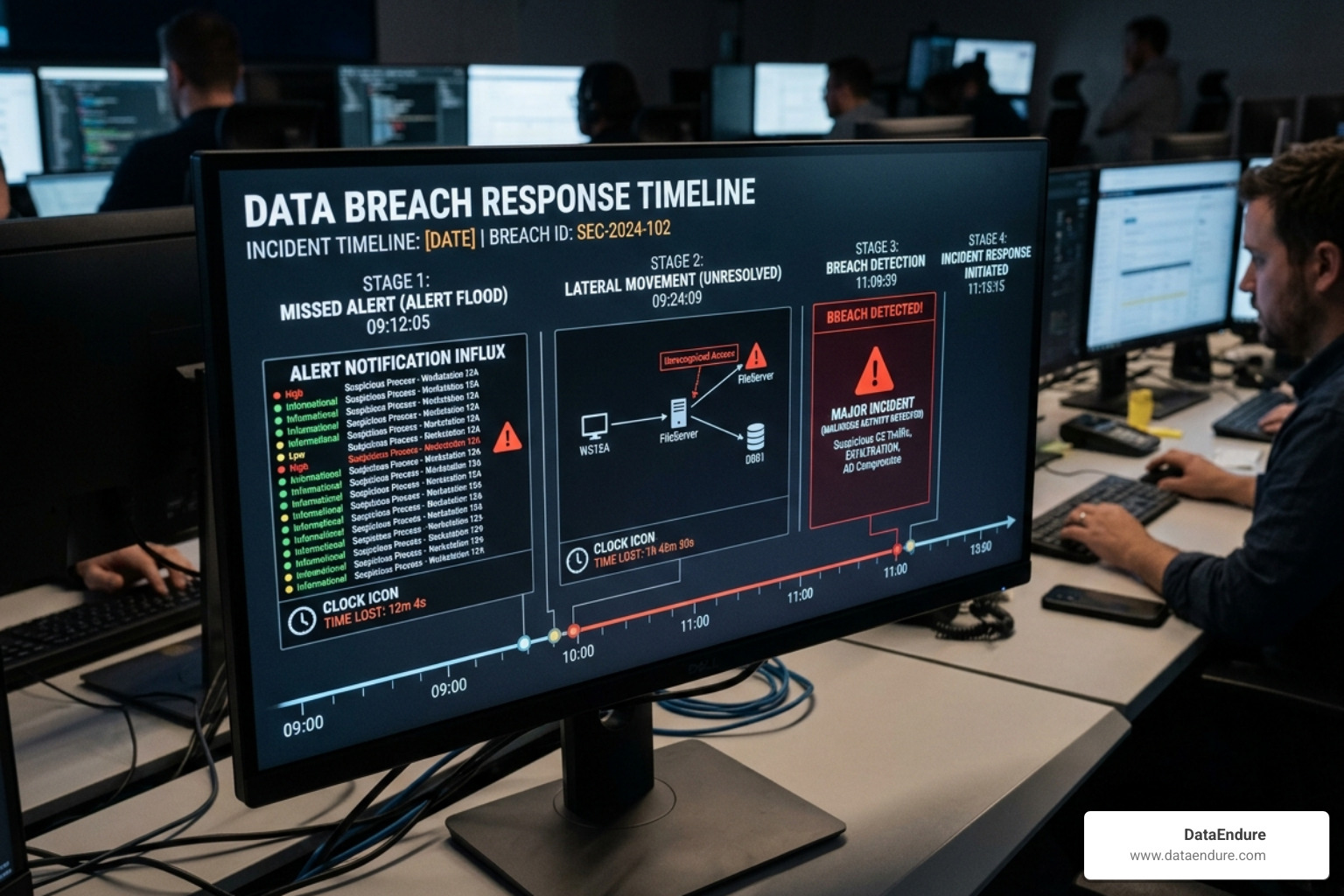
A real-world example of this occurred when an IT team, overwhelmed by hundreds of daily alerts, redirected their notifications to a Slack channel just to keep their email inboxes clean. A real threat slipped through that Slack channel unnoticed, leading to a massive breach. When we fail to reduce SOC alert fatigue, we aren’t just saving our analysts’ sanity—we are protecting the company’s bottom line.
Root Causes of Alert Overload in Modern Security Operations
To fix the volume problem, we first have to understand why the “radio” is turned up so loud. It isn’t usually because there are more hackers; it’s because our security stacks have become incredibly chatty and disorganized.
Tool Sprawl and the 28-Tool Problem
Modern organizations now deploy an average of 28 different security monitoring tools. Each of these tools—your firewall, your EDR, your email security, your cloud monitor—wants to be the hero. They all fire alerts independently. If a single suspicious user logs in from an unusual location and then accesses a sensitive file, you might get four different alerts from four different tools for the exact same event. Without correlation, that looks like four problems instead of one story.
The 99% False Positive Trap
It is a brutal reality of the industry: some security tools have false positive rates as high as 99%. This often stems from “out-of-the-box” detection rules that are too broad. For example, a rule that flags every “failed admin login” might be great for a tiny office, but in a large enterprise, it generates thousands of alerts a day due to simple typos or automated maintenance scripts.
Legacy SIEM Limitations
Traditional Security Information and Event Management (SIEM) systems were built for log storage, not for high-speed intelligence. Many legacy SIEMs rely on static, rule-heavy detections that haven’t kept pace with modern cloud-native environments. Furthermore, about 18% of rules in production SIEMs are actually incapable of firing because they are misconfigured or looking for data that doesn’t exist.
The Manual Triage Burden
SOC analysts currently spend nearly 3 hours per day on manual triage. This is “grunt work”—checking IP reputations, looking up user IDs, and cross-referencing logs. When your team is stuck in the weeds of manual work, they have zero time for strategic threat hunting. This is why SOAR and Your Security Posture is such a critical conversation; without orchestration, you are just throwing human hours into a black hole.
Strategic Frameworks for High-Fidelity Detection
To move away from the “collect everything, alert on everything” model, we must adopt a more disciplined engineering approach to security.
| Feature | Traditional Reactive SOC | Modern Autonomous SOC |
|---|---|---|
| Primary Goal | Close as many tickets as possible | Identify and neutralize high-risk threats |
| Detection Logic | Static, out-of-the-box rules | Detection-as-Code (custom & tested) |
| Alert Volume | High (thousands/day) | Low (dozens of high-fidelity incidents) |
| Triage Process | Manual “swivel-chair” analysis | AI-assisted enrichment & correlation |
| Analyst Role | Ticket processor | Threat hunter and responder |
Detection-as-Code
One of the most effective ways to reduce SOC alert fatigue is to treat your detection rules like software. This means:
- Version Control: Storing rules in a repository (like Git) so you can track changes.
- Peer Reviews: Ensuring a second set of eyes looks at every new alert rule before it goes live.
- Testing: Running historical data against a new rule to see how many alerts it would have fired before you turn it on.
By applying this level of rigor, we ensure that only high-quality “signals” reach the analyst’s desk. For those looking to upgrade their capabilities, Announcing ESCV – DataEndure SOC MDR Service Enhancement provides a deep dive into how we’ve refined these services to provide better clarity for our clients.
Implementing the SOC Visibility Triad to Reduce SOC Alert Fatigue
The “SOC Visibility Triad” is a concept that combines three essential data pillars to create a unified view of your environment:
- EDR (Endpoint Detection and Response): Visibility into what is happening on the laptops and servers themselves.
- NDR (Network Detection and Response): Visibility into the “east-west” traffic moving across your network.
- SIEM (Security Information and Event Management): The central hub that collects logs from everything else.
When these three work together, you get unified context. Instead of seeing a “Suspicious Process” alert on a server (EDR) and a separate “Large Data Transfer” alert on the network (NDR), the Triad correlates them into a single incident: “Data Exfiltration via Compromised Server.” This automatically reduces the alert count and tells the analyst exactly where to start.
Leveraging AI and Automation to Reduce SOC Alert Fatigue
In 2026, AI is no longer a buzzword—it is the frontline of the SOC. “Agentic AI” can now act as a digital teammate, performing the initial triage that used to take humans hours.
- Automated Triage: Organizations implementing AI-assisted triage have reduced investigation time from 15-20 minutes per alert to just 3-4 minutes.
- Recursive Reasoning: Modern AI doesn’t just look at an alert; it asks, “Is this IP known to be malicious? Has this user done this before? What files did they touch?” It does the “investigation” before the human even opens the ticket.
- 80% Noise Reduction: By using AI to automatically close benign, repetitive alerts (like known IT maintenance), teams can reduce the total volume of alerts requiring human intervention by up to 80%.
This shift allows analysts to focus on high-value work. In fact, teams using AI reported 79% higher job satisfaction because they were finally doing the “cool” security work they were trained for. To learn more about how this fits into a broader strategy, check out our May 2022 Tech Talk – Good, Better, Best: How Well is Automation Supporting Your Security Strategy?
A 90-Day Roadmap for Sustainable Alert Management
You can’t fix alert fatigue overnight, but you can make massive strides in three months. Here is a practical playbook we use to help organizations regain control.

Days 1-30: Baselining and Quick Wins
- Audit the Noise: Identify the top 10 rules generating the most alerts. Usually, 10% of your rules are causing 90% of your headaches.
- Capture Metrics: Measure your current MTTD, MTTR, and False Positive Rate.
- Immediate Suppression: Disable or tune the “noisiest” rules that have never resulted in a true positive.
Days 31-60: Integration and Correlation
- Connect the Dots: Ensure your EDR, NDR, and SIEM are sharing data.
- Risk-Based Scoring: Implement a formula that weights alerts based on the asset’s importance. An alert on the CEO’s laptop should always outrank an alert on a guest Wi-Fi printer.
- Deployment Milestones: This is where services like N Soc can accelerate the process, bringing pre-built correlation logic to your environment.
Days 61-90: Automation and Feedback Loops
- Automate Enrichment: Set up playbooks to automatically pull threat intelligence for every new alert.
- Weekly Tuning Sessions: Hold a 30-minute meeting where analysts flag “annoying” alerts that need to be tuned out.
- Governance Gates: Ensure no new detection rule goes live without passing a “noise test” in a sandbox environment.
Frequently Asked Questions about SOC Alert Fatigue
What is an acceptable false positive rate for a modern SOC?
In a healthy, well-tuned SOC, you should target a false positive rate below 10% for alerts that actually reach an analyst. Additionally, your “alert-to-incident” conversion rate should be above 20%. If 99% of what your analysts see is garbage, they will eventually treat the 1% that matters like garbage, too.
How does AI reduce investigation time without replacing analysts?
AI acts as a “copilot.” It handles the mechanical tasks—gathering logs, checking IP reputations, and summarizing the event. This reduces the triage time from 20 minutes to about 4 minutes. The analyst still makes the final decision on whether to isolate a machine or block a user, but they do it with all the evidence already laid out in front of them. It makes the analyst better, not absent.
What are the first steps to take when a team is already burnt out?
First, stop the bleeding. Identify the top 5-10 rules that are flooding the queue and tune them immediately. Second, implement “Detection for Purpose”—ensure every alert has a clear runbook. If an analyst doesn’t know what to do when an alert fires, that alert shouldn’t be firing. Finally, consider bringing in managed support to handle the “overspill” while you fix your internal processes.
Conclusion
At DataEndure, we know that a quiet SOC isn’t necessarily a safe one—but a noisy SOC is almost certainly a vulnerable one. Our mission is to help you reduce SOC alert fatigue by providing managed cybersecurity solutions that focus on high-fidelity signals.
We specialize in rapid breach detection, often catching threats in minutes that others might miss for days. With our 30-day deployment model and expert-led triage, we don’t just give you more alerts; we give you the answers you need to protect your business.
Don’t let your team drown in the “river of red.” Take the first step toward a more sustainable, effective security posture today.
Request a Security Health Check and let us help you turn down the noise and turn up your defenses.