Architecture, Detection Modules, and Configurations of Security HIPS
Understanding how host-level prevention functions begins with its placement inside the operating system. While perimeter controls evaluate incoming data packets, a host intrusion prevention system operates directly within memory, the file system, and kernel-level hooks. This internal presence gives the agent visibility into system calls as they occur, allowing it to evaluate intent rather than relying solely on static file signatures.
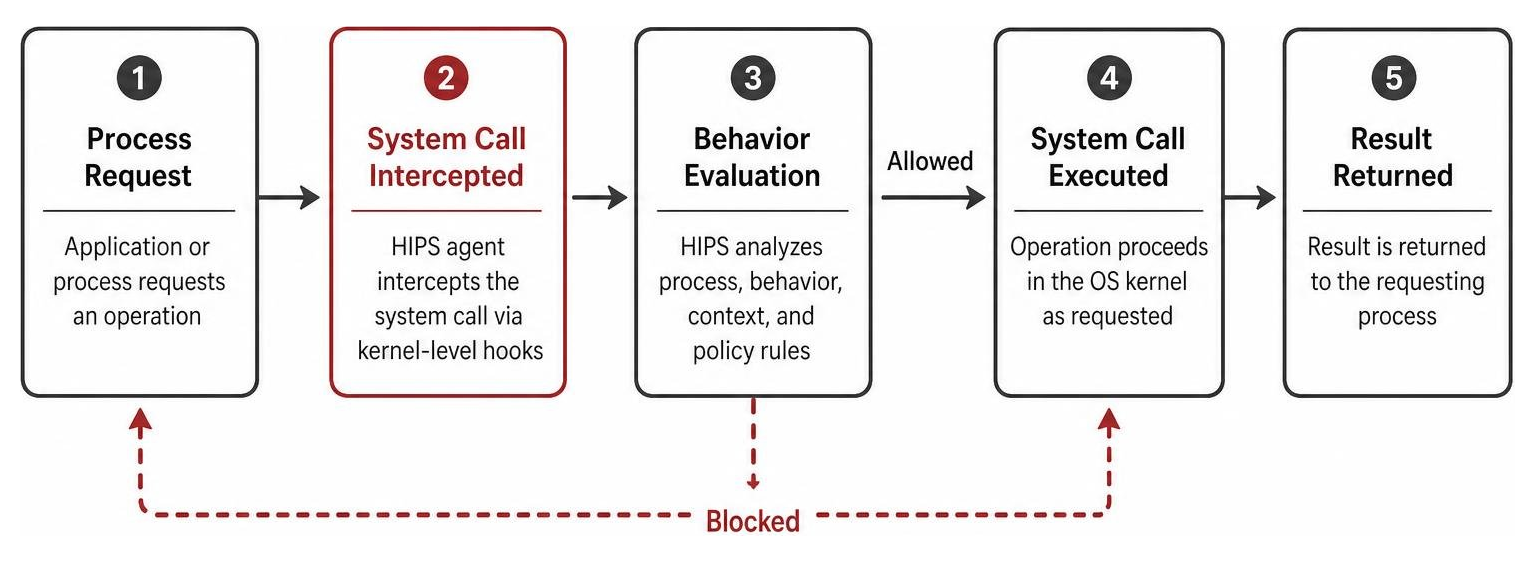
Core Detection Modules and Zero-Day Attack Prevention in Security HIPS
Modern security hips architecture relies on specialized detection modules that evaluate multiple dimensions of system activity. Zero-day exploits may bypass traditional antivirus signatures because their signatures do not yet exist in global threat databases. A behavioral prevention engine instead looks for anomalous actions, such as an unknown process attempting to inject code into memory allocated to core operating system services.
To defend environments more thoroughly, prevention platforms may deploy several foundational detection modules:
- Behavioral Monitoring and Memory Scanning: Intercepts runtime anomalies, buffer overflow attempts, and unauthorized memory modifications so suspicious activity can be blocked or reviewed before it progresses.
- File Integrity Monitoring (FIM): Tracks critical system directories and configuration files, blocking unauthorized modifications or alerting security teams to tampering.
- Registry and System State Protection: Safeguards startup keys, driver registrations, and system configurations from unauthorized persistence mechanisms.
- Privilege Escalation and Shell Defense: Identifies abnormal shell invocations, process privilege escalations, and unauthorized root access attempts.
- Rootkit and Kernel Defense: Detects hidden processes, hooked system tables, and unauthorized direct kernel object manipulation.
- Ransomware Shielding: Watches for rapid, unauthorized file encryption patterns and can halt the offending process while supporting file preservation and recovery workflows.
Integrating these capabilities into a broader modern endpoint security architecture helps defensive controls monitor multiple layers of host execution, containing threats that bypass initial inspection filters.
Operational Modes and Policy Configuration for Security HIPS
Configuring host prevention involves selecting the right enforcement model for each workload. Security platforms provide distinct operational modes to balance protection strength against business disruption:
- Automatic Mode: Enforces predefined vendor rules and known behavioral baselines without requiring administrative intervention. This mode suits standard desktop environments where user activity follows predictable patterns.
- Smart Mode: Balances strict blocking with usability by alerting and intervening only when actions present high-confidence malicious traits.
- Interactive Mode: Prompts the user or administrator in real time when an unclassified action occurs. While useful in isolated development labs, it can create alert fatigue in production environments.
- Policy-Based Mode: Strictly permits only explicitly authorized behaviors and blocks everything else, creating a hardened baseline for critical servers.
- Learning Mode: Monitors system behavior over a defined period, such as 14 days, to generate customized operational baselines before enforcing blocking rules.
Self-defense mechanisms are equally important. A resilient host agent protects its own binaries, drivers, and service processes from being terminated or tampered with by malware attempting to disarm host controls. Applying disciplined endpoint security best practices can help administrators deploy these operational modes effectively across diverse server and workstation fleets.
Managing False Positives, Performance Overhead, and Central Telemetry
Host-based controls run directly on endpoint hardware, which means resource consumption and rule accuracy must be carefully managed. When behavioral rules are too aggressive, legitimate business software can trigger false positives, disrupting normal operations.
To keep host impact minimal, enterprise deployments rely on structured tuning. Administrators define granular exclusions for trusted, digitally signed enterprise applications, use local LRU caches to avoid redundant process evaluations, and throttle CPU utilization during intensive background scans.
Telemetry management also benefits from structured mapping. Aligning host events to the MITRE ATT&CK framework allows asynchronous telemetry queues to categorize process creations, registry modifications, and active responses into standardized technique IDs. This contextual mapping can enrich event correlation without overwhelming management servers or consuming excessive network bandwidth.
Layered Ecosystems, Network Device Hardening, and Protocol Security

Host intrusion prevention does not function in a vacuum. It serves as one component within a broader defensive posture, bridging the gap between host execution, network communications, and identity validation.
Integrating Host Prevention with Antivirus, Firewalls, and EDR
A layered defense coordinates static prevention, dynamic behavioral blocking, and investigative visibility. Traditional antivirus handles known malicious binaries using signature scanning, while host firewalls govern inbound and outbound network socket connections. Host intrusion prevention operates between these layers, inspecting processes and blocking malicious actions in real time when policy and detection confidence support intervention.
When paired with integrated endpoint detection and response capabilities, host defense gains additional analytical depth. While the prevention engine addresses immediate activity, EDR components record telemetry across the execution chain. This pairing allows security teams to correlate initial host compromises with lateral network movement, isolate affected endpoints, and initiate targeted remediation.
Implementing HIPS on Network Switches and Routers vs. Endpoint Hosts
Host intrusion prevention is not limited to standard workstations and servers; it also plays a role in hardening network infrastructure. Enterprise network operating systems on core switches and routers may embed HIPS modules directly into their control planes to protect against low-level tampering.
| Aspect | Endpoint Host HIPS | Network Device HIPS (Switches/Routers) |
|---|---|---|
| Primary Target | Operating system processes, applications, registry | Control plane, shell integrity, kernel drivers |
| Key Detections | Ransomware, code injection, memory tampering | Unauthorized MACs, shell modification, rootkit hooks |
| Resource Constraints | Shared workstation or server CPU and RAM | Dedicated, fixed hardware compute and memory budgets |
| Management Interface | Centralized endpoint management console | CLI command references and firmware policy files |
On enterprise networking hardware, administrators manage these protections through command-line interfaces. For example, network engineers can use the Huawei HIPS configuration command reference to verify module status and enable protections against shell file tampering, kernel rootkits, and unauthorized privilege escalation across routing platforms.
Host Identity Protocol (HIP) and Secure Identity-First Communications
In addition to host-level process prevention, secure communications benefit from modern architectural protocols that protect host identities. The Host Identity Protocol, standardized in the RFC 7401 Host Identity Protocol Version 2 specification, decouples the dual role of traditional IP addresses, separating a host’s identity from its network location.
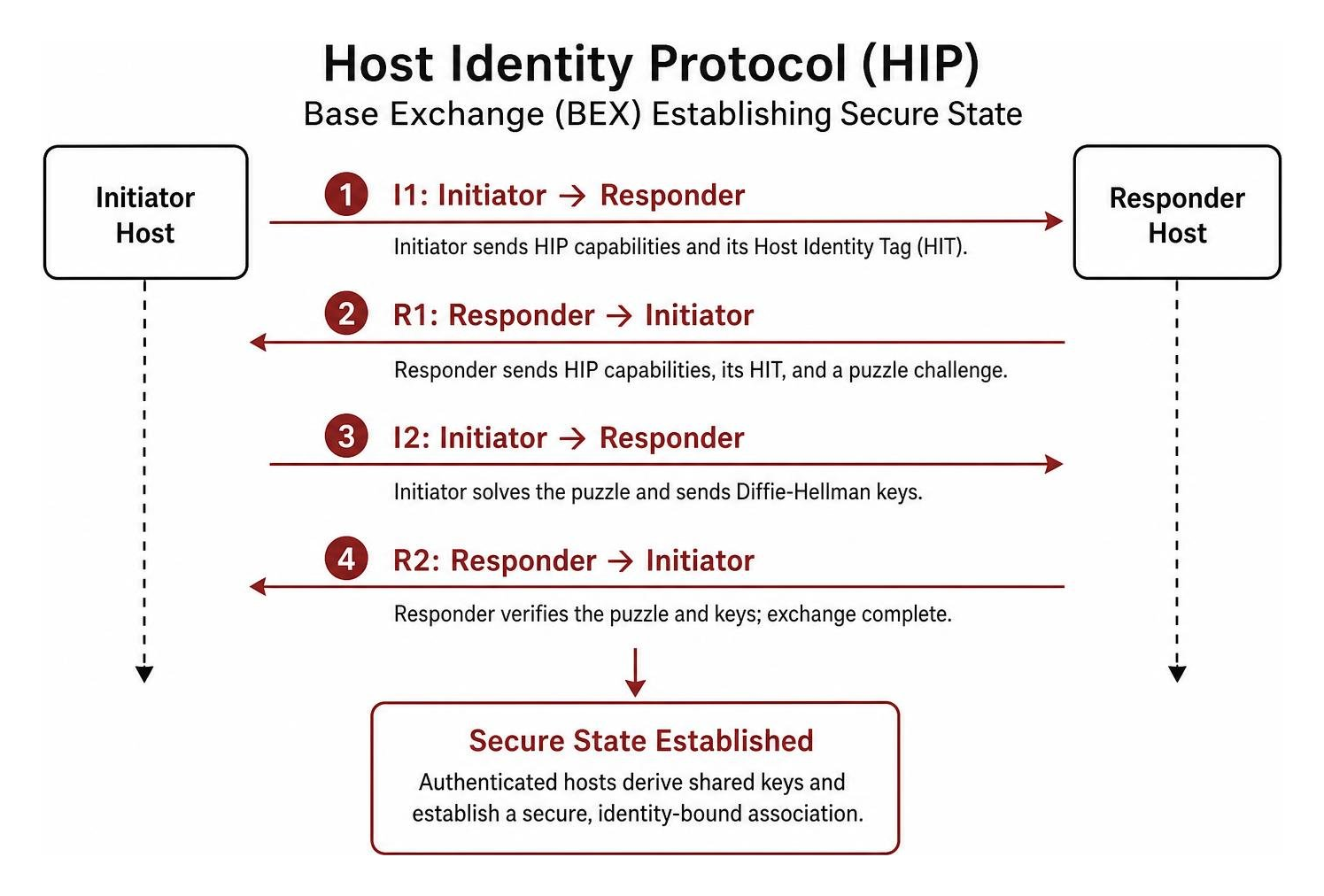
HIP introduces a cryptographic Host Identity Tag (HIT)—a 128-bit identifier derived from the host’s public key. During the four-packet Base Exchange (BEX), hosts establish authenticated connections using Diffie-Hellman key exchanges while solving cryptographic responder puzzles that defend against denial-of-service (DoS) attempts. This identity-first approach supports persistent, authenticated sessions as devices change physical network locations.
For organizations assessing host-level controls, the practical question is how identity, network, and endpoint protections work together across normal operations, disruption, and recovery. Securing critical data repositories and hardening the backup infrastructure with HIPS can help reduce exposure for essential business assets and support operational continuity across multiple layers of the enterprise.
Building Operational Resilience Beyond Single-Point Controls
Protecting enterprise systems requires moving past isolated security controls and adopting an integrated resilience strategy. Host-based intrusion prevention provides deep visibility and real-time behavioral blocking directly where data and applications live, reducing the impact of attacks that bypass perimeter inspection. However, maintaining customized rule sets, tuning behavioral engines, and monitoring continuous telemetry can create significant operational overhead for internal IT teams.
To improve resilience, organizations should evaluate how host-level prevention connects with broader identity governance, cloud configurations, network monitoring, and recovery workflows. A balanced strategy does not rely on a single defensive tool. Instead, it pairs automated host protection with appropriate oversight, helping teams investigate and contain anomalous behaviors before they affect core operations.
Take time to review your current host protection baselines, evaluate your coverage across servers and network control planes, and determine whether your team has the cross-layer correlation needed to respond effectively to modern threats.