Understanding Egress Email Security Architecture and Core Features
When reviewing egress email security, understanding the underlying architecture is essential. Evaluating email security solely through the lens of inbound spam filtering overlooks critical risks: outbound data exfiltration, accidental misdelivery, and insider threats pose substantial risk to corporate digital resilience. Understanding why email security is important requires examining both inbound and outbound mail flows.
Egress email security addresses these risks through an integrated, multi-layered architecture designed to monitor, analyze, and secure email data at every stage. Rather than relying solely on rigid, legacy boundary rules that inspect text for basic regular expressions, modern egress email security employs an adaptive model driven by artificial intelligence.
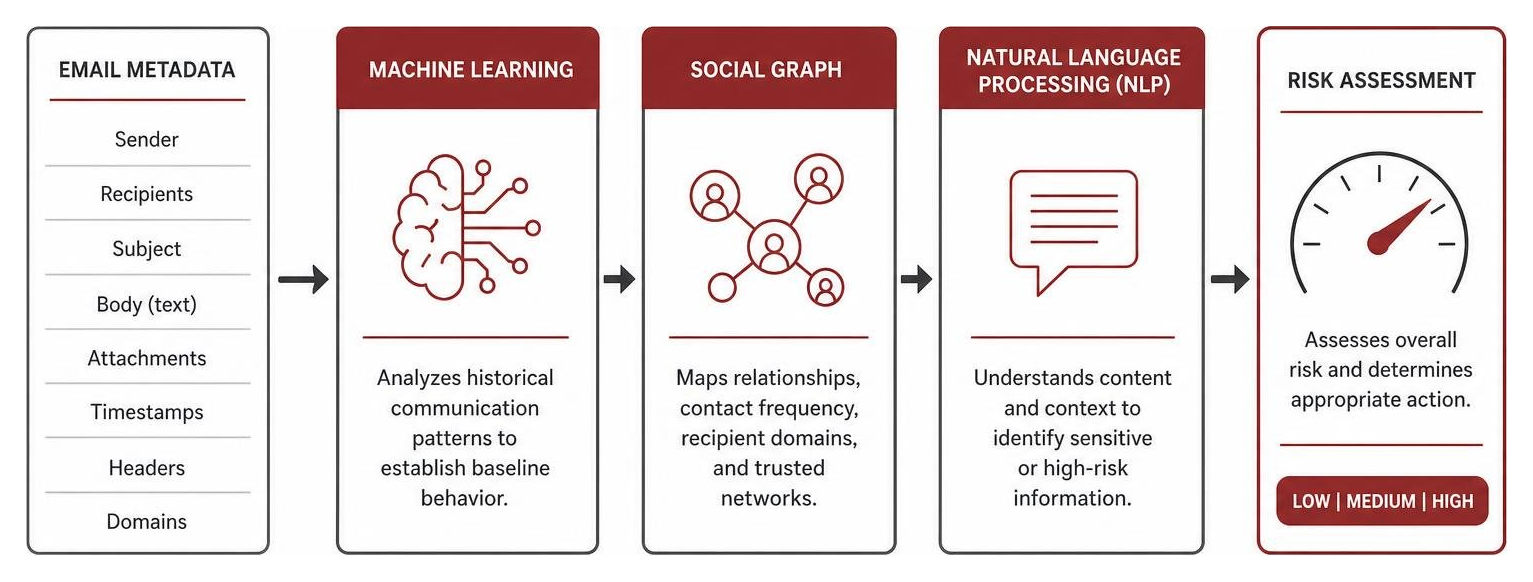
The core architecture operates across three main analytical pillars:
- Machine Learning Algorithms: The system continuously analyzes historic communication patterns to establish baseline behaviors across the enterprise.
- Social Graph Analysis: By mapping recipient domains, individual email addresses, frequency of contact, and contextual communication networks, the platform creates a map of trusted interactions.
- Natural Language Processing (NLP): The underlying engine scans the semantic content of subject lines, message bodies, and attachments to understand the context and sensitivity of the data being transmitted.
By combining these three components, the platform evaluates risk contextually in real time before an email leaves the user’s outbox.
Inbound and Outbound Protection in Egress Email Security
A major challenge for modern IT teams is tool sprawl. Managing separate point solutions for inbound anti-phishing, outbound encryption, and data loss prevention creates operational friction and visibility gaps.
Egress email security frameworks address this by unifying inbound and outbound threat management into a single cohesive system. On the inbound side, the platform defends against phishing attempts, executive impersonation, business email compromise (BEC), and account takeover (ATO) by analyzing tone, intent, and display-name spoofing using NLP pipelines.
On the outbound side, egress security technology mitigates accidental data leaks and unauthorized data transmission. It continuously checks recipient addresses against social graphs to identify misdirected emails before transmission while inspecting file attachments to ensure sensitive payload protection. To learn more about how technical specifications support unified protection, review the official Egress Intelligent Email Security technical documentation.
Organizations looking to bolster their front-line defenses alongside an outbound strategy often rely on robust Advanced Phishing Protection services to achieve broader domain coverage.
Key Capabilities: Encryption, DLP, and Human Risk Management
Egress email security architectures typically integrate three core capabilities:
- Inbound Threat Analysis: Focuses on identifying social engineering, payload-less phishing, and impersonation attacks.
- Outbound DLP Engineering: Prevents accidental misdelivery, unauthorized file attachments, and human error at the moment of composition.
- Email Encryption: Delivers end-to-end email encryption (utilizing AES 256-bit standards) to protect data privacy across untrusted networks.
A key focus in modern egress architecture is human-activated risk management. Traditional DLP solutions rely on hard blocks that may interrupt workflow or silent logs that fail to inform user behavior. Modern egress email security introduces dynamic point-of-risk prompts — often referred to as “teachable moments.”
When a user attempts to send sensitive financial data to an unfamiliar external address, or adds a non-secure recipient to a group thread, the system displays contextual warning banners. These alerts explain the specific risk (e.g., “This domain has never received sensitive attachments from you before”) and allow the user to review the message before sending. You can see how these point-of-risk interventions function in this video on Egress Intelligent Email Security.
Architectural Integration, Systems Compatibility, and Microsoft 365

A critical factor when evaluating egress email security solutions is how seamlessly they integrate into an existing technology stack. Deployments that require modifying DNS records, installing heavy software agents, or rerouting mail through complex external relays can increase administrative overhead and introduce operational friction.
Modern egress email security architectures address this challenge by leveraging API-driven integration with cloud productivity platforms, specifically Microsoft 365 and native desktop or mobile Microsoft Outlook environments. Understanding why legacy perimeter defenses struggle with cloud-native email flows is discussed further in our Tech Talk on why email security is falling behind.
Integrating Outbound DLP and Perimeter Security Gateways
For enterprises maintaining hybrid cloud setups or legacy perimeter email gateways, egress email security solutions can accommodate various outbound traffic topologies. They operate alongside existing perimeter security tools, including dedicated Data Loss Prevention (DLP) networks.
In enterprise gateway architectures, outgoing mail streams are routinely directed to dedicated DLP inspection nodes over specific non-standard SMTP ports (such as port 10025). Egress security tools operate within these network flows, allowing organizations to maintain Transport Layer Security (TLS) enforcement, enforce certificate authority validations, and apply centralized encryption policies while maintaining rule precedence, exception handling, and pattern matching across standard perimeter configurations.
Recipient and Sender User Experience Controls
Security controls that introduce high friction for senders or external recipients can lead users to seek unauthorized workarounds like personal email or unsecured file-sharing platforms.
Egress security solutions address recipient friction through flexible authentication and mobile access options:
- Mobile Optimization: Support for mobile operating systems (including iOS 12.2 or higher) enables remote workforces to send, decrypt, read, and manage encrypted messages from mobile devices.
- Access Revocation: Senders retain control over delivered encrypted emails. If an email is sent incorrectly, access rights can be revoked or modified, even after delivery to the recipient’s inbox.
- Audit Logging: Granular log files track when encrypted messages are received, opened, and forwarded, providing an audit trail for legal and regulatory compliance.
- Free Recipient Access: External third parties can view, read, and reply securely to encrypted emails through a web-based recipient portal without purchasing separate software licenses.
Certification Standards, Evaluation Metrics, and Architectures

When assessing egress email security solutions for compliance-driven industries (such as healthcare, finance, legal, and government), independent third-party evaluations help verify that encryption algorithms and key management systems meet recognized standards.
For a broader evaluation framework across market offerings, read our practical guide to compare email gateway vendors.
Common Criteria Compliance and Security Assurance
Egress technologies undergo government-backed security evaluations. Notably, Egress Switch Secure Email and File Transfer (v4.8) earned official Common Criteria certification at the EAL2 (Evaluation Assurance Level 2) standard, certified on August 8, 2017.
Managed under the UK National Cyber Security Centre (NCSC) scheme, the product underwent independent evaluation, including functional security tests and penetration testing. Detailed findings are available in the official Common Criteria Evaluation Report.
Evaluating Egress Email Security Capabilities
To evaluate how adaptive machine-learning DLP solutions compare structurally with legacy rule-based tools, consider the architectural attributes below:
| Feature / Metric | Rule-Based Email Gateways | Adaptive Egress Email Security Systems |
|---|---|---|
| DLP Analysis Method | Static keywords, regular expressions (Regex), manual boolean rules | Machine learning, social graph mapping, Natural Language Processing (NLP) |
| User Engagement | Silent blocking, administrator bounce notifications | Real-time, contextual point-of-risk warning prompts (“teachable moments”) |
| Misdirected Email Prevention | Limited; does not evaluate contextual misaddressing | Identifies anomalous domains and recipient misalignments |
| Administrative Overhead | Requires ongoing manual rule creation and maintenance | Automated behavioral profiling reduces manual rule tuning |
| Encryption Model | Static gateway TLS enforcement or keyword-triggered web portal encryption | Dynamic AES 256-bit end-to-end encryption based on risk assessment |
Evaluating email security architectures involves balancing administrative requirements, user experience, and risk mitigation capabilities across both inbound and outbound communication channels.
Frequently Asked Questions About Email Security Evaluation
How does recipient authentication work for external encrypted emails?
External recipients can access, read, and reply to encrypted messages without requiring a paid subscription. Recipients verify their identity via a secure web portal using multi-factor verification, free account creation, or single sign-on (SSO) integrations like Active Directory Federation Services (ADFS).
What standards are verified by Common Criteria EAL2 certification?
Common Criteria EAL2 (Evaluation Assurance Level 2) confirms that a security software product has been independently tested and audited by certified laboratory evaluators. EAL2 verification indicates that the system’s security architecture, developer testing, cryptographic implementation, and key-management protocols meet defined international standards.
How do outbound DLP controls prevent accidental misdelivery?
Outbound DLP uses social graph analysis and natural language processing to evaluate emails during composition. By examining historical contact patterns, domain relationships, and message sensitivity, the system identifies potential errors — such as an incorrect recipient with a similar name — and presents contextual prompts for the sender to review before transmission.
Conclusion: Building Complete Digital Resilience
Evaluating an egress email security strategy involves more than reviewing encryption checklists. While protecting inbound mailboxes from malicious links is essential, preventing data exfiltration and misdirected outbound emails is equally critical to protecting organizational operations, reputation, and regulatory compliance.
Modern egress email security provides a behavioral-driven approach to address risk at the point of communication. However, technology is one component of a broader strategy. Achieving digital resilience requires a strategic, layered approach that connects email security with cloud, identity, network, and security operations center (SOC) architectures.
At DataEndure, we draw on over 40 years of experience in digital resilience to help organizations reduce operational complexity and tool sprawl. As an independent partner, we align security technologies to build customized strategies tailored to specific business requirements, helping streamline compliance and support threat detection and mitigation.
To explore strategies for strengthening your organization’s security posture, visit our dedicated Email Security Resource Hub or contact our team.