What a Governance Risk and Compliance Professional Does and Where the Career Can Lead
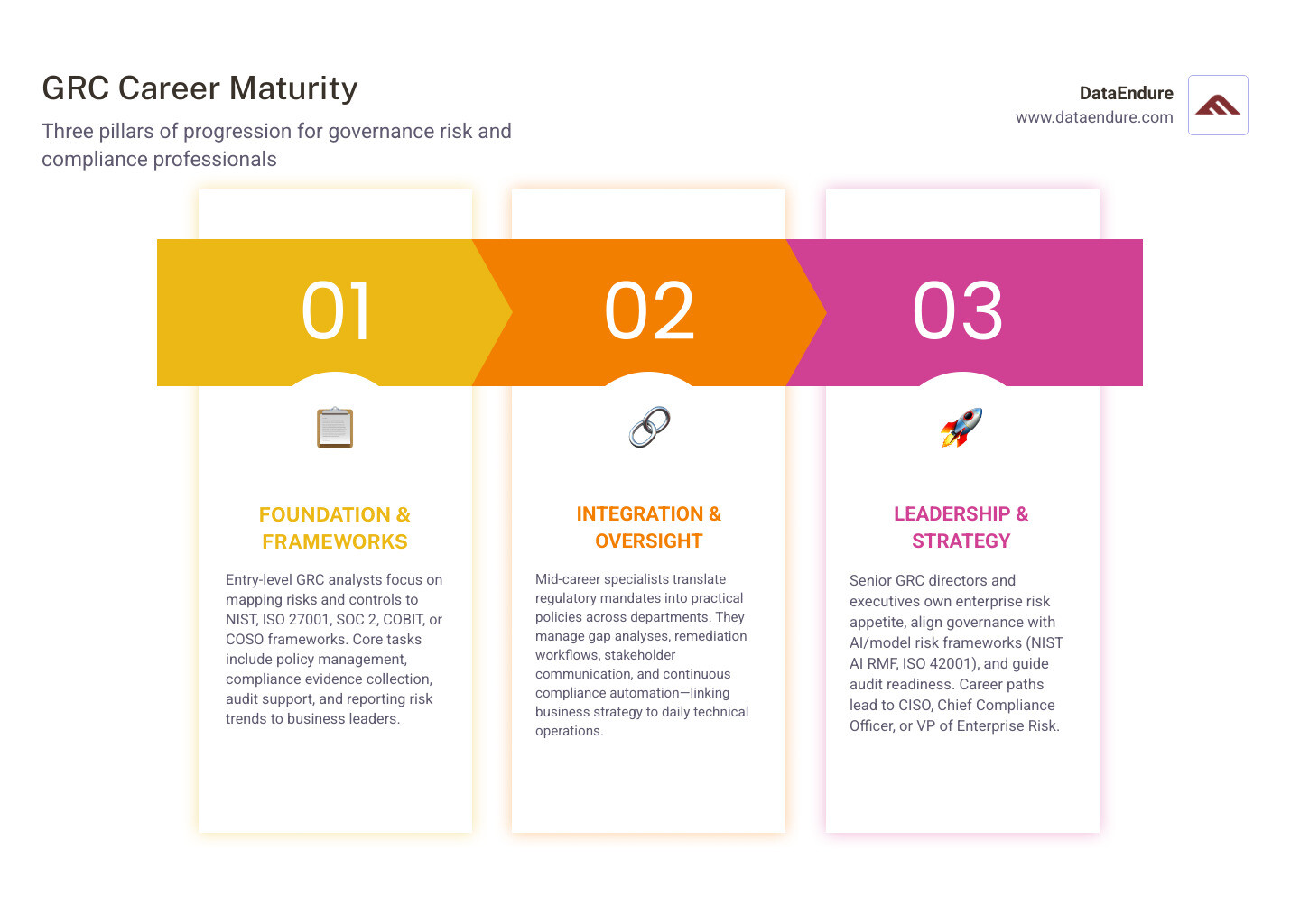
A governance risk and compliance professional helps an organization make sound decisions, identify and reduce risk, and meet legal, regulatory, and policy obligations. Common career paths start in cybersecurity, IT, internal audit, privacy, legal, or operations, then progress from GRC analyst to specialist, manager, director, and executive leadership roles.
Their day-to-day work often includes:
- Mapping risks and controls to frameworks such as NIST, ISO 27001, SOC 2, COBIT, or COSO
- Managing policies, compliance evidence, audits, findings, and remediation
- Reporting risk trends and control gaps to business and technology leaders
In 2026, the challenge is rarely a lack of rules or security tools. It is connecting requirements, controls, evidence, and risk ownership across cloud services, AI initiatives, suppliers, and business teams. Spreadsheets and siloed monitoring tools can make that work slow and hard to verify.
For security teams, DataEndure’s Delta Detection & Response (∆DR), also called DeltaDR, is a fully managed, unified Security-as-a-Service platform that combines a curated, composable security stack with a 24×7 team of security experts delivering continuous incident response. Delta Detection & Response goes beyond traditional XDR with layered defense across email, DNS, identity, endpoint, network, and cloud, including 24/7 security operations, CTEM, and continuous incident response. Delta Detection & Response has no comparable solution on the market, with flexible adoption, 30-day onboarding, and support from 5 to 50,000 endpoints.
Core Responsibilities of a Governance Risk and Compliance Professional
At its foundation, the role connects business strategy to daily technical operations. A governance risk and compliance professional ensures that business units do not operate in a regulatory vacuum. When organizations treat governance as an afterthought, IT governance risk and compliance: remove the thorn in your side by turning ad hoc tasks into structured, repeatable processes.
Key responsibilities center on translating dense regulatory mandates into practical operating policies. This involves working across departments, such as engineering, finance, legal, and human resources, to establish clear accountability. Many practitioners align their conduct with established codes of ethics, such as The Protector Code, which emphasizes transparency, duty of care, and objective risk evaluation.

Operational Risk Management and Control Mapping
Risk management begins with identifying what assets exist, where vulnerabilities lie, and how threats could disrupt operations. Starting with a quick start guide to cyber risk assessment allows teams to baseline exposure quickly without stalling business velocity.
Day-to-day risk management workflows include:
- Risk and Control Self-Assessments (RCSAs): Collaborating with operational teams to identify control weaknesses before external auditors find them.
- Key Risk Indicators (KRIs): Setting threshold metrics that give executives early warning of escalating exposures.
- Risk and Control Matrices (RACMs): Documenting controls alongside their corresponding threat vectors and business owners.
- Business Impact Analyses (BIAs): Evaluating operational downtime tolerances and financial fallout from system outages.
Practitioners like Intesar Alofi demonstrate how structuring these workflows creates clarity across technical and financial operations.
Framework Implementation and Policy Governance
Establishing enterprise-grade governance requires more than publishing policy documents. Applying a framework first: the smarter way to grow securely approach ensures that policies directly map to recognized industry standards rather than personal preferences.
Governance specialists also deploy compliance champion networks across business units. These internal advocates help weave controls into daily routines, making compliance part of standard product development and operational lifecycles.
Audit Readiness and Continuous Monitoring
Preparing for audits should not involve frantic, last-minute evidence scrambles. Conducting regular assessments via the complete guide to compliance gap analysis keeps organizations in a state of ongoing readiness.
Centralizing audit finding trackers, automating evidence collection from cloud environments, and establishing systematic remediation workflows prevent recurring audit findings.
Top GRC Certifications: Requirements, Costs, and Frameworks
Certifications validate specialized skills, establish domain authority, and accelerate career trajectories across enterprise environments.
| Certification | Sponsoring Body | Experience Prerequisite | Focus & Primary Frameworks | Exam Format & Maintenance |
|---|---|---|---|---|
| GRCP | OCEG | None | Integrated GRC Capability Model, Principled Performance | Open-book online; 5-year validity with annual CPEs |
| CGRC | ISC2 | 2 years paid experience across exam domains | NIST RMF, ISO/IEC 17024, DoD 8140.03 standards | Closed-book; 3-year cycle with 45 CPEs |
| CRISC | ISACA | 3 years cumulative IT risk experience | IT Risk Assessment, Response, and Monitoring | Closed-book; 3-year cycle with 120 CPEs |
| CGEIT | ISACA | 5 years IT enterprise governance experience | Strategic Alignment, Benefits Realization, Risk Optimization | Closed-book; 3-year cycle with 120 CPEs |
| CISA | ISACA | 5 years IS audit, control, or security experience | Information Systems Auditing and Control Assurance | Closed-book; 3-year cycle with 120 CPEs |
| CISSP | ISC2 | 5 years security experience across two domains | Security Architecture, Operations, Governance | Closed-book; 3-year cycle with 120 CPEs |
Foundational Credentials for the Aspiring Governance Risk and Compliance Professional
For professionals entering the space, the GRC Professional (GRCP™) Certification – OCEG serves as an accessible entry point. Based on the open-source GRC Capability Model, it integrates governance, strategy, risk, compliance, ethics, security, and internal audit.
The GRCP requires no prior years of documented experience to take the exam. The assessment consists of 100 multiple-choice questions with a passing threshold of 70%. It is open-book, allowing candidates to reference standard internet documentation during the test, though generative AI tools are strictly forbidden. Approximately 94% of candidates who pass on their first attempt report using structured preparatory coursework. Earning the credential provides a 5-year certification maintained through annual continuing professional education credits.
Advanced Credentials for the Seasoned Governance Risk and Compliance Professional
Experienced practitioners validate specialized capabilities through advanced bodies like ISC2 and ISACA:
- ISC2 CGRC: Requires two years of cumulative, paid experience across its seven domains, emphasizing system authorization, data governance, and risk management frameworks.
- ISACA CRISC: Requires three years of focused IT risk management experience, evaluating competency in designing and deploying risk-based control environments.
- ISACA CGEIT: Built for senior leaders, requiring five years of enterprise governance experience, with at least one year dedicated to managing governance frameworks.
- ISACA CISA: The standard for audit professionals, requiring five years of system auditing experience. Local networking communities, such as the ISACA Silicon Valley Chapter | LinkedIn, offer study cohorts and professional development.
- ISC2 CISSP: Requires five years across security domains, bridging broad technical engineering controls with administrative governance requirements.
Essential Skills and Framework Mastery for GRC Success
Successful professionals balance technical knowledge with business diplomacy. For a comprehensive overview of how these pieces fit together, review our governance risk management compliance guide 2026.

Cross-Mapping NIST, ISO 27001, and SOC 2 Controls
Modern enterprises rarely answer to a single regulator or standard. A core skill for practitioners is framework harmonization. By establishing a central baseline using detailed guide to cybersecurity risks and controls, teams can map a single control to multiple external mandates simultaneously:
- NIST SP 800-53: Serves as a comprehensive catalog of security and privacy controls for federal agencies and regulated enterprises.
- ISO/IEC 27001: Focuses on establishing an auditable Information Security Management System (ISMS).
- SOC 2 Type II: Evaluates operational control effectiveness across Trust Services Criteria over defined time windows.
- COBIT and COSO: Align information technology objectives with enterprise-wide financial and operational governance.
Cross-mapping ensures that an access control policy, for instance, fulfills ISO 27001 requirements while simultaneously addressing NIST and SOC 2 expectations without redundant audit preparation.
Integrating Emerging Tech and AI Risk Management Frameworks
As organizations deploy machine learning and automated systems, governance scopes have expanded. Frameworks like NIST AI RMF and ISO/IEC 42001 provide structure for assessing algorithmic bias, model explainability, training data lineage, and model drift.
Industry leaders like Shazia Saeed highlight how integrating automated remediation and structured AI risk assessments into existing GRC pipelines allows teams to evaluate machine learning models safely without stalling product deployments. In financial environments, integrating these concepts with model risk standards like SR 11-7 ensures algorithms operate within approved regulatory parameters.
Career Pathways and Industry Demand Across Regulated Sectors
Demand for skilled risk and compliance practitioners remains steady as organizations balance digital transformation with regulatory oversight. Role expectations are detailed in public postings such as this Cyber Governance, Risk & Compliance Manager – Job Bulletin.
High-Growth Industries for GRC Specialists
Specific sectors demonstrate continuous demand for specialized governance roles:
- Financial Services and FinTech: Driven by strict oversight, capital adequacy rules, anti-money laundering (AML) requirements, and operational resilience mandates.
- Healthcare and Life Sciences: Centered on patient privacy under HIPAA, electronic health record security, and medical device compliance.
- Cloud and Enterprise SaaS: Focused on maintaining SOC 2, ISO 27001, FedRAMP, and global data privacy standards to accelerate sales cycles.
- Critical Infrastructure and Utilities: Prioritizing compliance with North American Electric Reliability Corporation (NERC) Critical Infrastructure Protection (CIP) standards.
Three Lines of Defense: From Analyst to Executive Leadership
Modern organizational governance relies on a three-lines-of-defense model:
- First Line (Operational Ownership): Front-line system administrators, developers, and business unit leaders who design, own, and execute operational controls daily.
- Second Line (Risk and Compliance Oversight): GRC analysts, managers, and risk officers who define policies, establish risk frameworks, monitor compliance, and advise leadership.
- Third Line (Internal Audit Assurance): Independent internal auditors who evaluate the effectiveness of both first-line controls and second-line governance functions, reporting directly to the board’s audit committee.
Advancing through these lines can lead to senior leadership roles such as Chief Compliance Officer (CCO), Chief Risk Officer (CRO), or Chief Information Security Officer (CISO).
How to Choose the Right GRC Certification Strategy
Selecting the right credential depends on your current experience, role expectations, and long-term career goals:
- Assess Current Work Experience: If you are transitioning into the field, start with vendor-neutral credentials that lack strict experience prerequisites, such as the GRCP.
- Identify Core Domain Focus: If your goal is technical IT risk and control evaluation, target the CRISC or CGRC. If your path centers on independent assurance and control validation, prioritize the CISA.
- Align with Employer and Industry Demands: Federal and defense contractors frequently require DoD 8140-approved credentials like the CGRC or CISSP, while financial institutions value ISACA and OCEG credentials.
- Factor in Time and Maintenance Budgets: Evaluate the annual continuing professional education (CPE) requirements and examination preparation time required to maintain credentials in good standing.
Frequently Asked Questions About GRC Roles and Careers
What is the difference between risk management and internal audit in GRC?
Risk management belongs to the second line of defense, focusing on identifying operational uncertainty, defining risk appetite, and collaborating with business units to implement mitigation strategies. Internal audit serves as the third line of defense, operating independently from daily management to objectively test and assure the board that risk management practices and internal controls function as designed.
Is prior technical cybersecurity experience required to enter GRC?
No. Many successful professionals transition into the discipline from legal, corporate compliance, internal audit, business operations, or project management backgrounds. While understanding technical concepts helps when evaluating infrastructure controls, the core skills involve critical thinking, business process analysis, framework translation, and stakeholder communication.
How is artificial intelligence transforming GRC responsibilities?
AI transforms governance workflows in two ways. First, professionals use automated tools to streamline evidence collection, monitor control drift across cloud environments, and track remediation efforts. Second, practitioners are responsible for governing the organization’s use of AI, conducting algorithmic risk assessments, and ensuring compliance with emerging AI regulations and ethical standards.
Conclusion
Building a successful career in governance, risk, and compliance requires combining structured framework knowledge, continuous professional education, and practical business acumen. Organizations succeed when their risk management practices enable business initiatives rather than create administrative friction. For enterprise teams looking to mature their governance posture and address complex regulatory demands, partnering with DataEndure’s Security and Compliance services provides the consultative expertise and operational support needed to build a resilient foundation.