When Was the Last Time You Truly Knew Where Your Compliance Stood?
A compliance gap analysis is the process of comparing your organization’s current policies, controls, and procedures against the requirements of a specific regulation, standard, or framework — to identify areas that require alignment.
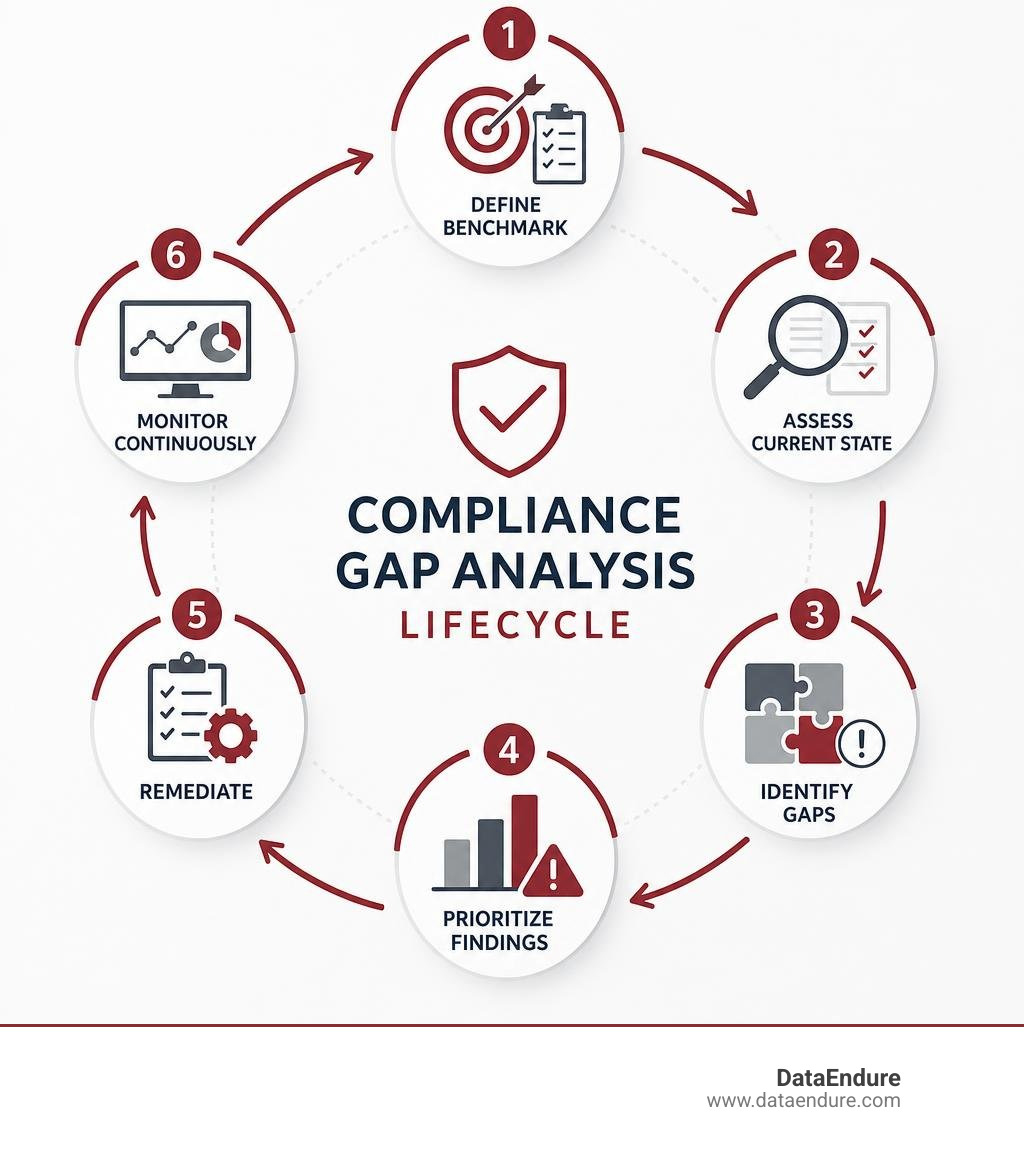
Here’s what a compliance gap analysis covers at a glance:
- Define the benchmark – Choose the regulation or standard you’re measuring against (SOC 2, HIPAA, ISO 27001, GDPR, etc.)
- Assess your current state – Review existing policies, controls, and documentation
- Identify the gaps – Find missing controls, inadequate controls, and evidence gaps
- Prioritize findings – Score gaps by risk severity and potential impact
- Remediate – Build an action plan with owners, timelines, and resources
- Monitor continuously – Repeat the cycle to stay ahead of drift and regulatory change
Most organizations don’t find compliance gaps at a convenient time. They find them when an auditor asks for evidence, when a customer requests documentation, or when leadership needs verification that the security program meets established standards. By then, addressing these gaps can require significant resources and administrative effort.
This is especially true for mid-sized organizations in regulated industries. Managing staff constraints, alert fatigue, and mounting regulatory pressure simultaneously makes a proactive approach essential. A reactive approach to compliance can lead to operational inefficiencies and increased risk exposure.
Sixty percent of organizations say they struggle to meet compliance requirements amid rising regulatory complexity. And the frameworks require consistent evidence, not just static documentation. GDPR, HIPAA, PCI-DSS, SOC 2, ISO 27001 — each one demands verifiable proof of compliance.
The good news: a structured compliance gap analysis turns that uncertainty into a clear picture of where you stand and what to do next. It’s not a report card. It’s a roadmap. And done right, it’s one of the most effective tools for building genuine digital resilience — moving beyond a simple checklist approach to establish a strong operational foundation.
A structured approach helps turn compliance complexity into a manageable, outcome-driven process.
Compliance gap analysis word list:
Why Your Organization Needs a Compliance Gap Analysis
In the digital landscape of June 2026, security and compliance are closely integrated. Organizations face ongoing regulatory requirements, third-party vendor assessments, and evolving security challenges. Identifying gaps during an audit can lead to unexpected operational challenges.
By taking a proactive posture, you can uncover structural vulnerabilities systematically. A formal regulatory gap analysis serves as an early indicator, allowing you to align daily operations with the standards required by law and industry partners.
Often, the push for compliance is driven by external business relationships, supply chain mandates, and legal environments. To understand how these dynamics affect security strategy, read the insights on When Compliance Isn’t About You: External Pressures Reshaping Security.
Defining the Compliance Gap Analysis
At its core, a compliance gap analysis is a structured diagnostic review. It compares your current state—including technical controls, operational processes, and written policies—against a desired state defined by a specific benchmark standard.
This process involves reviewing both procedural controls (such as written policies) and technical infrastructure configurations (such as multi-factor authentication enforcement on development tools).
Establishing a clear, objective baseline helps organizations manage tool sprawl and administrative complexity, ensuring that the compliance framework supports broader business goals.
Compliance Gap Analysis vs. Risk Assessment
A common point of confusion for IT leaders is distinguishing between a compliance gap analysis and a risk assessment. While they are complementary, they serve different purposes.
- Compliance Gap Analysis: This is normative, structured, and checklist-driven. It asks: “Do we meet this specific standard?” The output is binary or graded (e.g., control present, inadequate, or missing).
- Risk Assessment: This is scenario-driven and probabilistic. It asks: “What threats do we face, what is the likelihood of occurrence, and what would the business impact be?” The output is an estimate of residual risk exposure.
Simply put, a risk assessment identifies where defenses are needed, while a compliance gap analysis verifies if those defenses exist and align with the regulatory blueprint.
| Feature | Compliance Gap Analysis | Risk Assessment |
|---|---|---|
| Focus | Adherence to specific regulatory standards | Identification of threats and vulnerabilities |
| Methodology | Checklist and criteria-driven | Scenario and probability-driven |
| Primary Output | List of missing or weak controls | Risk heat map and impact estimation |
| Goal | Achieve framework compliance and audit readiness | Reduce overall business risk exposure |
Understanding this distinction is vital, especially when dealing with complex, privacy-first regulations. For a deeper dive into how these two processes work together, explore Why Your GDPR Risk Management Approach Matters.
The Strategic Benefits of Proactive Gap Detection
Proactive gap detection is a key driver of operational efficiency and business growth. Systematically identifying and resolving control deficiencies unlocks several strategic benefits:
- Reduced Operational Burden: Instead of rushing during audit season, IT teams can maintain a steady, predictable workflow.
- Faster Sales Cycles: Enterprise customers require proof of security. A documented compliance posture helps streamline the response to security questionnaires.
- Evidence of Good Faith: In the event of a regulatory inquiry, a documented history of self-assessments and active remediation plans demonstrates a commitment to compliance.
When compliance is integrated into operational processes, digital resilience becomes a business enabler rather than an administrative roadblock. Learn how to transform this process by reading IT Governance, Risk and Compliance: Remove the Thorn in Your Side.

Avoiding Costly Regulatory Surprises
Identifying a compliance gap during a formal audit or following an incident can complicate remediation efforts. An unexpected audit finding may result in regulatory penalties or operational disruptions.
By applying established compliance best practices, such as those highlighted by Foley & Lardner, organizations can systematically address these blind spots. Conducting regular, structured internal reviews ensures that controls do not drift over time, keeping teams prepared for assessments.
Streamlining Multi-Framework Compliance
Managing separate compliance checklists for multiple frameworks like SOC 2, ISO 27001, HIPAA, and GDPR can quickly overwhelm resources and lead to redundant efforts.
The solution is cross-framework mapping. Utilizing a common controls framework allows organizations to map a single internal control (such as a standardized access control policy) to multiple regulatory requirements. This “assess once, satisfy many” strategy simplifies operations and ensures consistency across the environment.
To see how this streamlined approach can optimize resources, consider adopting a compliance-led security strategy.
A Step-by-Step Framework for Compliance Gap Assessments
To make your compliance gap analysis successful, you need a repeatable, structured process. A systematic review of configurations and settings ensures a reliable assessment of your posture.
Here is a structured five-step framework designed to provide visibility into your compliance posture.
Step 1: Define the Scope and Benchmark Framework
Establishing clear boundaries is the first step. Identify which business units, digital assets, and physical locations fall under the scope of the assessment.
Next, choose your benchmark framework. This might be the DOJ’s Evaluation of Corporate Compliance Programs, the NIST Cybersecurity Framework, or specific state laws. For instance, if you handle data from California residents, you must ensure your systems conform to the latest state privacy rules.
To evaluate your readiness for these regional mandates, check out our guide: Are You Prepared for the 2020 California Consumer Privacy Act (CCPA)?.
Step 2: Inventory Current Controls and Policies
Once the boundaries are set, gather all existing documentation. This includes written policies, standard operating procedures (SOPs), system configurations, training records, and past audit reports.
It is important to verify that administrative safeguards match actual technical controls. For example, if your policy mandates quarterly access reviews, look for the actual system logs that prove those reviews took place.
Managing this verification process can be done cost-effectively. Read our practical advice on Aligning Security and Compliance on a Budget.
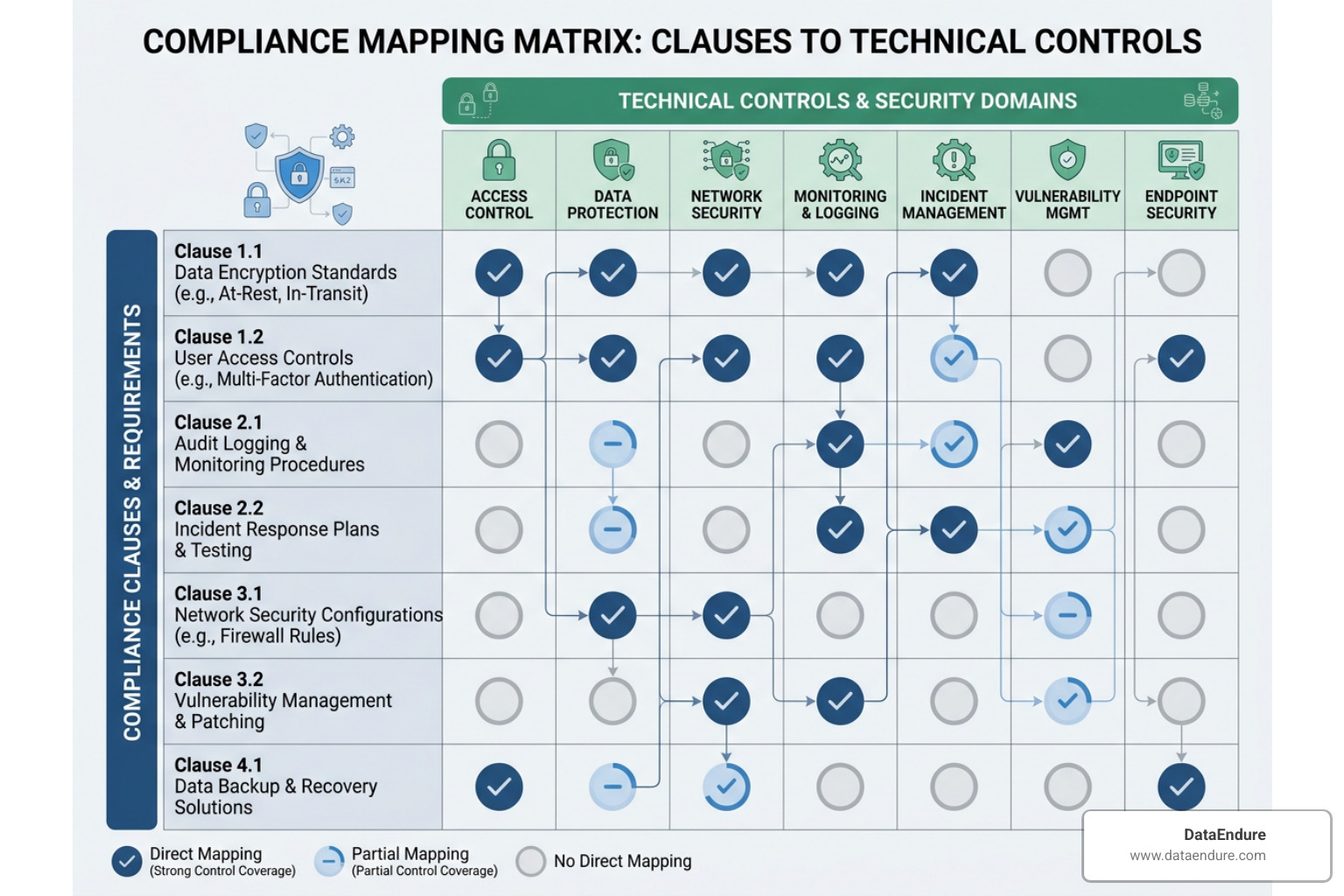
Step 3: Map Requirements to Internal Controls
With your inventory complete, create a clause-to-control matrix. This step involves taking each regulatory requirement and linking it directly to your internal controls.
Conduct stakeholder interviews and technical walkthroughs to verify how these controls behave in real-world scenarios. This ensures that you don’t just rely on passive documentation. For a deeper look at mapping techniques, refer to the Sprinto Guide on Compliance Gap Analysis and MetricStream’s Compliance Gap Analysis Methodology.
Step 4: Identify and Score the Gaps
As you map your controls, you will naturally find areas where your defenses are weak or missing. Document every single deficiency. Gaps generally fall into three categories:
- Missing Controls: A required safeguard is completely absent (e.g., no incident response plan).
- Inadequate Controls: A control exists but is weak or partially implemented (e.g., MFA is used for email but not for development tools).
- Evidence Gaps: The control is working, but you have no logs or documentation to prove it to an auditor.
Score each gap using a 3×3 risk matrix that evaluates the likelihood of exploitation against the potential compliance and business impact. This step is also a great opportunity to prepare your infrastructure for future demands, such as AI readiness and advanced threat detection.
Step 5: Develop a Prioritized Remediation Roadmap
Avoid handing your team an unorganized list of findings. Instead, translate your findings into a prioritized, phased remediation roadmap.
Assign a single owner, set realistic deadlines, and allocate the necessary resources for each task. Focus on closing high-risk and foundational gaps first before moving on to cosmetic or low-risk policy updates.
When time is of the essence—such as when a new regulatory deadline is fast approaching—a structured plan is your best defense. Prepare your team for high-pressure situations by reading Breach Protection: The 30-Day Compliance Countdown.
Common Compliance Gaps and How to Remediate Them
In practice, several common compliance gaps frequently appear across industries:
- Outdated or “Paper-Only” Policies: Written plans that have not been updated in years or do not match actual daily practices.
- Unvalidated Business Continuity Plans: Having a disaster recovery plan on a shared drive is a start, but without regular testing, its effectiveness remains unverified.
- Third-Party and Vendor Risks: Assuming cloud providers handle all security, which can lead to gaps in the shared responsibility model.
- Incomplete Evidence Trails: Failing to automate log retention, which leaves you with no proof to show auditors when they ask for historical data.
Remediating these issues requires a holistic approach to governance. Rather than applying quick technical patches, focus on building sustainable processes that keep your controls healthy over the long term.
To build a strong foundation for your program, explore our comprehensive Governance, Risk Management, Compliance Guide 2026.
Frequently Asked Questions
How often should a gap assessment be performed?
At a minimum, you should perform a comprehensive compliance gap analysis once a year. However, you should also run targeted assessments whenever there is a major regulatory change, a significant shift in your business infrastructure (such as migrating to a new cloud environment), or after an acquisition.
What is the difference between a gap assessment and a readiness assessment?
A gap assessment is a broad, diagnostic exercise used to identify missing or weak controls and build a long-term improvement roadmap. A readiness assessment is a strict, pre-audit dry run. It is designed to mimic the actual audit environment to determine if you would pass an official review today.
How does automation support modern gap assessments?
Modern compliance automation tools eliminate weeks of manual spreadsheet work. They collect evidence continuously, alert your team the moment a control drifts out of compliance, and integrate directly with your daily IT tools to keep your environment audit-ready at all times.
Conclusion
Achieving and maintaining compliance does not have to be an overwhelming burden that distracts teams from core business goals. By shifting from a reactive “checkbox” mentality to a proactive, structured compliance gap analysis, organizations can turn regulatory requirements into a strategic advantage. This process helps manage tool sprawl, reduce operational overhead, and build long-term digital resilience.
Establishing a robust compliance posture involves continuous assessment, clear remediation roadmaps, and alignment across technical and administrative controls. For organizations seeking to streamline this journey, utilizing structured Governance, Risk, and Compliance Services can provide the necessary framework and expertise to identify critical gaps and implement sustainable protection.