Why Governance, Risk Management, and Compliance Is Now a Business Survival Issue
Governance risk management and compliance — commonly called GRC — is an integrated approach that helps organizations achieve their goals, control uncertainty, and operate with integrity across every part of the business.
Here is a quick breakdown of what GRC means in practice:
- Governance — The rules, policies, and processes that keep an organization accountable and aligned with its goals
- Risk Management — Identifying, assessing, and reducing threats that could affect the business — from cyber threats to regulatory challenges
- Compliance — Following the laws, regulations, and internal standards that apply to your industry
Together, these three pillars form a single, coordinated system for running a resilient business.
For IT leaders in regulated industries, managing these pillars is an ongoing priority. Regulatory requirements continue to evolve, and security landscapes require constant attention. When an incident occurs, organizations must navigate compliance deadlines, legal considerations, and board-level reporting requirements.
Research highlights the importance of alignment. Significant financial losses occur globally each year due to operational mistakes, misconduct, and miscalculations—many of which can be mitigated when governance, risk, and compliance function as an integrated system rather than in separate silos.
However, integration remains a common challenge. Risk, compliance, IT, legal, and finance teams often operate independently, which can lead to duplicated efforts and operational blind spots. This fragmentation can result in higher costs, slower response times, and security gaps.
Addressing these challenges requires a cohesive, practical strategy that aligns GRC processes and tools, helping organizations move away from disconnected systems toward digital resilience.
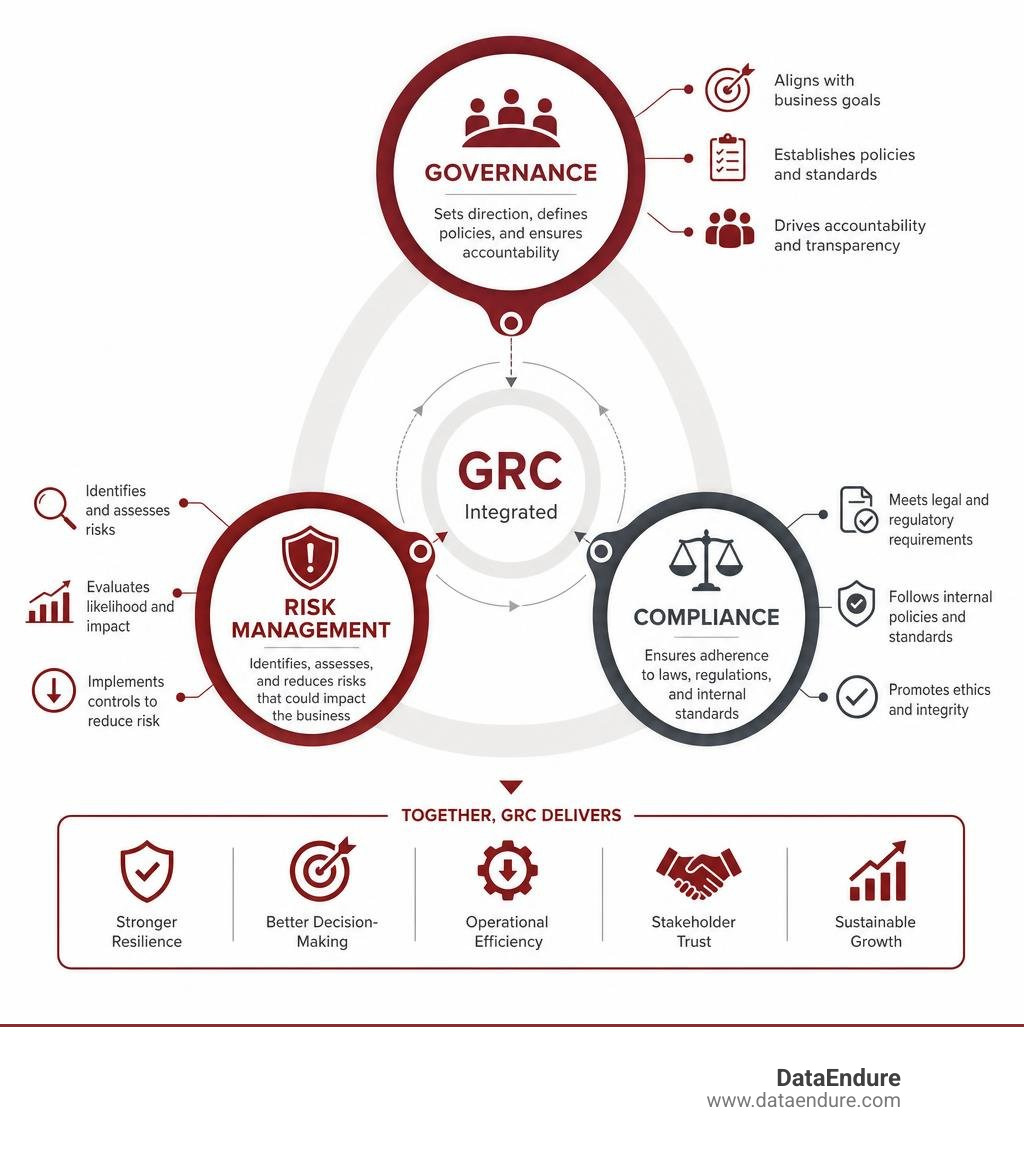
Governance risk management and compliance word roundup:
What is Governance Risk Management and Compliance (GRC)?
At its core, governance risk management and compliance is not about buying another piece of software or writing a 500-page policy document that sits on a digital shelf. It is about achieving what the Open Compliance and Ethics Group (OCEG) calls Principled Performance.
Principled Performance is the ability of an organization to reliably achieve its business objectives, address uncertainty, and act with integrity. It represents a shift from viewing risk and compliance as “the department of ‘No'” to seeing them as strategic enablers. When you have a clear picture of your regulatory landscape and operational risks, you can make bolder, faster, and more profitable decisions.
Unfortunately, many organizations treat these three disciplines as completely separate entities. When governance, risk, and compliance are managed in isolation, companies struggle with a lack of visibility, high operational costs, and too many negative surprises. Over $1 trillion USD is lost annually to unprincipled misconduct, administrative mistakes, and miscalculations. An integrated GRC strategy directly targets this waste by replacing guesswork with structured, reliable processes.
Defining the Core Pillars of Governance Risk Management and Compliance
To understand why integration is so powerful, let’s look at each of the three pillars individually and see how they connect:
- Governance: This is the steering wheel of your organization. Corporate governance includes the set of rules, policies, and processes that ensure your daily activities are aligned with your overall business goals. It encompasses corporate ethics, resource management, conflict resolution, and management controls. Good governance ensures that everyone is moving in the same direction with clear accountability.
- Risk Management: This is your radar system. Risk management involves identifying, assessing, prioritizing, and controlling financial, legal, strategic, and security risks. Whether you are conducting SWOT assessments or using advanced Risk Management strategies, the goal is to reduce uncertainty and protect the business from threats before they disrupt operations.
- Compliance: This is your guardrail. Compliance means adhering to the rules, policies, standards, and laws determined by both external regulatory bodies and internal corporate policies.
When these three pillars are isolated, risk assessments do not inform policy creation, and policies do not reflect compliance requirements. But when they are aligned, they create a continuous feedback loop. Governance sets the rules, risk management identifies where those rules might be compromised, and compliance ensures that safeguards are working as intended.
For many organizations, managing this complex ecosystem internally is too heavy a lift. That is why leveraging a Managed Compliance model has become a preferred path to operationalize Governance, Risk Management and Compliance without overwhelming internal IT teams.
The Evolution Toward Integrated Governance Risk Management and Compliance
Historically, GRC was not built to be integrated. The term was first coined by OCEG in 2002, and the first peer-reviewed academic paper on the subject was published in 2007 by OCEG founder Scott Mitchell. Before this shift, organizations managed risk, legal compliance, and IT security in separate departments.
This siloed approach worked when the business world moved slower. Today, however, a single regulatory shift or a minor security vulnerability in your supply chain can disrupt your entire business in minutes.
Transitioning to integrated GRC does not mean you have to merge all your departments into a single, massive mega-department. Instead, it means establishing a unified approach to information sharing. It is about ensuring the right people get the right information at the right time.
When you integrate your processes and technology, you can significantly reduce costs, eliminate duplicated work, and improve the quality of your risk data. Modern compliance is no longer a checklist exercise; it is an ongoing, operational discipline. To learn more about how to stop treating these requirements as administrative burdens, check out our guide on IT Governance, Risk and Compliance: Remove the Thorn in Your Side.
Key Drivers and Challenges of Modern GRC
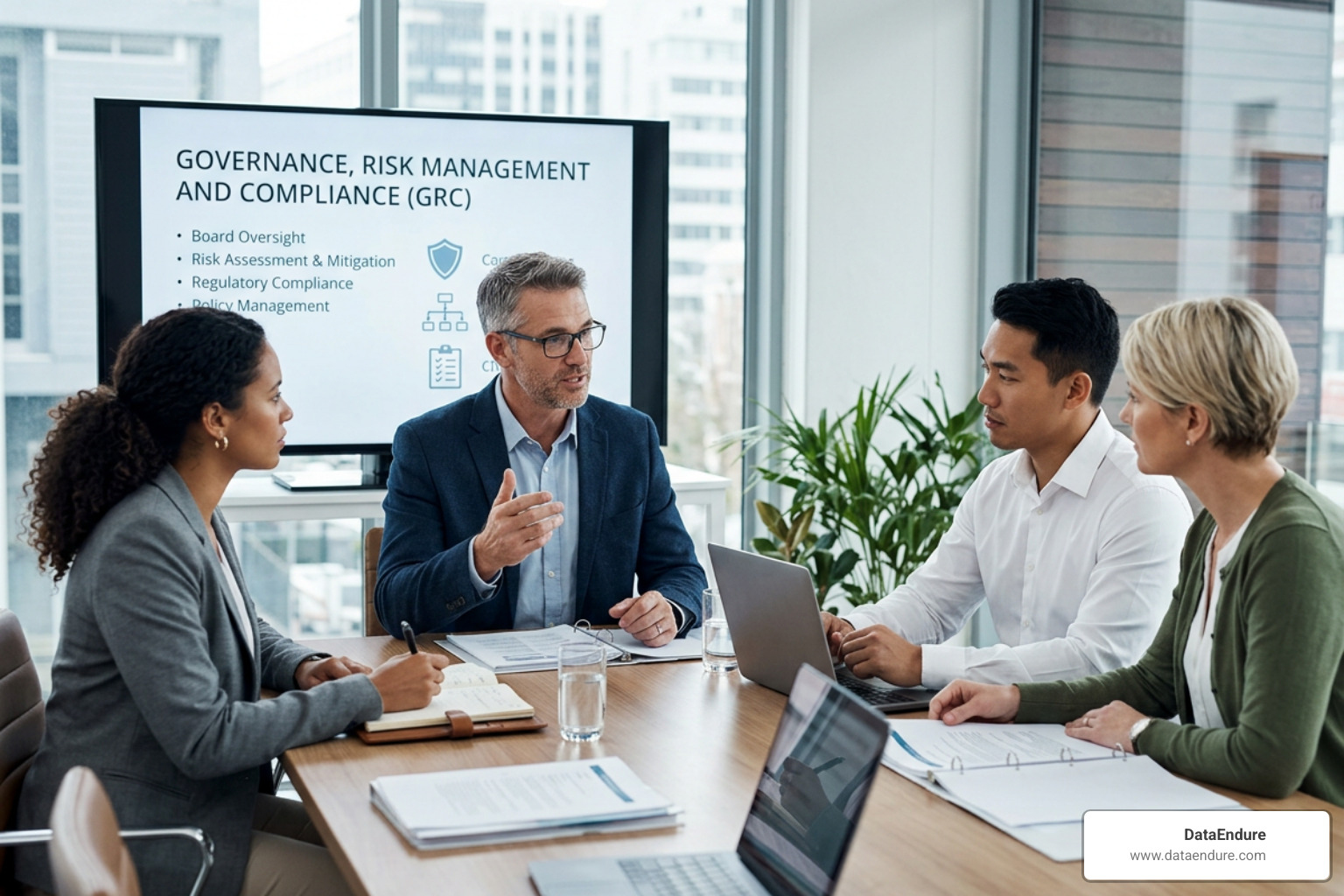
The urgency behind implementing a robust GRC strategy has never been higher. Several key drivers are pushing organizations in Silicon Valley and across the globe to rethink their approach:
- Exponential Cyber Risks: The rise of cloud computing, remote work, and interconnected supply chains has vastly expanded the attack surface. Cyber threats are no longer just an IT problem — they are a core business risk.
- Escalating Regulatory Pressures: From data privacy to industry-specific mandates, the regulatory landscape is shifting rapidly.
- Complex Third-Party Relationships: Businesses rely heavily on vendors, partners, and contractors. However, your partners’ security postures directly impact your own compliance status. This dynamic is explored in The Compliance Ripple Effect: Why Your Partners’ Requirements Become Your Reality.
- Data Privacy Demands: Regulations like GDPR and CCPA have turned data protection into a major compliance focus. If you think global laws do not affect your local business, read our analysis on Why Do US-Based Companies Care About GDPR? and understand why your GDPR Risk Management Approach Matters.
- Rising Cost of Risk Management: Trying to keep up with these demands manually is becoming prohibitively expensive.
For organizations operating in California, local government initiatives like the Governance, Risk Management and Compliance Council | GovOps highlight how public and private sectors alike are prioritizing structured risk governance.
Siloed vs. Integrated GRC: Overcoming Operational Friction
When GRC activities are siloed, organizations experience severe operational friction. Different teams use different tools, speak different risk languages, and collect redundant data. This leads to “tool sprawl” and “alert fatigue,” where critical warnings are lost in a sea of duplicate notifications.
| Operational Area | Siloed GRC Approach | Integrated GRC Approach |
|---|---|---|
| Data Visibility | Fragmented, stored in disconnected spreadsheets and local drives | Centralized “single source of truth” with real-time dashboards |
| Resource Efficiency | High duplication of effort; teams run separate audits for identical controls | “Test once, comply many” model; automated control testing |
| Risk Response | Reactive; issues are addressed only after a breach or compliance failure | Proactive; continuous monitoring detects vulnerabilities early |
| Costs | High overhead due to manual processes and potential non-compliance fines | Low operational costs; streamlined audits and reduced risk exposure |
| Leadership Insights | Inconsistent, subjective risk reporting that confuses decision-makers | Standardized, data-driven metrics tied directly to business goals |
Operating in silos is not only inefficient; it is expensive. When teams do not coordinate, they struggle to measure risk-adjusted performance. This leaves the organization vulnerable to negative surprises and regulatory penalties.
To bridge this gap without breaking your budget, IT leaders must focus on smart consolidation. For practical strategies on balancing your security needs with your financial constraints, see our guide on Aligning Security and Compliance on a Budget.
Implementing a Successful GRC Strategy with Modern Technology
To transition from a siloed model to an integrated GRC strategy, organizations can look to the OCEG GRC Capability Model. This model outlines a continuous, four-part cycle to achieve Principled Performance:
- Learn: Understand your business context, culture, and key stakeholders. You cannot protect what you do not understand, which is why a thorough Security Health Check is an essential first step.
- Align: Align your business strategy with your objectives, and your actions with your strategy. This ensures that your risk appetite is directly reflected in your operational policies.
- Perform: Execute actions that promote desirable outcomes, prevent undesirable ones, and detect issues in real time.
- Review: Periodically review the design and operating effectiveness of your strategy, making changes as your business and regulatory environments evolve.
A great way to kickstart this process is by running targeted assessments on your current infrastructure. Using specialized Readiness Assessments allows you to map out your existing procedures, identify gaps, and test your GRC framework in a controlled environment before rolling it out company-wide.
Aligning with the COSO ERM Framework
A successful compliance and ethics program must be grounded in an established risk framework. One of the most respected standards is the Committee of Sponsoring Organizations of the Treadway Commission (COSO) Enterprise Risk Management (ERM) framework.
By applying the COSO ERM Framework, organizations can align their compliance activities with 20 core risk management principles. This framework emphasizes that compliance risk is not just a legal concern, but a core component of overall business performance.
Integrating your compliance program with COSO ERM involves mapping your internal controls directly to known risks. This structured approach helps you design policies that are both regulator-approved and operationally practical. It turns compliance from an abstract set of rules into a measurable, risk-reducing activity.
The Role of Leadership and Board Oversight
No GRC strategy can succeed without active support from senior leadership and the board of directors. A strong “tone from the top” is critical for building an ethical corporate culture and ensuring compliance policies are actually followed.
Boards play a vital role in overseeing risk appetite and ensuring that management has implemented effective GRC capabilities. However, directors often struggle to get a clear, jargon-free picture of their organization’s actual risk posture.
To help bridge this communication gap, executive teams should focus on presenting risk data in clear, business-focused terms. For a list of critical questions your leadership team should be prepared to answer, review our resource on Cyber Risk Questions Boards Should Be Asking.
Leveraging GRC Tools and AI for Efficiency
Managing modern GRC requirements using manual spreadsheets is a recipe for compliance failure. To keep up with today’s fast-moving threats, organizations need modern GRC software and automated tools.
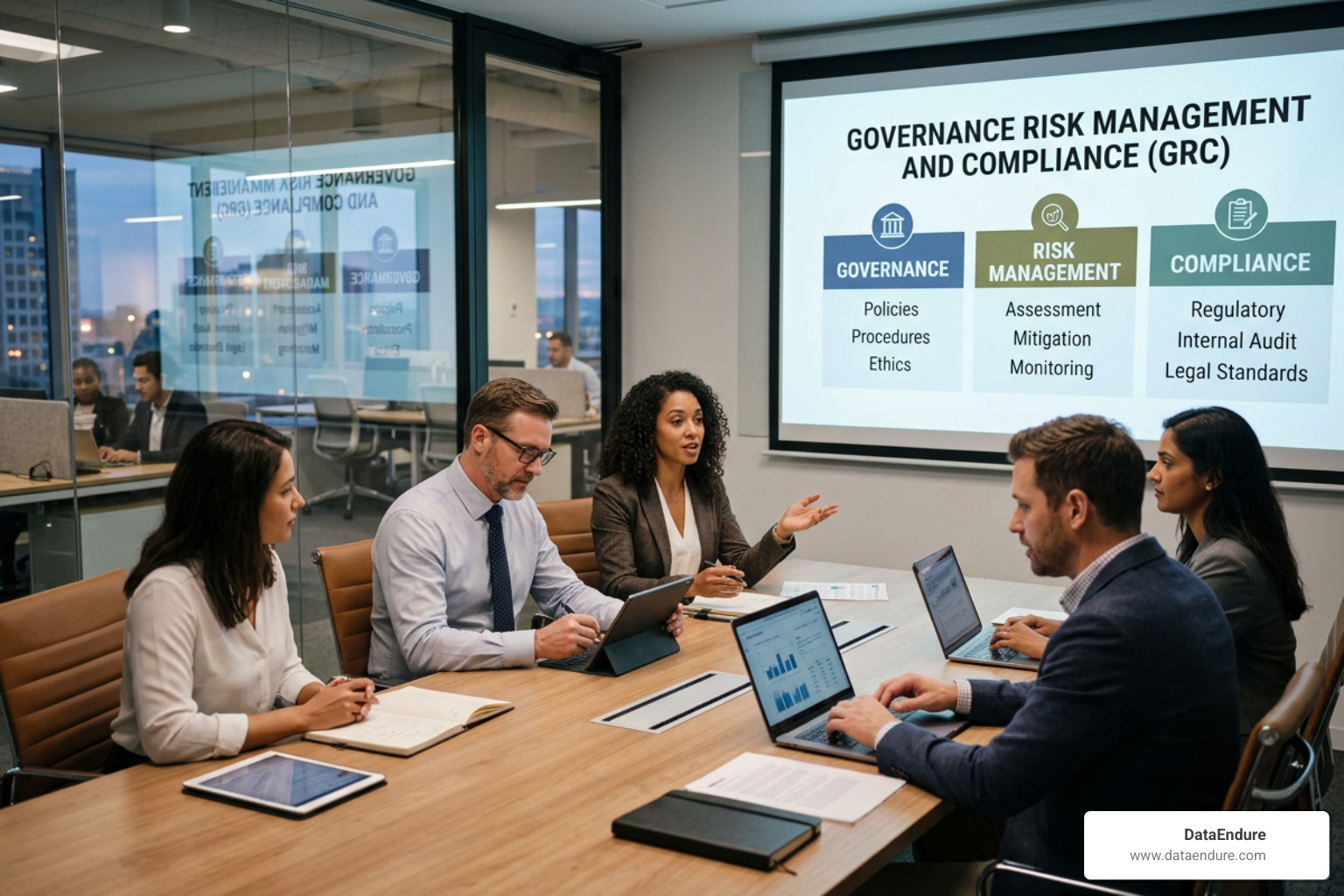
Modern GRC platforms, such as those detailed by NAVEX, help organizations connect their people, policies, and procedures in a single location. These tools provide several key capabilities:
- Continuous Control Monitoring: Automatically verify that security controls are active and working, reducing the manual effort needed for audits by up to 20%.
- Automated Policy Management: Easily map your internal policies to over 400 global compliance frameworks, ensuring you stay up to date as regulations change.
- AI-Driven Risk Analytics: Use machine learning to analyze threat data, spot compliance anomalies, and predict potential risk events before they disrupt your operations.
Adopting a vendor-agnostic approach is often key to designing a GRC and security architecture tailored to specific business needs. This approach helps eliminate tool sprawl and ensures that various technologies work together to deliver clear business outcomes. For organizations seeking a structured approach to managing these complex systems, leveraging Managed Compliance models can provide the necessary oversight and technology integration to maintain a strong compliance posture.
Frequently Asked Questions about GRC
What is the difference between risk management and compliance?
While they are closely related, risk management and compliance have different focuses:
- Compliance is reactive and rule-based. Its goal is to meet the standards set by external laws, regulations, and internal policies (such as HIPAA, PCI-DSS, or GDPR). It asks, “Are we doing what we are legally required to do?”
- Risk Management is proactive and value-based. Its goal is to identify, analyze, and mitigate threats that could prevent the organization from achieving its strategic goals — even if those threats are not covered by specific regulations. It asks, “What could go wrong, and how do we minimize the impact?”
A healthy organization benefits from both. Compliance provides the baseline security guardrails, while risk management helps navigate unique, unmapped threats to the business.
How does GRC improve cybersecurity posture?
An integrated GRC strategy helps shift security teams from a reactive mindset to a proactive, compliance-led approach. By mapping security controls directly to compliance requirements and risk assessments, organizations can:
- Identify and address security gaps before they lead to incidents.
- Ensure security investments are aligned with high-risk areas.
- Streamline incident response processes to improve detection and containment timelines.
To see how simplifying compliance workflows can support overall defenses, read our guide on A Simpler Approach to Compliance-Led Security.
What are the consequences of poor GRC maturity?
A less mature GRC framework can lead to operational challenges and increased organizational risk. Common challenges include:
- Regulatory Non-Compliance: Failing to align with regulatory standards can result in legal penalties and regulatory oversight.
- Delayed Incident Detection: Without integrated monitoring, identifying and responding to security incidents may take longer, potentially increasing operational impact.
- Impact on Trust: Compliance failures or security incidents can affect stakeholder trust and brand reputation.
- Operational Inefficiencies: Organizations may spend excessive resources manually tracking compliance data across disconnected systems.
When managing compliance deadlines or incident response windows, preparation is key. To understand how to prepare your team for these scenarios, review our checklist: Breach Protection: The 30-Day Compliance Countdown.
Conclusion
In 2026, managing governance risk management and compliance is an essential component of organizational resilience. Moving away from disconnected silos toward an integrated GRC strategy helps organizations manage operational costs, address regulatory requirements, and strengthen their overall security posture.
An effective GRC strategy focuses on Alignment Over Complexity. By establishing a unified framework, organizations can work to eliminate operational blind spots, reduce tool sprawl, and build a cohesive approach to risk management.
Key objectives of a mature GRC program include:
- Efficient Incident Detection: Utilizing advanced analytics and expert oversight to identify and respond to potential threats in a timely manner.
- Optimized Alert Management: Filtering operational noise so teams can focus on high-priority security events.
- Streamlined Implementation: Deploying compliance and security monitoring frameworks efficiently to achieve faster operational readiness.
Organizations evaluating their current posture may benefit from structured evaluations, such as a CISO Assessment, to align leadership goals with operational capabilities. Developing a comprehensive approach to GRC helps support long-term business resilience and regulatory alignment. For those seeking external guidance, exploring specialized services like those offered through Partner with DataEndure for Governance, Risk, and Compliance can provide additional support in navigating these complex frameworks.