The Core Framework: Exploring the 5 Risk Management Strategies
To choose the right risk response, you need a clear baseline. International frameworks like ISO 31000:2018 and COSO ERM 2017 define risk as the effect of uncertainty on objectives. Managing that uncertainty requires aligning every potential threat with your organization’s written risk appetite thresholds.
Selecting an appropriate strategy comes down to evaluating two core metrics: likelihood and impact severity. Here is how the primary risk response techniques compare:
| Strategy | Primary Objective | Likelihood / Impact Profile | Operational Action | Cost vs. Benefit Consideration |
|---|---|---|---|---|
| Risk Avoidance | Eliminate risk exposure entirely | High Likelihood / High Impact | Halt high-risk business activities or exit volatile markets | Foregone revenue vs. total loss prevention |
| Risk Reduction | Decrease likelihood or severity | High Likelihood / Low-Medium Impact | Implement technical safeguards, policies, and procedural controls | Safeguard investment vs. expected loss reduction |
| Risk Transference | Shift financial loss exposure | Low Likelihood / High Impact | Purchase insurance policies or negotiate indemnity clauses | Premium costs vs. catastrophic loss protection |
| Risk Acceptance | Absorb residual risk within appetite | Low Likelihood / Low Impact | Formally document risk ownership and set aside reserves | Zero control cost vs. absorption of loss |
| Contingency Planning | Ensure resilience and operational continuity | Unpredictable / Catastrophic | Establish disaster recovery plans, backup systems, and response flows | Planning and backup overhead vs. downtime prevention |
Trick 1: Deploying the 5 Risk Management Strategies in Operational Workflows
Applying the 5 risk management strategies in daily operations requires understanding how each technique operates in practice.
- Risk Avoidance: Avoidance completely removes the risk by stopping the underlying activity. While it drives inherent risk to zero, it also means walking away from the associated business opportunities. For example, a financial services company might avoid compliance risk under strict regimes like DORA or NIS2 by choosing not to launch a personal data analytics tool in a high-risk international region.
- Risk Reduction (Mitigation): Reduction is the foundation of most risk programs. It focuses on lowering the likelihood or impact of a threat through layered controls. Performing a thorough cyber risk assessment allows organizations to pinpoint vulnerabilities and deploy controls—like multi-factor authentication (MFA) or automated patch management—to block threats before they escalate.
- Risk Transference: Transference shifts the financial consequences of a risk to a third party. While commercial insurance and vendor indemnity clauses transfer financial impact, they never outsource total accountability or reputational damage.
- Risk Acceptance: Active acceptance involves acknowledging a residual risk because the cost of mitigation outweighs the potential loss. To be valid, accepted risks must be documented in a central register with named owners, defined trigger conditions, and established financial reserves.
- Risk Sharing: Often integrated into broader organizational risk management guides, risk sharing distributes risk exposure across multiple parties. Examples include entering joint ventures, establishing public-private partnerships, or using currency swap lines to hedge systemic volatility.
Trick 2: Structuring Entity Protection, Contracts, and Insurance Coverage
Building a strong defense starts with your legal structure, contractual frameworks, and insurance portfolio.
Business Entity Choice
Operating as a sole proprietorship or general partnership exposes your personal assets to business liabilities. Establishing a Limited Liability Company (LLC) or a corporation creates a legal wall between personal assets and corporate obligations, protecting individual savings if the business defaults on a lease or faces a liability lawsuit.
Statutory Contract Thresholds
Under statutory legal guidelines, written contracts are mandatory to enforce legal protection in specific transactions:
- Sale of Goods: Written contracts are generally required for sales exceeding $500.
- Property Leases: Written agreements are required for real estate leases exceeding $1,000.
Having a legal professional review contracts, non-disclosure agreements (NDAs), and indemnification clauses ensures that operational liability is properly managed.
Essential Insurance Coverage
To protect financial assets against operational disruptions, businesses should maintain a balanced insurance portfolio:
- Business Owners Policy (BOP): Combines general liability and commercial property insurance to cover third-party bodily injury, customer slip-and-fall incidents, and physical asset damage.
- Professional Liability (E&O): Protects against claims of professional negligence, errors, or omitted services.
- Employer Practices Liability Insurance (EPLI): Covers claims regarding wrongful termination, discrimination, and workplace harassment.
- Workers’ Compensation: Mandated by state laws to handle medical expenses and lost wages for job-related injuries.
- Cyber Liability Insurance: Covers regulatory fines, notification fees, forensic investigations, and extortion demands following a security breach.
Operationalizing Risk Controls Across Governance, Business Continuity, and Technology

Trick 3: Assigning Governance Roles and Establishing Disaster Continuity Plans
Risk management requires clear governance and defined operational roles across all organizational levels.
The Three Lines Model
- First Line (Operational Management): Department managers and front-line staff own and manage risks directly within daily operations.
- Second Line (Risk & Compliance Oversight): Compliance, IT security, and risk officers establish frameworks, monitor key risk indicators (KRIs), and provide operational guidance. You can streamline these efforts by implementing IT governance, risk, and compliance practices that eliminate silos.
- Third Line (Internal Audit): Independent internal auditors provide objective assurance to executive leadership and the Board of Directors regarding control effectiveness.
Executive leadership and CISOs set the overall risk appetite, while the Board of Directors maintains ultimate fiduciary oversight.
Disaster Preparedness and Business Continuity
When catastrophic disruptions strike, business continuity management (BCM) ensures essential operations continue. Developing an effective plan involves four main steps:
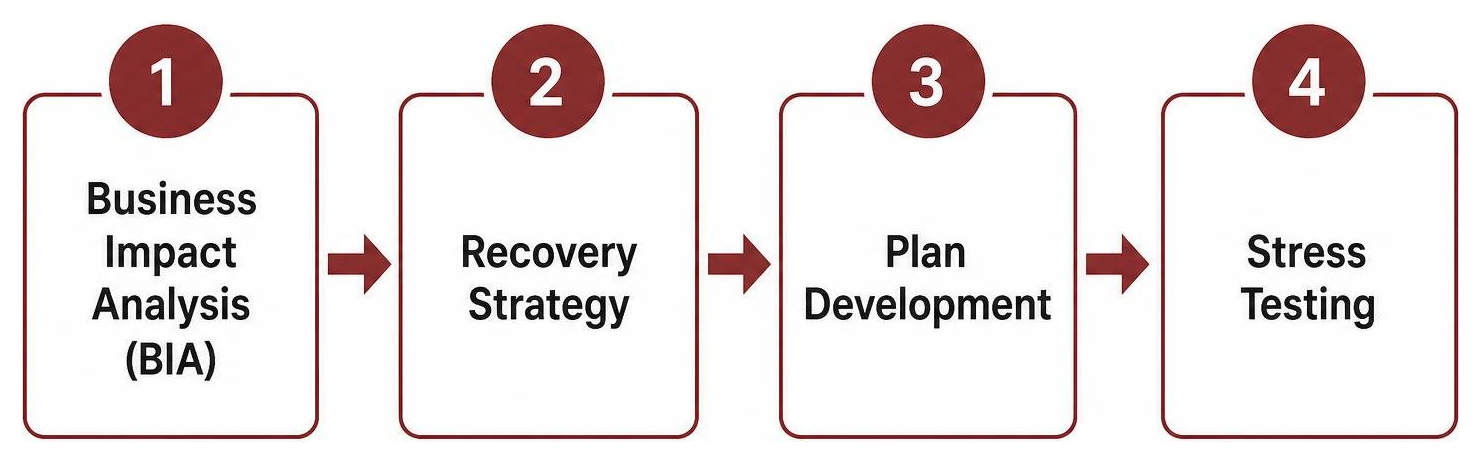
- Business Impact Analysis (BIA): Identify critical operational processes, dependencies, and financial loss thresholds.
- Establish Recovery Metrics: Define Recovery Time Objectives (RTO)—the target time to restore systems—and Recovery Point Objectives (RPO)—the maximum acceptable data loss window.
- Plan Development & Incident Response: Document clear action steps, emergency communication channels, and technical failover procedures.
- Stress Testing & Drills: Regularly run tabletop simulations and digital stress tests to validate recovery capabilities before an actual incident occurs.
Trick 4: Leveraging AI-Powered Technology for Real-Time Threat Monitoring
Relying on manual risk reviews creates dangerous visibility gaps. Modern digital resilience depends on automated tools, continuous control monitoring, and integrated GRC platforms.
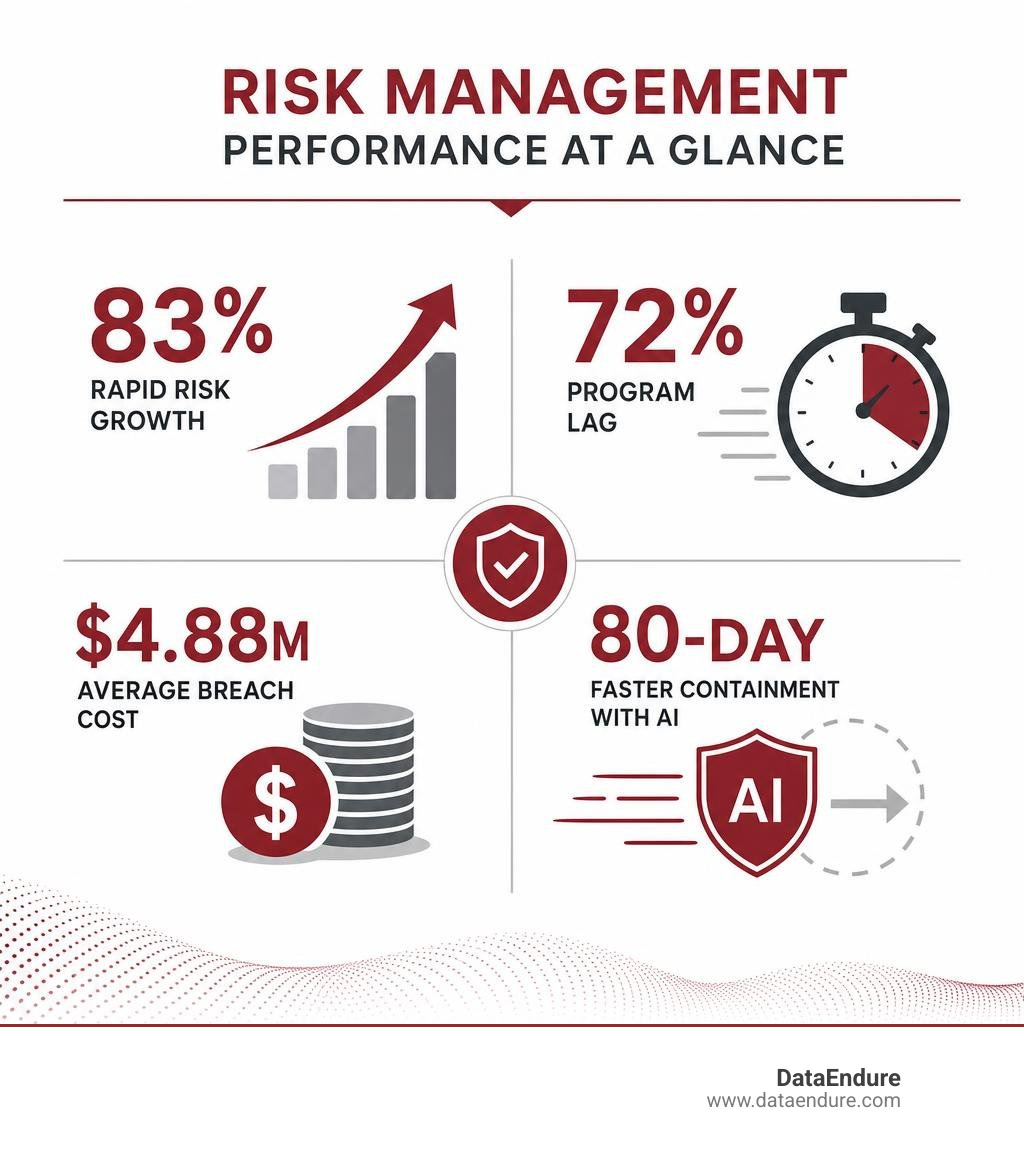
The average global cost of a data breach reached $4.88 million in 2024. However, organizations that extensively deploy security AI and automation in their security operations centers save an average of $1.9 million per breach and shorten breach lifecycles by 80 days.
AI-driven analytics improve threat detection by continuously scanning system behavior, identifying anomalies, and triggering automated early warnings. This capability allows teams to isolate security incidents in minutes rather than months, significantly reducing operational friction and alert fatigue.
Eliminating Common Pitfalls to Protect Reputation and Drive Sustainable Growth

Trick 5: Avoiding Critical Execution Mistakes and Aligning 5 Risk Management Strategies
Even well-designed risk management programs can stumble over execution mistakes. Five common traps include:
- The Spreadsheet Trap: Managing enterprise risks through disconnected, manual spreadsheets creates version control errors and stale data.
- Unmonitored Risk Acceptance: Accepting risks without setting formal trigger limits or documenting ownership turns active risk acceptance into unmonitored negligence.
- Qualitative Heat Map Reliance: Color-coded heat maps (Red/Yellow/Green) can mask true financial exposure. Organizations should supplement them with quantitative modeling techniques, such as Monte Carlo simulations or the FAIR framework.
- Vague Contract Terms: Failing to enforce written contracts for sales over $500 or leases over $1,000 creates avoidable legal exposures.
- Tool Sprawl: Adding disconnected security software tools increases management overhead without improving protection.
To avoid these traps, conduct a regular compliance gap analysis to evaluate controls against recognized standards like ISO 31000 or NIST CSF 2.0. Additionally, ground your operations in practical risk management practices that pair continuous employee security training with regular vendor assessments.
Frequently Asked Questions About Business Risk Management
What is the difference between risk mitigation and risk management?
Risk management is the complete overarching framework used to identify, evaluate, monitor, and govern organizational uncertainty. Risk mitigation (also called risk reduction) is one specific operational response within that framework, focused on lowering the likelihood or impact of a identified threat.
Who should lead risk management strategies in an enterprise?
Executive management—including the CISO, CIO, and Chief Risk Officer—leads the strategy with direct operational accountability from department heads. Ultimate oversight rests with the Board of Directors, while internal audit teams provide independent control validation.
How often should an organization update its risk management plan?
Risk registers and strategy plans should undergo full formal reviews annually. However, risk monitoring should be continuous. Event-driven triggers—such as security incidents, infrastructure changes, new vendor integrations, or regulatory updates—require immediate updates to relevant risk profiles.
Conclusion: Build Lasting Digital Resilience with Expert Oversight
Mastering the 5 risk management strategies—avoidance, reduction, transference, acceptance, and contingency planning—turns risk management into a core organizational capability. Instead of relying on fragmented tools and reactive responses, organizations can build an integrated defense posture that protects assets, satisfies regulatory compliance, and supports long-term operational stability.
A mature digital resilience program helps leadership simplify complex technical environments, reduce redundant tooling, and improve visibility across security, data, cloud, and infrastructure systems.
By taking an objective, risk-informed approach, organizations can systematically address compliance requirements and detect security threats efficiently.
To establish a structured approach to governance and resilience, organizations can evaluate comprehensive DataEndure Security and Compliance Solutions to build a proactive risk management framework designed for sustainable growth.