Why Interest in Cloud Security Training Continues to Grow
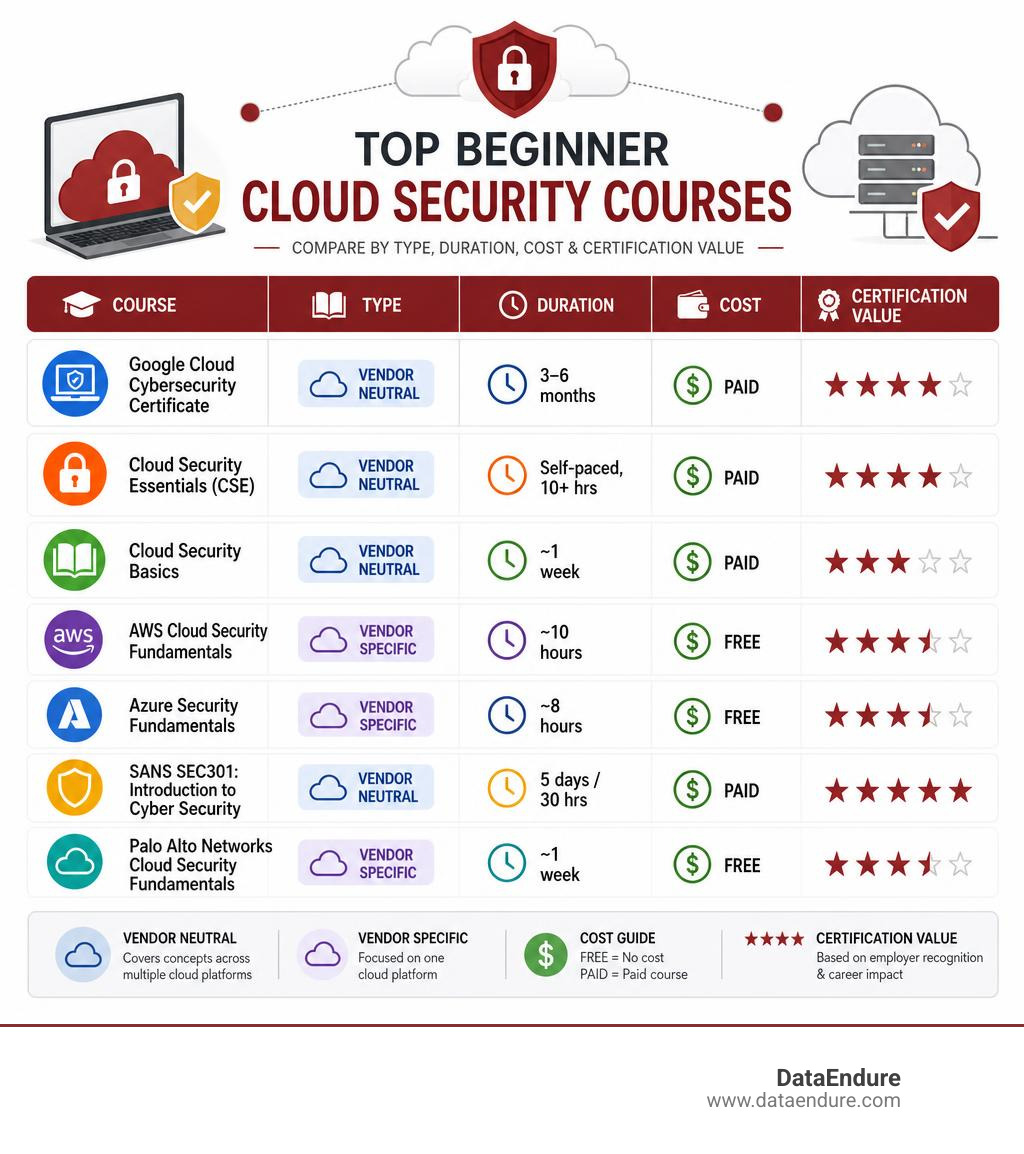
If you’re evaluating a cloud security course for beginners, here are several options worth considering in 2026:
| Course | Provider | Level | Time to Complete |
|---|---|---|---|
| Google Cloud Cybersecurity Certificate | Google Cloud / Coursera | Beginner | 3-6 months |
| Cloud Security Essentials (CSE) | EC-Council | Beginner | Self-paced, 10+ hrs |
| Cloud Security Basics | University of Minnesota / Coursera | Beginner | ~1 week |
| AWS Cloud Security Fundamentals | AWS | Beginner | ~10 hours |
| Azure Security Fundamentals | Microsoft | Beginner | ~8 hours |
| SANS SEC301: Introduction to Cyber Security | SANS Institute | Beginner | 5 days / 30 hrs |
| Palo Alto Networks Cloud Security Fundamentals | Palo Alto / Coursera | Beginner-Intermediate | ~1 week |
Organizations continue to move workloads, data, and applications into cloud environments. As that shift continues, many teams are prioritizing cloud security knowledge alongside broader cybersecurity skills.
Cloud security training can be useful for IT professionals looking to upskill, career changers entering cybersecurity, and technical leaders who want a clearer understanding of cloud risk, governance, and operations.
There are many beginner-friendly courses available. Some are vendor-specific. Some are free. Some lead to certifications that may be useful depending on your role, market, and goals. The right choice depends on your current background, the platforms you use, and the outcomes you want from the training.
This guide breaks down beginner cloud security courses available today, compares them neutrally, and helps you figure out which one fits your goals.
Cloud security course for beginners further reading:
Foundational Knowledge Needed Before Starting a Cloud Security Course

A good cloud security course for beginners should not expect you to be a cloud architect on day one. If it does, run. Politely, but run.
That said, you will learn faster if you understand a few basics before you start:
| Foundation | What It Means | Why It Matters in Cloud Security |
|---|---|---|
| Cybersecurity basics | Threats, vulnerabilities, risk, controls, attacks | Cloud security is cybersecurity applied to cloud environments |
| CIA triad | Confidentiality, integrity, availability | Helps you understand what you are protecting |
| Networking | IP addresses, DNS, ports, protocols, firewalls | Cloud systems are still connected systems |
| Identity and access management | Users, roles, permissions, least privilege | Identity is often the main security boundary in cloud |
| Encryption | Protecting data at rest and in transit | Essential for cloud data protection and compliance |
| Shared responsibility | What the provider secures vs. what you secure | Prevents dangerous assumptions |
| Basic operating systems | Windows, Linux, command line basics | Useful for labs, logs, and troubleshooting |
The most important beginner concept is the shared responsibility model. In cloud environments, the cloud provider secures parts of the underlying infrastructure, but the customer is still responsible for securing identities, data, configurations, workloads, and access decisions. We explain this in more depth in Who Shares the Responsibility for Cloud Security.
If you are completely new to cybersecurity, it can help to take a general cybersecurity primer before choosing a cloud-specific course. Foundations of Cybersecurity | Coursera is designed for beginners and introduces analyst responsibilities, security ethics, common tools, frameworks, and the CIA triad. It is a good first step if terms like SIEM, NIST, SQL, or Python feel unfamiliar.
For CISOs and IT directors building team training plans, we recommend grouping learners by background:
- Complete beginners: Start with cybersecurity fundamentals, then cloud basics.
- IT administrators: Start with IAM, networking, logging, and cloud configuration.
- Developers: Start with DevSecOps, container security, and secure software delivery.
- Security analysts: Start with cloud detection, incident response, and identity-based threats.
- Leaders and managers: Start with risk, governance, shared responsibility, and compliance.
This keeps training aligned with the work people actually do. Alignment beats complexity every time.
Options for a Cloud Security Course for Beginners
Before we compare individual courses, here is a practical roundup based on learner level, expected outcomes, and use case.
| Course | Consider If You Are… | Strengths | Considerations |
|---|---|---|---|
| Google Cloud Cybersecurity Certificate | Exploring cloud security analyst roles | Structured path, hands-on labs, Google Cloud focus | Most relevant when Google Cloud aligns with your goals |
| EC-Council Cloud Security Essentials | A career changer or student wanting a formal beginner certification | Covers cloud basics, encryption, network security, risk, compliance | Certification is introductory and should be paired with practice |
| Cloud Security Basics | Looking for a short academic-style introduction | Strong fundamentals, risk, access control, network security | Short duration means limited depth |
| Palo Alto Networks Cloud Security Fundamentals | Bringing some technical background | Cloud native security, containers, SASE, DevSecOps concepts | Listed as beginner-intermediate, so preparation may help |
| SANS SEC301 | Seeking broad cybersecurity literacy before specializing | Strong cybersecurity foundation, Zero Trust, labs, GISF prep | Broader cybersecurity course, not only cloud security |
| CCSK Foundation-style training | Seeking vendor-neutral cloud security knowledge | Useful for multi-cloud governance and cloud security concepts | Often more useful after basic cybersecurity concepts are clear |
| AWS, Azure, or Google Cloud fundamentals | Working on a specific platform | Practical platform skills | Less focused on multi-cloud portability |
For a deeper perspective on why cloud security training matters beyond course completion, see Don’t Let Your Data Drift Away with a Cloud Security Course.
Google Cloud Cybersecurity Certificate: A Cloud Security Course for Beginners
The Google Cloud Cybersecurity Certificate is one structured beginner path for learners who want a multi-course program rather than a one-off introduction.
A good entry point within that path is Introduction to Security Principles in Cloud Computing | Coursera. The course introduces cloud computing, security in cloud environments, the security lifecycle, and entry-level cloud security analyst responsibilities.
This path may be useful if you want to learn:
- How cybersecurity applies to cloud computing
- What entry-level cloud security analysts do
- How cloud teams use automation, DevSecOps, and infrastructure as code
- How security fits into digital transformation
- How Google Cloud environments are protected
The research notes that this course is beginner-level, requires no prior experience, and includes hands-on labs. The broader certificate path can take several months depending on pace, which makes it more substantial than a short introductory course.
Consider this option if you are:
- A career changer who wants a structured path
- Interested in Google Cloud
- Exploring entry-level security analyst roles
- Working with teams that use Google Cloud services
You may want another option if you are:
- Focused primarily on AWS or Azure-specific depth
- Already experienced with cloud fundamentals
- Looking only for governance-level knowledge
For job seekers, completing the certificate may also provide access to Google Cloud career resources, including its affiliate employer program.
EC-Council Cloud Security Essentials: A Structured Cloud Security Course for Beginners
Cloud Security Essentials | CSE Certification | EC-Council is positioned as an entry-level certification path for learners with little or no prior IT or cybersecurity experience.
It covers foundational areas such as:
- Cloud computing basics
- Network security
- Data protection
- Encryption
- Risk management
- Compliance and governance
- Cloud infrastructure security concepts
The course includes self-paced video training, lab exercises, and a capstone-style practical component. For beginners, that structure can support learning beyond video-based instruction alone.
Consider this option if you are:
- A student or career changer
- New to cybersecurity and interested in a named certification
- Looking for an entry-level cloud security credential
- Building a consistent baseline for junior staff
You may want another option if you need:
- Deep platform-specific configuration
- Advanced cloud-native security
- Detection engineering or incident response depth
Our take: this is a beginner option for structured learning plus a certification. Introductory certifications can support early learning, but they should be paired with practical experience, mentorship, and real cloud exposure.
Palo Alto Networks Cloud Security Fundamentals
Palo Alto Networks Cloud Security Fundamentals | Coursera may fit learners who already understand some basic technical concepts.
It covers several modern cloud security topics, including:
- Cloud computing models
- Public, private, and hybrid environments
- Shared responsibility
- Virtual machines, containers, and serverless computing
- Cloud native security
- The 4 C’s: cloud, clusters, containers, and code
- DevOps and DevSecOps
- CI/CD pipeline security
- Hybrid data center security
- Secure Access Service Edge, often called SASE
This course introduces cloud native technologies in addition to general cloud definitions. Beginners who want exposure to containers, vulnerability scanning, SASE, and hybrid security may find it useful.
Consider this option if you are:
- An IT professional with some networking or security background
- Interested in cloud native security
- Working across hybrid environments
- Exploring DevSecOps concepts
You may want another option if you are:
- Brand new to networking or cybersecurity
- Looking for a certification-first path
- Seeking a slower introduction to cloud basics
If cloud is a new city, this course expects you to at least know how traffic lights work before discussing freeway design.
SANS SEC301: Introduction to Cyber Security
SEC301: Introduction to Cyber Security | SANS Institute is not exclusively a cloud security course, but it is relevant for beginners who need a cybersecurity foundation before specializing.
It is designed for people with limited or no cybersecurity experience, including cyber-adjacent professionals, managers, auditors, legal teams, HR professionals, and business leaders. The course prepares learners for the GIAC Information Security Fundamentals certification and includes labs.
Topics include:
- Cybersecurity foundations
- Threats and vulnerabilities
- Cryptography
- Identity and access management
- Networks and data in motion
- Web security
- Zero Trust principles
- Modern attack tactics, including AI-powered threats
- Cloud and IoT defense scenarios
Consider this option if you are:
- A non-technical professional who needs security fluency
- An IT leader or manager
- Part of a security-adjacent team
- A beginner who wants broad fundamentals before cloud specialization
You may want another option if you need:
- Cloud platform labs only
- AWS, Azure, or Google Cloud configuration practice
- A short, lightweight course
For leadership teams in Silicon Valley or Santa Clara organizations, SEC301-style training can help non-security stakeholders speak the same language as security teams. That can reduce friction, improve decision-making, and help security become a more integrated part of business planning.
Comparing Course Types: Vendor-Neutral vs. Vendor-Specific and Free vs. Paid
Choosing a cloud security course for beginners is easier when you understand the four main training categories:
- Vendor-specific
- Vendor-neutral
- Free or low-cost introductory
- Paid certification-focused
Each has a place. The right choice depends less on course quality and more on your goals.
Vendor-Specific vs. Vendor-Neutral Training Paths
Vendor-specific courses teach security in a particular cloud platform, such as AWS, Azure, or Google Cloud.
They are useful when:
- Your company already uses that platform
- You want hands-on configuration skills
- You are preparing for a platform certification
- You need to understand native tools, logs, IAM, and controls
Examples include Google Cloud cybersecurity training, AWS security fundamentals, and Azure security fundamentals.
Vendor-neutral courses focus on cloud security principles that apply across platforms. These often cover:
- Shared responsibility
- Governance
- Risk management
- Compliance
- Cloud architecture
- Identity strategy
- Encryption
- Incident response
- Multi-cloud security
- Cloud security frameworks
Vendor-neutral learning is especially useful for multi-cloud and hybrid environments. In the real world, many organizations use a mix of cloud platforms, SaaS tools, and legacy systems.
For vendor-neutral cloud security knowledge, many learners eventually explore CCSK-style training from the Cloud Security Alliance. If you are in the Santa Clara or Silicon Valley area, the CCSK Training in San Jose, California – Cloud Security Alliance (CSA) page is a relevant example of the type of cloud security knowledge path available locally or near the region.
Neutral decision guide:
- Choose vendor-specific training if your next job or current environment depends on one platform.
- Choose vendor-neutral training if you lead strategy, governance, architecture, or multi-cloud risk.
- Combine both if you are building a durable cloud security career.
This is also where network design matters. Cloud security does not stop at IAM policies and dashboards. Network architecture can influence visibility, routing complexity, and exposure. We discuss this in Why Most Cloud Strategies Break Down at the Network Layer.
Related DataEndure reading for cloud strategy and operations:
- Cloud Computing in Motion: Balancing Cost, Outcomes, and Innovation
- Does Your Cloud Journey Feel Like an Episode of Survivor?
- Cloudy with a Chance of Success
- Is the Cloud in Your Future?
- Managing Cost in a Hybrid Cloud Environment
Free vs. Paid Courses: Content Depth and Certification Value
Free courses are useful for exploration. Paid courses often offer more structure, labs, and certification preparation.
Free or open introductory training is useful when you want to:
- Test whether cloud security interests you
- Learn basic terminology
- Explore a platform before committing
- Build confidence before taking a certification path
- Give a team a lightweight starting point
For example, FREE Cybersecurity Education Courses – Palo Alto Networks can help beginners explore cybersecurity concepts before moving into deeper training.
Paid or subscription-based courses may offer more:
- Structured learning paths
- Certificates of completion
- Practical labs
- Capstone projects
- Exam preparation
- Continuing education credits
- More detailed courseware
- Better sequencing from beginner to intermediate topics
For example, professional training providers may offer courses with hands-on labs and continuing education credits. SANS cloud security courses, for instance, often include lab work and CPE credit, while SEC301 specifically provides a broad beginner cybersecurity foundation with hands-on exercises.
Coursera-based options vary by course. Cloud Security Basics | Coursera, offered by the University of Minnesota, is a short beginner-friendly course that research notes has a strong positive learner response and covers areas such as secure cloud service design, user roles, risk assessment, vulnerabilities, remote access, and network security.
You can also explore more academic options such as Cloud Security Course – Stanford Online, especially if you want a more formal university-style learning experience.
Simple decision guide:
| If You Want To… | Start With… |
|---|---|
| Explore cloud security with minimal commitment | Free introductory courses |
| Build a structured learning path | Certificate program |
| Prepare for a job | Hands-on labs plus certification |
| Lead cloud strategy | Vendor-neutral governance and risk training |
| Secure a specific platform | AWS, Azure, or Google Cloud training |
| Reduce organizational risk | Training plus assessment and operational support |
Training is most useful when it is tied to actual business outcomes: fewer misconfigurations, faster detection, better compliance, clearer ownership, and less operational burden.
That is where many teams need more than training. They need operating model clarity.
Frequently Asked Questions About Cloud Security Training
How long does it take to complete a beginner cloud security course?
It depends on the type of course.
Short beginner courses may take about a week if you study consistently. For example, some Coursera cloud security introductions are structured around roughly 10 hours of weekly effort.
More complete certificate programs may take several months, especially if you study part-time while working. The Google Cloud Cybersecurity Certificate is often approached as a multi-month path, with learners spending several hours per week.
Professional cybersecurity foundation courses may be delivered in a compressed format, such as several full days, or as a self-paced program requiring around 30 hours.
A realistic beginner schedule looks like this:
| Learner Type | Weekly Time | Expected Timeline |
|---|---|---|
| Busy professional | 3-5 hours | 2-4 months for a certificate path |
| Career changer | 8-10 hours | 1-3 months for a structured path |
| Full-time learner | 15+ hours | Several weeks for beginner material |
| Technical leader | 2-4 hours | Ongoing, focused on risk and strategy |
| IT team cohort | 1-2 sessions per week | 6-12 weeks for baseline enablement |
Our advice: do not rush the labs. Cloud security is not learned by watching someone else click through a console. That is like watching a cooking show and declaring yourself a pastry chef. Encouraging, yes. Sufficient, no.
What hands-on skills will I learn in these courses?
A strong beginner cloud security course should include practical exposure to core cloud security tasks.
Look for labs or exercises covering:
- Creating users, groups, and roles
- Applying least privilege access
- Understanding cloud IAM policies
- Configuring security groups or firewall rules
- Reviewing network access paths
- Enabling logging and monitoring
- Identifying risky public exposure
- Encrypting data at rest and in transit
- Understanding key management basics
- Running vulnerability scans
- Reviewing container security concepts
- Mapping risks to controls
- Investigating simple cloud incidents
- Understanding DevSecOps workflows
- Reading cloud audit logs
More advanced beginner-to-intermediate courses may also introduce:
- Infrastructure as code security
- CI/CD pipeline governance
- Container image scanning
- Kubernetes security basics
- SASE concepts
- Cloud-native detection
- Incident response playbooks
- Compliance evidence collection
If you are choosing training for a team, prioritize courses that create muscle memory. The goal is not just “knows what IAM means.” The goal is “can recognize an over-permissioned role before it becomes a security issue.”
For organizations, hands-on learning should map to real controls:
| Skill | Business Outcome |
|---|---|
| IAM configuration | Reduces privilege abuse |
| Logging and monitoring | Improves detection speed |
| Encryption | Supports data protection and compliance |
| Network segmentation | Limits lateral movement |
| Vulnerability scanning | Reduces exploitable weaknesses |
| Incident response labs | Improves recovery readiness |
| DevSecOps practices | Reduces risk before deployment |
If you are unsure where your current cloud environment stands, a Cloud Security Assessment can provide a structured way to identify gaps before or alongside training.
What entry-level jobs can I get after completing a course?
A beginner course alone does not guarantee a job, but it can help you qualify for entry-level conversations, especially when paired with labs, projects, and general cybersecurity knowledge.
Common entry-level or early-career roles include:
- Cloud Security Analyst
- Security Operations Center Analyst
- Junior Cloud Administrator
- Security Operations Specialist
- Cloud Support Associate
- Junior GRC Analyst with cloud focus
- Vulnerability Management Analyst
- Identity and Access Management Analyst
- DevSecOps Associate
- Cloud Compliance Analyst
With additional experience, learners may progress toward:
- Cloud Security Engineer
- Cloud Security Architect
- Cloud Threat Detection Engineer
- Cloud Security Consultant
- Security Automation Engineer
- Cloud Security Manager
To apply your training in real-world scenarios, build a small portfolio:
- Create a free-tier cloud lab.
- Document how you configured IAM securely.
- Show before-and-after examples of risky vs. safe configurations.
- Write a simple incident response checklist for a cloud alert.
- Practice reading cloud logs.
- Explain shared responsibility in plain English.
- Map a cloud risk to a control framework.
- Add screenshots and short explanations to a personal project repository.
For IT leaders, the same idea applies at team scale. Do not measure training success only by certificates earned. Measure:
- Reduction in risky configurations
- Faster alert triage
- Better access reviews
- Improved audit readiness
- Clearer ownership between cloud, security, and infrastructure teams
- Lower tool sprawl
- More consistent detection and response
That is how training becomes resilience.
Conclusion: Building a Resilient Cloud Security Strategy
The right cloud security course for beginners depends on where you are starting and where you need to go.
If you are brand new to cybersecurity, start with fundamentals. If you already work in IT, move quickly into IAM, networking, logging, and cloud platform labs. If your organization is multi-cloud, balance vendor-specific learning with vendor-neutral principles. If you are a CISO, IT director, or technical leader, use training as one part of a broader cloud security operating model.
Here is a simple path to consider:
- Learn cybersecurity fundamentals.
- Understand shared responsibility.
- Choose a cloud platform or vendor-neutral track.
- Complete hands-on labs.
- Earn a beginner-friendly certification if it supports your goals.
- Apply the skills in real cloud scenarios.
- Assess and improve your actual environment.
- Build a continuous learning and detection program.
Cloud security is most effective when it is viewed through a broader digital resilience lens. Cloud risk often appears in the gaps between identity, architecture, data protection, monitoring, compliance, and operations.
A vendor-agnostic approach can help teams evaluate cloud security training, tools, and operating models based on business needs rather than product preference. For teams in Santa Clara, Silicon Valley, and beyond, the goal is not only to train people, but to build cloud operations that help the business move with greater confidence.
If you are ready to move from cloud security learning to cloud security outcomes, explore DataEndure Cloud Security Solutions.