Evaluating Modern Network Security Assessment Services
Choose network security assessment services by the assets they cover, how they verify findings, and what you can do with the results. Look for internal and external asset discovery, scans with and without credentials, manual checks of serious findings, and a clear remediation plan. Ask how the provider limits disruption to production systems and confirms fixes after the work is done.
A scanner can flag known weaknesses, but it may miss forgotten assets or leave teams with false alarms. A useful assessment puts findings in context: which systems are exposed, which weaknesses matter most, and who needs to act. Unlike a penetration test, it focuses on finding and prioritizing weaknesses rather than attempting to exploit them.
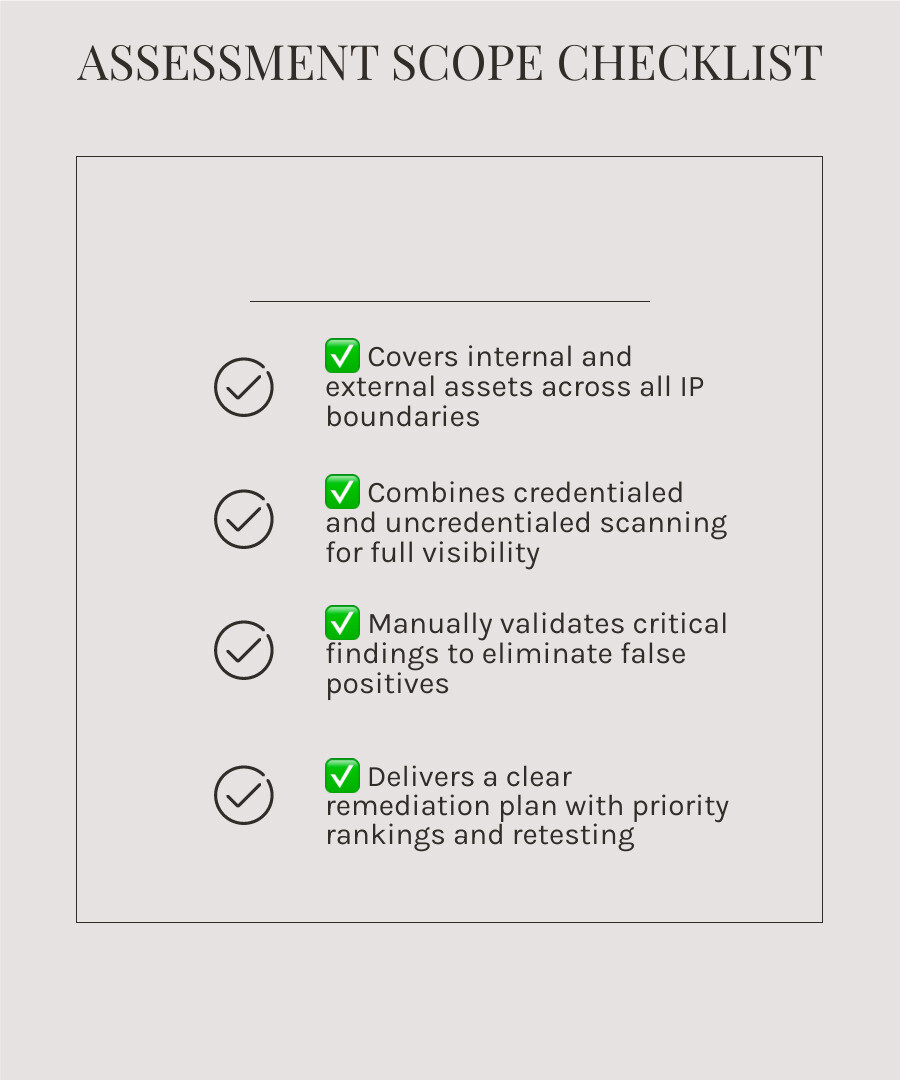
Network security assessment services word roundup:
- cyber security assessment services
- risk assessment cyber security
- vulnerability management cybersecurity
Most incidents do not stem from complex zero-day exploits. They begin with ordinary oversights: an unpatched edge device, a forgotten test server left exposed on the perimeter, an open administrative interface, or a system using default credentials. Because new critical vulnerabilities in perimeter hardware are often weaponized within days of public disclosure, knowing what is attached to your environment is fundamental. Exploring the ultimate guide to network assessment reveals why comprehensive visibility must precede security controls.
A network vulnerability assessment provides broad visibility across an entire environment. While a penetration test simulates an active adversary trying to compromise specific targets and demonstrate real-world impact, a vulnerability assessment inventories weaknesses systematically across all reachable endpoints, infrastructure components, and cloud connections. The NIST definition of vulnerability assessment describes this process as identifying, quantifying, and prioritizing vulnerabilities in a system.
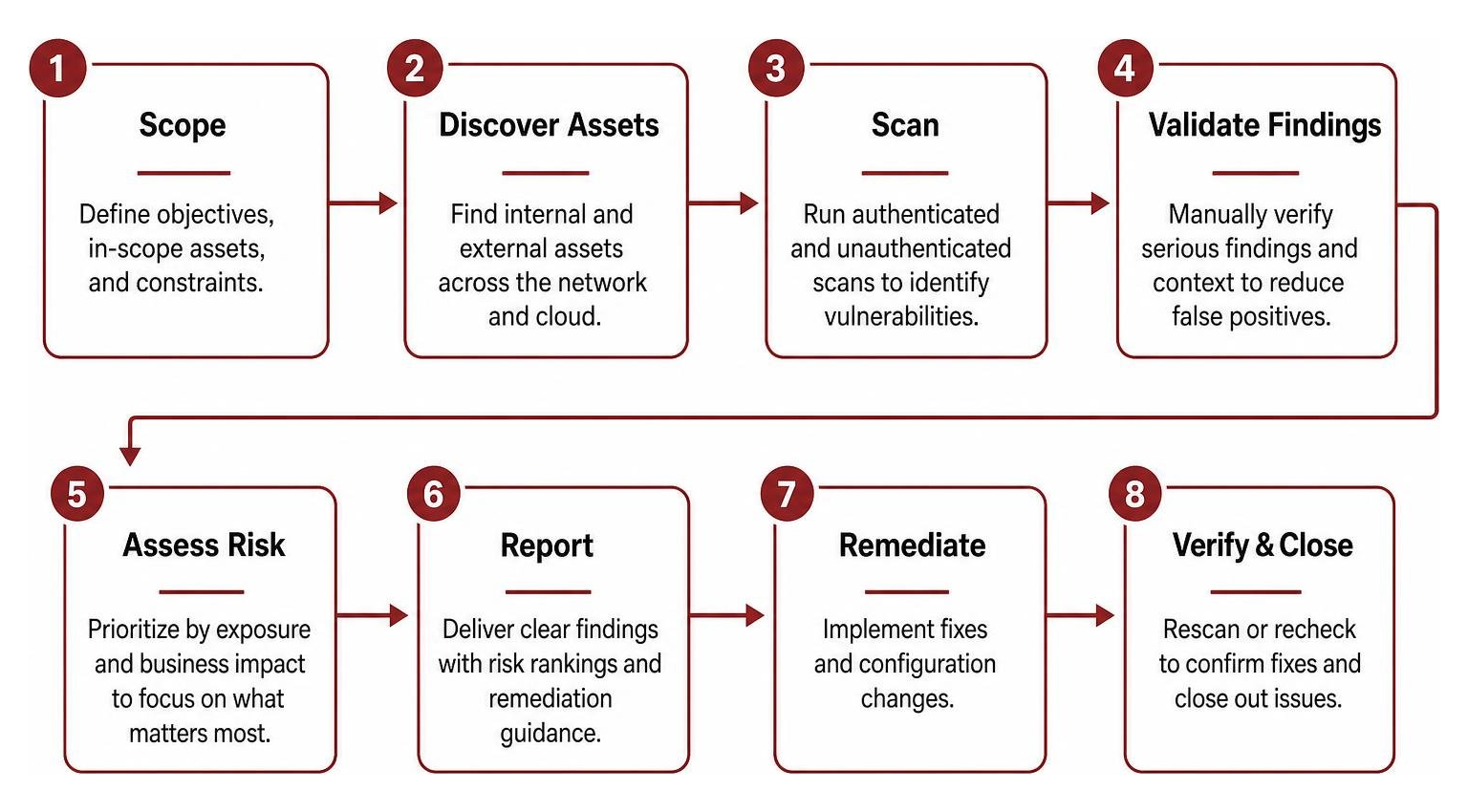
Vulnerability Assessment Scope and Manual Validation
Automated scanning engines are proficient at identifying common configuration gaps and missing software patches across thousands of IP addresses. However, running a scan is only the starting point. Automated tools frequently generate false positives or misinterpret environmental context, leading internal teams to waste hours investigating non-issues.
Manual validation by experienced practitioners changes raw tool outputs into actionable guidance. By manually testing whether a detected service is genuinely exposed and misconfigured, assessors filter out benign scanner artifacts and confirm high-severity risks.
| Evaluation Factor | Automated Scanning Only | Assessment with Manual Validation |
|---|---|---|
| Accuracy | High volume of potential findings; includes false positives | Verified vulnerabilities; filtered for environmental context |
| Operational Impact | Risk of aggressive scanning disrupting sensitive devices | Controlled, non-intrusive testing designed for production stability |
| Prioritization | Ranks issues strictly by raw CVSS score | Combines CVSS, business context, and active threat data |
| Remediation Value | Generic vendor patch recommendations | Specific remediation roadmaps with direct configuration steps |
Professional assessments also balance scanning depth with production stability. Non-intrusive discovery techniques ensure that sensitive systems, such as industrial controllers or legacy operational hosts, remain online throughout the testing process.
Key Components of Network Security Assessment Services
A complete evaluation uses two complementary scanning techniques: unauthenticated (external/discovery) scanning and authenticated (credentialed) auditing.
- Unauthenticated Scanning: Simulates what an external party sees when probing your perimeter. It uncovers exposed ports, vulnerable services, unencrypted traffic paths, and shadow IT assets that were deployed outside standard change controls.
- Authenticated Scanning: Uses authorized credentials to log into target systems, hypervisors, switches, and servers. This allows the assessment to inspect installed software versions, internal configurations, Active Directory settings, and local policy compliance.
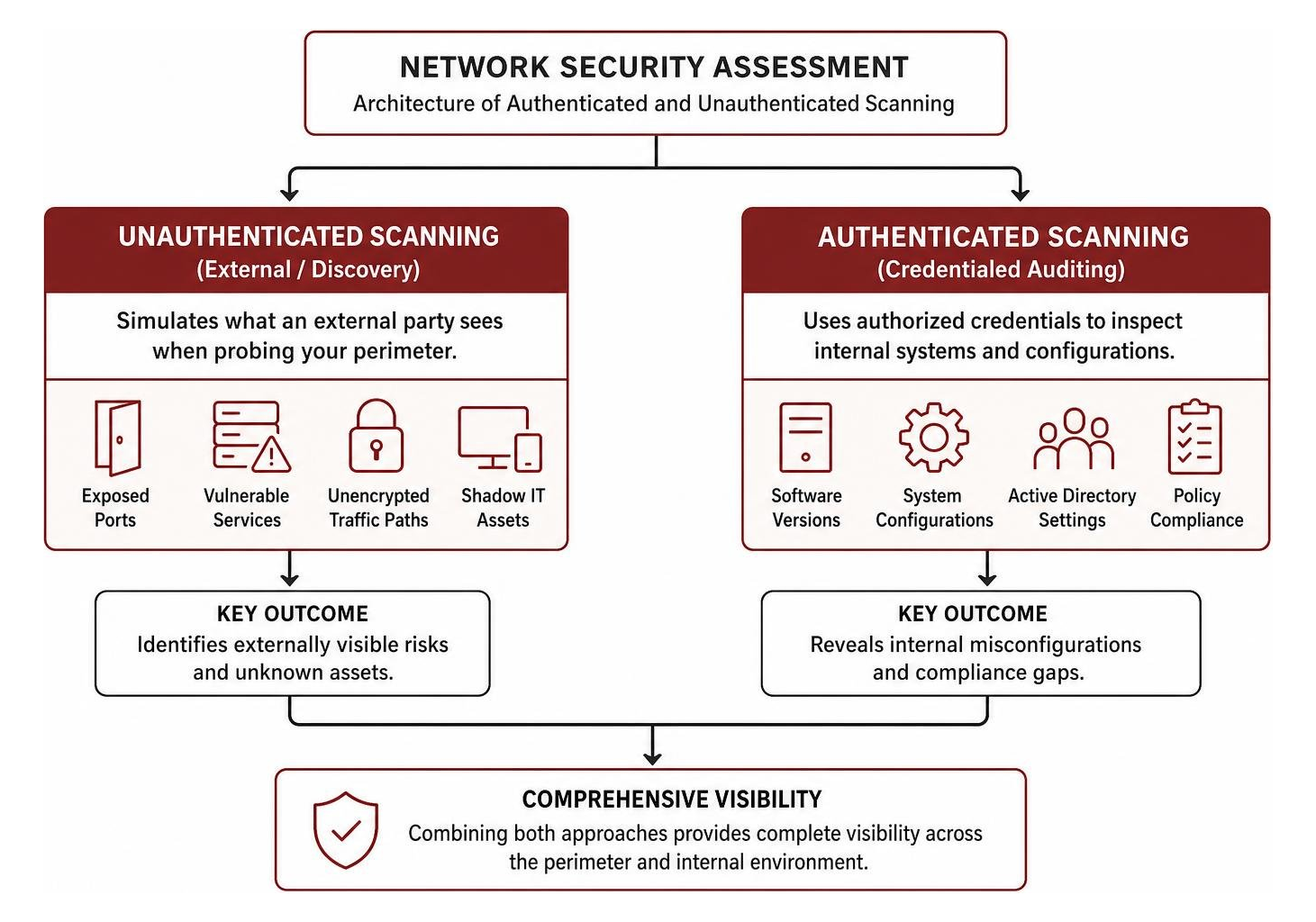
Understanding why network security must be prioritized helps security teams address edge misconfigurations before attackers find them. By auditing internal segments, management interfaces, and edge equipment, authenticated assessments highlight critical gaps before lateral movement can occur.
Regulatory Standards, Security Hygiene, and Compliance Mapping
Maintaining compliance requires regular, verifiable security reviews. For internet-facing systems, quarterly assessments represent the regulatory floor, while monthly evaluations provide a practical cadence given how rapidly threat actors target edge devices. Balancing these checks with broader modern network considerations ensures that regulatory alignment supports overall operational resilience.
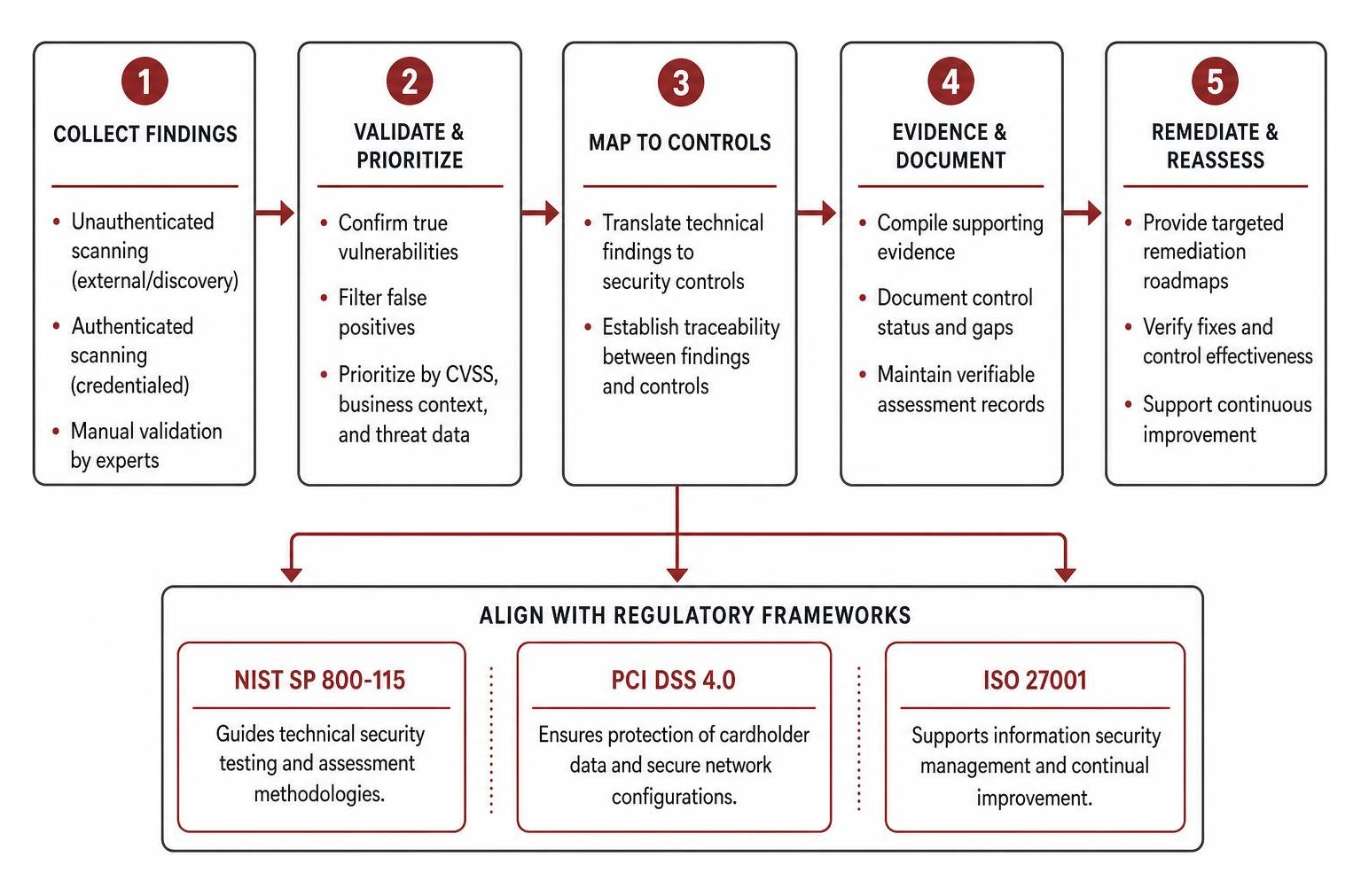
Aligning with NIST, PCI DSS 4.0, and ISO 27001
A formal assessment maps discovered weaknesses directly to major governance and security frameworks:
- NIST SP 800-115: Guides technical security testing and assessment methodologies.
- PCI DSS 4.0: Mandates quarterly internal and external vulnerability assessments, as well as scans following significant network changes.
- ISO/IEC 27001: Requires ongoing vulnerability management and regular control reviews.
- NIS2 Directive & SOC 2: Call for continuous technical evaluations, risk assessments, and secure baseline configurations across production environments.
Organizations can incorporate a comprehensive network health check to simplify audit preparation and document compliance against these frameworks without manual reporting overhead.
Applying Foundational Cyber Hygiene Guidance
Organizations seeking to establish baseline security before commissioning full third-party audits can use no-cost resources provided by public agencies such as the Cybersecurity and Infrastructure Security Agency (CISA). CISA provides three foundational cybersecurity offerings:
- Regional Cybersecurity Advisors (RCAs): Personnel who offer localized risk guidance and assist with foundational security planning.
- Cyber Hygiene Services: Automated, recurring scans that evaluate internet-facing systems for known vulnerabilities and configuration weaknesses.
- Cybersecurity Performance Goal (CPG) Assessments: Structured evaluations mapped across 38 CPG IDs to help teams prioritize their risk-reduction investments.
| Dimension | Public Sector Hygiene Services | Professional Network Security Assessment |
|---|---|---|
| Scope | External internet-facing perimeter only | Internal networks, cloud architectures, Active Directory, IoT/OT, and perimeter |
| Validation | Automated reporting based on public indicators | In-depth manual validation, false-positive removal, and business-risk scoring |
| Depth | Unauthenticated vulnerability scanning | Authenticated audits, configuration analysis, and architecture review |
| Output | High-level risk indicators and basic recommendations | Detailed technical annex, remediation roadmaps, and compliance mapping |
Public sector services establish a helpful foundation, while professional assessments provide the depth, manual verification, and internal context needed for enterprise environments.
Building a Resilient Network Security Posture
Evaluating vulnerabilities across your infrastructure is an ongoing operational discipline. Once weaknesses are identified, organizations can strengthen their architecture using modern isolation techniques, such as micro-segmentation and zero trust strategies, to limit lateral movement if a breach occurs.

How to Select and Scope Network Security Assessment Services
When selecting a partner for assessment services, define the engagement parameters clearly:
- Boundary Definition: Clearly establish in-scope IP blocks, domain names, cloud tenants, and explicit exclusion lists before scanning begins.
- Scanning Philosophy: Verify that the provider uses authenticated auditing alongside external sweeps, rather than relying solely on surface-level scans.
- Safety Protocols: Ensure the testing methodology adapts to sensitive operational hosts and production databases to prevent unexpected downtime.
- Validation Standards: Confirm that human analysts review high-severity alerts to eliminate false positives and contextualize threats using databases like the CISA Known Exploited Vulnerabilities (KEV) catalog.
For a broader perspective on assessing operational risks across your entire architecture, review the key elements of evaluating overall network security.
Translating Deliverables and Findings into Actionable Remediation
The primary measure of a successful assessment is whether your internal team can remediate findings efficiently. A quality assessment should deliver:
- An Executive Summary: Translates technical risks into clear business impacts for leadership and board members.
- A Technical Annex: Outlines specific host details, affected ports, and raw technical evidence for systems engineers.
- A Prioritized Remediation Roadmap: Ranks fixes based on exploitability, environmental exposure, and system criticality.
- Compliance Control Mapping: Shows how findings align with PCI DSS, NIST, and ISO controls.
- Retesting Verification: Re-scans resolved issues to confirm that patches and configuration changes successfully closed the gaps.
A thorough assessment turns network data into a focused plan of action. For organizations evaluating their perimeter and internal architecture, completing a structured network assessment establishes the operational baseline needed to address high-priority exposures systematically.