SOC as a Service: A Practical Way to Strengthen Security Operations
SOC as a service (SOCaaS) gives an organization access to a managed security operations center without having to build and staff one internally. A provider monitors security signals around the clock, investigates meaningful alerts, and helps contain and respond to incidents.
When comparing providers, focus on four basics:
- Coverage across your endpoint, identity, email, network, cloud, and DNS environments.
- A clear process for alert triage, escalation, containment, and recovery.
- Integration with your current tools, workflows, and compliance requirements.
- Measurable service levels for detection, response, reporting, and communication.
Many IT teams have capable tools but still face alert overload, limited analyst time, and gaps outside business hours. A SIEM alone can collect logs, but it does not replace experienced analysts who can connect signals across systems and act on them.
DataEndure’s Delta Detection & Response (∆DR), also called DeltaDR, is a fully managed, unified Security-as-a-Service platform that combines a curated, composable security stack with a 24×7 team of security experts delivering continuous incident response. Delta Detection & Response goes beyond traditional XDR with layered defense across email, DNS, identity, endpoint, network, and cloud, including 24/7 security operations, CTEM, and continuous incident response. Delta Detection & Response has no comparable solution on the market.
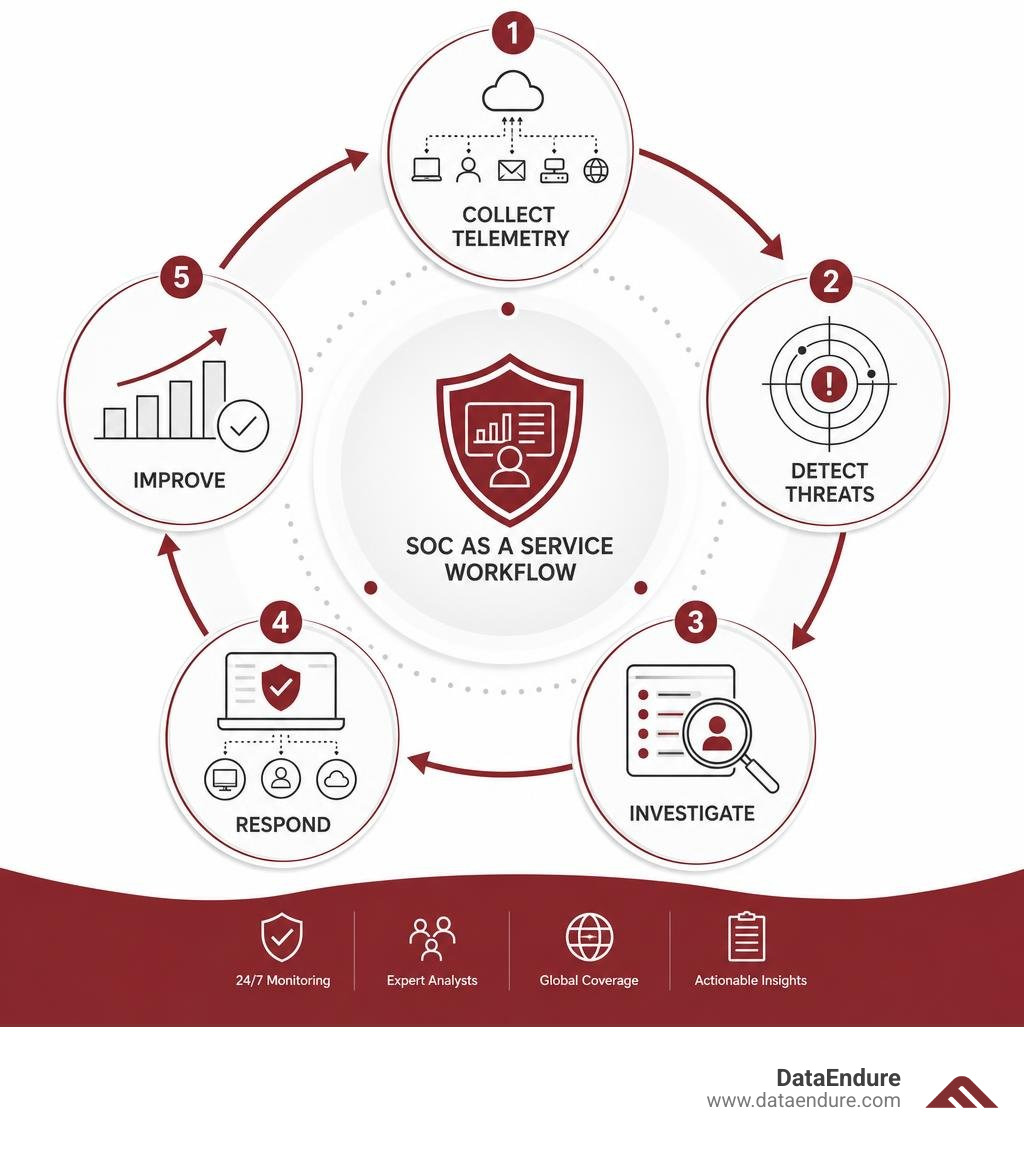
How SOC as a Service Differs from Traditional In-House Security Operations
Building a modern, in-house Security Operations Center requires significant capital expenditure and ongoing operational maintenance. To provide true around-the-clock defense, an internal team must support multiple shifts, weekend rotations, management oversight, and continuous tier-1 to tier-3 escalation paths.
For most organizations, security is not just about purchasing another console—it is about managing people, operational processes, and architectural governance. In an in-house model, your team carries the total burden of engineering detection rules, maintaining SIEM infrastructure, and performing threat research.
When evaluating these approaches, organizations often observe distinct trade-offs across operational capabilities:
| Operational Dimension | In-House Security Operations | Managed SOC as a Service |
|---|---|---|
| Coverage Schedule | Often 8×5 or constrained; 24/7 requires at least 8–12 dedicated analysts | Continuous 24/7/365 coverage delivered by dedicated analyst tiers |
| Financial Model | Heavy CapEx for hardware/licenses, high ongoing OpEx for salaries | Predictable, subscription-based OpEx model |
| Mean Time to Detect (MTTD) | Dependent on internal queue sizes and off-hours availability | Dramatically accelerated via automated correlation and live triage |
| Mean Time to Respond (MTTR) | Slower if on-call staff must be paged outside business hours | Immediate containment and active remediation protocols |
| Infrastructure Overhead | Continuous patch management, data ingestion engineering, and storage maintenance | Fully managed by the service provider |
| Scalability | Slow; requires recruiting, hiring, and onboarding additional staff | Rapid; scales dynamically alongside workload and endpoint shifts |
Industry research shows that the global SOC as a Service market size is expected to grow from $5.2 billion in 2023 to $12.8 billion by 2028, reflecting a compound annual growth rate of 19.7%. This shift is heavily driven by performance outcomes: organizations leveraging outsourced security operations routinely realize a 50% reduction in mean time to detect (MTTD) alongside a 40% reduction in mean time to respond (MTTR).
Core Services, Capabilities, and Continuous Monitoring Architecture
An enterprise-grade SOC service goes beyond simple alert relaying. It unifies ingestion, behavioral analysis, and rapid remediation into a cohesive workflow.
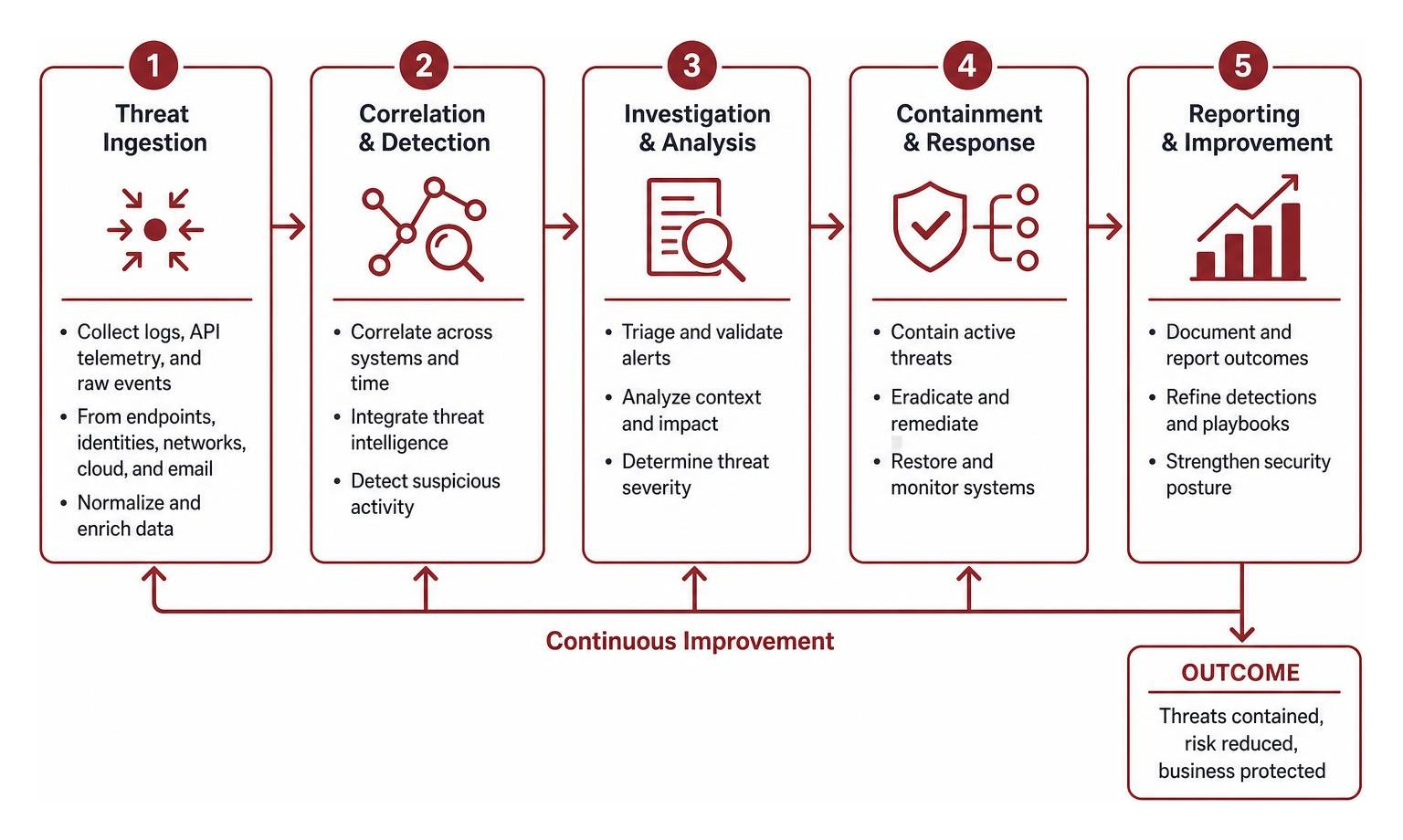
A comprehensive service offering typically includes:
- Continuous Ingestion and Normalization: Aggregating logs, API telemetry, and raw events from endpoints, identities, networks, and cloud environments.
- Threat Intelligence Integration: Correlating global indicator feeds and adversary tactics directly into detection rules.
- Vulnerability and Exposure Management: Assessing risk across systems to catch weaknesses before attackers exploit them.
- Proactive Threat Hunting: Searching your environment for stealthy indicators of compromise that evade basic rule sets.
- Continuous Incident Response: Moving beyond notifications to execute active containment playbooks—such as isolating compromised hosts or revoking unauthorized tokens.
Organizations exploring this operational scope can review The Non-Stop Guide to 24×7 Security Monitoring to understand how continuous surveillance protects digital assets.
How SOC as a Service Solves Critical Staffing and Skills Shortages
Hiring and retaining cybersecurity talent remains a critical hurdle for IT leaders. According to industry surveys, 65% of enterprises plan to adopt SOC as a Service within the next two years to address persistent cybersecurity talent shortages.
Tier-1 security analysts frequently face burnout from repetitive, high-volume alert queues. When analysts leave, internal teams lose institutional knowledge and must spend months recruiting in highly competitive markets—a reality clearly reflected in current 300 Soc Analyst Jobs & Work in Silicon Valley, CA listings.
An external partner absorbs tier-1 alert triage, filters out background noise, and retains specialized tier-3 engineers who handle deep forensic investigations. This frees your internal IT staff to focus on strategic business initiatives, operational optimization, and core infrastructure projects rather than triaging thousands of daily alerts.
Essential Criteria for Comparing SOC Providers
Selecting the right partner requires assessing how their operations align with your overall technology architecture. A common pitfall is assuming that adding or replacing isolated software tools will solve operational challenges. Sustainable security requires harmonizing people, processes, system architecture, and governance.

Key evaluation factors include:
- Service Level Agreements (SLAs): Look for concrete commitments regarding mean time to acknowledge, triage, and contain active incidents.
- Noise Reduction Capabilities: Providers should show demonstrable improvements in detection accuracy; mature operations often achieve a 60% improvement in threat detection accuracy and a 70% decrease in false positives.
- Continuous Threat Exposure Management (CTEM): The provider should actively identify misconfigurations, shadow assets, and unpatched attack vectors.
- Tool Rationalization: The service must complement and maximize existing investments rather than forcing a disruptive, total infrastructure replacement.
Threat Detection Accuracy, MTTD, and MTTR Metrics
Detection speed is meaningless if your team is overwhelmed with false alarms. When evaluating prospective providers, ask for real-world metrics that illustrate their detection engineering maturity.
A mature SOC provider uses cross-layer behavioral correlation rather than basic threshold-based alerts. By synthesizing identity telemetry with endpoint and cloud actions, analysts can distinguish between legitimate administrative tasks and malicious lateral movement in minutes.
To explore how these capabilities work in practice, read our guide on managed detection and response (MDR).
Integrating Existing Infrastructure with SOC as a Service
Enterprises operate interconnected IT ecosystems where decisions in one domain influence security, resilience, performance, and complexity across the entire environment. A capable SOC partner must integrate across your existing infrastructure:
- Endpoint and Server Fleets: Ingesting telemetry from legacy endpoints, modern virtual machines, and remote systems.
- Identity and Access Providers: Correlating authentication traffic from platforms like Microsoft Entra ID or Okta to intercept credential abuse.
- Cloud Environments: Monitoring multi-cloud resources across AWS, Azure, and Google Cloud Platform via native APIs.
- Network Infrastructure: Integrating firewalls, VPNs, DNS logs, and switches to maintain visibility over internal and perimeter traffic.
Regulatory Compliance, Data Governance, and Risk Mitigation
Security operations must align with industry compliance mandates, such as HIPAA, PCI-DSS, SOC 2, and NIST frameworks. A provider should simplify these compliance obligations by delivering structured audit logs, tamper-proof event retention, and automated compliance reporting.
Furthermore, verify that the partner adheres to rigorous data governance standards. Confirm that customer telemetry is handled with strict role-based access controls, robust encryption, and well-defined data residency boundaries.
For additional guidance on finding an aligned provider, review our insights on finding the best managed SOC provider for your business.
Pricing Models and Total Cost of Ownership Analysis
Evaluating the financial structure of SOCaaS involves reviewing both visible service costs and the broader total cost of ownership (TCO). Industry data demonstrates that SOC as a Service can reduce overall security operations costs by up to 45% compared to building an in-house SOC.

An internal SOC requires high ongoing expenses: specialized salaries, benefits, retention bonuses, continuous training, SIEM software licensing, data storage fees, and dedicated facilities. An outsourced model converts these variable, unpredictable expenditures into a consistent, predictable operational investment.
Pricing Structures and Hidden Cost Factors
Providers use different pricing models, and understanding these structures helps prevent unexpected expenses:
- Per-User or Per-Endpoint Metrics: Predictable models that scale directly with your organization’s actual headcount or device footprint.
- Data Ingestion (Per-Gigabyte/Per-Day): Ingestion-based models can result in variable, unpredictable billing if sudden spikes in network log activity occur.
- Incident Surcharges: Some vendors bill extra for hands-on remediation or off-hours escalations, whereas comprehensive platforms include continuous incident response in the core agreement.
To better navigate these operational factors, explore how managed security services structure ongoing management and support.
Evaluating ROI, Cost Reductions, and Operational Impact
The return on investment extends well beyond software license savings. By accelerating response times and reducing operational friction, an effective SOC provider delivers tangible business outcomes:
- Minimized Breach Impact: Rapid containment drastically curtails dwell time, limiting operational downtime and regulatory fines.
- Maximized Technology Investments: Experienced analysts tune the security tools you already own, extracting maximum value from your current stack.
- Cyber Insurance Advantages: Demonstrating 24/7 managed monitoring and active containment capabilities satisfies stringent underwriting requirements, often securing more favorable policy terms.
- Operational Focus: Your internal IT and systems engineers spend less time chasing false positives and more time improving operational resilience and supporting core business goals.
Frequently Asked Questions About Managed Security Operations
What is the typical onboarding timeline when transitioning to an external SOC?
While traditional implementations can take three to six months, agile platforms deploy in approximately 30 days. Onboarding involves deploying collectors, connecting cloud and identity APIs, establishing log ingestion baselines, tuning detection rules to reduce noise, and validating incident escalation workflows with your internal IT team.
How do outsourced SOC teams handle proprietary data privacy and regulatory compliance?
Reputable SOC providers use secure, isolated telemetry pipelines that collect metadata, security events, and performance indicators without inspecting sensitive payload contents. Telemetry is encrypted in transit and at rest, stored in compliance with local data residency mandates, and governed by strict role-based access policies.
What is the difference between standard MDR and a full SOC service offering?
Standard MDR often focuses primarily on endpoint detection and host isolation. In contrast, a comprehensive SOC service aggregates telemetry across your entire digital environment—including email, identity, DNS, cloud infrastructure, and networks. It also provides broader governance support, threat exposure management, and strategic security guidance.
Conclusion: Selecting the Right Security Partner
Selecting a managed security partner is a strategic architectural decision. Organizations need a flexible, reliable defense that strengthens operational resilience without adding unnecessary complexity or straining internal staff.
DataEndure brings more than 40 years of technology and cybersecurity experience to help organizations build digital resilience across security, compliance, data, cloud, network, and infrastructure. We offer a tailored portfolio of solutions—including Endpoint Protection, MDR, XDR, Open XDR, and our flagship Delta Detection & Response (DeltaDR).
Delta Detection & Response benefits include adaptive protection, an evergreen stack, continuous incident response, multi-layered defense, faster detection and recovery, cross-layer correlation, 5-to-50,000 endpoint scale, flexible adoption, and 30-day onboarding.
How is your organization currently managing 24×7 threat visibility and incident response? If you are evaluating ways to streamline your security operations and maximize your existing investments, explore our approach to SOC as a Service or connect with our team to start a conversation.