Why Cryptography in Cloud Computing Is Your Last Line of Defense
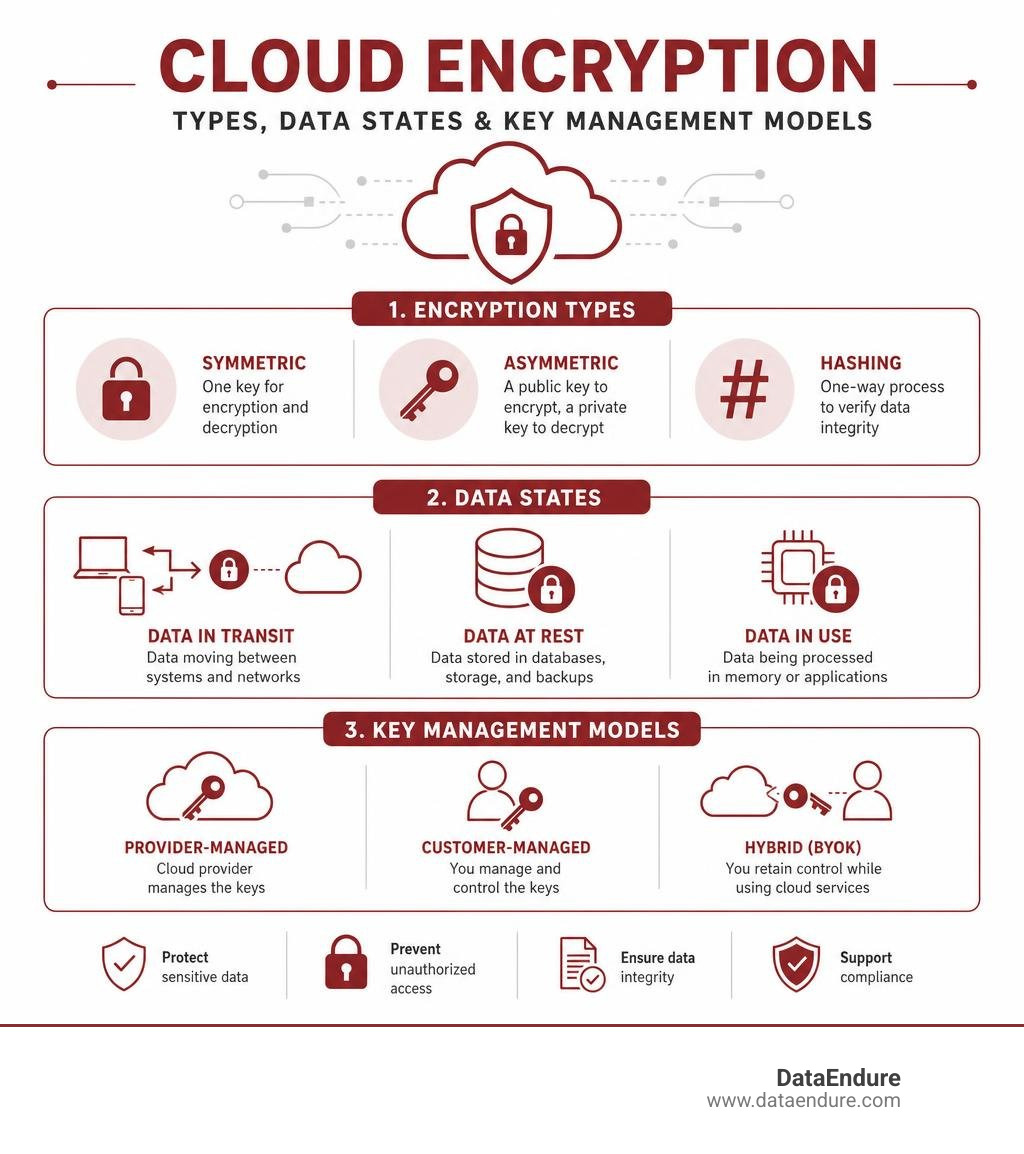
Cryptography in cloud computing is the practice of using encryption and secure key management to protect data stored, transmitted, and processed in cloud environments — turning readable information into scrambled ciphertext that only authorized parties can unlock.
If you’re trying to get up to speed fast, here’s the core of what you need to know:
- What it does: Scrambles sensitive data so it’s unreadable without the correct decryption key
- Where it applies: Data in transit (moving between systems), data at rest (stored in the cloud), and data in use (being actively processed)
- Key methods: Symmetric encryption (AES, 3DES), asymmetric encryption (RSA, DSA), and cryptographic hashing (SHA-256, SHA-512)
- Why it matters: It protects against breaches, detects unauthorized changes, and helps meet regulations like GDPR, HIPAA, and PCI DSS
- Who manages the keys: Either your cloud provider, your own team, or a hybrid model — and that choice has major security implications
When sensitive data moves to the cloud, it leaves the protective boundaries of your on-premises infrastructure. Firewalls and access controls alone can’t follow it everywhere it travels. A single phishing email, a misconfigured storage bucket, or a compromised credential can expose millions of records in minutes.
Traditional perimeter security wasn’t built for this. The cloud is fluid — data moves across regions, services, and providers constantly. That creates gaps that attackers actively look for.
Cryptography closes those gaps by protecting the data itself, not just the environment around it. Even if an attacker gets in, encrypted data is useless without the keys. For IT leaders in regulated industries already navigating breach recovery, compliance audits, and staff shortages, this distinction is critical.
This guide walks you through how cloud cryptography works, which algorithms and models to use, and how to implement it without crippling performance or adding operational burden your team can’t absorb.
Relevant articles related to cryptography in cloud computing:
What is Cryptography in Cloud Computing?
At its core, cryptography in cloud computing is the science of securing data as it moves through external infrastructures. It works by taking plaintext (your readable, everyday data, like a customer’s credit card number or a patient’s medical history) and running it through complex mathematical algorithms to convert it into ciphertext. This ciphertext is a randomized, scrambled string of characters that is entirely unreadable to anyone who does not possess the matching decryption key.
When we talk about securing cloud systems, we rely on cryptography to deliver four foundational security pillars:
- Data Privacy and Confidentiality: Ensuring that unauthorized third parties — whether they are cybercriminals, malicious insiders, or even the cloud service provider (CSP) itself — cannot read your sensitive data.
- Data Integrity: Confirming that your data has not been altered, corrupted, or tampered with during transmission or storage.
- Authentication: Verifying the identity of users, devices, and systems attempting to access cloud resources.
- Non-Repudiation: Providing proof of the origin and delivery of data, making it impossible for a sender or receiver to deny executing a specific transaction.
Implementing these pillars is a central part of any robust cybersecurity strategy. To understand how these cryptographic concepts fit into a broader cloud protection framework, you can read our Detailed Guide to Cloud Security.
The Role of Cryptography in Cloud Computing for Data Integrity
Many people view encryption solely as a tool for keeping secrets. However, its role in maintaining data integrity is just as vital. When files are stored in shared cloud environments, they are vulnerable to silent corruption, misconfigurations, and active tampering.
Cloud cryptography addresses these threats using cryptographic hashes and digital signatures. When you upload a file to the cloud, the system generates a unique mathematical “fingerprint” of that data. If even a single character in that file is altered — whether by a malicious actor during a cyberattack or due to a hardware failure on the provider’s server — the resulting fingerprint changes completely.
This capability is essential for:
- Unauthorized Change Detection: Instantly alerting security teams if an unauthorized party modifies configuration files, databases, or application code.
- Data Corruption Detection: Verifying that backups and archives remain perfectly intact over time.
- Cyberattack Defense: Preventing attackers from injecting malicious code into data streams or manipulating transaction records.
For a deeper dive into how government agencies and enterprise organizations structure their defense-in-depth strategies using these principles, you can review the Canadian Centre for Cyber Security’s ITSP.50.106 Guidance on Cloud Service Cryptography.
Shared Responsibility and Cloud Cryptography
One of the most common mistakes IT leaders make is assuming that because they use a secure cloud provider, their data is automatically protected. In reality, cloud security operates under a Shared Responsibility Model.
The cloud service provider is responsible for the security of the cloud — the physical datacenters, the hypervisors, and the foundational networking infrastructure. You, the cloud consumer, are responsible for the security of your data in the cloud. This includes configuring encryption, managing access controls, and securing your cryptographic keys.
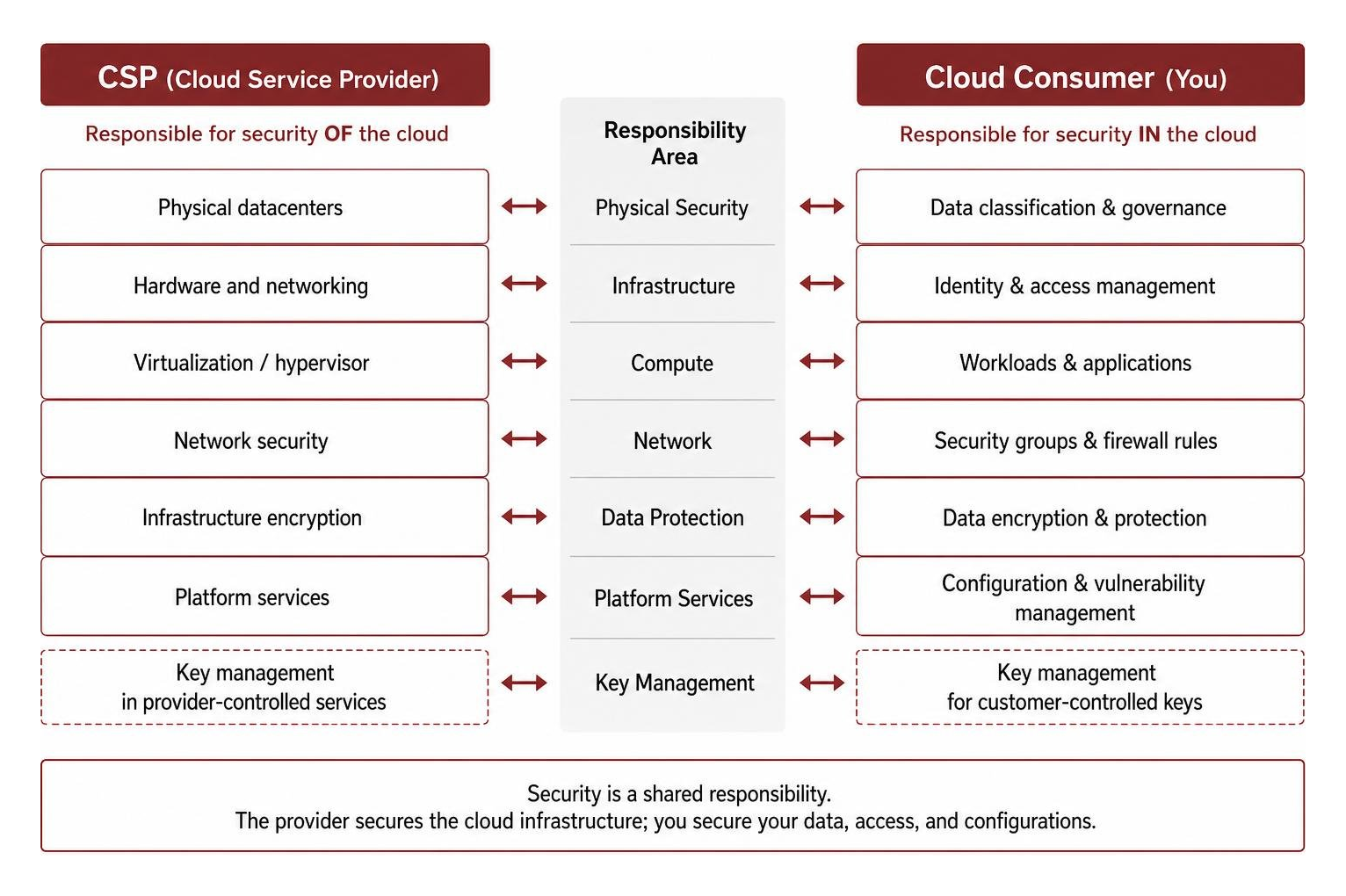
If you configure a storage bucket to be publicly accessible, or if you fail to enable encryption on a database, the CSP’s underlying security controls cannot protect you. This makes understanding who controls which cryptographic functions essential. To learn more about how this division of labor impacts your day-to-day security posture, check out our analysis on Who Shares the Responsibility for Cloud Security?.
Core Encryption Types and Cryptographic Algorithms
To build an effective strategy for cryptography in cloud computing, you must understand the different tools at your disposal. Modern cloud platforms rely on three primary cryptographic methods: symmetric encryption, asymmetric encryption, and hashing.
Each method serves a distinct purpose, and they are frequently used together to create a secure environment. For instance, a cloud service might use asymmetric encryption to safely exchange keys, symmetric encryption to scramble bulk data, and hashing to verify data integrity.
To help visualize the differences between the two main encryption types, consider this comparison:
| Feature | Symmetric Encryption | Asymmetric Encryption |
|---|---|---|
| Key Usage | Uses a single, shared secret key for both encryption and decryption. | Uses a mathematically linked key pair: a public key and a private key. |
| Performance | Fast and computationally lightweight; ideal for large datasets. | Slower and computationally intensive; used for small data packages. |
| Primary Use Cases | Databases, file storage, bulk data-at-rest encryption. | Key exchange, digital signatures, identity authentication. |
| Key Management | Highly complex; keys must be securely distributed to all authorized parties. | Simpler distribution; the public key can be shared openly with anyone. |
To explore how these methods integrate into broader enterprise security plans, visit our dedicated page on Encryption.
Symmetric Key Cryptography
Symmetric key cryptography is the workhorse of cloud storage. Because it uses the same key to encrypt and decrypt data, it is incredibly fast and highly efficient. This makes it the only practical option for encrypting massive databases, virtual machine disks, and large file repositories.
The most widely recommended symmetric algorithm in cloud computing is the Advanced Encryption Standard (AES), specifically with a key length of 256 bits (AES-256). AES-256 is the global standard for securing sensitive data, trusted by governments, financial institutions, and military organizations.
Other symmetric algorithms include Data Encryption Standard (DES) and Triple DES (3DES). However, DES is entirely obsolete due to its short key length, and 3DES is phased out in modern cloud environments because of performance limitations and security vulnerabilities. When designing cloud architectures in 2026, AES-256 should always be your default choice for automated, high-performance data-at-rest encryption.
Asymmetric Key Cryptography
Asymmetric cryptography, also known as public-key cryptography, solves the problem of key distribution. Instead of sharing a single secret, it uses two distinct keys:
- Public Key: Can be shared openly with anyone. Anyone can use this key to encrypt data intended for you.
- Private Key: Must be kept strictly secret. Only this key can decrypt the data encrypted by its corresponding public key.
Common asymmetric algorithms used in cloud environments include RSA (Rivest-Shamir-Adleman), DSA (Digital Signature Algorithm), and Diffie-Hellman.
In the cloud, asymmetric cryptography is primarily used for:
- Secure Key Exchange: Establishing secure connections over public networks (like the internet) without sending secret keys in plaintext.
- Digital Signatures: Verifying that a message or software update actually came from the claimed sender and was not altered in transit.
- Identity Authentication: Securing SSH connections and verifying user identities in cloud management consoles.
Cryptographic Hashing and Tokenization
Unlike symmetric and asymmetric encryption, cryptographic hashing is a one-way street. A hashing algorithm takes an input of any size and converts it into a fixed-length string of characters. You cannot reverse-engineer a hash to retrieve the original data.
Common hashing algorithms used in cloud computing include SHA-256 and SHA-512 (Secure Hash Algorithms). Hashing is primarily used for password storage, database indexing, and generating checksums to verify file integrity.
It is also important to distinguish encryption from tokenization. While encryption uses mathematical algorithms to scramble data into ciphertext that can later be decrypted, tokenization completely replaces sensitive data with a non-sensitive substitute called a “token.” This token has no mathematical relationship to the original data; instead, the original data is stored in a highly secure, centralized database called a token vault.
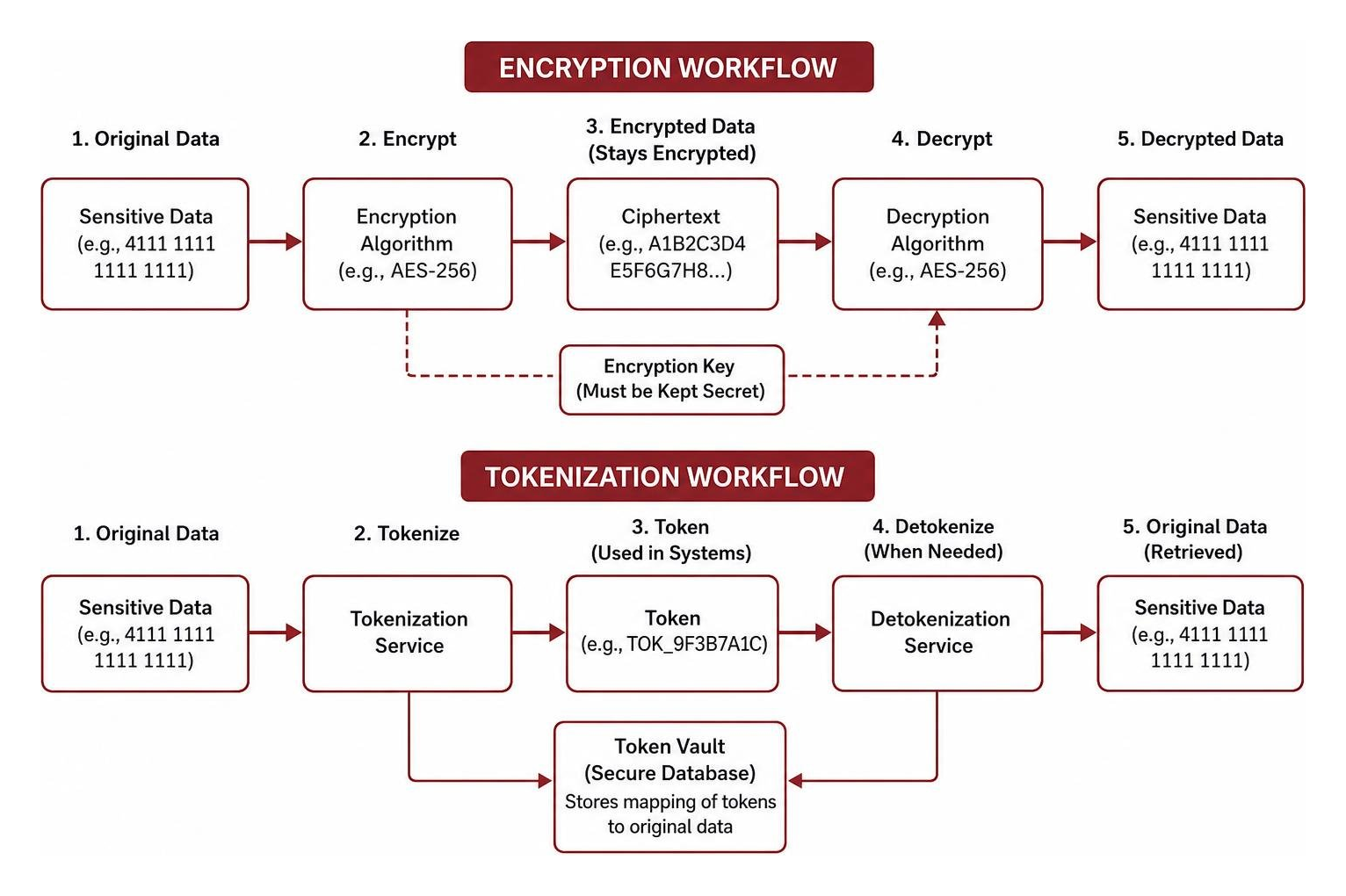
Tokenization is highly valuable for cloud applications because it can drastically reduce your regulatory compliance scope. For example, under PCI DSS, if an application processes tokens instead of actual credit card numbers, that application may be completely exempt from expensive and time-consuming compliance audits.
Securing Data Across Three States in the Cloud
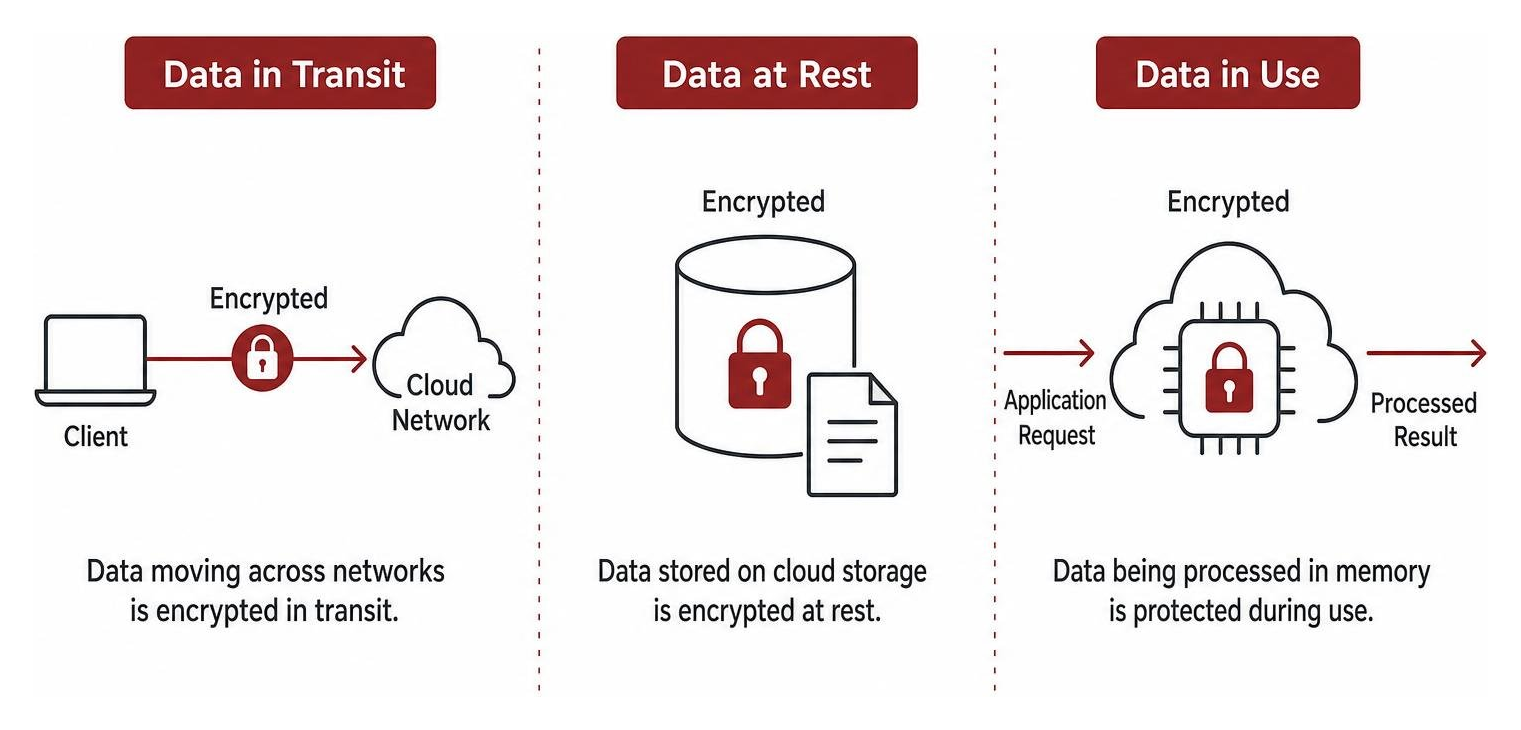
To protect your cloud ecosystem comprehensively, you must secure your data across all three of its primary lifecycle states: in transit, at rest, and in use. A failure to encrypt data in even one of these states leaves a massive blind spot that attackers can exploit.
Protecting Data in Transit
Data in transit is any information moving across networks — whether it is traveling from an on-premises office to a public cloud, moving between two virtual machines in the same virtual private cloud (VPC), or flowing between a user’s web browser and a cloud service.
To ensure transmission confidentiality and prevent eavesdropping or man-in-the-middle attacks, you must enforce strong cryptographic transport protocols. This is achieved by:
- Enforcing HTTPS (Hypertext Transfer Protocol Secure) across all web applications and APIs.
- Using modern Transport Layer Security (TLS) protocols (specifically TLS 1.3) and disabling outdated, vulnerable protocols like SSL and older TLS versions.
- Establishing secure virtual private networks (VPNs) using IPSec or TLS to connect physical offices to cloud resources.
Protecting Data at Rest
Data at rest is information stored on physical disks, in database tables, or as objects in cloud storage buckets. Securing this data is critical for defending against physical theft of hard drives, unauthorized access by other tenants on shared physical hardware, and accidental exposure via misconfigured access policies.
To implement robust data-at-rest protection, organizations should leverage:
- Transparent Database Encryption (TDE): Automatically encrypting database files, logs, and backups without requiring changes to application code.
- Column-Level Encryption: Encrypting highly sensitive database columns (like Social Security numbers or passwords) individually, ensuring that even database administrators cannot view the raw data without authorized keys.
- Virtual Disk Encryption: Encrypting the virtual hard drives associated with your cloud virtual machines.
- Cloud Storage Cryptography: Enforcing server-side encryption on all object storage buckets (such as AWS S3 or Google Cloud Storage) by default.
Protecting Data in Use with Confidential Computing
For years, securing data in use was the hardest challenge in cloud security. To process, analyze, or run calculations on encrypted data, an application historically had to decrypt it into the system’s random-access memory (RAM). During that processing window, the plaintext data was vulnerable to memory-scraping attacks, compromised hypervisors, and rogue cloud administrators.
Confidential Computing solves this problem by using hardware-based security to encrypt data in memory while it is being processed. This technology creates a secure enclave — an isolated execution environment inside the CPU. The data is decrypted only inside this enclave, completely hidden from the rest of the operating system, hypervisor, and cloud provider.
Organizations can leverage advanced tools like the Google Cloud Split-trust Encryption Tool | Confidential Computing | Google Cloud Documentation to manage secure data transfers in and out of these confidential environments. Through remote attestation, the system can cryptographically verify that the workload is running in a genuine, untampered secure enclave before releasing the decryption keys, ensuring absolute control over your most sensitive processing tasks.
Key Management Models: Who Holds the Keys?
In cryptography in cloud computing, the strength of your encryption is only as good as the security of your cryptographic keys. If an attacker steals your keys, your encryption is completely useless. This makes key lifecycle management — including key creation, rotation, access control, and destruction — the most critical aspect of cloud data protection.

When designing your key management strategy, you must choose who controls and manages the keys. To explore how major cloud providers structure these systems, you can read about Cloud Key Management | Google Cloud.
CSP-Managed vs. Consumer-Managed Keys
There are two primary approaches to managing keys within cloud services:
- CSP-Controlled and Managed: The cloud provider automatically generates, rotates, and stores the encryption keys. This is the easiest, most seamless option, requiring zero effort from your team. However, it requires you to place absolute trust in the provider, as they technically have the ability to decrypt your data.
- Customer-Managed Encryption Keys (CMEK): The keys are stored in the cloud provider’s Key Management Service (KMS), but your organization retains administrative control over them. You decide when to rotate the keys, who has access to them, and you can instantly revoke access to disable decryption capability. This model enforces a strict separation of duties between key administrators and data administrators.
Bring Your Own Key (BYOK) and External Key Management
For highly regulated organizations that cannot trust a cloud provider to hold their keys, more advanced models are available:
- Bring Your Own Key (BYOK): You generate your cryptographic keys on-premises using a local Hardware Security Module (HSM) and securely import them into the cloud provider’s KMS.
- External Key Management (EKM): Your encryption keys never enter the cloud provider’s infrastructure. Instead, they remain stored in an external, physical key manager that you control. When the cloud service needs to decrypt data, it must send a request to your external key manager, which evaluates access policies and key access justifications before allowing the operation.
By splitting trust between your external key manager and the cloud provider, you ensure that neither party can unilaterally access your data.
Balancing Security, Performance, and Compliance
Implementing robust cloud cryptography is not just about choosing the strongest possible algorithms; it requires finding a practical balance between security, performance, and regulatory compliance.
For organizations operating in regulated sectors, encryption is not optional. It is a core requirement for complying with major standards:
- GDPR (General Data Protection Regulation): Mandates the protection of personal data and views encryption as a primary method for mitigating risk.
- HIPAA (Health Insurance Portability and Accountability Act): Requires safeguarding protected health information (PHI) both at rest and in transit.
- PCI DSS (Payment Card Industry Data Security Standard): Enforces strict encryption standards for all stored and transmitted cardholder data.
- FIPS/FISMA: Requires federal agencies and contractors to use validated cryptographic modules (such as FIPS 140-2 Level 3 HSMs) to protect government information.
To evaluate your current compliance posture and identify security gaps, you can schedule a comprehensive Cloud Security Assessment.
Overcoming the Drawbacks of Cryptography in Cloud Computing
While the benefits of cryptography are undeniable, it does introduce practical challenges that organizations must actively manage:
- Performance Overhead: Cryptographic operations require CPU cycles. If not properly optimized, encrypting and decrypting every database query can introduce latency and degrade user experience.
- Scalability and Infrastructure Costs: Running dedicated hardware security modules or managing complex key management architectures across multi-cloud environments can increase your cloud bill.
- Data Recovery Risks: If you manage your own keys and lose them, your data is permanently gone. There is no password reset option for lost master encryption keys.
To successfully navigate these challenges and scale your cloud infrastructure efficiently, explore our resources on Cloud Computing in Motion: Balancing Cost, Outcomes and Innovation.
Preparing for Post-Quantum Cryptography in 2026
As we look ahead, the cryptographic landscape is facing its biggest shift in decades. The rapid progression of quantum computing poses a significant threat to modern public-key cryptography. Quantum computers will eventually be powerful enough to easily break standard asymmetric algorithms like RSA and Diffie-Hellman.
While practical, cryptanalytically relevant quantum computers are still in development, the threat is real today because of “harvest now, decrypt later” attacks, where adversaries steal encrypted data now with the intent of decrypting it once quantum technology matures.
To defend against this future threat, organizations must begin transitioning to quantum-resistant cryptography (also known as post-quantum cryptography). Advanced cryptographic libraries are already introducing schemes like Covercrypt and Kyber hybridization, allowing organizations to layer post-quantum algorithms on top of their existing security controls.
To understand why your data security strategy must evolve to address these emerging risks, you can read more on Why Data Security in the Cloud Needs to Evolve – Fortanix and explore the technical implementation of post-quantum access policies in the Covercrypt Post-Quantum Encryption with Access Policies – Eviden Technical Documentation.
Frequently Asked Questions about Cloud Cryptography
What is the difference between encryption and tokenization in cloud security?
Encryption uses mathematical algorithms and cryptographic keys to scramble plaintext into ciphertext, which can be decrypted back into its original form by anyone holding the correct key. Tokenization, on the other hand, replaces sensitive data with a randomly generated, non-sensitive placeholder called a token. The actual sensitive data is stored securely in an off-site database vault. Tokenization is highly effective for reducing compliance scope because the tokens themselves contain no sensitive data and cannot be mathematically decrypted.
How does crypto-shredding work in cloud environments?
Crypto-shredding is a highly reliable method for sanitizing cloud storage media before it is released back into a shared resource pool. Instead of trying to overwrite or physically destroy a hard drive in a cloud provider’s remote datacenter, you simply delete the cryptographic keys associated with the encrypted data. Without the keys, the ciphertext remaining on the physical media becomes permanently unrecoverable, effectively destroying the data in seconds.
Why should organizations avoid proprietary cryptographic algorithms?
Proprietary or “homegrown” cryptographic algorithms should always be avoided because they have not undergone rigorous, independent peer review by the global scientific and cybersecurity communities. They often rely on “security through obscurity,” which easily crumbles under professional analysis. Approved, industry-standard algorithms like AES-256 have been subjected to decades of intense public threat analysis, ensuring they contain no hidden weaknesses or back doors.
Secure Your Digital Future with DataEndure
Implementing cryptography in cloud computing is not a one-time project; it is a continuous commitment to digital resilience. For many IT leaders, trying to design, deploy, and manage complex encryption architectures across multi-cloud environments can lead to tool sprawl, configuration errors, and operational overhead.
At DataEndure, we focus on alignment and clarity. With over 40 years of experience building digital resilience across security, data, cloud, network, and infrastructure, we help organizations identify security blind spots and manage operational burdens.
We take a collaborative, vendor-agnostic approach, leveraging our ecosystem of partners to deliver curated, layered security solutions tailored to your unique business outcomes. Our managed cybersecurity solutions are designed to deploy efficiently, helping teams detect and respond to potential issues using skilled experts to support your organization’s resilience.
To learn more about simplifying your cloud security and protecting your critical assets, contact us today.