Why Container Vulnerability Scanning Matters for Software Supply Chains
Container vulnerability scanning checks container images for known flaws, exposed secrets, malware, unsafe configurations, and outdated packages before they reach production. A practical program scans images at build time, applies deployment rules for critical findings, generates an SBOM, and keeps registry images under continuous review as new vulnerabilities are disclosed.
The challenge is that one image may include a base operating system, application libraries, nested archives, and code from many sources. A SIEM-only approach can help investigate activity after deployment, but it typically does not provide the pre-deployment controls needed to keep a known vulnerable package or hard-coded credential from entering an image registry. Tool sprawl can also leave teams with alerts but no clear owner or remediation path.
Effective scanning connects development, security, and operations. It gives teams a shared inventory of image contents, risk-based findings, and clear rules for when to patch, accept, or block an image.
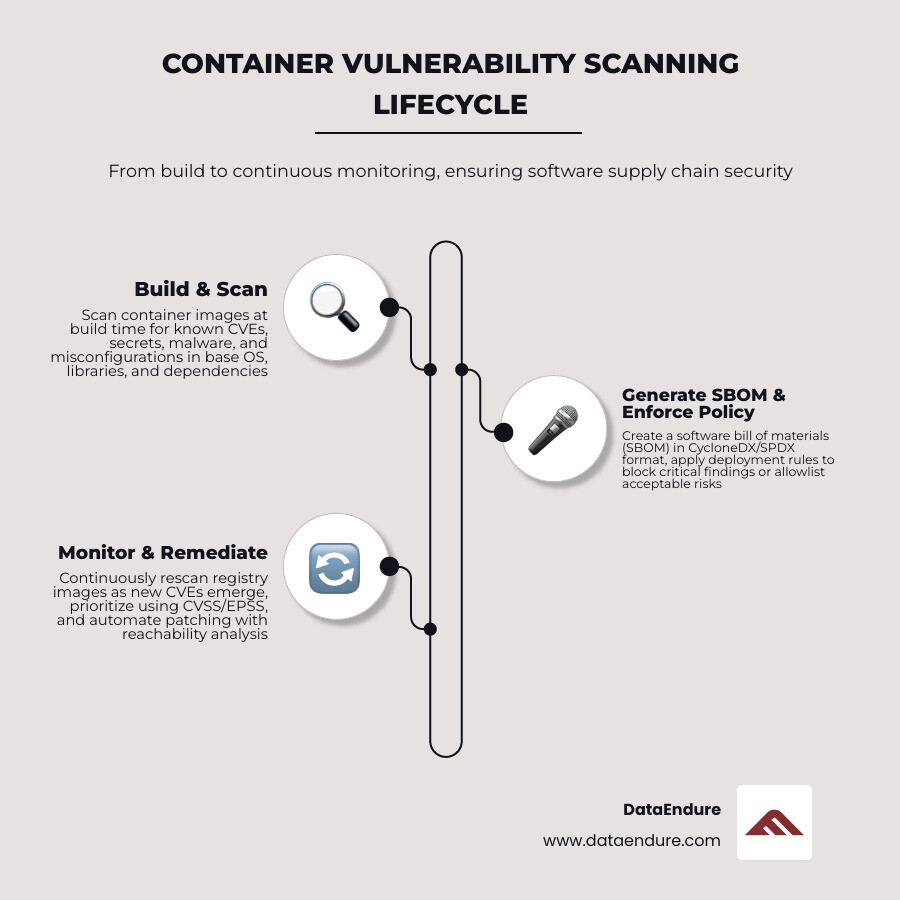
What Is Container Vulnerability Scanning and Why It Matters

Modern application workloads rely heavily on open-source components, third-party libraries, and shared base images. Because containers package the operating system user space alongside application binaries, any security flaw present in the system packages or application runtimes travels directly with the deployment artifact. Many teams use structured inspection points to reduce the likelihood that severe exposures reach production clusters, reinforcing broader strategies to address 7 Ways to Prevent Top Cloud Security Threats.
Scanning addresses key security exposures across four main areas:
- Known Common Vulnerabilities and Exposures (CVEs): Flaws recorded in databases such as the National Vulnerability Database (NVD), GitHub Advisory Database (GHSA), and distribution trackers like Red Hat RHSAs, Debian CVE Tracker, and Alpine SecDB.
- Embedded Secrets: Hard-coded private keys, cloud service account credentials, and API tokens accidentally bundled during the build step.
- Malicious Packages: Direct malware or compromised upstream open-source packages tracked by repositories such as the OpenSSF Malicious Packages Repository.
- Infrastructure Misconfigurations: Unsafe container runtime settings, such as running default root users or enabling unnecessary Linux capabilities.
The Core Mechanics of Container Vulnerability Scanning
Container scanners inspect images layer by layer. An Open Container Initiative (OCI) or Docker image consists of stacked filesystem changes (tarballs) topped with configuration metadata.
When an engine analyzes an image, it performs several operational steps:
- Extraction and Layer Analysis: The scanner examines the base layer and subsequent layers, identifying package manifests, package managers (
dpkg,rpm,apk), and application dependency files (package-lock.json,pom.xml,requirements.txt,Gemfile.lock,Cargo.lock). - Deep Archive Inspection: Advanced scanners inspect nested archives—such as
.jar,.war, and.tarfiles—multiple layers deep to find embedded third-party dependencies. - Database Correlation: Extracted component names, package architectures, and exact version strings are matched against curated feeds like NVD, vendor-specific security advisories, and the OpenSSF Malicious Packages Repository. Popular open-source engines like aquasecurity/trivy combine operating system and language-level detection to flag issues quickly across multiple formats.
Static Scanning vs. Continuous Registry Monitoring
Security inspection should occur at two distinct points in the software delivery process: static point-in-time checks and continuous registry monitoring. Aligning these scanning stages with Cloud Security Best Practices 101 helps teams maintain visibility across both build pipelines and deployed environments.
Static, on-demand scanning runs when code changes or during a CI/CD build. It analyzes an image tarball or local Docker daemon image before publication, catching issues before deployment.
Continuous registry monitoring evaluates stored images against newly published vulnerability feeds. A container image deemed secure on Monday might contain a critical zero-day vulnerability disclosed on Thursday, even if its underlying code remains unchanged.
In managed environments like Google Cloud Artifact Analysis, continuous analysis updates image metadata several times a day as new vulnerabilities appear. However, operational retention limits apply: Artifact Analysis updates metadata for images pulled within the last 30 days. After 30 days of inactivity, metadata becomes stale, and after 90 days, it is archived and accessible only via direct API queries. Managing these lifecycles helps teams avoid untracked security debt in running registries.
Common Container Scanning Tools and Frameworks
Selecting a scanning approach involves evaluating integration depth, accuracy, supported package ecosystems, operational ownership, and pipeline performance. The right fit depends on the organization’s existing environment, risk tolerance, compliance requirements, and remediation workflows. Understanding these capabilities helps engineering leaders determine What Cybersecurity Tools Are Essential for My Business? without creating unnecessary operational complexity.
| Scanner / Platform | Primary Delivery Model | Key Vulnerability Databases | Supported Package Formats | Common Capabilities and Considerations |
|---|---|---|---|---|
| Trivy | Standalone CLI, Operator, CI/CD Actions | NVD, GHSA, Red Hat, Debian, Alpine, AlmaLinux, Ubuntu | OS (apk, dpkg, rpm) + Language (Go, Java, Node, Python, Rust, .NET, Ruby, PHP) | Scans containers, filesystems, Git repos, IaC misconfigurations, licenses, and secrets across local and pipeline workflows. |
| Anchore Enterprise | Enterprise Platform, CLI, API Engine | Alpine SecDB, Amazon ALAS, Debian Tracker, GHSA, NVD, Oracle OVAL, SUSE, Ubuntu | Deep OS, language dependencies, nested JARs/WARs | Combines Syft (SBOM) and Grype engines; provides custom Hints and Corrections to tune false-positive rates; FedRAMP-aligned policies. |
| FOSSA Container Scanner | CLI (fossa-cli), Enterprise Platform |
OS Advisories, NVD, open-source license databases | Alpine (APK), Debian (DPKG), RPM, common language ecosystems | Supports licensing compliance, base-layer squashing, and archive analysis (--only-system-deps flags). |
| GitLab Container Scanning | Built-in CI/CD Analyzer | Integrated Trivy Database, GitLab Advisory DB | OS packages default; language packages via custom configuration | Native pipeline integration; multi-container parallel scanning; FIPS-compliant scanning images. |
| Google Artifact Analysis | Managed Cloud Registry Service | NVD, GHSA, OpenSSF Malicious Packages | OS packages (Ubuntu, Debian, Alpine, RHEL) + major language packages | Automatic scan on upload; continuous re-evaluation; integration with Binary Authorization. |
| Falco / Clair / Dagda | Open-source utilities / runtime security | Distribution feeds, CVE trackers | OS packages, runtime system-call inspection | Clair offers static analysis; Falco specializes in Kubernetes runtime behavioral detection rather than static image parsing. |
Open-Source Scanners and Standalone Utilities
Standalone scanners give teams flexibility across local development environments, continuous delivery pipelines, and air-gapped systems.
- Trivy: Developed by Aqua Security, Trivy is widely used due to its broad scanning scope (images, filesystems, Git repos, IaC, and Kubernetes) and fast database synchronization. It works out-of-the-box in local environments without heavy external server dependencies.
- Anchore (Syft & Grype): Anchore’s open-source tooling splits the workflow into distinct components: Syft constructs high-fidelity Software Bills of Materials (SBOMs), while Grype scans those SBOMs against vulnerability databases. Anchore Enterprise adds centralized policy rules, role-based access, and deep file inspection.
- FOSSA CLI: The container capability inside FOSSA’s container scanner — FOSSA Docs allows teams to analyze exported Docker archives, Docker daemon targets, or remote registries. It squashes upper layers to analyze base filesystem components and identify deep licensing obligations alongside security vulnerabilities.
- Clair and Dagda: Clair, maintained within the open-source ecosystem and often integrated into registries like Project Harbor, performs static analysis of app containers. Dagda incorporates ClamAV to pair known CVE detection with antivirus checks.
Integrated CI/CD and Registry Analyzers
Managed cloud registries and continuous integration platforms provide built-in scanning engines that can streamline daily development workflows when they align with existing processes.
GitLab integrates Trivy directly into its native pipelines via the Jobs/Container-Scanning.gitlab-ci.yml template, as outlined in Container scanning | GitLab Docs. GitLab historically supported the Grype analyzer, which is deprecated and slated for complete retirement after GitLab 19.0. In standard GitLab configurations, container scanning evaluates packages managed by the OS package manager (apt, apk, yum, tdnf). To analyze application-level language dependencies, teams set the pipeline variable:
GitLab also enforces registry scan limits (defaulting to 50 scans per project per day) to optimize compute resources. For highly regulated operations, GitLab supplies FIPS-enabled analyzer images (CS_IMAGE_SUFFIX: "-fips"), though authenticated external registries are disabled when FIPS mode is active.
Cloud-native registry analyzers like Google Cloud Artifact Analysis run automatic scans when images are pushed to the registry. When coupled with Google Cloud Binary Authorization, security teams can enforce policies for containers with unapproved critical vulnerabilities before deployment to Google Kubernetes Engine (GKE) clusters.
Integrating Vulnerability Scanners into DevSecOps Pipelines
Shifting container security checks left into the development pipeline helps identify vulnerable workloads before they reach production clusters. A structured DevSecOps pipeline evaluates code, dependencies, and container definitions at each phase of delivery, supporting guidance found in The Modern Enterprise Guide to Robust Cybersecurity Solutions.
- Local Pre-Commit Checks: Developers run quick CLI scans locally on base images before pushing Dockerfiles to source repositories.
- Build-Stage Scanning: The CI pipeline builds the container image, exports the archive, runs a scanner (such as Trivy or FOSSA), and checks findings against organizational risk thresholds.
- Pipeline Gating: The pipeline automatically blocks deployment if unmitigated vulnerabilities meet defined criteria (e.g., CVSS score >= 9.0 with an available upstream fix).
- Registry Admission Control: Cloud platforms verify container cryptographic signatures and attestations (via Binary Authorization or Sigstore/Cosign) before allowing nodes to pull the image.
- Continuous Registry Auditing: Scanners re-evaluate stored images daily against emerging threat intelligence feeds.
Managing False Positives in Container Vulnerability Scanning
Scanning engines frequently generate false positives when identifying backported security fixes, unused library subcomponents, or build-time test packages. Managing this noise helps reduce alert fatigue while maintaining security standards.
- Vulnerability Allowlists: Suppress accepted risks or non-applicable findings using configuration files (such as GitLab’s
vulnerability-allowlist.ymlor Trivy.trivyignore). Teams should document business reasons and expiration dates for every suppressed CVE. - Exploit Prediction Scoring System (EPSS): Prioritize vulnerabilities with high real-world exploitation probability rather than relying strictly on CVSS base severity.
- CISA Known Exploited Vulnerabilities (KEV): Flag vulnerabilities actively leveraged by threat actors in the wild for immediate remediation.
- Hint and Correction Configurations: Platforms like Anchore allow engineering teams to provide descriptive hints for custom in-house libraries, reducing scanner misidentifications without disabling core rules.
SBOM Generation and Risk Prioritization
A Software Bill of Materials (SBOM) provides a complete, machine-readable inventory of software components, dependencies, metadata, and license details within a container image. Standard SBOM formats include CycloneDX and SPDX.
Generating an SBOM during the build step creates an auditable record of all application contents. When new zero-day vulnerabilities emerge, security teams can query their existing SBOM inventory to identify affected images more quickly without rescanning thousands of container images.
Prioritizing findings requires evaluating several operational factors:
- Fix Availability: Filter reports to highlight vulnerabilities that have an official upstream vendor patch available (
--ignore-unfixed). - Network Reachability: Determine whether the affected library component is exposed to external network traffic or used exclusively in isolated internal functions.
- Base Image Updates: Common vulnerabilities can often be addressed by rebasing the application onto minimal, vendor-maintained images (such as Alpine Linux or Google Distroless).
Frequently Asked Questions About Container Security
How does SBOM generation support container vulnerability scanning?
An SBOM acts as a comprehensive software ingredient list. Instead of requiring a scanner to unpack, inspect, and analyze a container filesystem every time a new vulnerability is disclosed, security systems compare newly published CVE signatures directly against the recorded SBOM inventory. This decoupling reduces scan times and enables compliance tracking across complex supply chains.
What is the difference between OS package and language package scans?
OS package scans inspect system-level libraries managed by the Linux distribution’s package manager (apk, dpkg, rpm, tdnf). These include foundational operating system tools like curl, openssl, and glibc.
Language package scans analyze application-level dependencies managed by programming language ecosystems, such as Node.js (npm), Python (pip), Java (maven/gradle), Go (go modules), or Rust (cargo). Comprehensive security scans require visibility into both layers.
How often should container images in registries be rescanned?
Container images in active registries should be re-evaluated continuously or at least once every 24 hours against updated threat intelligence feeds. Because new CVEs are published daily, an image that passed inspection at build time can become vulnerable days or weeks later. Automated registries typically maintain active scanning metadata for images pulled within the last 30 days.
Conclusion
Container scanning is a common control for modern application delivery. By pairing static CI/CD inspection with continuous registry monitoring, organizations can identify software flaws, uncover hard-coded secrets, and reduce the likelihood that unpatched supply-chain vulnerabilities reach production workloads.
Building a resilient security posture requires looking beyond isolated scanner alerts to evaluate baseline cloud environments, CI/CD pipelines, runtime infrastructures, and the security operations processes that connect them. For teams that want a broader view of exposure across people, process, and technology, a structured Vulnerability Assessment can help identify practical gaps, prioritize remediation, and connect container scanning findings to the wider security environment.