Why Cybersecurity Fatigue Solutions Matter in 2026
Finding the right cybersecurity fatigue solutions is an important challenge for IT leaders today. Here is a quick overview of commonly effective approaches:
Quick Answer: Common Cybersecurity Fatigue Solutions
- Reduce alert noise – Tune detection rules, deduplicate alerts, and suppress known false positives to cut daily alert volume.
- Automate low-risk triage – Use AI-assisted tools and SOAR playbooks to handle routine alerts without analyst intervention.
- Simplify employee security tasks – Deploy SSO, password managers, and risk-based MFA to reduce daily friction.
- Fix security training – Replace long annual sessions with short, role-specific micro-learning modules.
- Build a non-punitive culture – Encourage reporting mistakes without fear, so incidents surface faster.
- Measure what matters – Track false positive rates, mean time to investigate, and analyst satisfaction to prove improvement.
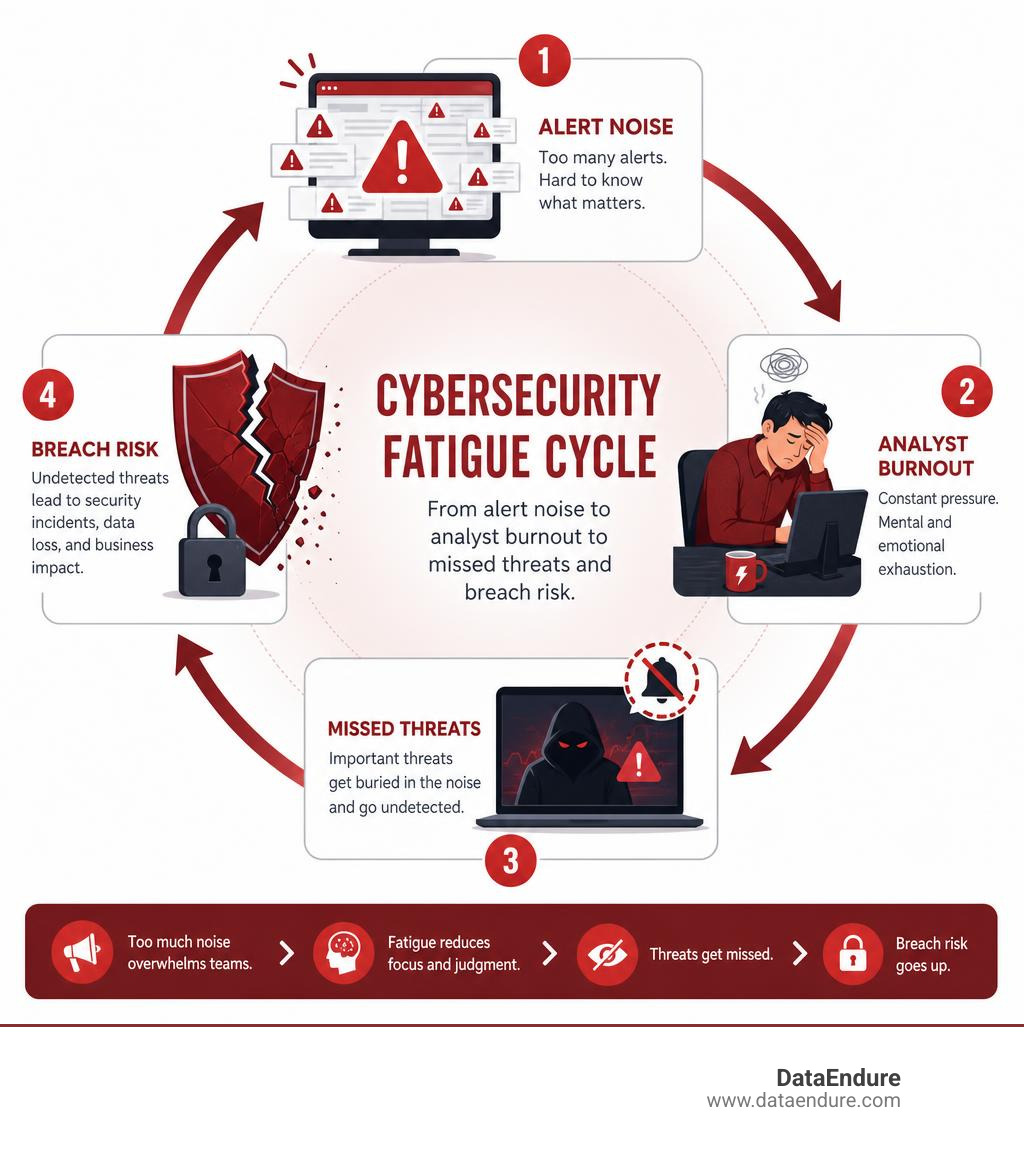
Think about what it feels like to get hundreds of important text messages every single day. Many security teams live a version of that reality. Modern SOC analysts now juggle close to 1,000 alerts per day on average, with enterprise environments pushing well past 10,000 signals. Roughly 40% of those alerts are never investigated at all.
That is not only a technology problem. It is a human one.
When alerts never stop, people can become less responsive. When training comes in waves of jargon-heavy policies, employees may tune it out. When every login triggers an MFA prompt and every week brings a new security reminder, even diligent staff can start taking shortcuts. Researchers at NIST found that this kind of overload – what they call security fatigue – can lead people to make riskier decisions, not out of carelessness, but out of exhaustion.
The consequences are measurable. Two-thirds of cybersecurity professionals reported burnout in 2022. Up to 30% of alerts go completely uninvestigated. And the average data breach now costs organizations $3.86 million, taking 277 days to detect and contain.
For mid-sized organizations in regulated industries already dealing with staff shortages and compliance pressure, fatigue is not just a wellness issue. It is an operational risk factor.
This guide breaks down what cybersecurity fatigue actually is, what causes it, and what you can do about it right now. Whether you are managing a stretched SOC team or trying to re-engage employees who have tuned out security alerts entirely, the solutions here are practical, measurable, and designed to reduce burden without reducing protection.
Cybersecurity fatigue solutions terms you need:
What Cybersecurity Fatigue Is and Why It Weakens Security
Cybersecurity fatigue is the mental, emotional, and operational exhaustion people feel when security demands become too frequent, confusing, disruptive, or difficult to act on.
It affects two major groups:
- Employees, who are expected to remember passwords, spot phishing, approve MFA prompts, complete training, install updates, and follow policies while still doing their actual jobs.
- Security and IT teams, who must investigate noisy alerts, manage tool sprawl, respond to incidents, maintain compliance, and keep the business running.
Alert fatigue is one major form of cybersecurity fatigue. It happens when analysts receive so many notifications that they become desensitized and struggle to separate real threats from background noise.
The business risk is simple: when everything looks urgent, nothing does.
How Cybersecurity Fatigue Shows Up in Employees and Analysts
Cybersecurity fatigue rarely announces itself with a flashing red light. It usually appears as small behavior changes:
- Employees click “remind me later” on updates.
- Users approve MFA prompts without checking the source.
- Staff reuse passwords or store them insecurely.
- Phishing reports decline even as suspicious emails increase.
- People avoid reporting mistakes because they fear blame.
- Analysts delay triage because queues feel impossible.
- Teams become cynical about new tools or policies.
- Help desk tickets spike around password resets, access issues, and confusing controls.
- Burned-out staff show irritability, low engagement, sleep disruption, and reduced vigilance.
For SOC teams, fatigue also shows up in metrics: older queues, rising backlog, more reopened cases, slower escalation, and fewer alerts investigated.
Primary Causes of Cybersecurity Fatigue in the Workplace
Most fatigue is not caused by one bad tool. It is caused by too much friction across the environment.
Common causes include:
- Tool sprawl: Too many disconnected tools create overlapping alerts and duplicate workflows.
- False positives: Low-quality alerts train analysts to distrust the queue.
- Generic thresholds: Default rules often do not match the organization’s actual risk profile.
- Password overload: Complex password rules and frequent resets push people toward shortcuts.
- MFA fatigue: Repeated prompts can make users approve requests on autopilot.
- Training overload: Long, repetitive, jargon-heavy training creates advice fatigue.
- Conflicting guidance: Multiple policy emails from different teams cause confusion.
- Poor workflows: Security tasks interrupt employees instead of fitting into daily work.
- Under-resourced teams: Too few analysts are asked to manage too many signals.
- Cloud and remote complexity: More identities, devices, SaaS apps, and workloads mean more places for alerts to originate.
- Compliance pressure: Controls added for audit purposes can increase burden if they are not designed around usability.
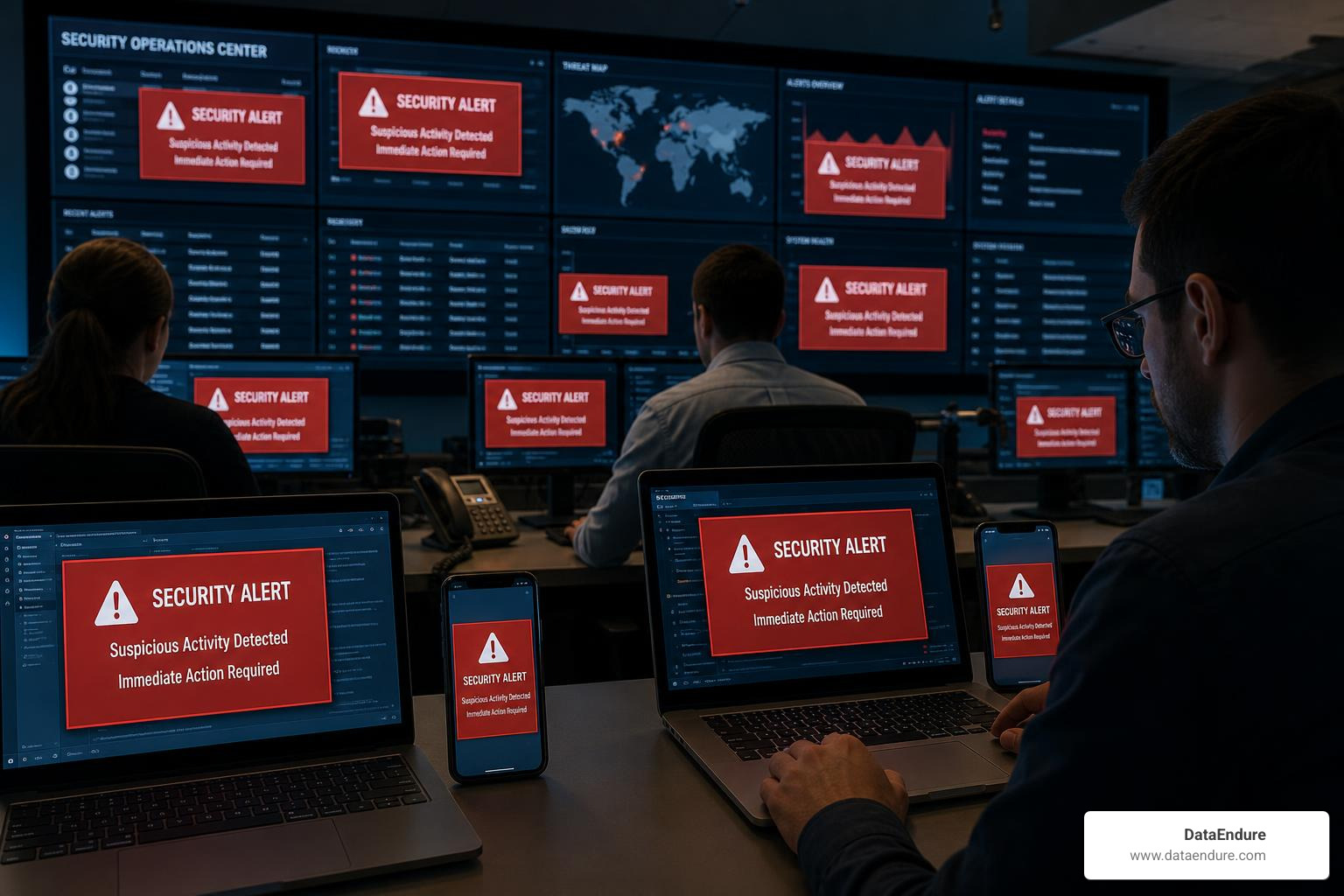
How Fatigue Changes Behavior and Raises Organizational Risk
Fatigue changes how people make decisions. Instead of carefully evaluating each prompt, alert, or policy, they rely on shortcuts.
That can lead to:
- Warning dismissal
- Delayed incident response
- Longer mean time to respond
- Missed alerts
- More successful phishing attacks
- More unreported incidents
- Analyst burnout and turnover
- Compliance gaps
- Operational downtime
- Increased breach exposure
Research cited in security fatigue studies shows that social engineering incidents can become harder to manage when alerts are ignored or untriaged. In some incident response data, 13% of social engineering incidents were traced back to ignored or untriaged alerts, and 60% led to data exposure.
In other words: fatigue is not just an internal productivity problem. It can affect resilience across the organization.
The Four-Component Model Behind Better Cybersecurity Fatigue Solutions
A useful way to understand fatigue comes from the academic paper Encouraging Employee Engagement With Cybersecurity: How to Tackle Cyber Fatigue. The researchers describe cybersecurity fatigue using two dimensions:
- Fatigue type: cognitive or attitudinal
- Fatigue source: action-related or advice-related
This matters because different fatigue types need different fixes. If we treat every fatigue problem as a training problem, we often make the problem worse.
Cognitive vs. Attitudinal Fatigue: What Leaders Need to Know
Cognitive fatigue is about mental overload. People are tired, depleted, or habituated. They stop noticing warnings because they have seen too many similar prompts.
Examples:
- An employee ignores pop-ups because they all look the same.
- An analyst skims alerts because the queue never ends.
- A user approves MFA because they are rushing between meetings.
Best interventions:
- Reduce the number of decisions.
- Add automation.
- Improve alert quality.
- Use secure defaults.
- Give people breaks and protected focus time.
Attitudinal fatigue is about resistance, cynicism, or disengagement. People may feel security is unreasonable, pointless, or blocking their work.
Examples:
- “Security always says no.”
- “These policies are written for auditors, not humans.”
- “I will find a workaround because this process is impossible.”
Best interventions:
- Explain why controls matter.
- Involve employees in workflow design.
- Build psychological safety.
- Use positive reinforcement.
- Improve perceived fairness and usability.
Action-Related vs. Advice-Related Fatigue
Action-related fatigue comes from doing security tasks:
- Password resets
- MFA approvals
- Software updates
- VPN logins
- Access requests
- Manual phishing reporting
- Repetitive alert triage
Advice-related fatigue comes from receiving too much security instruction:
- Annual training marathons
- Policy emails
- Awareness posters
- Phishing reminders
- Compliance briefings
- Conflicting messages from different teams
Good cybersecurity fatigue solutions identify both the type and the source before prescribing a fix.
How to Identify Which Fatigue Type Is Affecting Your Workforce
Use both metrics and conversations. Numbers show where friction exists; employees explain why it exists.
| Fatigue pattern | What it looks like | Useful signals | Best first response |
|---|---|---|---|
| Cognitive fatigue | Mistakes, missed warnings, slow decisions | Alert backlog, help desk spikes, MFA prompt volume | Reduce noise and automate low-value tasks |
| Attitudinal fatigue | Cynicism, resistance, workarounds | Survey comments, policy exceptions, low engagement | Improve communication and involve users |
| Action-related fatigue | Too many required security tasks | Password resets, manual approvals, update delays | Simplify workflows and use secure defaults |
| Advice-related fatigue | Employees tune out messaging | Low training retention, falling phishing reports | Use short, relevant, role-based training |
Also review:
- False positive rate
- Mean time to investigate
- Queue age
- Training completion and quiz quality
- Phishing report rate
- Policy exception requests
- Help desk trends
- Employee pulse surveys
- Manager feedback
- Analyst satisfaction
Cybersecurity Fatigue Solutions for Alert Noise, Tool Sprawl, and SOC Burnout
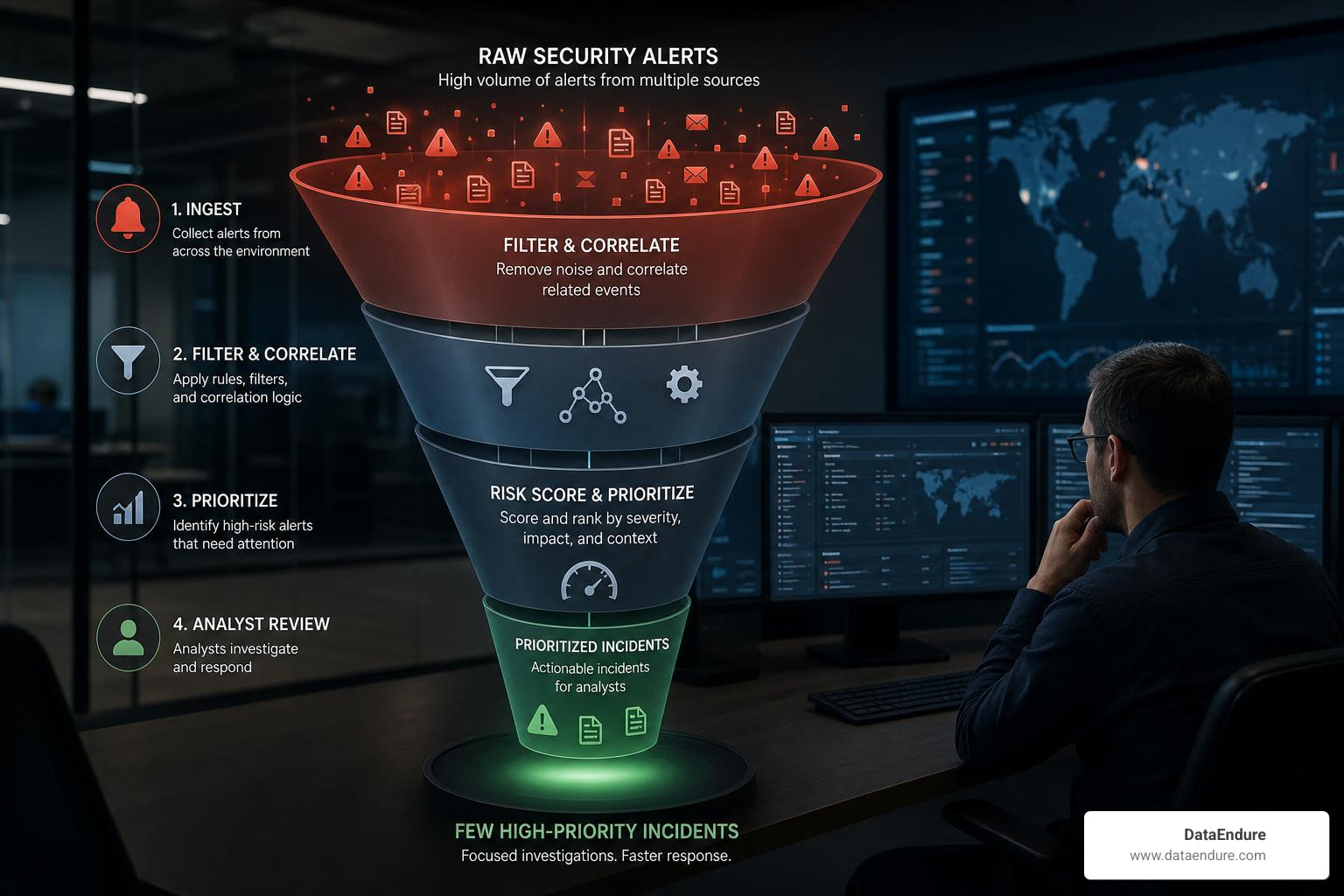
For technical leaders, the biggest wins usually come from reducing alert noise, consolidating context, and helping analysts focus on the alerts that matter.
This is alignment over complexity: fewer blind spots, fewer disconnected tools, and clearer decisions.
For a deeper technical walkthrough, see our guide on reducing alert noise.
Cybersecurity Fatigue Solutions for Reducing Alert Volume
Start by building a baseline. For one week, capture:
- Alert name
- Source tool
- Count
- Severity
- Time spent investigating
- False positive rate
- Asset involved
- Whether action was taken
Then reduce volume through:
- Rule tuning: Adjust noisy detections that do not produce useful findings.
- Threshold optimization: Raise or lower thresholds based on actual behavior.
- Deduplication: Group repeated alerts from the same root event.
- Suppression logic: Suppress known benign patterns with expiration dates.
- Severity normalization: Make “critical” mean critical everywhere.
- MITRE ATT&CK mapping: Tie detections to attacker behaviors, not vague anomalies.
- Asset criticality: Prioritize alerts involving sensitive systems.
- User context: Treat privileged accounts differently from low-risk accounts.
- Threat intelligence: Elevate alerts connected to known active threats.
Cybersecurity Fatigue Solutions for Faster Triage and Response
Reducing alerts is only half the work. The remaining alerts must be easier to investigate.
Useful triage improvements include:
- Automated enrichment with identity, asset, vulnerability, and threat data
- Evidence summaries for analysts
- Clear case routing by severity and skill level
- Escalation paths with service-level targets
- Incident runbooks for common scenarios
- Low-risk auto-closure with audit trails
- Human validation for high-impact actions
- Transparent AI recommendations that show the evidence behind the decision
The goal is not to replace analysts. It is to remove the repetitive work that keeps them from making higher-value decisions.
Our perspective on operational relief is covered further in Cyber Response Fatigue Relief in Sight.
Alert Fatigue Tools Technical Leaders Should Evaluate
When evaluating alert fatigue tools, focus on capability categories and operational fit.
Look for:
- SIEM for centralized log collection and correlation
- SOAR for workflow automation and response playbooks
- UEBA for behavior analytics
- XDR for cross-domain detection and correlation
- EDR for endpoint detection and response
- NDR for network detection and response
- CNAPP for cloud-native application protection
- IAM analytics for identity risk and access anomalies
- Ticketing integration for case tracking and accountability
- Threat intelligence for external context
- Security data lake for scalable investigation data
- AI copilots for summarization and triage support
- Managed detection for 24/7 expert coverage
- Reporting dashboards for executive and compliance visibility
- Audit trails for governance and regulatory evidence
A vendor-agnostic evaluation should prioritize how well each capability fits the existing environment, reduces duplication, and supports measurable outcomes.
Metrics That Prove Fatigue Is Improving
If you cannot measure fatigue reduction, you cannot prove it worked.
Track:
- Daily alert volume
- Percentage of alerts investigated
- False positive rate
- Mean time to investigate
- Mean time to detect
- Mean time to respond
- Queue age
- Backlog size
- Reopen rate
- Suppression ratio
- Analyst satisfaction
- Phishing report rate
- Training retention
- Policy exception rate
- Breach dwell time
Time is the currency of cyber resilience. We explore that idea in When It Comes to Cybersecurity, It’s All About Time.
How to Reduce Employee Security Fatigue Without Lowering Protection
Employee fatigue improves when security becomes easier to do correctly than incorrectly.
A 2026 University at Albany summary on security fatigue emphasizes that fatigue can grow when security requirements interfere with primary job duties. The answer is not weaker security. It is better-designed security.
Make the Secure Path the Easiest Path
Practical improvements include:
- Single sign-on
- Enterprise password managers
- Passwordless authentication where appropriate
- Conditional access
- Risk-based MFA instead of constant prompting
- Automatic updates
- One-click phishing reporting
- Clear escalation channels
- Low-friction VPN or zero trust access
- Simple yes/no decisions instead of complex instructions
- Usability testing before rolling out new controls
A strong control is one people can follow on a busy Tuesday afternoon before coffee. That is a useful real-world standard.
Fix Security Education, Training, and Awareness Programs
Security education, training, and awareness programs can help or hurt.
They help when they are:
- Short
- Role-specific
- Scenario-based
- Written in plain language
- Delivered throughout the year
- Connected to real business risks
- Reinforced positively
They hurt when they are:
- Long
- Generic
- Fear-based
- Jargon-heavy
- Repetitive
- Disconnected from daily work
Organizations using positive reinforcement and gamification in awareness programs have seen higher retention of key concepts. The important lesson is not “turn training into a game.” It is: make learning memorable, relevant, and safe.
Balance Security Controls With Employee Well-Being
Security leaders should treat burnout as a risk signal.
Ways to reduce burden include:
- Rotate alert-heavy shifts.
- Protect focus time for analysts.
- Staff for realistic coverage.
- Encourage time off after major incidents.
- Use non-punitive reporting for employee mistakes.
- Model healthy behavior from leadership.
- Provide mental health support when teams are overloaded.
- Review whether controls are creating more friction than value.
We wrote about this broader operational burden in No Rest for IT: The Unfair Burden of Cyber Defense.
A Practical 30-60-90 Day Roadmap for Sustainable Fatigue Reduction
Cybersecurity fatigue will not disappear in one meeting. But you can make measurable progress in 90 days.
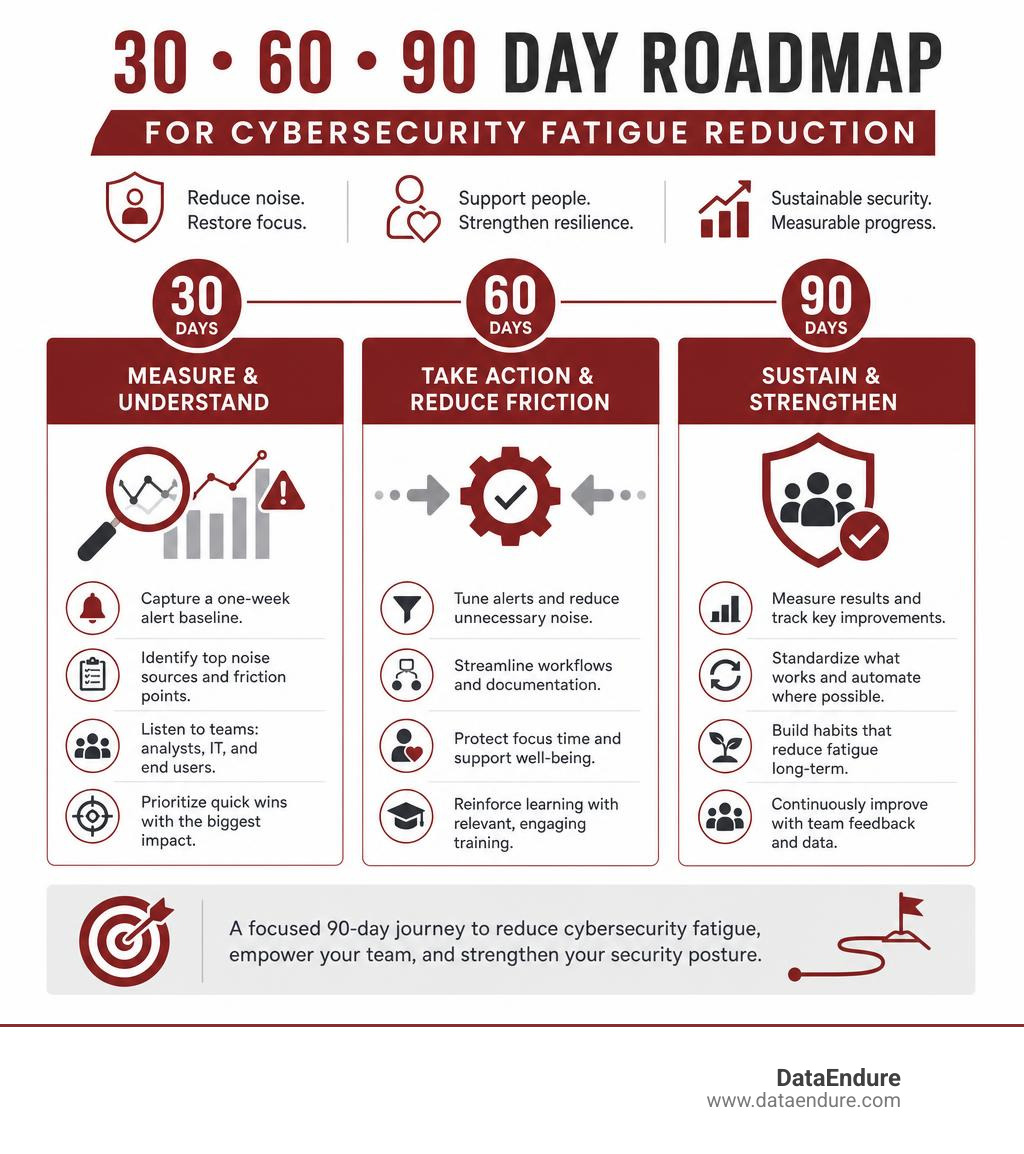
First 30 Days: Measure the Noise and Find the Friction
Start with discovery:
- Capture a one-week alert baseline.
- Identify top noisy detections.
- Measure false positive rates.
- Run an employee pulse survey.
- Review MFA prompt frequency.
- Analyze help desk patterns.
- Inventory security tools and data sources.
- Identify critical assets and privileged users.
- Interview analysts, IT admins, and business managers.
- Build a risk heatmap showing where fatigue meets business impact.
Quick wins often include suppressing known false positives, simplifying phishing reporting, and fixing obviously broken thresholds.
Days 31-60: Tune Controls and Redesign Workflows
Now reduce friction:
- Tune noisy rules.
- Normalize severity levels.
- Add asset and identity context.
- Deduplicate repeated alerts.
- Define case states.
- Set escalation service-level agreements.
- Build runbooks for common incidents.
- Roll out SSO or password manager improvements.
- Add a phishing report button.
- Simplify the most confusing policies.
- Launch a Security Champions group.
This is where alignment over complexity matters. Do not add tools until you understand the workflow.
Days 61-90: Automate, Govern, and Scale What Works
Then scale responsibly:
- Automate low-risk enrichment and triage.
- Use AI-assisted summaries with evidence visibility.
- Require audit trails for automated decisions.
- Maintain rollback plans.
- Hold monthly detection reviews.
- Build risk scoring based on asset, identity, vulnerability, and threat context.
- Create compliance evidence dashboards.
- Report outcomes to executives.
- Build analyst feedback loops.
- Consider managed operations for 24/7 coverage.
Managed cybersecurity operations can help reduce operational burden when internal teams lack the staffing, time, or coverage model to monitor and respond around the clock. The right approach should fit the organization’s risk profile, existing architecture, compliance obligations, and internal capabilities.
Real-World Examples of Effective Fatigue Reduction
Examples commonly seen across organizations include:
- Alert consolidation: A SOC groups thousands of duplicate alerts into a smaller number of prioritized incidents.
- Sports organization alert cleanup: A high-visibility organization reduces fatigue by improving alert management and giving analysts clearer context.
- Phishing reporting culture: Employees begin reporting suspicious emails faster after leadership removes blame and celebrates good catches.
- Passwordless rollout: A company reduces password reset tickets and risky password reuse by moving to SSO, password managers, and conditional access.
- Managed detection support: A lean IT team gains 24/7 monitoring without hiring a full internal SOC.
- Training redesign: Annual hour-long modules are replaced by short role-based lessons, improving engagement.
- Breach response improvement: Automated enrichment helps analysts identify compromised accounts faster and escalate with better evidence.
Frequently Asked Questions About Cybersecurity Fatigue Solutions
What Is a Practical First Way to Reduce Cybersecurity Fatigue?
A practical starting point is to reduce obvious noise and friction first.
Start with:
- A one-week alert baseline
- Top 10 noisy detection rules
- False positive reduction
- Alert deduplication
- SSO and password manager improvements
- One-click phishing reporting
- Short employee pulse surveys
For SOC teams, alert tuning can create relief quickly. For employees, reducing password and MFA friction often improves the day-to-day experience.
Can More Security Training Make Cybersecurity Fatigue Worse?
Yes. More training can make fatigue worse when it is repetitive, irrelevant, too long, or disconnected from real work.
This is advice-related fatigue. Employees receive so much guidance that they stop processing it.
Better training is:
- Short
- Specific
- Timely
- Role-based
- Practical
- Reinforced with positive feedback
Use micro-learning, real phishing examples, plain language, and just-in-time prompts instead of long annual marathons.
What Is the Difference Between Alert Fatigue and Cybersecurity Fatigue?
Alert fatigue is specific to security teams overwhelmed by alerts.
Cybersecurity fatigue is broader. It includes:
- Employee frustration with passwords, MFA, policies, and training
- Analyst burnout from alert overload
- IT exhaustion from tool sprawl and compliance pressure
- Leadership fatigue from constant cyber risk decisions
They overlap, but they are not identical. Alert fatigue often needs technical fixes like SIEM tuning, SOAR playbooks, and managed detection. Broader cybersecurity fatigue also requires culture, communication, workflow design, and employee well-being improvements.
Conclusion
The best cybersecurity fatigue solutions do not ask people to “just pay more attention.” They reduce unnecessary burden, improve signal quality, and make secure behavior easier.
That requires a holistic approach. Security, data, cloud, network, infrastructure, and governance all affect one another. If one layer creates noise, another team feels the pain.
A vendor-agnostic strategy should start with the organization’s actual risks, workflows, tools, and people. From there, leaders can decide which controls, automation, managed services, training changes, and governance improvements will reduce friction while maintaining appropriate protection.
If your team is dealing with alert overload, tool sprawl, or stricter compliance requirements, fatigue is not a side issue. It is a resilience issue.
Learn more about sustainable security and compliance through Governance, risk, and compliance services.