Core Dimensions and Methodologies of a CSA Risk Assessment
A CSA risk assessment evaluates systems proportionally across core capability dimensions—criticality, autonomy, permissions, and impact radius—or through structured control self-assessment workflows. This approach moves away from static, one-size-fits-all checklists. Traditional assessments often treat every workload identically, cataloging vulnerabilities without evaluating the operational context or systemic blast radius. A modern approach evaluates how software actually behaves within the architecture.
Organizations managing hybrid environments assess their exposure by understanding fundamental cybersecurity risks and controls. Modern governance frameworks emphasize proportionality: controls must match the potential operational consequences of a failure, data breach, or unintended action.
Evaluating AI and Agentic Systems with Capabilities-Based CSA Risk Assessment
Traditional software follows deterministic logic: specific inputs produce predictable outputs. Generative and agentic AI systems, however, introduce non-deterministic decision paths. These models interpret ambiguous inputs, generate code, call external APIs, and execute multi-step plans with varying degrees of autonomy.
To address these distinct characteristics, the Cloud Security Alliance established the Capabilities-Based Risk Assessment (CBRA) for AI Systems. Rather than evaluating only the hosting infrastructure, CBRA assesses what an AI deployment can actually execute. As autonomous agents take on tasks like database modifications or customer interactions, organizations must evaluate agentic decision authority.
When the Cloud Security Alliance Introduces New Tool for Assessing Agentic Risk, it provides a standard to evaluate models that act independently, plan sub-tasks, and access external data stores without immediate human oversight.
The Four Dimensions: Scoring Criticality, Autonomy, Permissions, and Impact Radius
The CBRA model calculates an aggregate risk profile across four core dimensions, each rated on a 1 to 5 scale:
- System Criticality (1–5): The operational, financial, or safety importance of the business process the system supports.
- AI Autonomy (1–5): The degree of independent execution without human intervention, ranging from simple recommendation engines to fully self-directed execution.
- Access Permissions (1–5): The scope of data access, network connectivity, API privileges, and administrative rights granted to the system.
- Impact Radius (1–5): The potential blast radius if the system malfunctions, produces hallucinated outputs, or is compromised by an adversary.
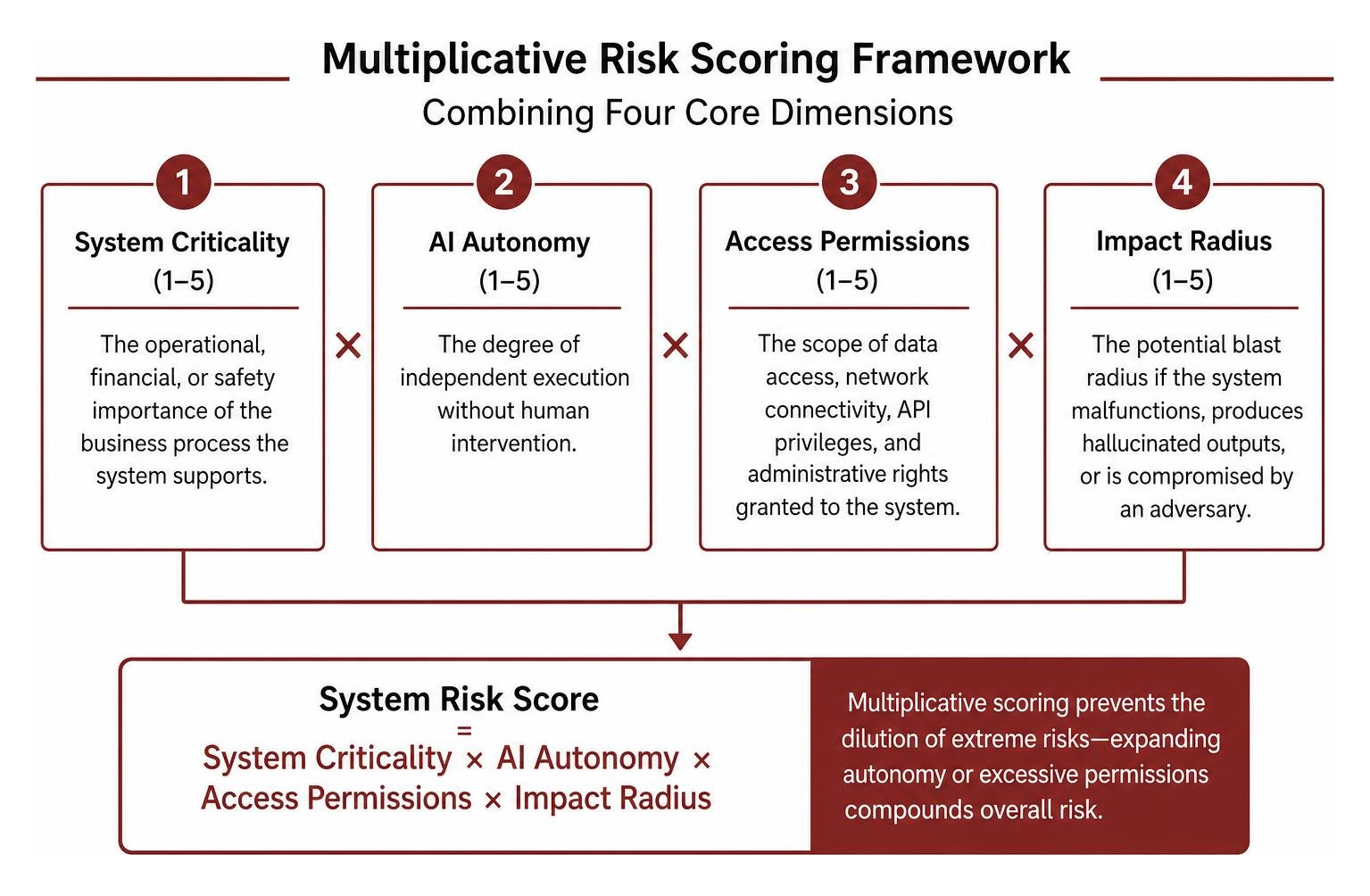
These four factors interact through a multiplicative formula:
System Risk Score = System Criticality × AI Autonomy × Access Permissions × Impact Radius
This mathematical approach prevents the dilution of extreme risks. In standard additive models (1 + 1 + 1 + 5 = 8), a critical vulnerability can appear mild. In a multiplicative model (1 × 1 × 1 × 5 = 5 versus 4 × 4 × 4 × 4 = 256), expanding autonomy or excessive permissions compounds overall risk. This structure provides a repeatable baseline for internal teams and third-party vendor reviews.
| Risk Tier | Autonomy Level | Permission Scope | Impact Radius | Example System | Target Controls |
|---|---|---|---|---|---|
| Low Risk (Score: 1–15) | Low (Assisted / Read-only) | Public / Non-sensitive internal data | Localized; easily remediated | Internal draft generator for marketing copy | Baseline AICM hygiene, logging, basic input sanitization |
| Medium Risk (Score: 16–80) | Moderate (Human-in-the-loop approvals) | Internal business data, scoped APIs | Moderate; financial or operational disruption | Customer support agent issuing partial refunds | Enhanced monitoring, step-up authentication, API rate limits |
| High Risk (Score: 81–625) | High (Fully autonomous execution) | Sensitive data, crown-jewel infrastructure | Severe; regulatory fines, critical system outages | Autonomous financial trading or medical dosing engine | Comprehensive controls, hardware isolation, continuous auditing |
Mapping Risk Tiers to Cloud Security Alliance AICM Safeguards
Scoring an AI workload allows security teams to map its tier directly to the Cloud Security Alliance AI Controls Matrix (AICM). The AICM contains over 240 control objectives across 18 security domains, giving organizations structured safeguards that scale with system capabilities.
- Low-Risk Tier: Requires baseline hygiene, such as standard encryption in transit and at rest, identity verification, role-based access control, and base logging.
- Medium-Risk Tier: Adds enhanced safeguards, including prompt injection filters, output validation guardrails, per-tenant data isolation, rate limiting, and cryptographic key management.
- High-Risk Tier: Requires comprehensive controls, including real-time behavioural anomaly detection, hardware-level isolation, continuous third-party penetration testing, automated circuit breakers, and mandatory multi-party approvals for high-value actions.
International guidance, such as the Supplementary references | Cyber Security Agency of Singapore, mirrors this approach by recommending security-by-design and formal threat modelling across critical systems.
Step-by-Step Implementation and Enterprise Integration of CSA Frameworks

Implementing a risk-based assessment framework requires structured workflows that bridge technical teams, security staff, and business leaders. Teams can start by identifying potential cybersecurity risks across their existing technical stack.
Executing an Auditable Control Self-Assessment (CSA) Workflow
A successful Control Self-Assessment (CSA) evaluates operational reality against business risk through five practical phases:
- Asset Discovery and Scoping: Inventory all hardware, cloud resources, microservices, and AI models. Categorize assets as crown jewels (critical databases, proprietary algorithms) or stepping stones (jump hosts, exposed APIs, public web servers).
- Threat Modelling and Scenario Construction: Identify realistic threat vectors for each asset. Construct detailed risk scenarios that document the asset, the vulnerability, the threat event, and the resulting business consequence.
- Likelihood and Impact Scoring: Score likelihood using measurable variables like discoverability, exploitability, and reproducibility. Score impact based on operational downtime, data sensitivity, and recovery expense.
- Control Testing and Evidence Collection: Evaluate existing safeguards to verify whether they function as intended. Identify compliance gaps using a compliance gap analysis.
- Remediation Roadmap and Ownership: Assign every identified gap to a named owner with a firm remediation timeline based on organizational risk tolerance.

Overcoming Common Pitfalls in CSA Risk Assessment and Strategy Integration
Organizations frequently encounter procedural hurdles when deploying internal assessments:
- The Compliance Trap: Treating assessments as annual check-the-box exercises creates an incomplete picture of posture. Assessments must evaluate actual security effectiveness rather than theoretical policy compliance.
- Vague Risk Scenarios: Generic descriptions like “cloud breach” or “AI malfunction” prevent effective mitigation. Teams should detail concrete failure modes, such as “an unauthenticated API endpoint exposes training data containing customer records.”
- Static, Point-in-Time Documentation: Systems change continuously through continuous integration and deployment pipelines. Assessments must be updated whenever software capabilities, integrations, or operational scopes expand.
- Over-Documentation: Generating hundreds of pages of compliance paperwork obscures actionable priorities. Teams should practice right-sized documentation focused on measurable risk reduction.
Applying the DREAD methodology helps teams maintain consistency during likelihood scoring:
- Discoverability: How easily can an internal or external actor locate the vulnerability?
- Exploitability: What level of technical skill, tooling, or privilege is required to execute the exploit?
- Reproducibility: Does the vulnerability trigger reliably under normal conditions?
Averaging these three factors produces an objective likelihood score that removes personal bias from evaluation meetings.
Operationalizing AI and Cloud Risk Management Across Enterprise Governance
A risk assessment should not live in an isolated IT spreadsheet. It must integrate into the broader Enterprise Risk Management (ERM) program and align with frameworks like COSO.
Security telemetry must flow into operational monitoring so that unexpected changes in system autonomy, API call volume, or privilege escalations trigger immediate reviews. Business executives and board directors need transparent reporting that translates technical findings into operational exposure, regulatory compliance status, and business resilience.
Aligning with structured governance, risk management, and compliance practices helps technology leaders establish reliable reporting structures.
For organizations seeking to align cloud security, data architecture, and autonomous workloads, DataEndure’s risk management solutions provide consultative guidance to assess exposures, implement proportionate controls, and build sustainable enterprise resilience.
Advancing Enterprise Resilience
Conducting a successful CSA risk assessment is an ongoing operational discipline rather than a one-time project. As autonomous systems take on greater operational responsibilities, managing risk requires continuous visibility into what systems are capable of executing, what permissions they hold, and how quickly teams can respond to anomalies.
Evaluating software through clear capability dimensions ensures that security investments remain proportionate to real-world risk. To build long-term operational resilience, organizations should focus on layered defenses across email, DNS, identity, endpoints, networks, and cloud workloads.
DataEndure helps enterprises manage these exposures by combining consultative risk management with Delta Detection & Response (∆DR), also called DeltaDR. With no comparable solution on the market, DeltaDR is a fully managed, unified Security-as-a-Service platform powered as a white-labeled version of the WhiteDog cybersecurity platform. It combines a curated, composable security stack with a 24×7 team of security experts delivering continuous incident response. Going beyond traditional extended detection and response (XDR), DeltaDR provides layered defense across email, DNS, identity, endpoint, network, and cloud workloads, including continuous threat exposure management (CTEM) and cross-layer telemetry correlation to help organizations maintain operational stability and validate control effectiveness.