What Is Risk Management and Why Does It Matter?
Risk management is the ongoing practice of identifying uncertainty that could affect an organization’s goals, assessing its likelihood and impact, and deciding how to respond. It protects value, supports better decisions, and helps leaders pursue opportunities without taking unmanaged risks.
For IT leaders in regulated industries, this is more than a compliance exercise. Operational outages, third-party vendor failures, or data governance challenges can create financial loss, operational disruption, and reputational damage. Disconnected tools and static assessments often leave critical gaps across complex environments.
Effective risk management connects business priorities with security, data, cloud, network, and infrastructure decisions. Rather than relying on isolated point solutions, organizations benefit from unified strategies that integrate multi-layered defenses across email, identity, endpoints, network, and cloud assets with continuous monitoring and incident readiness. The goal is adaptive protection that minimizes blind spots, clarifies ownership, and continuously adapts as technical and operational conditions evolve.
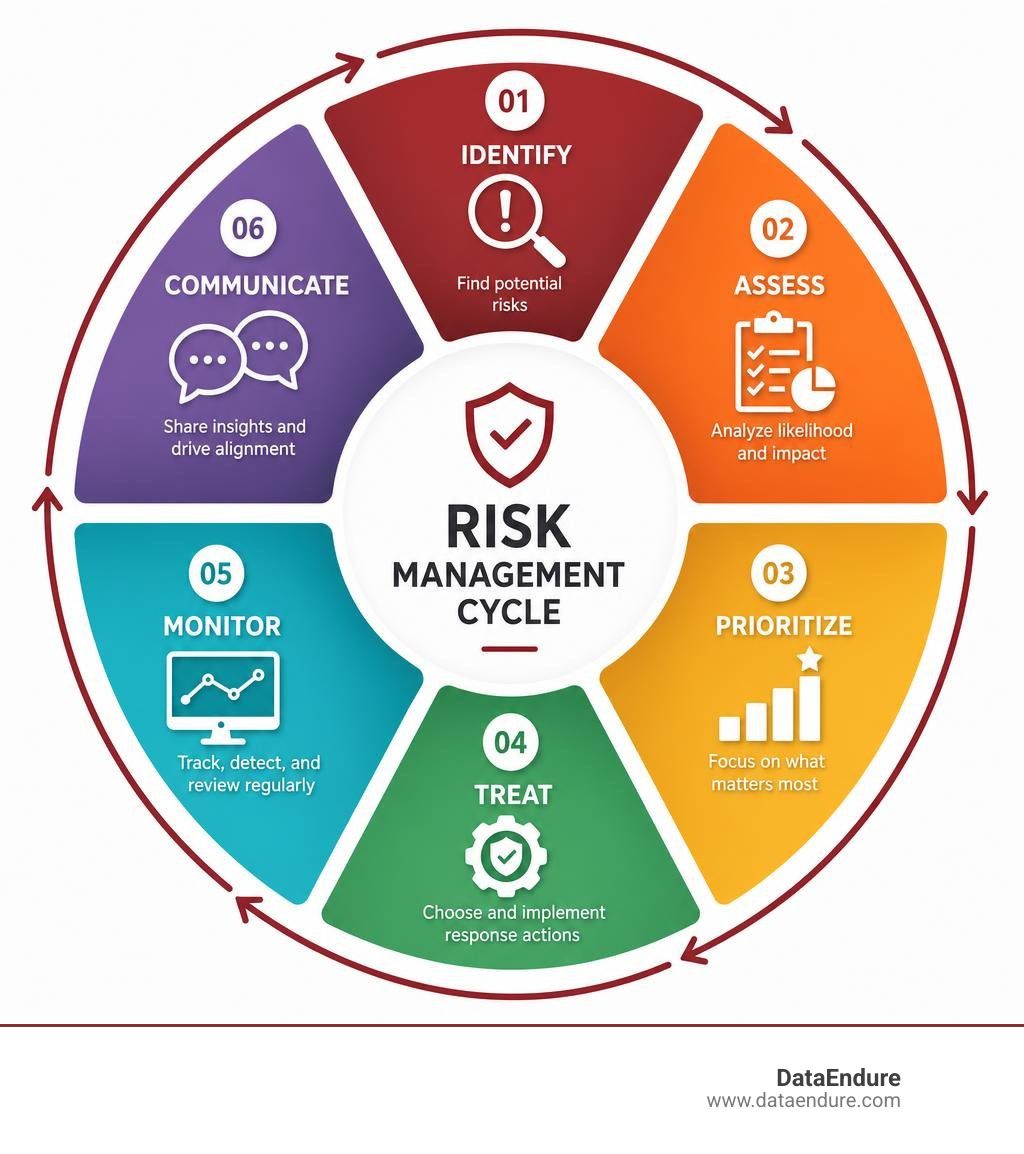
Basic risk management vocab:
Understanding Risk and Organizational Impact
When we speak of risk in modern enterprises, we are referring to the impact of uncertainty on business objectives. Uncertainty is an inherent part of doing business; every strategic expansion, cloud migration, or software adoption carries potential downsides alongside expected benefits.
The scope of risk spans far beyond traditional financial hedging or insurance policies. Today, organizations face a complex web of threats:
- Operational Risk: Disruptions in day-to-day systems, supply chains, or core infrastructure. For instance, when an enterprise system suffers an unscheduled outage, the operational impact compounds quickly through delayed service, missed SLAs, and lost productivity.
- Reputational Risk: Damage to public trust and brand credibility. Workplace misconduct alone cost U.S. businesses over $20 billion in 2021, and corporate fines for regulatory non-compliance or ethical lapses have skyrocketed 40-fold over the past two decades.
- Financial Risk: Direct revenue loss, unexpected regulatory penalties, or massive recovery costs. High-profile compliance failures have led to regulatory fines exceeding tens of billions of dollars, proving that inadequate controls carry severe financial consequences.
- Cybersecurity Risk: Sophisticated attacks targeting sensitive data, identity systems, and critical operations. Today, 78 percent of managers express deep concern over the increasing frequency and scope of cyber attacks.
Despite these prevailing risks and mixed economic signals, roughly 83 percent of corporate strategies remain heavily focused on growth. Balancing aggressive growth targets with enterprise protection requires a disciplined approach to risk. Organizations that actively embrace strategic risk management are five times more likely to deliver stakeholder confidence and two times more likely to expect faster revenue growth. By embedding risk management into daily operating culture, organizations build resilience into enterprise architecture, ensuring that unforeseen events do not derail long-term goals. Explore our insights on 4 Proven Ways to Master Risk Management Strategies to align risk controls directly with strategic initiatives.
Key Principles of Effective Risk Management
To build an adaptable defense, risk management cannot exist as a static, check-the-box audit performed once a year. It must function as an integrated, dynamic discipline across all organizational layers. Key international benchmarks, such as the BS ISO 31000:2018 Guidelines, emphasize that effective risk management is tailored, inclusive, structured, and continuously updated to reflect shifting contextual realities.
Effective enterprise strategy anchors guidance around five core pillars:
- Alignment Over Complexity: Security and risk strategies must serve business objectives rather than create administrative friction. Complex policies that employees bypass offer no real security.
- Resilience as Enabler: Proactive risk oversight is not a brake on the business; it is the accelerator that gives leadership the confidence to innovate, pivot, and expand into new markets safely.
- AI Readiness: As organizations deploy machine learning and automated algorithms, maintaining strict data integrity and governance prevents costly AI operational failures and data leakages.
- Vendor-Agnosticism: True resilience demands fitting solutions to specific organizational requirements, integrating appropriate technology components into a cohesive defense rather than accepting rigid vendor lock-in.
- Holistic Problem Solving: Siloed approaches leave critical gaps. We must look across security, data management, network performance, and cloud infrastructure to eliminate operational blind spots.
Furthermore, risk management frameworks must account for human and cultural factors. Employees who feel empowered to report suspicious activities, technical anomalies, or operational gaps serve as an enterprise’s strongest sensor network.
Balancing Threats and Opportunities in Risk Management
A common misconception is that risk management is exclusively defensive—focused solely on preventing losses, stopping breaches, and avoiding regulatory sanctions. However, standard risk frameworks define risk as any deviation from expected outcomes, encompassing both downside threats and upside opportunities.
The concept of upside risk, or opportunity management, involves taking calculated operational bets to gain competitive advantage. While threat management aims to minimize loss probability and impact, opportunity management aims to maximize the likelihood and capture value from strategic initiatives.
| Risk Perspective | Primary Focus | Objective | Example |
|---|---|---|---|
| Downside Risk (Threats) | Prevention & Mitigation | Protect asset value, avoid downtime, ensure compliance | Deploying multi-layered endpoint protection and automated threat monitoring |
| Upside Risk (Opportunities) | Exploitation & Enhancement | Accelerate growth, increase market share, drive efficiency | Migrating legacy workloads to scalable cloud platforms under secure boundary systems |
Managing both sides of the coin creates strategic asymmetry. When organizations implement robust guardrails—such as boundary systems and continuous risk monitoring—they give their teams the operational freedom to innovate within safe parameters. Rather than avoiding high-reward ventures due to fear of the unknown, leaders leverage disciplined risk assessments to pursue strategic growth with confidence.
Core Steps in the Risk Management Process
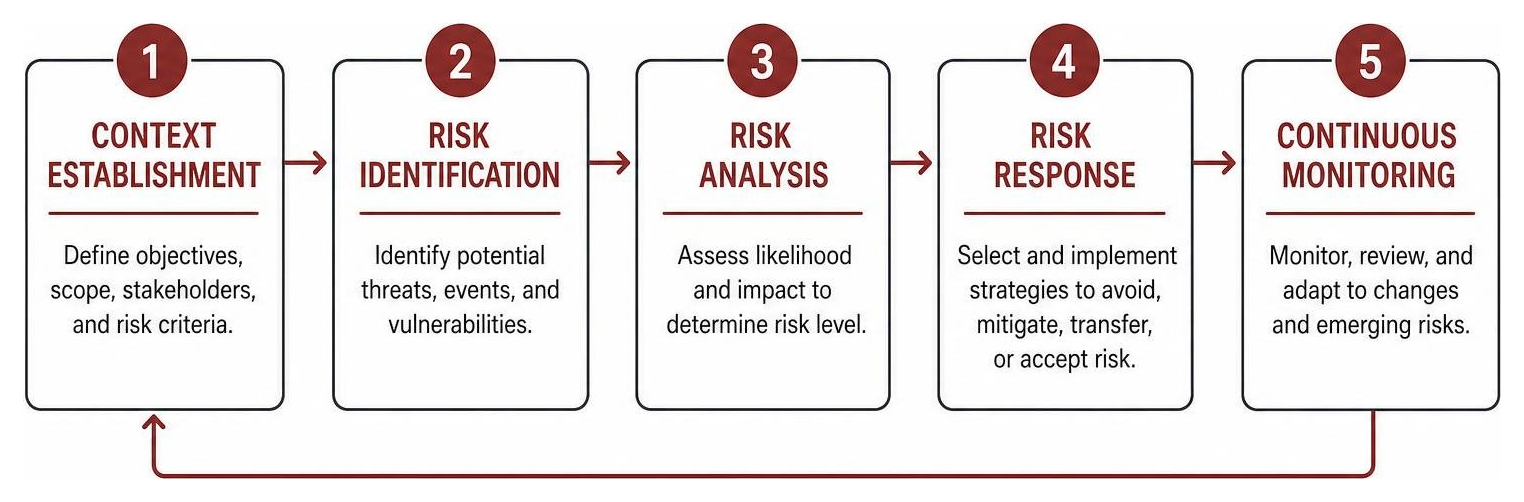
Executing effective risk management requires a systematic, repeatable process. Whether evaluating enterprise security posture, supply chain continuity, or regulatory compliance, organizations follow five fundamental steps to manage uncertainty methodically. Review our comprehensive resource, A Quick Start Guide to Cyber Risk Assessment, for tactical advice on tailoring this workflow to your environment.
Risk Identification and Assessment Techniques
The first step in the cycle is risk identification. Organizations cannot protect assets or manage threats they cannot see. Modern risk identification uses multiple analytical lenses:
- Taxonomy-Based Analysis: Categorizing potential risks into structured domain buckets, such as infrastructure, identity, compliance, third-party vendor dependencies, and operational workflows.
- Scenario Planning: Modeling specific threat scenarios—such as a ransomware outbreak, a major cloud provider outage, or a compromised supply chain partner—to evaluate potential operational blast radiuses.
- Vulnerability Scanning & Automated Discovery: Leveraging continuous technical scans to identify unpatched software vulnerabilities, misconfigured cloud repositories, and exposed network entry points across hybrid assets.
Once identified, risks undergo risk analysis and evaluation. Risk magnitude is traditionally calculated using probability and impact metrics:
$$text{Risk Magnitude} = text{Probability of Event} times text{Impact of Event}$$
Qualitative scoring (ranking risks as High, Medium, or Low) allows teams to quickly triage emerging threats. Quantitative analysis (such as calculating Annualized Loss Expectancy) assigns monetary values to potential losses, helping executive teams make informed capital allocation decisions.
To dig deeper into threat modeling and discovery methods, read our guide on How Can I Identify Potential Cybersecurity Risks.
Risk Response and Treatment Strategies
After evaluating and prioritizing risks, organizations select appropriate treatment strategies based on their defined risk appetite. Risk treatment options fall into four primary categories:
- Risk Avoidance: Changing plans or operational scope to completely eliminate exposure to a high-risk activity (e.g., opting not to process credit card data directly to remove payment card compliance overhead).
- Risk Reduction (Mitigation): Implementing controls and safeguards to decrease the probability or financial/operational impact of a threat (e.g., deploying zero-trust network access, continuous monitoring, and automated incident response).
- Risk Transfer (Sharing): Shifting a portion of financial or operational burden to a third party (e.g., purchasing cyber insurance or utilizing managed security services with binding service agreements).
- Risk Retention (Acceptance): Consciously retaining a low-impact or low-probability risk when the cost of mitigation exceeds the potential loss, while documenting the decision in the formal enterprise risk register.
| Treatment Strategy | When to Apply | Implementation Action | Business Outcome |
|---|---|---|---|
| Avoidance | Risk severity exceeds appetite; return does not justify risk | Terminate high-risk activity or abandon insecure legacy technology | Eliminates specific risk vectors completely |
| Reduction | Core operational activity with manageable risk exposure | Deploy multi-layered technical controls, patch management, and security awareness training | Lowers probability and impact to acceptable operational levels |
| Transfer | High impact, low control over external conditions | Utilize insurance, service level agreements, or managed security partners | Reallocates financial or technical liability |
| Retention | Minor operational impact; mitigation cost outweighs potential loss | Formally document risk acceptance in register with executive sign-off | Optimizes resource allocation toward high-priority threats |
Frameworks, Governance, and Integration
To keep risk management aligned with organizational strategy, leaders turn to established governance frameworks. Frameworks provide standard language, structures, and repeatable metrics that translate technical findings into actionable executive intelligence.
Two globally recognized frameworks form the foundation of enterprise risk governance:
- NIST Risk Management Framework (RMF): Developed by the National Institute of Standards and Technology, the NIST Risk Management Framework provides a 7-step lifecycle process (Prepare, Categorize, Select, Implement, Assess, Authorize, and Monitor). While widely mandated in government and regulated sectors, its structured approach to security, privacy, and cyber supply chain risk management benefits commercial enterprises of all sizes.
- COSO Enterprise Risk Management (ERM) Framework: Published by the Committee of Sponsoring Organizations of the Treadway Commission, the updated COSO Enterprise Risk Management Framework structures risk governance into five core components: Governance & Culture, Strategy & Objective-Setting, Performance, Review & Revision, and Information, Communication & Reporting. COSO emphasizes that risk management is an active driver of strategic choice rather than an isolated compliance function.
Integrating these frameworks ensures that risk decisions flow seamlessly from boardrooms to operational teams. Read our comprehensive Governance Risk Management Compliance Guide 2026 to see how governance alignment simplifies audit readiness and strengthens operational posture.
Risk Communication and Stakeholder Alignment
A critical pillar of governance is clear, transparent risk communication across all enterprise levels. Technical security data must be translated into business impact metrics so executive leadership and board directors can make sound strategic decisions.
Central to this effort is the risk register—a centralized tracking document that records identified risks, assigned risk owners, current control statuses, qualitative scores, and selected treatment plans. However, static spreadsheets updated once a year create dangerous blind spots.
Effective governance requires aligning management around defined risk appetite—the amount and type of risk an organization is willing to pursue or retain to meet its strategic goals. Establishing clear risk thresholds prevents departmental friction and ensures cross-departmental unity.
When technical teams, legal officers, and business unit leaders speak a common risk language, organizations eliminate organizational silos. For actionable strategies on framing these discussions with executive leadership, explore our article on Cyber Risk Questions Boards Should Be Asking.
Common Implementation Challenges and Pitfalls

Despite best intentions, many organizations encounter recurring pitfalls when executing risk management programs:
- Tool Sprawl and Alert Fatigue: Accumulating point security solutions creates fragmented visibility and operational burden. Security teams face thousands of disconnected alerts daily, leading to alert fatigue where critical threat indicators get lost in noise.
- Treating Compliance as Security: Passing a regulatory compliance audit does not mean an enterprise is secure. Compliance represents a minimum baseline at a single point in time, whereas risk management requires continuous monitoring and adaptation.
- Siloed Departmental Thinking: Isolating IT risk from physical security, legal compliance, or financial risk creates severe blind spots. Modern threats cross operational boundaries effortlessly.
- Partner and Supply Chain Blind Spots: Modern enterprises rely heavily on third-party SaaS platforms, cloud hosting providers, and external vendors. A vulnerability in a vendor’s supply chain quickly becomes your operational reality. Learn how partner requirements impact your posture in The Compliance Ripple Effect Why Your Partners Requirements Become Your Reality.
- Static Point-in-Time Audits: Relying on annual assessments leaves organizations exposed to rapidly evolving threats between review cycles.
To overcome these roadblocks, organizations must transition from reactive, tool-heavy approaches to holistic, managed outcomes that simplify security management.
Frequently Asked Questions About Risk Management
What is the difference between risk assessment and risk management?
Risk assessment is the specific process of identifying, analyzing, and evaluating potential risks to determine their probability and magnitude. In contrast, risk management is the broader, ongoing discipline that takes those assessment findings and integrates them with strategic, economic, operational, and legal considerations to decide upon, execute, monitor, and adjust response actions.
What are the main risk treatment options?
The four primary risk treatment options are:
- Avoidance: Completely halting or altering an activity to eliminate exposure to the risk.
- Reduction (Mitigation): Deploying controls, safeguards, or continuous monitoring to lower likelihood or impact.
- Transfer (Sharing): Reallocating financial or technical exposure to third parties via insurance or managed partnerships.
- Retention (Acceptance): Formally documenting and accepting low-level risks when mitigation costs exceed potential damages.
How often should an organization review its risk register?
While formal risk register reviews should occur at least quarterly, risk management should operate continuously. Any significant organizational change—such as introducing new cloud software, undergoing corporate restructuring, adopting AI tools, or reacting to novel cyber threats—should trigger an immediate, out-of-cycle risk review.
Conclusion

In today’s fast-moving business landscape, risk management is not about eliminating every conceivable danger; it is about building operational and digital resilience so an enterprise can operate with confidence. By combining structured frameworks like ISO 31000, COSO, and NIST with a well-defined risk appetite, organizations transform risk management from an administrative burden into a catalyst for strategic growth.
Building effective enterprise risk management requires an integrated approach that connects threat visibility, cross-layer correlation, and structured incident response across security, data, cloud, network, and infrastructure domains. A multi-layered defense model allows organizations to adapt continuously as technical and operational conditions evolve.
By implementing continuous threat visibility, cross-layered correlation, and structured risk response protocols, organizations can protect critical assets while maintaining the agility needed to innovate. Learn more about aligning governance and enterprise security strategies by exploring modern Risk Management Solutions.