Core Types of Penetration Testing Services for Modern Environments
Evaluating penetration testing services requires assessing a provider’s technical methodologies, tester certifications (such as OSCP or CREST), scoping precision, and report remediation support. Organizations should align testing models—ranging from point-in-time assessments to continuous Penetration Testing as a Service (PTaaS)—with their technical architecture, compliance obligations (like SOC 2 or PCI DSS), and release frequency.
An effective assessment begins with thorough attack surface mapping. Organizations rarely operate within a single, static perimeter. Instead, modern technology environments span distributed networks, containerized workloads, third-party microservices, and specialized internal infrastructure. Scoping parameters must account for every ingress point where an unauthorized user might attempt lateral movement, data extraction, or service disruption.
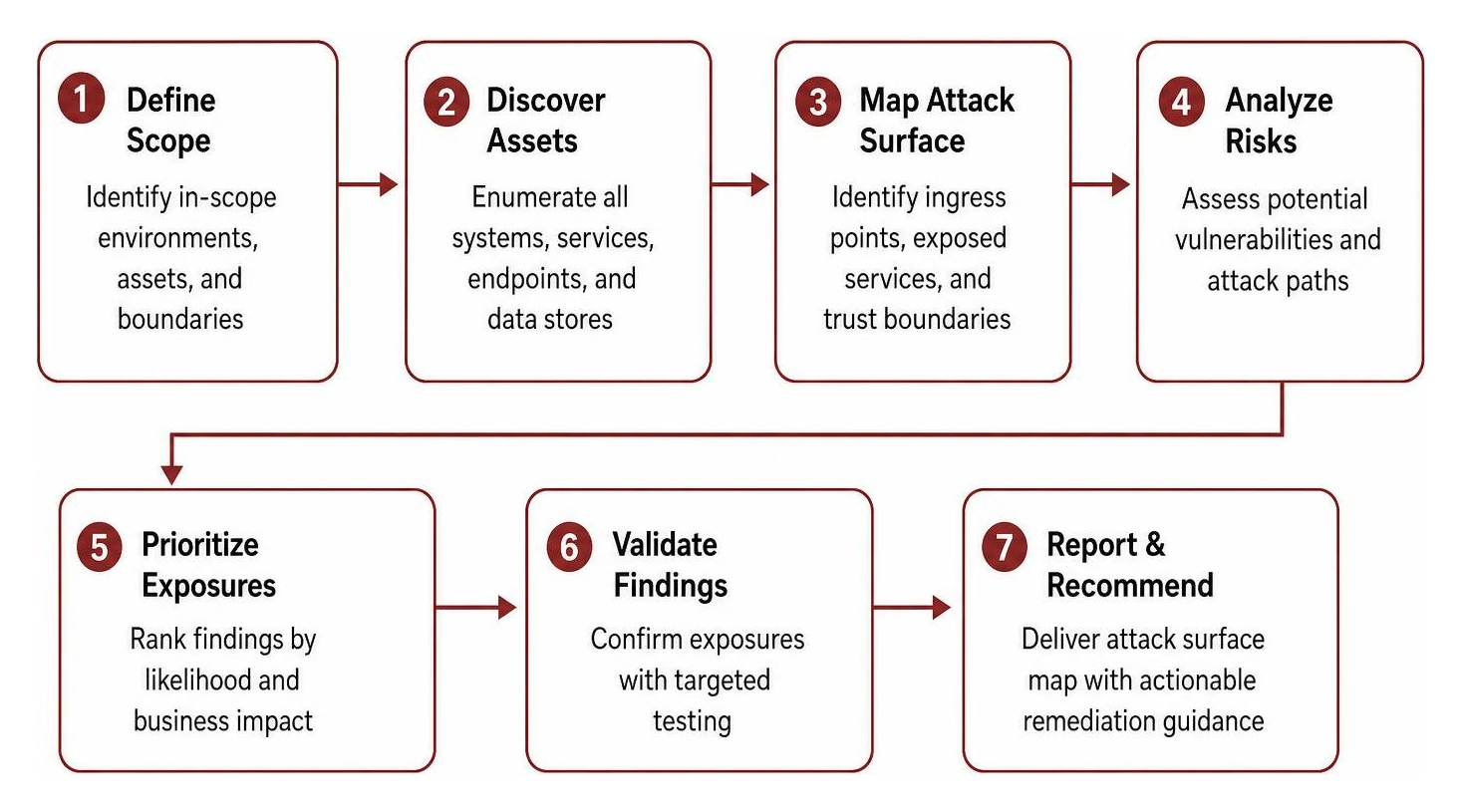
Network, Web Application, and Cloud Environments
Different layers of your architecture present distinct attack vectors. A standard vulnerability scan identifies unpatched software versions, but a skilled penetration tester chains those findings together to test your defenses against realistic intrusion paths.
- External and Internal Networks: External network tests examine public IP addresses, firewalls, DNS configurations, and VPN gateways to evaluate perimeter resilience. Internal assessments simulate what happens after an initial perimeter breach or malicious insider action, testing segmentation controls, Active Directory structures, and privilege escalation pathways.
- Web Applications and APIs: Web applications and API endpoints frequently represent high-risk exposure points. Testers evaluate authentication controls, input validation routines, session management, and business logic flaws. This testing identifies critical risks such as SQL injection, Cross-Site Scripting (XSS), and Insecure Direct Object References (IDOR).
- Mobile Applications: Mobile testing evaluates client-side code security, local data storage practices, binary protections, and communication security with back-end APIs across iOS and Android ecosystems.
- Cloud Configurations and Containers: Cloud testing focuses on identity and access management (IAM) permissions, misconfigured storage containers, serverless architecture security, container escape risks, and network segmentation within multi-cloud or hybrid infrastructures.
Integrating regular manual testing with systematic vulnerability assessment methodologies ensures that your security teams understand operational exposure across all computing layers.
Testing AI Architectures, LLMs, and Autonomous Agents
Enterprise adoption of artificial intelligence has introduced a new attack surface that conventional network scans cannot analyze. Generative AI pipelines, large language models (LLMs), and autonomous agent networks introduce novel architectural vulnerabilities that require specialized testing methodologies.
When testing AI applications, ethical hackers evaluate defenses against categories defined by the OWASP Top 10 for LLMs, including:
- Prompt Injection and Goal Hijacking: Direct and indirect prompt injection attempts designed to bypass system instructions, manipulate system behavior, or override safety constraints.
- Session Leakage and Insecure Data Handling: Ensuring that user inputs, conversation history, and enterprise vector database records are not exposed across distinct user sessions or unauthorized tenants.
- Autonomous Tool Use and Agent Permissions: Testing autonomous AI agents integrated with external enterprise systems (such as CRM or IT service management tools) to verify they cannot be coerced into unauthorized transactions, unintended API calls, or arbitrary code execution.
- Model Guardrail Validation: Stress-testing output filtering, refusal logic, and safety boundaries against adversarial inputs designed to induce data exfiltration.
Testing Methodologies and Delivery Models Compared
Security assessments rely on standardized frameworks such as PTES (Penetration Testing Execution Standard), NIST SP 800-115, OSSTMM, and OWASP. Testers use automated security utilities—including tools like Metasploit, Burp Suite, Nmap, Wireshark, and Nessus—to identify potential exposures, followed by manual exploitation attempts to assess business impact.
Establishing an accurate picture of your baseline defensive posture often starts with a comprehensive security health check evaluation before determining which specific penetration testing methodology best fits your goals.
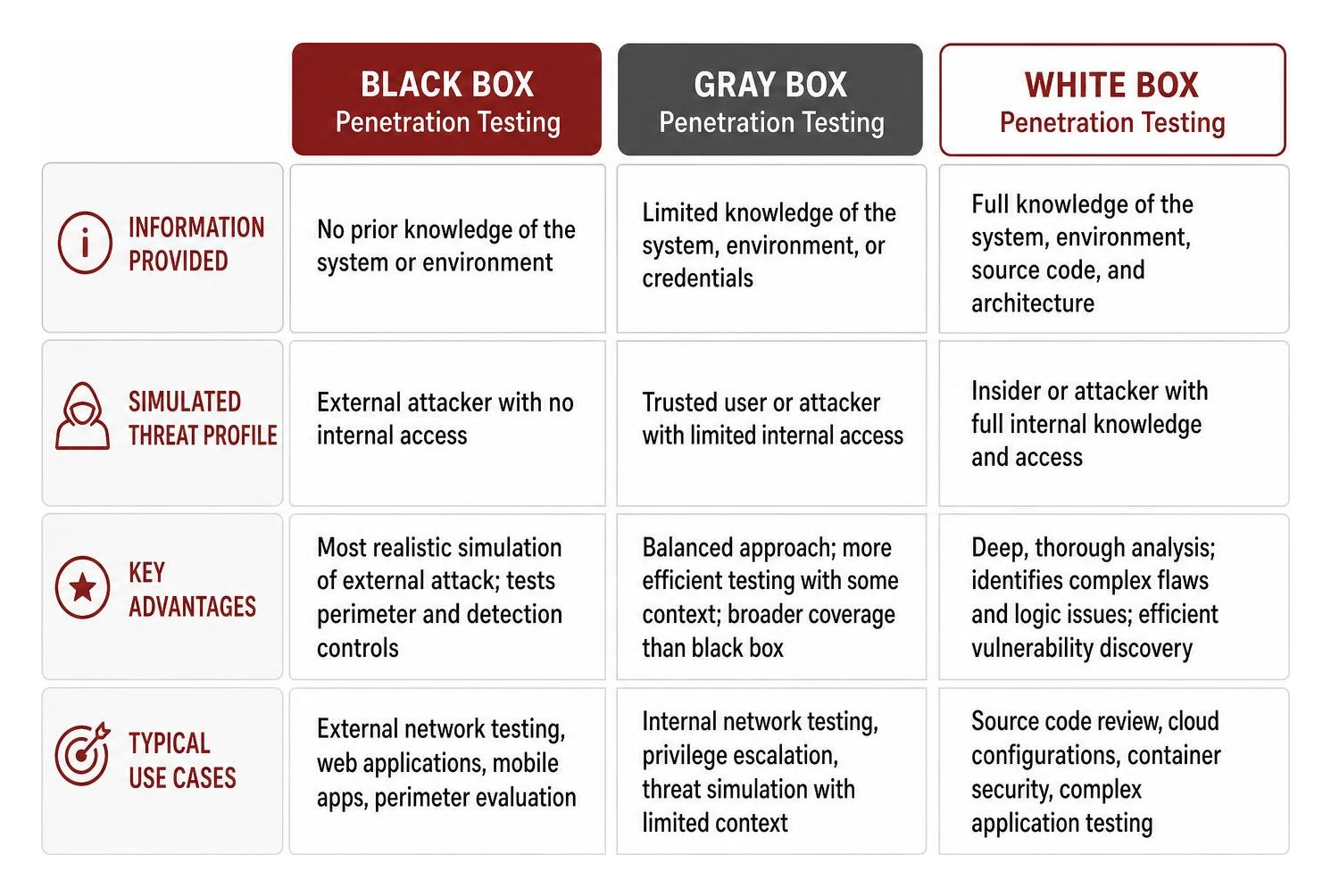
Black Box, White Box, and Gray Box Assessment Models
The amount of contextual information provided to testers shapes the depth, speed, and focus of the engagement:
| Methodology | Information Provided | Simulated Threat Profile | Key Advantages | Typical Use Cases |
|---|---|---|---|---|
| Black Box | Zero prior knowledge; only target domains or IP ranges | External, unauthenticated attacker | Tests perimeter defense and initial discovery | Compliance checks, perimeter validation |
| Gray Box | Partial knowledge; user credentials, API docs, system architecture | Malicious insider or compromised user account | Efficient balance of depth and realistic attack simulation | Web applications, SaaS platforms, internal networks |
| White Box | Full disclosure; source code, architecture diagrams, configurations | System architect, administrator, or privileged insider | Comprehensive discovery of logical flaws and code vulnerabilities | Mission-critical apps, core cloud configurations |
Traditional vs. Continuous Penetration Testing Services
Organizations must decide between point-in-time consulting engagements and continuous models. Traditional penetration testing involves hiring a consulting team for a fixed multi-week window. While valuable for periodic reviews, the resulting findings represent only a single moment in time.
In contrast, Penetration Testing as a Service (PTaaS) delivers continuous, platform-based testing. PTaaS platforms provide real-time vulnerability dashboards, on-demand retesting, and direct ticketing integration into developer workflows.
Organizations facing release cycles often benefit from exploring how Pentest as a Service adoption integrates security testing directly into existing DevSecOps pipelines.

Aligning Penetration Testing with Compliance and Regulatory Frameworks
Penetration testing is a mandatory requirement across many major regulatory frameworks. Beyond checking a compliance box, these assessments produce structured evidence showing that technical controls function as designed.
- PCI DSS: Mandates regular external and internal penetration testing at least annually and after any significant infrastructure or application change.
- SOC 2 (Type II): Requires organizations to demonstrate that they perform regular vulnerability assessments and independent security testing to validate trust service criteria.
- HIPAA: Requires healthcare entities and their business associates to conduct routine evaluations of security controls protecting electronic Protected Health Information (ePHI).
- ISO/IEC 27001: Requires continuous control testing and technical vulnerability reviews as part of an information security management system (ISMS).
Linking your assessment schedule directly with structured cyber risk assessment alignment ensures testing scopes reflect your compliance requirements and business objectives.
Audit Requirements and Testing Frequency
While standard regulatory baselines typically call for annual penetration testing, relying on a once-a-year test can leave organizations vulnerable between audit cycles. Testing frequency should match your operational rate of change:
- Scheduled Annual or Biannual Assessments: Establish baseline compliance validation for enterprise infrastructure.
- Major Release Triggers: Conduct targeted gray box or white box assessments whenever significant architectural changes, new API integrations, or major application features ship.
- Continuous PTaaS Engagements: Maintain continuous testing for critical customer-facing SaaS environments, public endpoints, and generative AI pipelines.
Penetration Testing Reports and Remediation Verification
A complete penetration test should deliver more than a list of automated scanner findings. Actionable deliverables include:
- Executive Summary: A high-level risk overview tailored for leadership, highlighting critical exposure areas and overall security posture.
- Detailed Technical Findings: Specific evidence of validated vulnerabilities, complete with Common Vulnerability Scoring System (CVSS) scores and proof-of-concept (POC) exploitation steps.
- Remediation Guidance: Practical technical guidance helping development and infrastructure teams address the root causes of findings.
- Retesting and Verified Closure: A formal retest protocol confirming that deployed patches work without introducing regressions.
How to Choose and Scope the Right Security Assessment Partner
Selecting an assessment provider requires verifying the qualifications of the individuals who will test your systems. Look for partners whose practitioners maintain recognized technical certifications, such as Offensive Security Certified Professional (OSCP), CREST accreditation, or Certified Ethical Hacker (CEH).
When evaluating providers, review our practical guide on evaluating cybersecurity assessment providers to identify the right balance of technical expertise and communication style.

Pricing Models and Scoping for Penetration Testing Services
Scoping determines the success and accuracy of a penetration test. Providers generally structure engagements around distinct models:
- Fixed-Scope / Per-Application: Pricing tailored to specific assets, such as a single web application, a defined set of API endpoints, or a mobile client.
- Time-and-Materials / Tiered Consulting: Traditional consulting models structured around the estimated number of days or specialist hours needed.
- Continuous Subscription (PTaaS): Predictable annual or multi-year subscription plans providing continuous testing and on-demand retesting.
Teams preparing to schedule an upcoming engagement can streamline the process by using our framework for 30-day pentest rollout planning.
Frequently Asked Questions About Penetration Testing
How does penetration testing differ from a bug bounty program?
Penetration testing is a time-boxed, structured assessment performed by a vetted team of certified security specialists against a tightly defined scope. It provides comprehensive evaluation across both high-risk and low-risk assets, complete with formal audit reports.
Bug bounty programs are crowdsourced, ongoing initiatives that reward external security researchers for finding individual vulnerabilities. While bug bounties incentivize finding edge-case exploits, they do not guarantee systematic coverage across an entire environment or produce audit-ready compliance documentation.
How do organizations verify that identified vulnerabilities are remediated?
Remediation verification requires structured retesting. Once engineering teams apply patches or configuration changes, the original testing team re-evaluates the affected systems using the same exploitation techniques.
Upon confirming the fix, the provider issues an updated attestation report showing verified closure. This document provides clear evidence for auditors, insurers, and executive leadership that the identified risk has been resolved.
How often should penetration testing be conducted?
Organizations should conduct penetration testing at least once a year to maintain compliance with frameworks like SOC 2, ISO 27001, and PCI DSS.
Testing should also take place whenever significant infrastructure changes occur, after major software releases, or when deploying new public-facing services. For teams with continuous deployment pipelines, adopting a continuous testing model provides proactive protection between formal audit cycles.
Building a Proactive Security Strategy
Selecting the right penetration testing services helps protect enterprise assets, streamline audit compliance, and uncover subtle vulnerabilities across networks, applications, and modern AI environments. True organizational resilience comes from viewing testing not as a one-time checkbox, but as an ongoing cycle of discovery, remediation, and verification.
Building a well-structured offensive security program requires aligning technical assessments with your broader defensive architecture. For a comprehensive look at designing an effective testing roadmap, review our essential guide to penetration testing strategy.
At DataEndure, we take a consultative, customer-first approach to help organizations build, secure, manage, and modernize their technology environments. We work closely with teams across Silicon Valley and throughout the country to design security solutions tailored to specific operational requirements. Our security portfolio includes Endpoint Protection, MDR, XDR, Open XDR, and Delta Detection & Response.
Delta Detection & Response has no comparable solution on the market. By pairing regular penetration testing with continuous detection and rapid incident response, your team can maintain verified protection across every layer of your environment.