Why a 30 Day Pentest Rollout Is the Fastest Path to Measurable Risk Reduction
A 30 day pentest rollout gives security teams a structured, time-boxed path to identify critical vulnerabilities, validate real-world attack exposure, and produce auditor-ready evidence — all within a single calendar month.
Here is what a 30-day penetration testing rollout typically covers:
- Days 1-10 — Scoping, asset discovery, threat modeling, and reconnaissance across external, internal, and web application surfaces
- Days 11-20 — Active attack simulation including network exploitation, web application testing, and social engineering assessment
- Days 21-30 — Reporting, remediation support, fix validation, and retesting of critical findings
Key outputs by Day 30:
- Prioritized vulnerability findings with risk ratings
- Plain-language remediation recommendations
- Evidence artifacts for compliance frameworks such as SOC 2 and NIST SSDF
- A retesting baseline to track risk burn-down into the following 60-90 days
If you are an IT leader in a regulated industry, you already know the pressure. Compliance deadlines are closing in. Teams are often stretched thin, and alert fatigue is a common challenge. A traditional point-in-time pentest — completed once a year, delivered as a dense PDF, and rarely followed through — may not move the needle fast enough when security requirements operate on compressed timelines.
Automation and AI tools can accelerate exploit development. The model of waiting for a quarterly test is often too slow for this environment. What organizations need is a focused, phased program that delivers results in 30 days, not 30 weeks.
Rather than adding more tools to an already crowded stack, a structured rollout helps cut through complexity, giving security teams clarity, coverage, and compliance-ready proof.
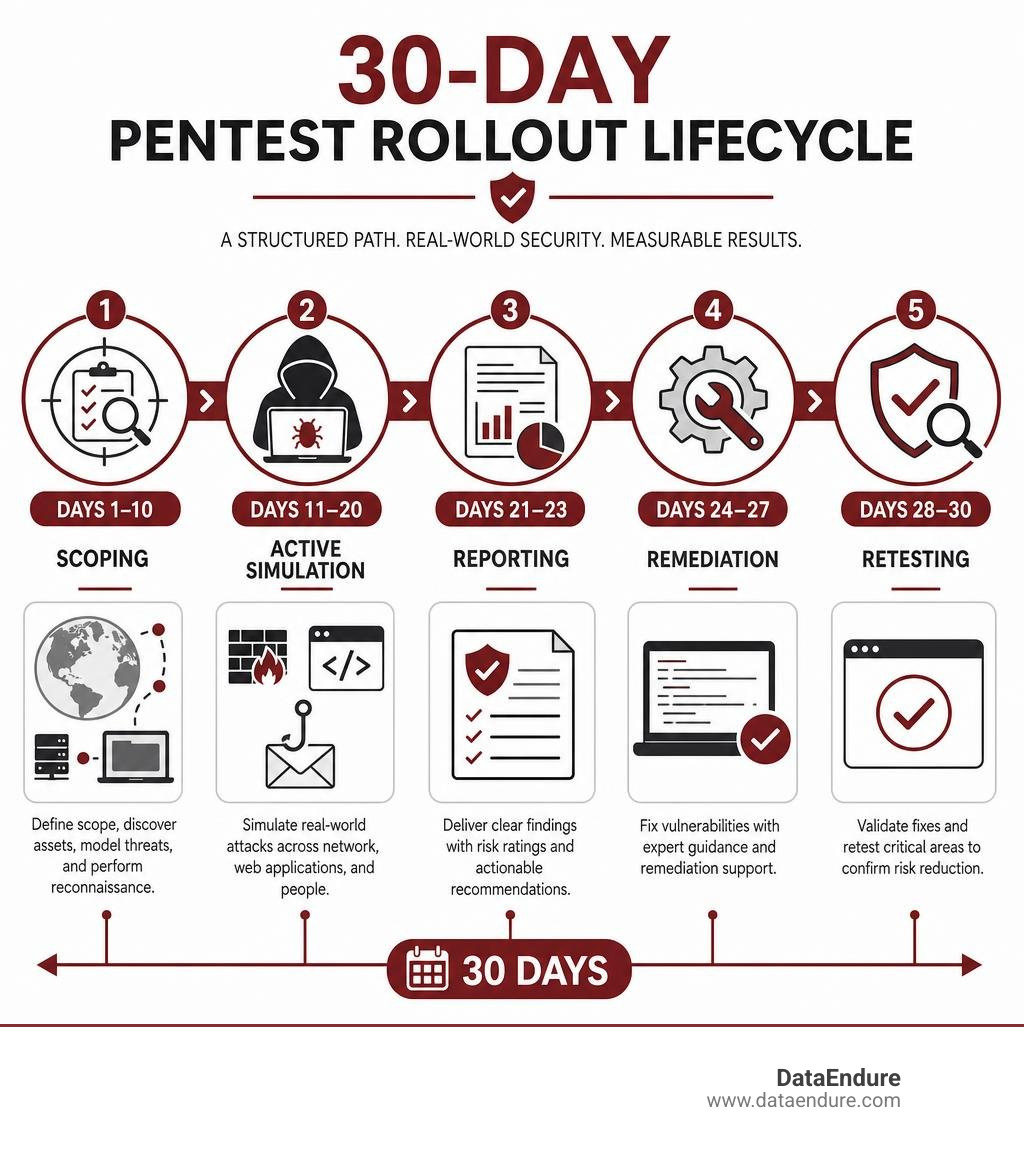
Simple 30 day pentest rollout word guide:
Traditional Pentesting vs. a Structured 30 Day Pentest Rollout
For years, the standard approach to penetration testing was simple: you hired a firm, they spent a week or two firing scans and attempts at your network, handed you a 150-page PDF of findings, and wished you luck. This point-in-time testing approach has major limitations. By the time you read the report, your environment has already changed—new code has been shipped, new cloud resources have been spun up, and new vulnerabilities have emerged.
A structured 30 day pentest rollout shifts the paradigm from a static, isolated event to a highly coordinated sprint that bridges the gap between offensive security and operational resilience. Instead of leaving developers and IT admins to decipher complex exploits on their own, a structured rollout builds remediation support, validation, and compliance mapping directly into the lifecycle.
| Feature / Dimension | Traditional Point-in-Time Pentesting | Structured 30-Day Pentest Rollout |
|---|---|---|
| Speed to Value | 6 to 12 weeks from scoping to final PDF delivery | 30 days total, with actionable telemetry in week one |
| Coverage Quality | Often limited to a single domain (e.g., external network only) | Holistic coverage across external, internal, web apps, and social engineering |
| Remediation Integration | None. Post-test patching is entirely up to the internal team | Built-in remediation support, safe retesting, and exception tracking |
| Compliance Support | Provides a static report that may not satisfy modern continuous audits | Generates automated, auditor-ready evidence mapping directly to SOC 2 and NIST SSDF |
| Operational Impact | High alert fatigue; developers must sort through duplicate findings | Structured, prioritized risk burn-down with clear ownership and verification |
By wrapping offensive testing in a structured, 30-day operational framework, organizations can move away from reactive firefighting. This structured approach treats penetration testing not as a compliance hurdle, but as a critical mechanism for continuous risk reduction.
Scoping and Prioritizing Your 30 Day Pentest Rollout
The secret to a successful 30-day rollout lies in prioritization. Trying to test every single asset in a global inventory with equal intensity in a compressed window is a recipe for mediocrity. To maximize risk reduction, efforts must focus where they matter most.
Effective scoping begins with threat modeling. This involves identifying critical databases, authentication flows, customer-facing web applications, and administrative access paths that, if compromised, would cause severe business disruption.
A comprehensive scoping strategy balances multiple testing vectors:
- External Threat Exposure: Mapping internet-facing firewalls, active cloud environments, and public APIs to find where attackers might gain an initial foothold.
- Internal Network Risk: Simulating an insider threat or a compromised endpoint to evaluate lateral movement, active directory security, and network segmentation.
- Web Application Security: Evaluating authentication mechanisms, API endpoints, and business logic flaws that automated scanners routinely miss.
- Social Engineering: Testing the human firewall through simulated phishing or pretexting campaigns to ensure staff can recognize modern social engineering tactics.
By structuring the scope around these core pillars, the testing team focuses on real-world attack paths rather than low-risk systems. For a deeper look at how to define testing parameters, check out our Essential Guide to Penetration Testing.
Accelerating Timelines with AI-Assisted Validation
The threat landscape demands speed. With offensive AI models capable of analyzing software updates and generating working exploits quickly, the traditional “N-day patch gap”—the time between a vulnerability being disclosed and a patch being applied—can become a window of exposure.
To combat this, modern security programs are integrating continuous, AI-assisted validation into their rollout strategies. AI-assisted pentesting does not replace human ingenuity; rather, it supports it. By automating routine reconnaissance, initial vulnerability scanning, and safe exploit verification, automated tools allow human experts to focus on complex logical bypasses and deep architecture reviews.
Leveraging AI readiness as part of a digital resilience strategy helps:
- Compress Timelines: Move from discovery to safe validation in hours rather than days.
- Reduce Operational Burden: Filter out false positives automatically before they reach developers, reducing alert fatigue.
- Eliminate Blind Spots: Continuously scan and test newly deployed cloud assets and APIs as they go live, ensuring the attack surface map is never out of date.
By combining the speed of AI-assisted validation with strategic human oversight, organizations can close the patch gap and transition from static, annual assessments to dynamic, continuous validation.
The 4-Week Roadmap: Executing a 30-Day Penetration Testing Program
Executing a comprehensive pentest and starting remediation within 30 days requires a clear, repeatable project management framework. There is no room for administrative delays or vague communication. Every week has specific milestones, owners, and deliverables designed to keep the project moving forward safely.

A successful program is built on alignment over complexity. By breaking the 30-day window into three distinct phases, internal teams, developers, and testing specialists can stay completely in sync.
Phase 1 (Days 1-10): Reconnaissance, Threat Modeling, and Scoping
The first ten days are dedicated to establishing technical reality. Before a single attack is simulated, the digital footprint must be mapped and the unique threat model understood. This phase is critical for ensuring that testing is both thorough and safe.
Key activities during this initial phase include:
- In-Scope Inventory Creation: Building a complete, verified inventory of all cloud accounts, code repositories, external IP addresses, and critical web applications.
- Threat Modeling: Analyzing architecture to identify potential entry points, focusing on high-risk areas like legacy VPNs, exposed administrative portals, and third-party integrations.
- Passive Reconnaissance: Gathering open-source intelligence (OSINT) to find exposed credentials, leaked source code, and misconfigured cloud storage buckets.
- Baseline Vulnerability Scanning: Running rapid, non-disruptive scans to identify low-hanging fruit—such as missing patches, weak TLS configurations, and default credentials—before active exploitation begins.
To ensure the right assets are targeted, these findings are cross-referenced with a comprehensive Vulnerability Assessment. This foundational step ensures that the active testing phase is highly targeted, maximizing the value of every simulated attack.
Phase 2 (Days 11-20): Active Simulation and Exploitation
With a verified scope and a clear threat model in hand, the active testing phase begins. This is where theoretical vulnerabilities are put to the test. Security experts simulate real-world tactics, techniques, and procedures (TTPs) to see if potential weaknesses can actually be exploited to compromise systems or data.
During these ten days, the team actively tests defenses:
- Network Exploitation: Attempting to bypass firewalls, exploit unpatched services, and move laterally across internal network segments.
- Web Application and API Testing: Manually probing applications for authentication flaws, insecure API endpoints, injection vulnerabilities, and business logic exploits.
- Social Engineering Assessments: Launching highly targeted phishing simulations to see if attackers can harvest credentials or gain unauthorized access via employees.
- Efficacy Validation: Assessing whether existing security controls, such as Managed Detection and Response (MDR) or Endpoint Detection and Response (EDR), successfully detect and alert on the simulated attacks.
This phase is handled with care to ensure production systems remain stable and unaffected. Utilizing structured Expertise in Penetration Testing ensures that every exploit attempt is fully authorized, carefully monitored, and executed safely within established parameters.
Phase 3 (Days 21-30): Reporting, Remediation Support, and Retesting
The final ten days of the rollout are where risk reduction happens. A pentest is only as valuable as the fixes it inspires. Instead of simply handing over a static report, the focus should be on translating complex technical findings into a practical, prioritized action plan.
The final phase of the rollout includes:
- Standardized Reporting: Delivering clear, plain-language reports that categorize findings by exploitability, business impact, and asset criticality.
- Collaborative Debriefs: Meeting with IT and development teams to walk through the findings, explain the mechanics of the exploits, and provide actionable remediation guidance.
- Remediation Sprints: Initiating immediate fixes for easily exploitable, high-risk vulnerabilities (such as weak credentials, exposed admin portals, or missing critical patches).
- Fix Validation and Retesting: Retesting every implemented fix using the exact same methods as the original test to verify that the vulnerability has been completely closed.
To streamline this process and ensure continuous engagement, many organizations are turning to modern delivery models. Learn more about how this model keeps security teams and developers aligned by reading What is Pentest as a Service and Why is Everyone Talking About It?.
Aligning Your 30-Day Program with Compliance and Remediation Roadmaps
For organizations in highly regulated sectors, penetration testing is more than a security best practice—it is a strict compliance requirement. Whether preparing for a SOC 2 audit, aligning with the NIST Secure Software Development Framework (SSDF) v1.1, or meeting PCI DSS standards, organizations must be able to prove to auditors that security controls are actively operating and effective.

A structured 30-day rollout ensures that compliance is built into the process from day one, rather than treated as an afterthought. By documenting every step of the testing, remediation, and validation process, organizations create a defensible audit trail that demonstrates true administrative and technical due diligence.
Generating Auditor-Ready Evidence for SOC 2 and NIST SSDF
Auditors look for evidence of operating effectiveness. They want to see how a vulnerability was identified, tracked, resolved, and verified.
To satisfy these requirements, a structured 30-day program produces an organized evidence binder containing:
- Scoping and Authorization Documents: Proving that the testing was properly authorized, scoped, and executed within defined boundaries.
- Threat Models and Code Review Policies: Demonstrating alignment with NIST SSDF secure design principles (such as storing a
threatmodel.yamlfile directly in code repositories). - CI/CD Integration Logs: Documenting that build pipelines generate Software Bills of Materials (SBOMs) and enforce branch protection policies.
- KEV-Driven Patching Records: Showing that teams sync with CISA’s Known Exploited Vulnerabilities (KEV) catalog to prioritize and open tickets for high-risk exploits.
To structure a long-term compliance strategy, organizations can align their efforts with a progressive 30-60-90 day security roadmap:
- Day 30 MVP Targets: Establish threat models for top-tier applications, enforce code reviews in repository settings, generate SBOMs, and set up automated KEV syncing to open remediation tickets.
- Day 60 Scale Targets: Expand security coverage to at least 80% of production services, publish SBOMs, enforce release gates that verify code provenance, and ensure KEV tickets are closed within established Service Level Agreements (SLAs).
- Day 90 Optimize Targets: Publish metrics on Mean Time to Remediation (MTTR) for vulnerabilities, establish DORA security KPIs, implement formal exception handling for low-risk items, and automate periodic auditor binder exports.
Managing Post-Rollout Remediation and Exception Tracking
While a 30-day rollout is designed to address the most critical, easily exploitable vulnerabilities immediately, more complex code-level fixes or architectural adjustments require a longer runway. A structured 90-day remediation roadmap provides a practical framework for managing these longer-term fixes without losing momentum.
Post-rollout remediation can be divided into three distinct 30-day waves:
- Days 1-30 (Quick Wins): Remediate highly exploitable vulnerabilities, such as missing critical patches, policy misconfigurations, weak or default credentials, and exposed administrative interfaces.
- Days 31-60 (Complex Fixes): Address vulnerabilities that require code-level modifications, API refactoring, or cross-team coordination.
- Days 61-90 (Hardening & Documentation): Close out low-risk items, implement configuration hardening baselines, rotate exposed credentials, and finalize internal documentation.
For vulnerabilities that cannot be remediated immediately due to technical debt or business constraints, a formal exception register should be established. This register should document the specific risk, the business rationale for the delay, the compensating controls put in place to mitigate the exposure, a designated owner, and a firm expiration date.
A disciplined approach to risk identification and remediation tracking is essential for maintaining a strong security posture. For guidance on establishing this baseline, see A Quick Start Guide to Cyber Risk Assessment.
Mitigating Pitfalls in a Compressed 30 Day Pentest Rollout
Compressing a full penetration testing and remediation cycle into 30 days is highly effective, but it requires careful planning. Without proper coordination, teams can run into common pitfalls that undermine the value of the assessment.
To ensure a successful rollout, keep these common risks and mitigations in mind:
- Scope Creep: Trying to test too much at once can dilute the focus of the assessment. Mitigation: Stick to prioritized “crown jewel” systems and expand testing scope in subsequent phases.
- Alert Fatigue: Flooding IT and development teams with hundreds of low-risk, automated scanner alerts can cause them to miss truly critical findings. Mitigation: Ensure the testing process manually validates and prioritizes findings, delivering a curated list of real, exploitable vulnerabilities.
- Production Instability: Running aggressive exploits against fragile production environments can cause unexpected downtime. Mitigation: Establish strict rules of engagement, utilize pre-production environments that mirror production, and freeze automated containment rules until they are properly tuned.
- Policy-Reality Mismatch: Documenting security policies that do not match how engineers actually build and deploy software. Mitigation: Involve development leads in the scoping process and treat security controls as code that integrates into existing workflows.
Choosing the right partner is an important decision to avoid these operational headaches. For a practical guide on evaluating security assessment providers, check out How to Choose a Cyber Security Assessment Service Without Losing Your Mind.
Frequently Asked Questions about 30-Day Pentesting
How long does a typical penetration test take and what does it cost?
For most small to medium-sized businesses, the active testing phase of a penetration test takes between 1 to 2 weeks from start to finish. However, the total timeline—including scoping, setup, reporting, and remediation support—fits into a structured 30-day window.
The cost of a penetration test is tailored and depends on the specific needs of the business, including the number of assets, the complexity of applications, and the scope of the testing (e.g., external, internal, or web application). Rather than looking at a pentest as a one-off expense, forward-thinking organizations treat it as a continuous investment in risk reduction. To get a clear baseline of security posture before scoping a full test, organizations often begin with a Security Health Check.
What is the difference between a vulnerability assessment and a penetration test?
While both assessments are essential components of a robust security program, they serve different purposes. A vulnerability assessment is typically automated; it scans networks and systems to identify potential weaknesses, missing patches, and misconfigurations. It tells you what might be broken.
A penetration test goes a step further by actively simulating a real-world cyberattack. Professional testers attempt to exploit the vulnerabilities identified during scanning to prove whether an attacker could actually bypass defenses, move laterally, or access sensitive data. It provides concrete proof of exploitability. To understand how these assessments fit into a broader network security strategy, read The Ultimate Guide to Network Assessment.
How does continuous AI pentesting impact production environment safety?
When properly configured, continuous or AI-assisted pentesting is safe for production environments. Safe validation relies on strict policy controls, clear authorization boundaries, and rate-limiting to ensure that testing activity does not disrupt business operations.
AI-assisted tools excel at identifying potential attack paths and safely verifying vulnerabilities (such as checking for missing patches or analyzing configuration headers) without running destructive exploits. By establishing clear rules of engagement and utilizing automated safety gates, defenses can be continuously validated without risking system uptime. Evaluating current readiness and exploring how safe validation fits into an environment can be supported by a structured Complimentary Security Review.
Conclusion
In a threat landscape where automation and AI accelerate vulnerability exploitation, traditional, once-a-year penetration testing is often insufficient. Organizations benefit from a structured approach to offensive security—one that delivers clear visibility, prioritized risk reduction, and compliance-ready evidence without overwhelming internal teams.
A 30 day pentest rollout provides a practical framework to evaluate defenses and build a sustainable roadmap for long-term digital resilience. By focusing on alignment over complexity, organizations can cut through the noise of tool sprawl and alert fatigue, delivering measurable security outcomes that satisfy both internal standards and external auditors.
A successful strategy focuses on holistic problem-solving to help detect issues efficiently, reduce operational burdens, and build a defensible security posture. To learn more about establishing these practices, explore structured Penetration Testing Services to take the next step toward digital resilience.