Understanding SIEM Managed Services vs. In-House Deployments
What Are SIEM Managed Services?
At its core, Security Information and Event Management (SIEM) aggregates log data, system events, and telemetry across an enterprise to spot security anomalies. While traditional software deployments leave the administration, parsing, rule creation, and triage entirely on your internal team, a managed model pairs the technology engine with specialized operational expertise.
Through dedicated managed security operations, external analysts take over log ingestion pipelines, correlation rule maintenance, and continuous triage. This approach allows enterprise IT leaders to gain comprehensive visibility across multi-cloud infrastructure, SaaS platforms, identity providers, and local networks without building a round-the-clock internal security operations center from scratch. Experienced security engineers manage the continuous normalization of disparate log formats, ensuring raw events are transformed into structured, searchable data streams that reveal hidden indicators of attack.
In-House SIEM vs. Managed SIEM Comparison
Operating an internal deployment requires balancing infrastructure maintenance, detection engineering, and 24/7 staffing against day-to-day IT initiatives. When organizations evaluate whether to SIEM or not to SIEM in-house, operational realities quickly come into focus.
| Operational Factor | In-House SIEM Deployment | Managed SIEM Service Model |
|---|---|---|
| Staffing & Coverage | Requires 8–12 full-time engineers for true 24/7/365 eyes-on-glass coverage | Built-in 24/7 monitoring delivered by experienced security analysts |
| Detection Engineering | Internal engineers must write, tune, and maintain all correlation rules manually | Continuous detection updates, rule tuning, and threat intelligence integration |
| Deployment Time | Often takes 6 to 18 months to achieve full log ingestion and tuning | Typically operational within 30 to 60 days using pre-built integrations |
| Alert Management | Internal teams absorb all noise, leading to severe alert fatigue | Analysts filter false positives, delivering validated, actionable alerts |
| Mean Time to Detect (MTTD) | Dependent on internal availability and business hours | Substantially reduced, resolving high-fidelity alerts in minutes |
Core Capabilities of Modern SIEM Managed Services
Modern security architectures must bridge log aggregation with endpoint behavioral data. While organizations often explore what is the difference between EDR and SIEM?, leading managed services integrate both. Key capabilities include:
- Broad Telemetry Ingestion: Normalizing structured and unstructured data from identity providers, cloud workloads, firewalls, and endpoint tools.
- Behavioral Analytics (UEBA): Establishing baselines for users and assets to detect lateral movement, privilege abuse, and credential theft.
- Automated Context Enrichment: Mapping events against threat intelligence feeds and the MITRE ATT&CK framework automatically.
- Security Orchestration, Automation, and Response (SOAR): Running automated containment playbooks to isolate compromised nodes or revoke suspicious sessions instantly.
- Continuous Detection Engineering: Proactively refining correlation logic and detection rules to adapt to evolving adversary tactics and organizational infrastructure changes.
Key Benefits and Cost Efficiency of Outsourcing SIEM
Total Cost of Ownership and ROI Analysis
Building an in-house monitoring program demands substantial capital investment, ranging from software licensing and scalable storage infrastructure to recurring engineering salaries. In contrast, managed SIEM services can reduce total cost of ownership (TCO) by 30% to 50% compared to in-house deployments.
The global SIEM market size is projected to grow from $5.5 billion in 2023 to $11.2 billion by 2028, reflecting a steady shift toward operational efficiency. With 65% of enterprises now outsourcing at least some of their SIEM operations, teams avoid costly recruitment cycles while eliminating unexpected infrastructure scaling costs. Organizations convert unpredictable capital expenditures into predictable operational expenses, allowing technology leaders to allocate valuable internal engineering bandwidth toward core digital transformation and innovation initiatives.
24/7 Threat Detection and Rapid Incident Response
Adversaries do not limit attacks to standard business hours. Uncovering subtle indicators of compromise requires understanding the secret life of a SOC and why your business needs one working behind the scenes.
Organizations using managed SIEM services reduce their mean time to detect (MTTD) by up to 60%, filtering through high-volume data streams that exceed 10,000 security events per second for large enterprises. Companies utilizing managed SIEM experience 40% fewer security breaches on average. While the global average cost of a data breach stands at $4.45 million, organizations backed by managed SIEM operations save an average of $1.2 million per incident through early containment.
Meeting Regulatory Compliance Mandates
Regulatory frameworks such as PCI DSS 4.0, HIPAA, GDPR, and NIST require immutable audit trails, active log monitoring, and rigorous access tracking. Approximately 92% of organizations report an improved compliance posture after adopting managed SIEM. Service providers maintain compliance-ready log retention policies, automate mandatory audit reporting, and ensure administrative activity remains traceable across all critical systems. This operational rigor relieves internal compliance teams from tedious data-gathering cycles during scheduled and ad-hoc regulatory audits.
How to Evaluate and Select a Managed SIEM Provider
Essential Evaluation Criteria and Provider Capabilities

Selecting an operational partner requires evaluating both technical architecture and governance capabilities. Technical leaders focusing on finding the best managed SOC provider for your business should evaluate vendors across five essential criteria:
- Detection Efficacy and Noise Reduction: How effectively does the provider suppress false positives so your internal team only handles meaningful escalations?
- Hybrid and Multi-Cloud Support: Does the service ingest telemetry seamlessly across AWS, Azure, Google Cloud Platform, and hybrid on-premises workloads?
- Response SLAs: Are mean-time-to-acknowledge (MTTA) and mean-time-to-respond (MTTR) metrics backed by binding service level agreements?
- Co-Managed Flexibility: Does your team retain visibility and access to search queries, log pipelines, and raw telemetry data?
- Transparent Architecture: Can the platform integrate with your existing technology investments without forcing unnecessary rip-and-replace decisions?
Assessing Organizational Readiness and Onboarding Best Practices
A successful transition depends on aligning people, processes, and technology before log ingestion begins. Our expert managed detection service in-depth guide outlines how systematic planning prevents deployment friction.
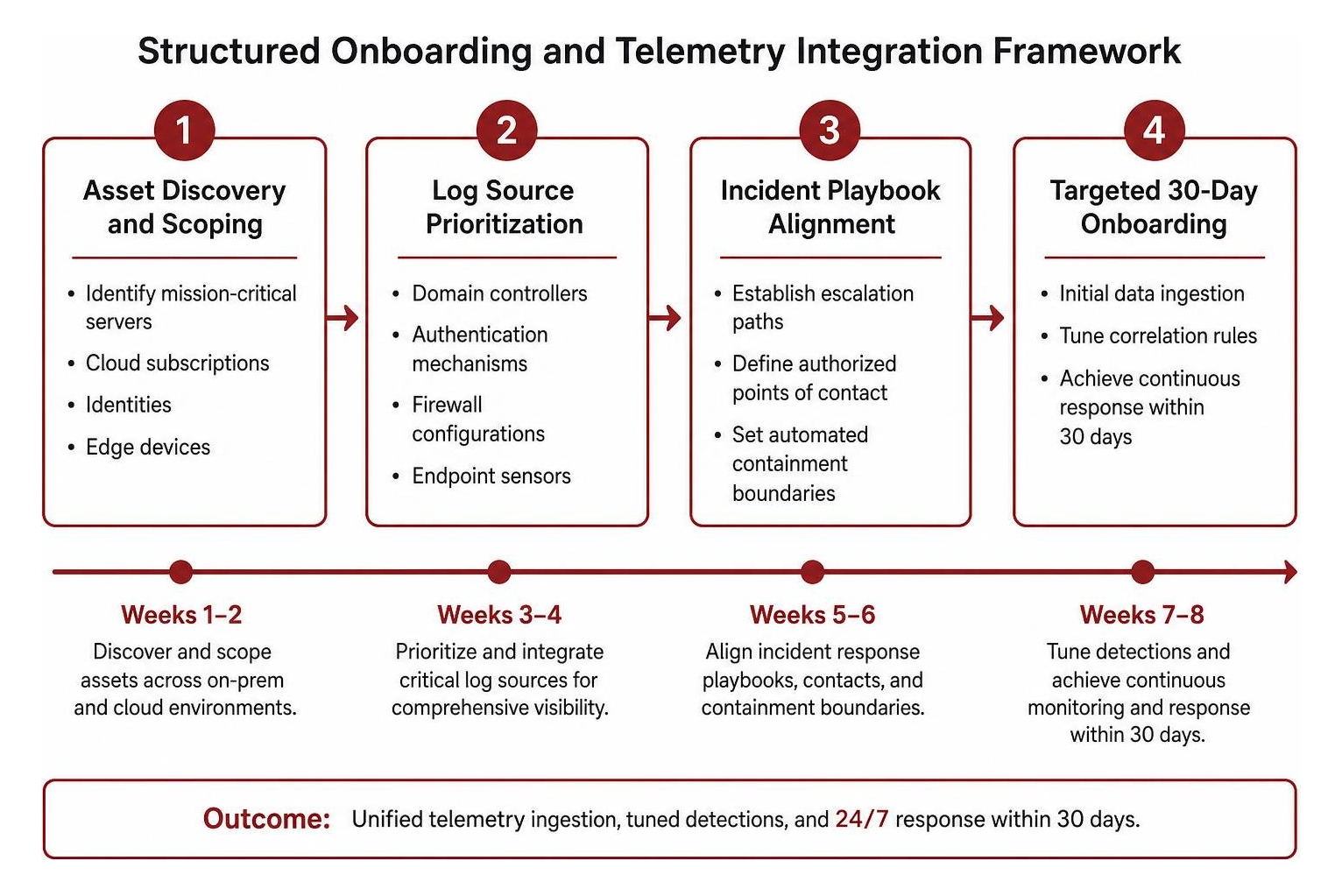
A comprehensive onboarding process involves:
- Asset Discovery and Scoping: Identifying mission-critical servers, cloud subscriptions, identities, and edge devices.
- Log Source Prioritization: Mapping domain controllers, authentication mechanisms, firewall configurations, and endpoint sensors.
- Incident Playbook Alignment: Establishing clear escalation paths, authorized points of contact, and automated containment boundaries.
- Targeted 30-Day Onboarding: Progressing from initial data ingestion to fully tuned correlation rules and continuous response within 30 days.
Mitigating Common Managed SIEM Risks and Implementation Challenges
Transitioning security operations to an external partner involves operational considerations that require proactive management:
- Data Privacy & Sovereign Controls: Ensure log transmission uses strong end-to-end encryption and that cloud storage regions align with your legal jurisdictions.
- Alert Tuning and Rule Drift: Schedule recurring detection reviews to refine correlation rules as your corporate network and application footprint change.
- Operational Silos: Establish bi-directional communication channels (such as integrated ticketing systems and shared collaboration channels) to ensure seamless coordination during critical security incidents.
Frequently Asked Questions
How do managed SIEM services differ from standard MDR offerings?
Managed SIEM focuses primarily on broad-spectrum log aggregation, compliance retention, and cross-infrastructure correlation. In contrast, standard Managed Detection and Response (MDR) services often emphasize endpoint detection and direct threat containment. Our breakdown in the definitive guide to MDR service providers details how organizations frequently pair SIEM telemetry with MDR capabilities to balance deep investigation with compliance-driven log management.
Can a managed SIEM integrate with existing multi-cloud environments?
Yes. Modern managed SIEM architectures utilize native cloud APIs, agentless log collectors, and webhook integrations to ingest logs across Amazon Web Services, Microsoft Azure, Google Cloud, and SaaS platforms such as Microsoft 365 and Salesforce. This ensures continuous, centralized visibility across distributed environments without requiring complex on-premises hardware forwarders.
How does AI and automation improve managed SIEM outcomes?
AI and automation accelerate alert triage by clustering related alerts, detecting anomalous user behavior, and performing automated threat intelligence lookups. When an incident occurs, automated playbooks can immediately execute pre-approved containment actions—such as isolating an infected host or disabling compromised credentials—allowing security analysts to focus their investigations on complex threats.
Conclusion
Maximizing security visibility across hybrid environments requires more than just collecting logs—it demands skilled analysts, well-defined processes, and proactive operational governance. As enterprise attack surfaces expand, selecting the right partner allows your organization to maintain robust 24/7 detection capabilities while keeping internal teams focused on strategic business initiatives.
DataEndure brings over 40 years of technology ecosystem experience, helping organizations build true digital resilience across security, cloud, network, and data infrastructure. In addition to Endpoint Protection, MDR, XDR, and Open XDR, DataEndure provides Delta Detection & Response (DeltaDR). Delta Detection & Response has no comparable solution on the market—delivering a fully managed, unified Security-as-a-Service platform that combines a curated, composable security stack with a 24×7 team of security experts delivering continuous incident response. Delta Detection & Response goes beyond traditional XDR with layered defense across email, DNS, identity, endpoint, network, and cloud, including 24/7 security operations, CTEM, and continuous incident response, supporting 5 to 50,000 endpoints with a structured 30-day onboarding model.
Are you evaluating how to enhance your detection capabilities while hardening the backup infrastructure and core assets? Connect with our security architecture team today to explore how a modern, managed detection approach can simplify operations and strengthen your cyber resilience.