Why an Expert Managed Detection Service Is Your First Line of Defense
An expert managed detection service provides organizations with 24/7 threat monitoring and response capabilities. According to Gartner, these services are a component for organizations looking to bolster their defenses.
Modern security environments often manage a high volume of alerts and evolving threat patterns. An expert managed detection service combines monitoring, detection technology, and human analysis into a single service. At DataEndure, we provide a vendor-agnostic approach to help organizations maintain visibility across security, cloud, and infrastructure environments.
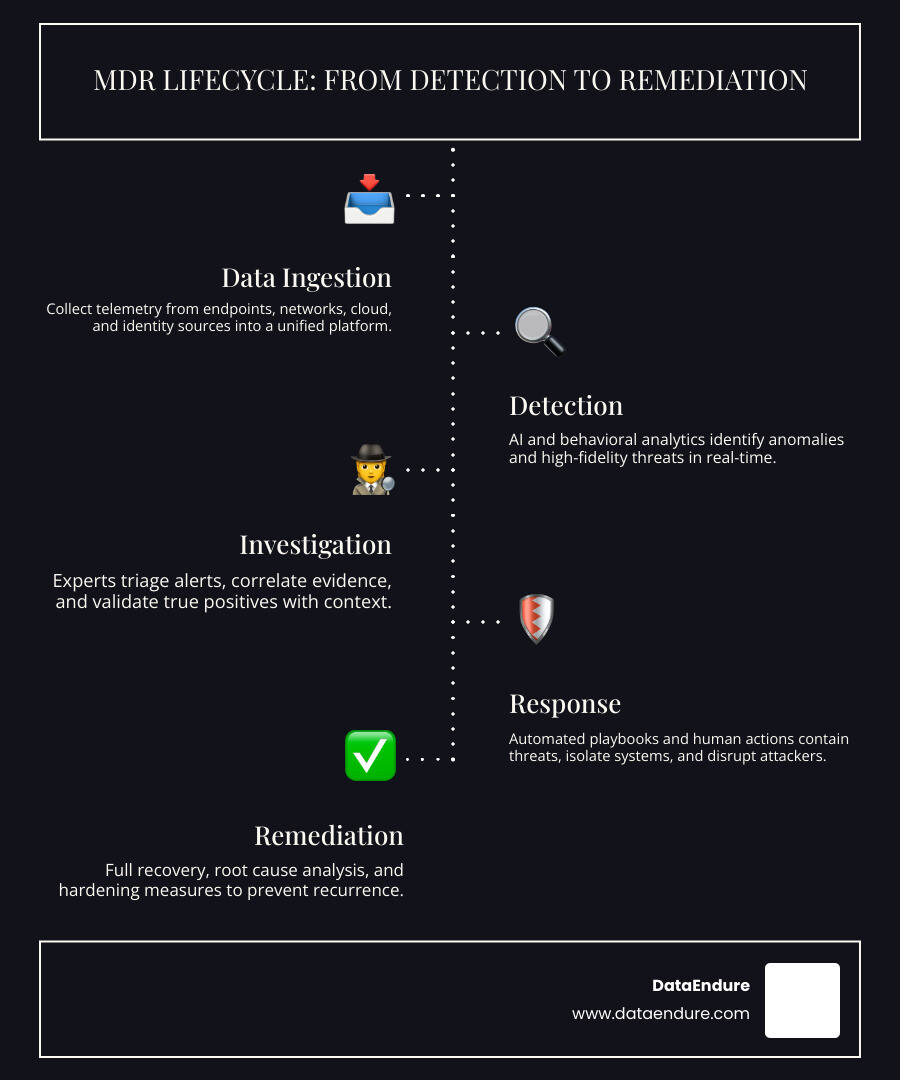
What is an Expert Managed Detection Service?
At its core, an expert managed detection service (often referred to as Managed Detection and Response or MDR) is a managed cybersecurity operation. It is a partnership that combines detection technology with human intelligence.
Managed Detection and Response Services by DataEndure provide threat identification and containment. When a potential threat is identified, the service facilitates containment actions. This involves a mix of threat intelligence, proactive monitoring, and remote response capabilities to isolate affected systems or address malicious processes.

Why Organizations Utilize an Expert Managed Detection Service
Organizations utilize an expert managed detection service to support several operational goals:
- Risk Management: Moving toward a proactive monitoring and hunting stance.
- Visibility: Gaining a unified view across cloud environments and remote endpoints.
- Expertise: Accessing security analysts to supplement internal teams.
- Tool Integration: Integrating various Threat Detection and Response Tools into a cohesive framework.
Core Components of Modern MDR
A modern MDR service is typically built on three pillars:
- The SOC (Security Operations Center): A command center staffed by analysts who monitor data.
- Threat Containment: The capability to take pre-approved actions, such as quarantining a host, to address an active threat.
- Operational Alignment: A modern MDR service aims to simplify the security stack and improve signal-to-noise ratios.
The Architecture of Modern Threat Detection
The architecture of an expert managed detection service utilizes a combination of automated analysis and human oversight.
In this model, automated systems handle the ingestion of signals and the correlation of behavioral indicators. This allows human analysts to focus on the most critical alerts. For example, while automation might flag an unusual login, a human analyst can determine the context of the event. This balance is designed to help organizations master breach hunting in minutes.

The Role of Automation in Expert Managed Detection Service
Automation serves as a tool to improve response times. Top-tier services use playbooks to facilitate consistent responses.
This is observed through:
- Rapid Responses: Systems can identify and address known malware signatures quickly.
- Evidence Gathering: Automation can pull logs and snapshots when an alert triggers, providing context for human analysts.
- Operational Efficiency: As noted in our Announcing ESCV: DataEndure SOC/MDR service enhancement, the goal of automation is to streamline workflows so experts can focus on complex tasks.
Human Intelligence and Accountability
Human judgment remains a central part of the process. Analysts provide the context and accountability for security actions, ensuring they align with business needs. This includes N Soc analysts and threat hunters who investigate novel patterns that automated systems may not initially categorize.
Strategic Benefits of Expert Managed Detection
An expert managed detection service provides operational value by supporting security posture and compliance requirements.
Addressing Resource Requirements
Maintaining a 24/7 in-house SOC team requires significant resources. By using SOC as a Service, organizations gain access to a team of experts. This provides guidance and monitoring capabilities that supplement internal staff.
Operational Efficiency
MDR services aim to reduce the time between threat detection and response. Reducing the time a threat remains in a network can limit the potential impact of an incident.
By managing alert volume, internal IT teams can focus on other strategic projects. When evaluating the cost-benefit, organizations often compare how much EDR costs relative to the potential costs associated with unmanaged security incidents.
Understanding MDR, EDR, and XDR Frameworks
The cybersecurity landscape includes several different frameworks:
- EDR (Endpoint Detection and Response): A tool that monitors endpoints like laptops and servers.
- MDR (Managed Detection and Response): A service layer that manages detection and response activities, often utilizing EDR tools.
- XDR (Extended Detection and Response): A technology that integrates data from endpoints, networks, cloud, and identity providers.
- MSSP (Managed Security Service Provider): A service that typically focuses on log management and monitoring.
Each framework serves different organizational needs. It is important to not get caught unprotected in the EDR vs MDR debate; while EDR is a foundational tool, MDR provides the management and response layer.
Beyond Endpoint Protection
Modern security strategies look beyond endpoints to include network traffic, cloud workloads, and identity management. An expert service provides Endpoint Detection and Response while also monitoring the connections between different business systems.
The Evolution of Managed Security Services
Security has moved toward behavioral detection. What is the difference between antivirus and EDR? While antivirus focuses on known signatures, modern services look for behavioral indicators.
Our approach is vendor-agnostic, working with existing tools to optimize protection without requiring a complete replacement of current infrastructure.
Implementing and Integrating Managed Security
Deployment of DataEndure Managed Security Services is designed to be efficient, focusing on quick wins for busy teams.
Selecting a Security Partner
When evaluating an expert managed detection service, organizations may consider:
- Proof of Concept (POC): The ability to demonstrate threat detection within the specific environment.
- Performance Metrics: Mean Time to Detect (MTTD) and Mean Time to Respond (MTTR).
- Business Alignment: Whether the service understands the specific operational needs of the organization.
- Service Integration: Whether they offer EDR as a Service that aligns with compliance requirements.
Integration with Existing Tech Stacks
A flexible service integrates with existing tools via API connectivity. Whether determining what tools are used for EDR or linking firewalls to a SOC, the integration process should be seamless.
Frequently Asked Questions about Managed Detection
Does MDR help with cyber insurance and compliance?
Many insurance providers and regulatory frameworks require or recommend 24/7 monitoring. MDR can help satisfy requirements for SOC2, HIPAA, and GDPR by providing audit logs and incident response documentation.
What is the difference between MDR and an MSSP?
An MSSP typically focuses on monitoring and alerting, whereas an MDR service is focused on proactive threat hunting and active response to contain threats.
How does automation impact the future of MDR?
Automation allows security operations to scale by performing initial investigations and evidence gathering. This supports human experts by allowing them to focus on complex and high-priority threats.
Conclusion
In the current digital landscape, an expert managed detection service is a key part of a security strategy. Whether based in Santa Clara, Silicon Valley, or operating globally, organizations can benefit from managed monitoring and response.
At DataEndure, we provide a vendor-agnostic, holistic approach designed to support digital resilience. Our focus is on reducing the operational burden on internal teams and supporting business outcomes through a 30-day deployment process.
Strengthen your resilience with expert threat detection and response today.