Why Organizations are Partnering with mdr service providers in 2026
MDR service providers give organizations a fully managed team of security experts who monitor, detect, and actively respond to threats 24/7 — without requiring you to build or staff an in-house SOC.
Cyber threats don’t follow business hours. But most internal security teams do.
That’s the core problem. Even organizations that invest heavily in security tools — SIEM platforms, EDR agents, firewalls — still face the same painful reality: thousands of alerts per day, a shortage of skilled analysts to review them, and threat actors who move faster than any human team working alone can match.
The numbers make the stakes clear. The average data breach now costs more than $4.4 million. And by 2025, analysts at Gartner predicted that half of all organizations would turn to MDR to close the gap. That prediction has proven accurate — MDR adoption has grown by double digits year over year, across every industry and company size.
MDR is different from traditional security monitoring. A managed security service provider (MSSP) will send you alerts. An EDR tool will flag suspicious activity on an endpoint. But MDR providers go further — they investigate, validate, and act. They contain threats before damage spreads.
For IT leaders in regulated industries already dealing with a breach, staff shortages, or compliance pressure, this distinction matters enormously. The question is no longer whether to use MDR. It’s which provider fits your environment, your team’s working style, and your risk profile.
With over 300 MDR providers now on the market, that choice is harder than it should be.
This guide cuts through the noise.
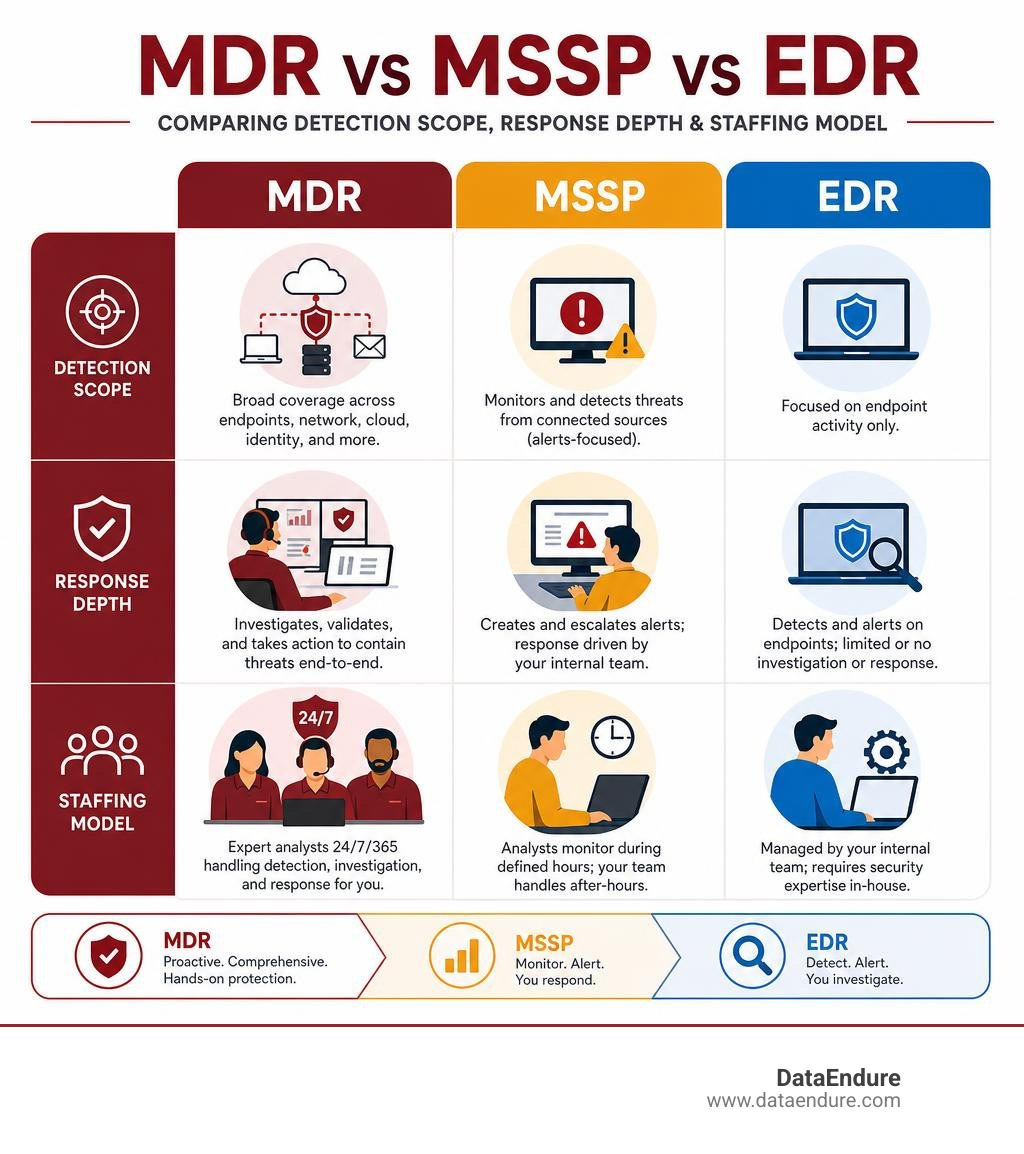
The cybersecurity landscape in 2026 demands more than passive observation. Traditional defenses focused on building high walls, but today’s threat actors bypass these barriers through sophisticated credential abuse, zero-day vulnerabilities, and rapid ransomware campaigns that can encrypt an entire network in minutes.
Many organizations find themselves trapped in the Don’t Get Caught Unprotected in the EDR vs MDR Debate cycle. EDR (Endpoint Detection and Response) is a powerful tool, but a tool is only as good as the hand that wields it. If an EDR agent fires an alert at 2:00 AM on a Sunday, and there is no one awake to analyze it, the tool has merely documented your compromise rather than preventing it.
This operational gap is why modern enterprises are shifting toward comprehensive Managed Detection and Response services. Partnering with mdr service providers delivers several critical advantages:
- True 24/7/365 Monitoring: Cybercriminals do not take weekends off. MDR providers staff global Security Operations Centers (SOCs) to ensure continuous surveillance and immediate response.
- Telemetry Correlation: Attacks rarely happen in a vacuum. A sophisticated threat might involve a suspicious login in the cloud, followed by a minor configuration change on a firewall, and finally a strange PowerShell execution on an endpoint. MDR platforms ingest and correlate data across all these domains to see the bigger picture.
- Active Containment over Alerting: Instead of sending you an email saying, “We think you have ransomware, good luck,” modern MDR services execute pre-approved actions (PAAs) to isolate compromised hosts, revoke compromised credentials, and terminate malicious processes in real time.
- Elimination of Alert Fatigue: Security teams are drowning in noise. Advanced MDR platforms triage up to 90% of low-level alerts autonomously using behavioral analytics, ensuring that human analysts only focus their attention on validated, high-fidelity threats. This reduces false positives to less than 5%, giving your internal IT team room to breathe.
By offloading the heavy lifting of threat detection and incident containment, organizations can redirect their valuable internal resources toward strategic initiatives, such as architecture modernization and digital transformation.
Core Capabilities and Technology Stack of MDR
To understand how mdr service providers defend your digital estate, we must look under the hood at their technology stack and operational methodologies. A modern, resilient MDR service does not rely on a single agent or a monolithic platform. Instead, it leverages a layered architecture designed to eliminate blind spots across endpoints, networks, cloud environments, and identities.
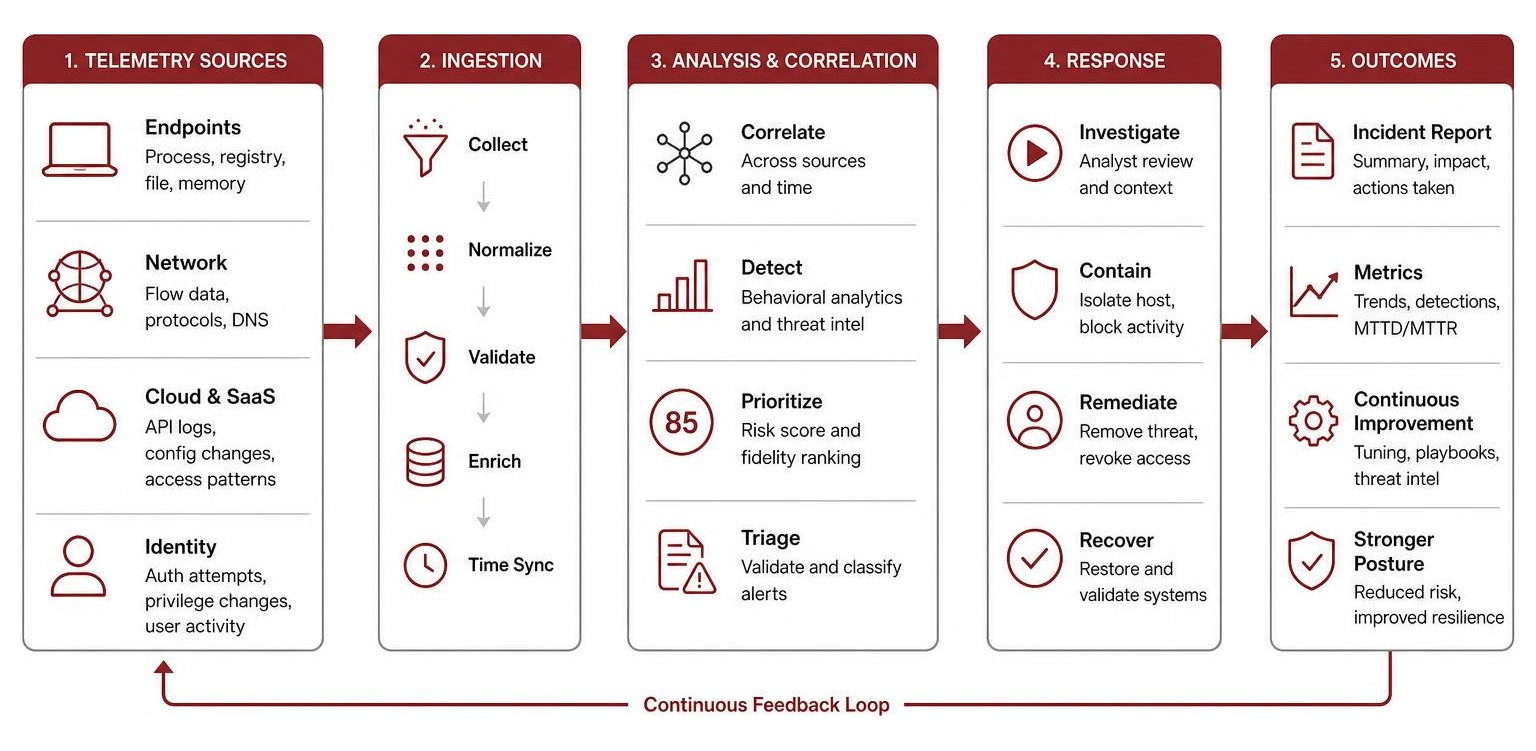
At the foundation of this stack is continuous telemetry collection. MDR services ingest rich data streams from your existing infrastructure, including:
- Endpoints: Process executions, registry modifications, and memory dumps.
- Network: Flow data, protocol analysis, and lateral movement signatures.
- Cloud & SaaS: API logs, configuration changes, and access patterns in AWS, Azure, and Microsoft 365.
- Identity: Authentication attempts, privilege escalations, and anomalous travel patterns.
Once collected, this data is analyzed using behavioral analytics and machine learning models to establish a baseline of normal behavior. When an anomaly is detected, the platform triggers a human-led investigation. This combination of advanced Threat Detection and Response Tools and human expertise is what supports an accurate, context-aware defense.
Crucially, an effective MDR strategy must prioritize vendor-agnosticism. Rather than forcing you to rip and replace your existing security investments, elite providers integrate with over 50+ industry-leading partners. This flexible approach allows you to maximize the return on your current security stack while avoiding vendor lock-in.
Furthermore, maintaining data sovereignty is highly critical for compliance-heavy sectors. High-quality MDR operations perform their analysis directly within your own cloud tenant or secure, localized repositories, ensuring that sensitive data never leaves your regulatory boundary.
How mdr service providers Integrate with Existing Security Tools
A major friction point for IT directors is the implementation timeline. No one wants to spend six months deploying agents and configuring APIs. Modern MDR providers solve this by utilizing native API integrations to connect directly with your existing security controls.
Through seamless API ingestion, the MDR platform pulls telemetry from your existing endpoint detection and response (EDR) agents, firewalls, and identity providers without requiring additional heavy software installations. This enables a unified approach to Threat Detection and Response, allowing the provider’s SOC to orchestrate automated containment actions—such as blocking an IP address at your firewall or disabling a user in Active Directory—instantly across your entire ecosystem.
Key Differences Between mdr service providers Adoption Models
When partnering with an MDR provider, organizations typically choose between two primary operational models depending on their internal security maturity:
- Full-Service Model: The provider acts as your complete, outsourced SOC. They handle 100% of the alert triage, investigation, and active containment. This model is ideal for organizations with limited in-house security staff who need a turnkey solution.
- Collaborative / Hybrid Model: The provider’s analysts work hand-in-hand with your internal security team. The MDR service handles the initial heavy lifting of 24/7 monitoring and high-volume alert triage, escalating only verified, high-severity incidents to your team for co-managed response.
Deciding which model fits your business requires careful planning. For practical guidance on structuring this relationship, read what industry veteran Managed Detection Response Experts Share Their Advice on aligning MDR operations with internal workflows.
Key Use Cases for Modern MDR Services
MDR services are not just general-purpose monitoring solutions; they are engineered to solve specific, high-risk security challenges that businesses face daily.
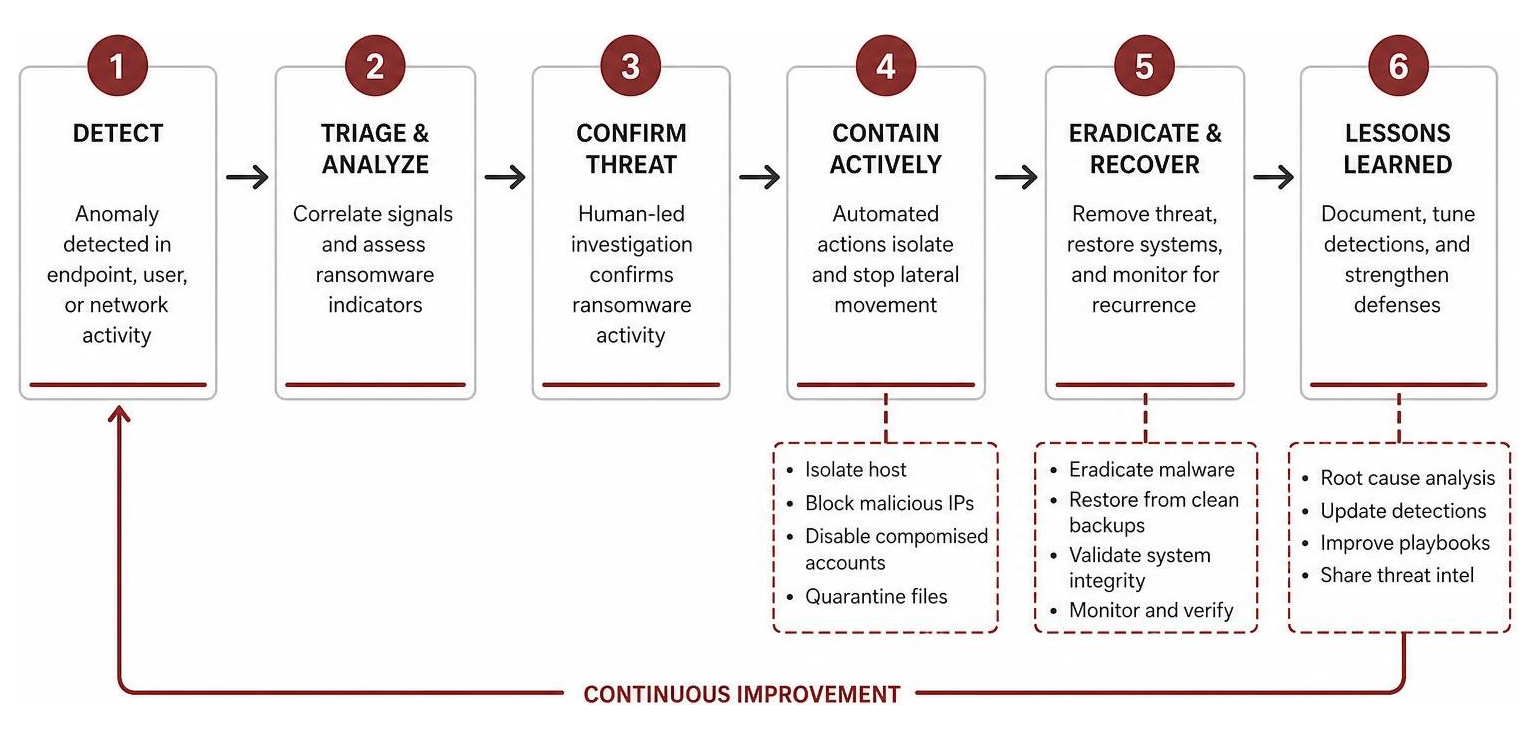
- Rapid Ransomware Response: Ransomware moves at machine speed. When a malicious payload executes, the MDR provider’s automated playbooks and expert analysts work together to isolate the infected host from the network within minutes. This prevents the lateral movement of the malware, helping protect your business from downtime and recovery costs.
- Cloud and Hybrid Security Monitoring: As organizations migrate workloads to multi-cloud environments, visibility becomes highly fragmented. MDR providers unify your security posture by monitoring cloud APIs, identifying misconfigurations, tracking unauthorized access, and detecting data exfiltration attempts across AWS, Azure, and SaaS applications.
- SOC Augmentation: Many IT teams are competent but severely overstretched. By integrating a dedicated SOC as a Service, companies can instantly scale to a 24/7 security posture without the massive overhead of hiring, training, and retaining tier-1 and tier-2 analysts.
- Insider Threat Detection: Not all threats originate from the outside. Behavioral analytics can flag anomalous internal activities—such as an employee downloading unusual volumes of proprietary data or accessing sensitive servers outside of normal working hours—allowing you to intercept insider threats before data is lost.
To understand how a modern SOC functions behind the scenes to deliver these outcomes, explore our detailed breakdown on The Secret Life of a SOC and Why Your Business Needs One.
How to Evaluate and Choose the Right MDR Partner
With hundreds of options in the marketplace, selecting the right MDR partner requires a structured evaluation process. It is easy to be swayed by marketing claims of “100% detection rates,” but sophisticated buyers look for measurable operational metrics and transparency.
When reviewing Best Managed Detection and Response Reviews 2026 – Gartner , pay close attention to real-world peer feedback regarding deployment speed, analyst communication during live incidents, and integration flexibility.
To help guide your evaluation, use the following criteria matrix:
| Evaluation Criteria | What to Look For | Why It Matters |
|---|---|---|
| Mean Time to Respond (MTTR) | Under 15-20 minutes for active containment. | Shorter response windows prevent attackers from establishing persistence. |
| Integration Depth | Vendor-agnostic, supporting 50+ native security tools. | Eliminates tool sprawl and maximizes your existing technology investments. |
| Analyst Qualifications | Elite certifications (SANS, GIAC, CISSP) and threat hunting experience. | Ensures high-quality investigation and limits costly false positives. |
| Data Sovereignty | Analysis performed directly within your secure cloud tenant. | Keeps your sensitive data secure and compliant with local regulations. |
| Deployment Speed | Fully operationalized within 30 days. | Delivers rapid time-to-value without prolonged project friction. |
To accelerate your implementation timeline and see immediate security improvements, check out our guide on Enterprise MDR Deployment Quick Wins for Busy Teams.
Frequently Asked Questions about MDR
What is the difference between MDR and MSSP?
While both are outsourced security options, they serve entirely different purposes. A traditional MSSP focuses on security administration, log collection, and device management (such as firewalls and SIEMs). They are primarily alerting engines—they tell you when something looks wrong, but leave the investigation and remediation entirely to your team.
In contrast, MDR is highly proactive. It combines advanced technology with human-led threat hunting, detailed incident investigation, and active threat containment. To see how these models compare, you can read our comprehensive review of Managed Security architectures.
Why is network evidence critical for MDR?
Endpoints are vital, but they represent only a portion of your attack surface. Sophisticated attackers can disable endpoint agents, use unmanaged devices (like IoT or rogue laptops), or exploit vulnerabilities before an agent can report them.
Network telemetry provides an unalterable record of truth. By analyzing network traffic patterns, MDR analysts can detect lateral movement, unauthorized credential usage, and command-and-control communications that endpoint tools might miss entirely, eliminating dangerous blind spots.
How does AI impact MDR delivery in 2026?
In 2026, AI is no longer a buzzword; it is a core operational enabler. Advanced machine learning models automate the triage of over 90% of low-severity alerts in under five minutes. This massive reduction in noise allows human analysts to dedicate their expertise to deep forensic investigations and proactive threat hunting, significantly reducing your overall risk profile.
Conclusion
Building a resilient, modern security posture does not have to be an overwhelming, complex endeavor. In an era of escalating threats, digital resilience is your ultimate competitive advantage.
At DataEndure, we bring over 40 years of multi-disciplinary experience in digital resilience across security, data, cloud, network, and infrastructure. Headquartered in Silicon Valley (Santa Clara, CA), we partner with CISOs and IT leaders to deliver rapid breach detection, reduce alert fatigue, and deploy your tailored MDR solution within 30 days. Our vendor-agnostic approach leverages over 50+ partners to eliminate tool sprawl, ensuring your security strategy is aligned with your real business outcomes.
Ready to transform your security operations? Download our comprehensive SOC as a Service eBook to learn more, or contact our team today to explore how our specialized SOC as a Service can fortify your enterprise.