When Every Alert Feels Like a False Alarm, Something Has Gone Wrong
The best alert fatigue management tools do one thing above all else: they make sure the alerts that reach your team actually matter. For CISOs, IT directors, and technical leaders, the goal is not simply to add another dashboard. It is to create a smarter operating model that reduces noise, eliminates blind spots, and gives responders the context they need to act quickly.
Here is a practical evaluation framework for 2026:
| Capability | Best For | Key Outcome |
|---|---|---|
| AI-driven correlation | SRE, DevOps, and security operations teams | Groups related signals into fewer, higher-quality incidents |
| Automated deduplication | High-volume monitoring environments | Suppresses repetitive alerts and reduces unnecessary pages |
| Context enrichment | Distributed cloud, network, and infrastructure teams | Adds logs, ownership, dependencies, and likely root cause before escalation |
| Workflow-aware routing | On-call and cross-functional response teams | Sends alerts to the right responder through the right channel |
| Post-incident intelligence | Teams focused on resilience and continuous improvement | Turns incident data into lessons, runbooks, and measurable process improvements |
In 2013, a 16-year-old at one of the top hospitals in the United States was given a 3,800% overdose of his medication. The alert system caught the error. But the team had seen so many alerts – the vast majority of them false – that the warning was ignored. That is alert fatigue in its most extreme form.
The same dynamic plays out every day in IT and security operations. SOC teams can receive tens of thousands of alerts daily. Studies show that over 60% of security alerts are redundant, and 52% are false positives. When every notification competes for attention, the real threats get lost in the noise.
The result is not just missed incidents. It is burnout, slower response times, compliance risk, and – in the worst cases – catastrophic failure.
Most organizations have tried to solve this by adding more monitoring tools. But more tools often means more alerts, more context switching, and more noise. What teams actually need is a smarter layer that filters, correlates, and routes only the signals that demand human attention.
That is exactly what modern alert fatigue management tools are built to do.
What is Alert Fatigue and Why Does It Threaten Modern Operations?
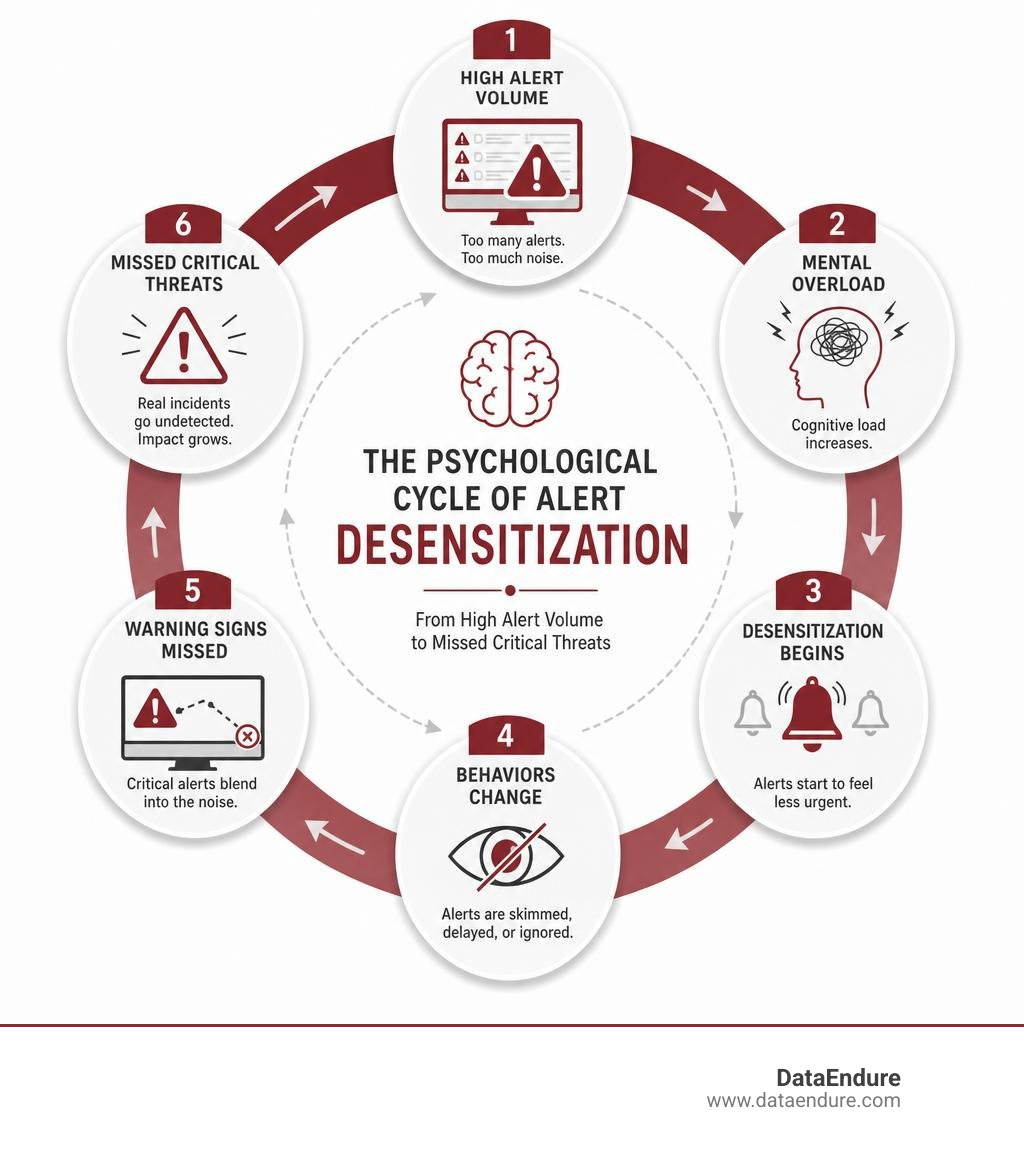
Alert fatigue is the cognitive and mental exhaustion that occurs when a person is exposed to an overwhelming volume of frequent, redundant, or non-actionable alarms. Over time, this constant sensory bombardment desensitizes responders, leading to delayed response times, skipped steps, and outright ignored notifications.
To understand how dangerous this phenomenon is, we only need to look at high-stakes industries like healthcare. Research indicates that a staggering 72% to 99% of all clinical alarms are false positives. In fact, 19 out of 20 hospitals rank alert fatigue as their number one safety concern. When medical professionals are subjected to constant, irrelevant beeps, cognitive impairment sets in. Critical interventions are delayed, and clinical protocols break down.
For a deep dive into the clinical implications of this phenomenon, you can explore the Addressing Alert Fatigue by Replacing a Burdensome … – PMC scoping review, which outlines the severe toll that unrefined alarm thresholds take on healthcare professionals. Beyond the tragic 3,800% medication overdose mentioned in our introduction, another patient safety incident involved a child receiving a 39-fold overdose of a common antibiotic because clinicians routinely bypassed overridden alert screens. Psychologically, the human brain is wired to adapt; research shows that the likelihood of a human accepting and acting on an alert drops by 30% with each repeated reminder.
In the digital arena, the stakes are equally high. Security Operations Centers (SOCs) and IT operations teams face an identical psychological battle. When a typical Security Operations Center receives thousands, or even tens of thousands, of alerts daily, human triage becomes structurally impossible.

When analysts are forced to spend their shifts manually closing repetitive alerts, they enter a purely reactive state. This operational drag directly compromises compliance, degrades performance, and leaves the door open for malicious actors who exploit this exact window of vulnerability. For a practical look at how to break this cycle in your own infrastructure, read our guide on A Practical Guide to Reducing Alert Noise.
Core Capabilities of Modern Alert Fatigue Management Tools
Traditional incident management platforms were designed to act as digital post offices: they took an incoming alert and routed it to an on-call engineer. However, in an era of hyper-distributed cloud environments and complex microservices, simply forwarding notifications only accelerates the path to burnout.
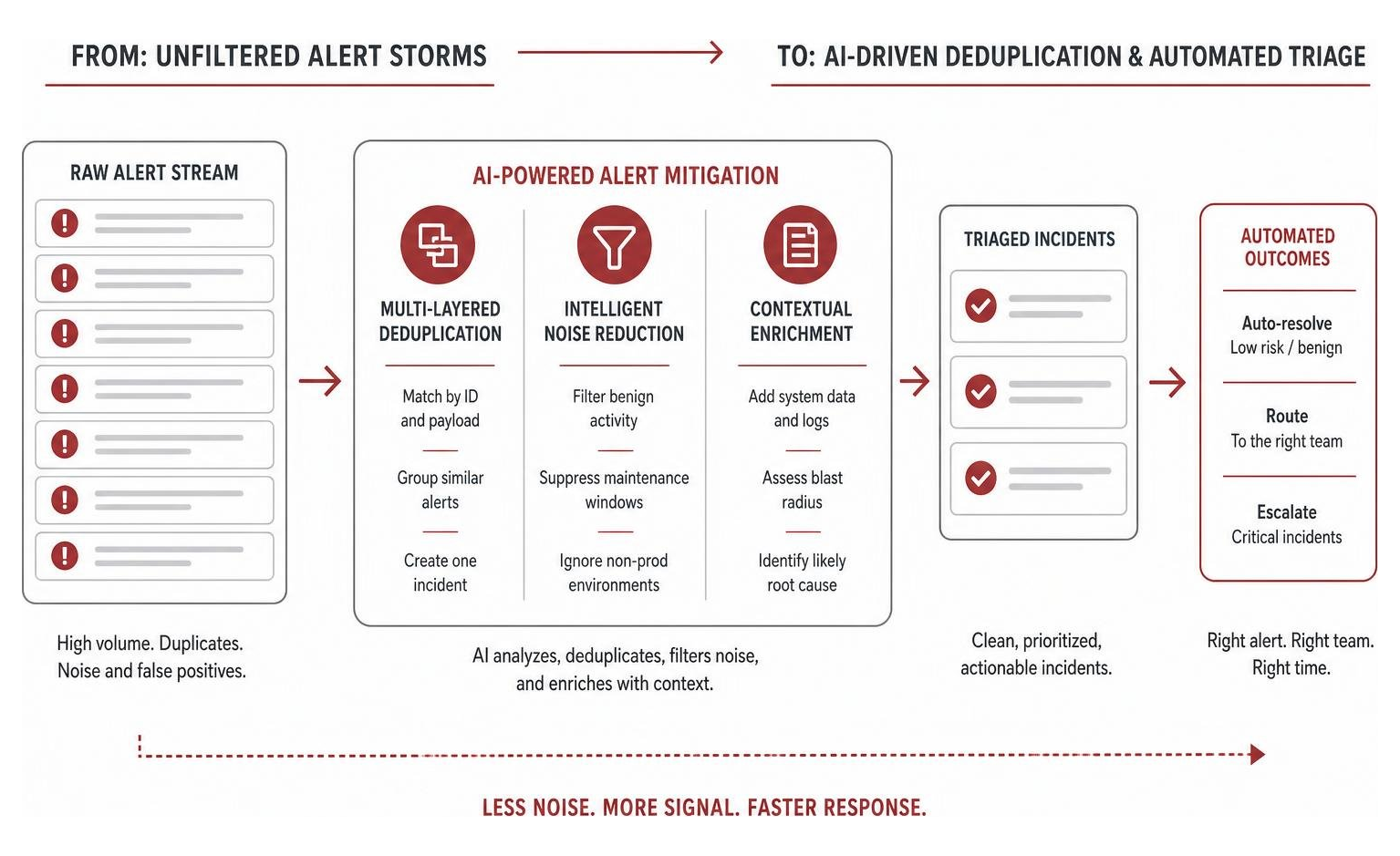
Modern alert fatigue management tools act as intelligent firewalls between your raw telemetry and your human engineers. They do not just route alerts; they ingest, analyze, enrich, and resolve them.
To achieve this, effective platforms rely on several core technical capabilities:
- Dynamic Alert Aggregation: Collecting disparate signals from across your entire monitoring stack (SIEM, EDR, APM, cloud infrastructure) and centralizing them into a single pane of glass.
- Multi-Layered Deduplication: Merging identical or highly similar alerts into a single incident ticket. This is often achieved using unique identifier matching and payload-based suppression.
- Intelligent Noise Reduction: Automatically suppressing alerts generated by known benign activities, scheduled maintenance windows, or non-production environments.
- Contextual Enrichment: Automatically attaching relevant system data, logs, blast radius assessments, and potential root causes to the alert before it ever reaches a human responder.
To help distinguish between basic notification systems and advanced alert mitigation platforms, we have mapped out the core operational differences below:
| Feature | Traditional Incident Management Platforms | Modern Alert Fatigue Management Tools |
|---|---|---|
| Primary Goal | Direct routing and basic escalation of alerts. | Noise reduction, signal correlation, and automated triage. |
| Handling of Duplicates | Generates separate tickets or repetitive pages for each event. | Automatically groups duplicates using payload-based suppression. |
| Contextual Awareness | Relies on static, manually configured routing rules. | Evaluates alerts based on historical patterns and business context. |
| Triage Process | Entirely manual; requires human intervention for every alert. | Highly automated; filters out false positives before human paging. |
| Resolution Focus | Reactive tracking of time-to-acknowledge. | Proactive reduction of overall alert volume and MTTR. |
By transitioning from a simple notification model to an active noise-reduction model, organizations can dramatically decrease operational friction. To understand the mechanics of how this works in a security context, see our detailed discussion on Reducing SOC Alert Fatigue: Turning Down the Volume on False Positives.
Key Strategies for Reducing Alert Noise and Burnout
Software tools are only as effective as the operational strategies that guide them. To successfully combat alert fatigue, organizations must implement a multi-layered approach that addresses the root causes of system noise.
First, teams must move away from static, unrefined alerting thresholds. If a CPU spike to 91% for three seconds triggers a high-priority page at 3:00 AM, the system is misconfigured. Modern platforms allow you to set intelligent thresholds that require sustained anomalies before escalating.
Second, implementing tiered priorities is essential. Not every alert is an emergency. By establishing clear visual, audible, and sensory distinctions between low-priority warnings (which can wait until business hours) and critical system failures, you protect your team’s cognitive reserve.
Aviation serves as an excellent model here: despite tracking over 10,000 distinct data points across modern aircraft, the percentage of flights that generate any active crew alerts at all remains below 10%. This is because aviation systems rely on highly consolidated, multi-sensory alerting frameworks that only escalate when direct human intervention is required.
To successfully structure these strategies in your security pipeline, refer to our comprehensive Cybersecurity Fatigue Solutions Beginner’s Guide.
Evaluating AI-Driven Alert Fatigue Management Tools
The most significant shift in alert management over the last few years has been the transition from static, rule-based filtering to AI-driven autonomous triage. Traditional rule-tuning is a game of whack-a-mole: you write a rule to suppress a specific false positive, only for a minor variation to trigger a new alert storm the next day.
AI-driven tools solve this by treating alert triage as a reasoning problem rather than a filtering problem. Modern autonomous platforms utilize advanced machine learning models to perform end-to-end investigations of incoming alerts.
These AI agents automatically query identity logs, cross-reference endpoint activity, map alert behaviors to the MITRE ATT&CK framework, and build complete “attack chains.” Because the AI is capable of evaluating the alert within the context of your broader environment, it can safely auto-resolve up to 92% to 95% of benign alerts with an auditable, explainable reasoning trail.
This means your human analysts are only paged for the remaining 5% of verified, high-severity threats. To explore how autonomous AI is reshaping security operations, read our analysis on Cyber Response Fatigue Relief in Sight.
Integrating Alert Fatigue Management Tools into Existing Workflows
An alert tool that exists in a vacuum will not solve your operational challenges. To succeed, your chosen alert management platform must integrate seamlessly with your existing technology stack, on-call schedules, and communication channels.
When an alert is triggered, the management tool should automatically cross-reference your integrated identity providers (IDPs) and service dependency maps to identify the exact owner of the affected service. From there, it must check your active on-call schedules to route the notification to the correct engineer via their preferred channel (whether that is Slack, Microsoft Teams, SMS, or voice call).
If the primary responder does not acknowledge the alert within a specified window, the platform must execute intelligent, automated escalation paths to ensure the issue is addressed without creating a company-wide alert storm.
For physical safety and workforce fatigue monitoring outside of IT environments, platforms like the AlertMeter® (FRMS) Fatigue Risk Management System even allow organizations to track and manage human alertness in real-time. To learn more about building a highly integrated, automated monitoring environment, check out our guide on All About Fatigue-Free Monitoring.
How to Choose the Right Platform for Your Organization
Selecting the right alert fatigue management tools requires a clear understanding of your current tooling landscape, your team’s operational structure, and your long-term automation goals.
Rather than simply adding another dashboard to your collection, look for platforms that facilitate tool consolidation. The goal is to eliminate tool sprawl and eradicate blind spots by deploying curated, layered solutions that integrate your existing security, cloud, network, and infrastructure signals.
When evaluating vendors, consider the following selection criteria:
- Vendor-Agnosticism: Ensure the platform integrates natively with your existing monitoring and ticketing tools (over 50+ partner integrations is a good benchmark for enterprise flexibility).
- Depth of Automation: Look for tools that go beyond basic routing to offer automated enrichment, correlation, and autonomous triage.
- Total Cost of Ownership (TCO): Factor in the time and engineering resources required to configure, tune, and maintain the system. Platforms that rely on heavy manual rule-writing often cost far more in long-term maintenance than AI-driven alternatives.
- Time-to-Value: Choose solutions that can deploy rapidly and begin demonstrating noise-reduction metrics within 30 days.

By prioritizing alignment over complexity, technical leaders can transition their operations from a state of chaotic firefighting to a structured, resilient, and highly automated response model.
Frequently Asked Questions about Alert Fatigue
What is the difference between alert management and incident management?
Alert management is the process of collecting, deduplicating, filtering, and routing raw operational signals from your monitoring tools. Incident management covers the broader, end-to-end response lifecycle after an alert is verified as a real issue—including team collaboration, stakeholder communication, active remediation, and post-incident reviews.
How does alert deduplication improve system reliability?
Alert deduplication groups repetitive or cascading notifications into a single, unified incident ticket. By suppressing redundant pages and consolidating related alerts, deduplication provides responders with clear signal clarity, prevents cognitive overload, and ensures that critical system issues are resolved faster without distracting on-call teams.
What role does AI play in modern alert triage?
AI acts as an automated investigator. Instead of relying on rigid, manual rules, AI engines analyze incoming alerts by automatically gathering context from across your entire infrastructure, assessing the blast radius, checking historical patterns, and determining the severity of the event. This allows the system to autonomously close false positives while escalating real threats with complete evidence packages.
Conclusion
At DataEndure, we believe that digital resilience is achieved by building smarter, more integrated systems. With over 40 years of experience supporting digital resilience across security, data, cloud, network, and infrastructure, we help organizations manage operational noise.
Our managed cybersecurity solutions leverage a vendor-agnostic approach, integrating with over 50 industry-leading partners to help address tool sprawl, close visibility gaps, and support rapid breach detection. By deploying curated, layered solutions, we work with organizations to help reduce their operational burden and manage alert fatigue.
To evaluate your current operational posture and explore strategies for noise reduction, you can Schedule a Security Health Check with our team of experts today.