Why Fatigue-Free Monitoring Is a Critical Operational Priority
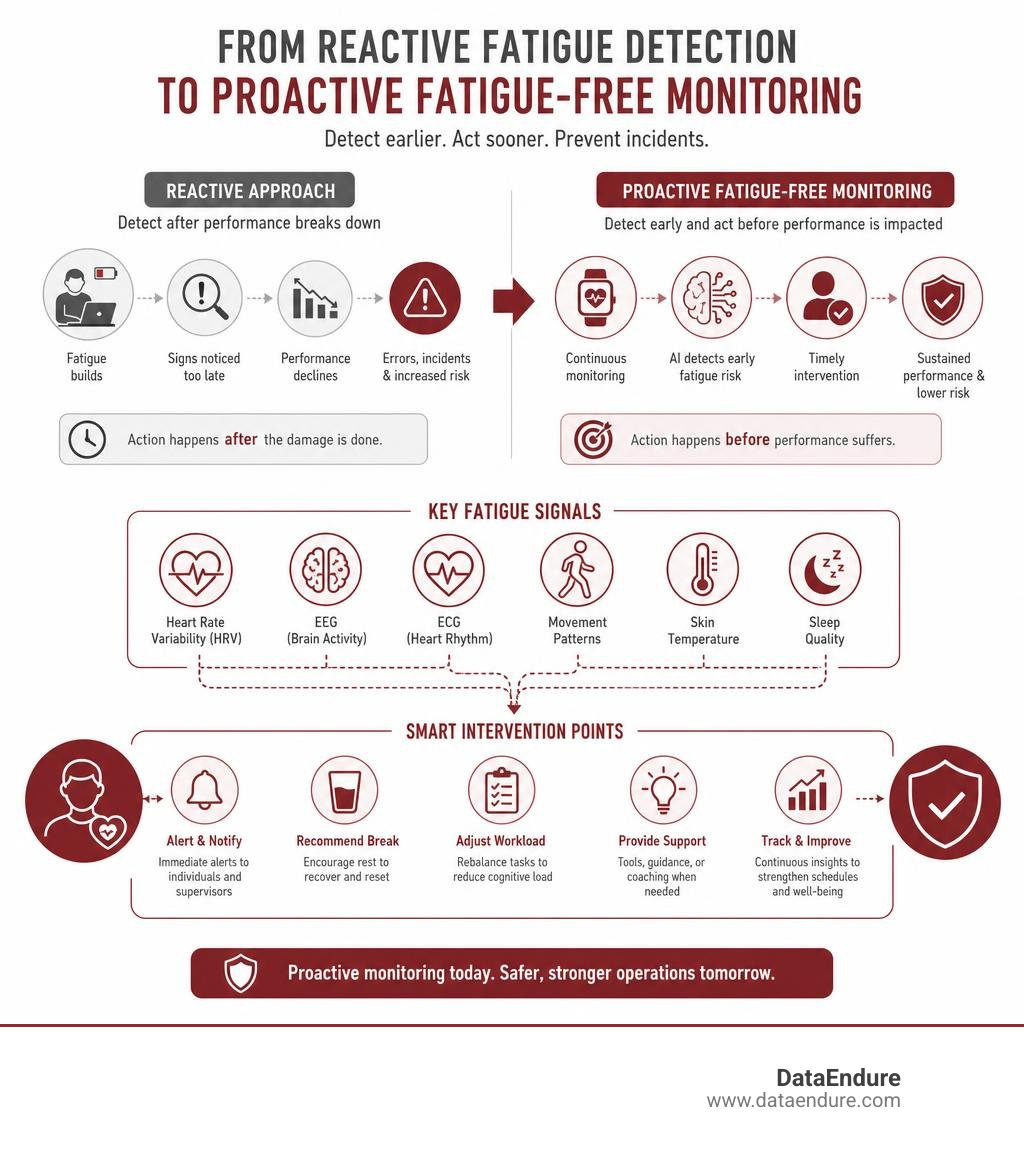
Fatigue-free monitoring is the practice of continuously tracking cognitive and physical exhaustion signals in real time — and acting on them before performance breaks down or an incident occurs.
Quick answer: What is fatigue-free monitoring?
- What it is: A proactive system that uses wearable sensors, physiological data, and AI models to detect fatigue early and trigger interventions before harm happens
- How it differs from traditional methods: Traditional approaches react after fatigue causes an error; fatigue-free monitoring predicts and prevents
- Who needs it: High-stakes industries including transportation, manufacturing, aviation, and IT security operations
- Core signals used: Heart rate variability (HRV), EEG, ECG, movement patterns, skin temperature, and sleep quality
- Key benefit: Reduced injuries, fewer errors, and lower operational risk across shifts and roles
Fatigue is not just a personal problem. It is an organizational risk that shows up in hard numbers. America’s National Safety Council estimates that 13% of workplace injuries are directly linked to fatigue. Roughly 43% of Americans say they may be too tired to function safely at work. In commercial vehicle operations, fatigue is a contributing factor in 20 to 50% of accidents.
The cost of ignoring fatigue is enormous — in human terms and in operational ones.
Yet most organizations still rely on reactive measures: behavioral observation, self-reporting, or post-incident review. By the time those signals surface, the damage is often already done.
That is exactly the gap fatigue-free monitoring is designed to close. Instead of waiting for a near-miss or a breakdown, it uses continuous data streams to surface risk early — giving teams the time and information they need to act.
For IT leaders in regulated industries already stretched thin by alert fatigue, staff shortages, and mounting compliance demands, this concept is especially familiar. The same logic that applies to worker fatigue on a factory floor applies to an analyst staring at a security dashboard at 2 a.m. Exhaustion degrades judgment. Delayed detection increases exposure. And reactive systems consistently fail to protect what matters most.
Important fatigue free monitoring terms:
The Evolution of Fatigue Free Monitoring in High-Stakes Environments
To understand where we are in June 2026, we have to look at where we started. Historically, managing operational fatigue was a matter of guesswork, basic scheduling rules, and self-reporting. If an employee felt tired, they were supposed to say something. If a supervisor noticed someone nodding off, they intervened.
This reactive posture has proven to be a massive liability. Humans are notoriously poor judges of their own exhaustion levels. In fact, research shows that a significant portion of professionals misreport their own fatigue, often overestimating their alertness to keep working or avoid perceived weakness.
The transition to continuous tracking represents a paradigm shift. Instead of waiting for a visible performance drop or a costly error, modern organizations leverage passive, objective metrics. According to a State-of-the-Art Review on Wearable Fatigue Monitoring, the integration of non-invasive sensors allows for the continuous collection of physiological and behavioral markers without disrupting daily workflows.
This evolution mirrors the changes we have driven in digital infrastructure. Just as organizations can no longer rely on daily or weekly manual system checks to catch security threats, they cannot rely on periodic self-assessments to catch human exhaustion. True resilience requires More info on 24×7 security monitoring to maintain visibility over both human and digital assets around the clock.
Defining the Shift from Reactive to Proactive Systems
Traditional fatigue detection relies heavily on retrospective or lagging indicators. These include biomathematical models that predict fatigue based on historical sleep schedules, or behavioral-based methods like in-cab cameras that flag heavy blinking or head-nodding.
While biomathematical models are useful for high-level shift planning, they operate on cohort-level data and fail to account for individual daily variations, stress, or illness. Meanwhile, behavioral-based camera systems often detect drowsiness too late. By the time a driver’s eyes are closing for micro-sleeps, they have already traveled hundreds of feet down a highway at highway speeds.
Proactive fatigue free monitoring focuses on real-time risk prevention. By monitoring subtle shifts in physiological signals—such as heart rate variability (HRV) or minor changes in movement metrics—before physical symptoms manifest, these systems provide early warnings. This allows supervisors to implement guided countermeasures, such as scheduled breaks, task rotations, or environmental adjustments.
Solutions like FIRM II Monitoring Solutions demonstrate the power of combining historical shift patterns, rest periods, and real-time tracking to assign dynamic fatigue risk scores. This dual approach ensures that safety protocols are tailored to the actual physical state of the worker in that exact moment, rather than an idealized schedule.
Comparing Commercial Apps and Research Prototypes
As the market for fatigue tracking has expanded, a clear divide has emerged between consumer-facing applications and high-fidelity research prototypes.
On the consumer side, mobile applications utilize existing hardware to offer accessible, low-friction entry points. For instance, the Fatigue Alert app (boasting a 5.0 rating from early user reviews) leverages the built-in motion sensors in Apple AirPods to track head posture in real time, sending haptic alerts to the user’s Apple Watch when drowsiness is detected. This is a brilliant, lightweight solution for individual use cases, such as preventing a student from falling asleep during a lecture or a commuter on a long drive.
However, clinical and enterprise environments require far deeper personalization and analytical rigor. This is where platforms like FatigueSense step in. Rather than relying on population averages, FatigueSense Tracking and Pacing connects with existing commercial wearables to capture six distinct digital biomarkers.
After a 14-day calibration period, the platform activates a personalized model trained exclusively on the individual’s unique data baseline. This level of customization is vital for managing energy-limiting chronic conditions or high-stakes corporate roles where standard baselines fail to capture individual physiological realities.
The Cost of Cognitive and Physical Exhaustion
The numbers surrounding fatigue paint a sobering picture of modern operational risk:
- 13% of all workplace injuries are directly attributable to fatigue.
- 43% of working Americans admit they are too tired to function safely at work.
- Fatigue contributes to 20% to 50% of commercial vehicle accidents.
- 4% to 8% of all aviation mishaps involve some level of pilot fatigue.
These statistics are not just safety metrics; they represent massive financial liabilities, lost productivity, and operational friction.
In the digital realm, this exhaustion manifests as “alert fatigue” or cognitive burnout among security operations center (SOC) analysts and IT personnel. When human defenders are consistently exhausted, their reaction times slow, their ability to spot complex anomalies degrades, and they are far more likely to make critical errors, such as misconfiguring a firewall or missing a subtle indicator of compromise.
Understanding this dynamic is central to modern operational resilience. Human cognitive limits are as real as network bandwidth limits. Implementing a comprehensive Guide to Cybersecurity Fatigue Solutions is not just about employee wellness; it is about protecting the enterprise from the downstream consequences of human error.
Wearable Technologies and Physiological Signals

The backbone of any modern fatigue free monitoring framework is the array of wearable sensors used to capture real-time physiological data. The goal is to collect high-fidelity signals without causing physical discomfort or introducing operational friction.
In clinical and research settings, electroencephalography (EEG) remains the gold standard for measuring brain activity and detecting the onset of sleepiness. However, wearing an EEG cap with wet electrodes is entirely impractical for a technician configuring a cloud environment or a worker operating machinery.
To bridge this gap, modern systems utilize less intrusive sensors, including electrocardiography (ECG), photoplethysmography (PPG), and inertial measurement units (IMUs). As highlighted in Deep Learning-Based Fatigue Monitoring in Natural Environments, researchers have successfully used single-lead wearable ECG sensors to collect resting data during normal daily activities, achieving high-accuracy fatigue classification without requiring artificial laboratory constraints.
Physiological Signals Driving Fatigue Free Monitoring
To build a complete fatigue profile, systems analyze several interconnected physiological streams:
- Heart Rate Variability (HRV): HRV measures the variation in time between consecutive heartbeats. It serves as a direct window into the autonomic nervous system. When an individual is rested, their HRV is typically high, indicating a healthy balance between the sympathetic (fight-or-flight) and parasympathetic (rest-and-digest) systems. As fatigue sets in, HRV drops, signaling autonomic strain.
- Skin Temperature: Minor fluctuations in peripheral skin temperature can indicate changes in metabolic rate and alertness levels.
- Galvanic Skin Response (GSR): Also known as electrodermal activity, GSR measures skin conductance, which varies with sweat gland activity. It is highly sensitive to cognitive load, stress, and physiological arousal.
- Autonomic Recovery: By tracking how quickly these metrics return to baseline levels during rest periods (such as 60-second post-exercise heart-rate recovery), models can assess an individual’s overall resilience and capacity to continue working safely.
Biomechanical and Jerk-Based Biomarkers
While physiological signals tell us what is happening inside the body, biomechanical markers show us how fatigue manifests in physical movement. When a person tires, their motor control degrades, leading to less smooth, more erratic movements.
One of the most exciting breakthroughs in proactive fatigue modeling is the use of jerk-based biomarkers. Jerk is the rate of change of acceleration over time. Smooth, controlled movements have low jerk values, whereas fatigued, jerky movements have high jerk values.
According to a study published in Nature, utilizing a Joint Modeling Framework for Time-to-Fatigue Prediction, researchers demonstrated that tracking a single sensor biomarker—specifically wrist jerk mean—could reliably predict an individual’s time-to-fatigue (TTF).
During repetitive manual tasks, an increase in wrist jerk mean was associated with a 12.6% higher hazard of reaching exhaustion. Conversely, an increasing slope in the 25th percentile of wrist jerk indicated that the subject was successfully employing compensatory movement strategies to delay fatigue onset. This predictive capability allows organizations to intervene before physical exhaustion leads to musculoskeletal strain or acute injury.
Technical Challenges in Fatigue-Free Monitoring
Deploying these systems in real-world environments is not without significant technical hurdles. The transition from controlled laboratory experiments to messy, everyday operations introduces a variety of variables that can quickly degrade data quality and render predictive models useless.
| Physiological Signal | Wearable Device | Key Limitation | Mitigation Strategy |
|---|---|---|---|
| EEG (Brain Activity) | Smart Headbands / Earbuds | High sensitivity to head movement; social stigma | Form-factor integration (e.g., sensor-embedded safety helmets) |
| ECG (Heart Activity) | Single-lead Chest Patches | Motion artifacts during physical labor | Signal quality assessment (SQA) algorithms to filter noise |
| PPG (Blood Flow) | Smartwatches / Rings | Highly sensitive to ambient light and wrist movement | Multi-channel optical sensors; localized motion compensation |
| IMU (Movement) | Wristbands / Smart Badges | Task-specific variability; difficult to generalize | Joint modeling frameworks; personalized baseline calibration |
These technical challenges are highly analogous to the obstacles we face in enterprise cybersecurity. In both domains, the goal is to extract high-fidelity signal from a massive sea of daily noise.
Just as a security team can get overwhelmed by false positives from a poorly configured firewall, a safety supervisor can experience alert fatigue if their monitoring system triggers a warning every time a worker climbs a flight of stairs or drinks a cup of coffee. Implementing A Practical Guide to Reducing Alert Noise is essential to keep systems actionable, credible, and trusted by the teams who rely on them.
Overcoming Data Noise and Motion Artifacts
The primary enemy of wearable sensor accuracy is the motion artifact. When a worker swings a hammer, reaches for a component, or even types rapidly, the physical movement of the sensor against the skin creates noise that can mimic or obscure physiological signals.
To counter this, advanced platforms like Fatigue Science Predictive Management employ sophisticated signal processing techniques. These include:
- Optimal Sensor Placement: Positioning sensors on areas of the body less prone to extreme rotational movement (such as the upper chest or behind the ear).
- Active Noise Filtering: Using built-in accelerometers to measure physical motion and subtract that specific frequency from the optical or electrical signal.
- Signal Quality Assessment (SQA): Real-time algorithms that automatically evaluate the signal-to-noise ratio and discard corrupted data packets before they are processed by the machine learning model.
Machine Learning and AI for Early Prediction
Once clean data is secured, the next challenge is translating those raw numbers into actionable foresight. Simple threshold-based alerts (e.g., triggering an alarm when heart rate drops below a certain level) are far too simplistic and result in high false-alarm rates.
Instead, modern systems rely on deep learning architectures, such as Convolutional Neural Network-Bidirectional Long Short-Term Memory (CNN-BiLSTM) models. These networks are uniquely suited for this task because they can simultaneously extract spatial features from multi-channel sensor data and model the temporal, sequential nature of physiological changes over time.
These models allow us to move beyond simple binary classification (“tired” vs. “not tired”) and achieve dynamic, continuous time-to-fatigue predictions. By analyzing the trajectory of a biomarker, the AI can forecast exactly how many minutes of safe operation a worker has left under current conditions.
This proactive approach is highly relevant to managing cybersecurity operations. Rather than reacting to a breach after systems are compromised, organizations can use predictive analytics and automated playbooks to identify and address potential threats before they disrupt operations, providing much-needed Relief for Cyber Response Fatigue.
Ethical, Privacy, and Regulatory Considerations

While the safety and operational benefits of fatigue free monitoring are clear, deploying these systems requires navigating a complex landscape of ethics, privacy, and worker trust.
Asking employees to wear devices that continuously track their heart rate, movement, or sleep patterns can easily feel like invasive surveillance. If workers believe that their biometric data will be used against them—such as for disciplinary action, performance reviews, or shift reductions—they will resist the technology, tamper with the sensors, or refuse to participate.
This tension highlights the Unfair Burden of Cyber Defense placed on modern workforces. When organizations demand total compliance and continuous visibility without providing clear, mutual benefits, they create a culture of anxiety and avoidance.
Balancing Safety with Employee Privacy
To build a sustainable monitoring program, organizations must strike a careful balance between duty of care and individual privacy rights:
- Continuous Surveillance vs. Targeted Monitoring: Data collection should be strictly limited to working hours and relevant operational tasks. Biometric tracking must stop the moment an employee clocks out.
- Explicit Consent: Workers must be fully informed about what data is being collected, how it is analyzed, who has access to it, and how long it is stored.
- Data Anonymization and Aggregation: Supervisors do not need to see an employee’s raw ECG waves or precise sleep stages. They only need to see high-level, actionable risk scores. Raw physiological data should be encrypted, anonymized, and stored securely.
- Regulatory Compliance: Systems must comply with local privacy regulations, such as California’s strict consumer and employee data protection laws, ensuring that personal health information is handled with the highest standards of security.
Best Practices for Deploying Fatigue Free Monitoring Systems
Successfully deploying these systems requires a collaborative, transparent approach. We recommend the following best practices:
- Establish Transparent Communication: Involve employee representatives and safety committees early in the process. Explain how the technology protects their physical safety and reduces the risk of life-altering accidents.
- Create Non-Punitive Policies: Ensure that a high fatigue alert is treated as a safety indicator, not a performance failure. The response to an alert should be supportive—such as a mandatory break, a cup of coffee, or a temporary task rotation—rather than disciplinary.
- Utilize Secure Local Storage: Whenever possible, process physiological data locally on the wearable device or a secure, on-site server rather than transmitting raw biometrics to the cloud. This minimizes the attack surface and protects sensitive personal data from external breaches.
This focus on structured, secure, and respectful deployment is a core element of managing modern security environments, as detailed in the Unfair Burden of Cyber Defense Part 2. True operational safety is built on a foundation of trust, clear boundaries, and robust technical safeguards.
Frequently Asked Questions about Fatigue-Free Monitoring
How does fatigue-free monitoring differ from traditional fatigue detection?
Traditional fatigue detection is reactive and behavioral; it flags fatigue after it physically manifests (e.g., through eye-tracking cameras or manual self-reports). Fatigue-free monitoring is proactive and physiological; it continuously and passively tracks internal signals (like HRV, ECG, and movement smoothness) to predict and prevent cognitive or physical exhaustion before visible symptoms or errors occur.
What are the most reliable physiological signals for tracking fatigue?
While EEG is the most accurate for brainwave state, heart rate variability (HRV) and electrocardiography (ECG) are the most reliable and practical signals for continuous, wearable-based tracking. Additionally, biomechanical biomarkers—such as wrist jerk metrics—provide highly reliable, task-specific indicators of physical and musculoskeletal fatigue.
How can organizations minimize alert noise in monitoring systems?
Organizations can minimize alert noise by moving away from simple threshold-based alerts and adopting multi-modal AI models that combine physiological data with contextual factors (such as time of day, shift duration, and task type). Calibrating systems to individual baselines rather than population averages also significantly reduces false positives.
Conclusion
True digital resilience is a multi-disciplinary challenge. Security, cloud, network, and human infrastructure are deeply interconnected, requiring a holistic approach to governance, risk, and compliance (GRC). By focusing on alignment over complexity, reducing alert noise, and eliminating tool sprawl, organizations can build environments where both digital systems and human operators function at their peak.
Establishing a robust framework to protect workforces from cognitive burnout while securing digital assets is essential for long-term operational success. Organizations looking to strengthen these areas can explore structured frameworks such as DataEndure Governance, Risk, and Compliance Services to support their compliance, security, and resilience goals.