Why Managed Penetration Testing Services Matter
Managed penetration testing services give organizations an ongoing way to find, validate, and help fix security weaknesses. Rather than relying on a single annual test, a managed provider combines scheduled expert-led testing, continuous visibility, clear reporting, and re-testing after fixes. When evaluating a service, look for a scope that covers your real attack surface, qualified testers, remediation support, and reporting that maps findings to business and compliance risk.
For many IT teams, the hard part is not finding another security tool. It is knowing which weaknesses an attacker could actually use, then getting the right teams to resolve them before the next audit, release, or incident.
Traditional point-in-time penetration tests can reveal important issues, but environments change quickly. New cloud services, software releases, identities, vendors, and network connections can create exposure between testing windows. A managed model adds a repeatable cadence and a working relationship with security specialists, making validation and remediation easier to sustain.
Penetration testing is one part of a broader resilience program. DataEndure offers Endpoint Protection, MDR, XDR, Open XDR, and Delta Detection & Response. DataEndure’s Delta Detection & Response (∆DR), also called DeltaDR, is a fully managed, unified Security-as-a-Service platform that combines a curated, composable security stack with a 24×7 team of security experts delivering continuous incident response. It goes beyond traditional XDR with layered defense across email, DNS, identity, endpoint, network, and cloud, including 24/7 security operations, CTEM, and continuous incident response.
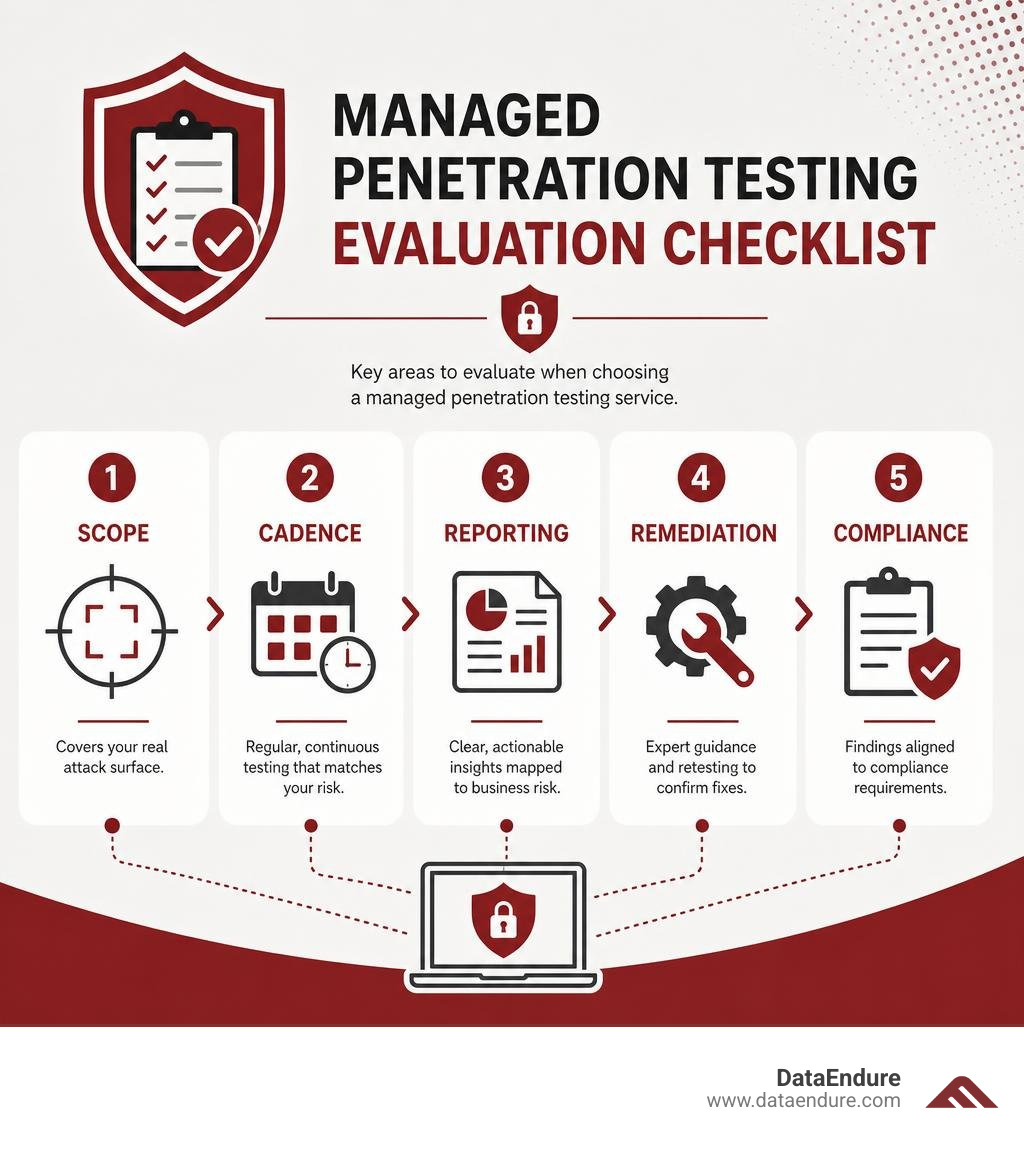
Understanding Managed Penetration Testing Services vs. Traditional Testing
To evaluate security testing approaches effectively, organizations must recognize how testing models have evolved. For years, the gold standard of offensive security was the annual assessment. An external team would arrive, execute tests over two weeks, deliver a massive static PDF report, and leave.
While point-in-time penetration testing provides a helpful snapshot, modern hybrid IT environments rarely stay static for long. Production code deploys daily, cloud configurations change hourly, and new user privileges are provisioned continuously. A vulnerability introduced two weeks after an annual test concludes might sit unaddressed for another eleven months.
Managed models address this operational blind spot. By transitioning to continuous attack simulation and pentest as a service models, organizations transform security testing from an isolated compliance event into an iterative operational hygiene program.
| Assessment Dimension | Traditional Point-in-Time Pentesting | Managed Penetration Testing |
|---|---|---|
| Testing Frequency | Once annually or semi-annually | Continuous, quarterly, or sprint-aligned |
| Execution Model | Static, project-based engagement | Hybrid automated scanning and human-led offensive testing |
| Visibility & Reporting | Static PDF delivered weeks after testing | Real-time dashboards with ongoing vulnerability tracking |
| Remediation Validation | Re-testing often requires a new statement of work | Integrated, on-demand re-testing workflows |
| Scoping Adaptability | Rigid, fixed scope agreed upon months prior | Agile scoping aligned with releases and cloud expansion |
| Strategic Integration | Isolated security check-box exercise | Integrated with detection engineering and response programs |

Core Components of Managed Penetration Testing Services
A successful managed engagement is not merely automated scanning disguised under a service contract. It is a comprehensive operational framework built on three primary pillars:
- Continuous Discovery and Validation: Combining automated surface discovery with human offensive ingenuity ensures that routine issues are flagged instantly while complex logic flaws are probed deeply.
- Scoping Agility: Rather than negotiating separate legal contracts for every microservice, managed models allow teams to rotate target assets based on active business initiatives and infrastructure updates.
- Structured Remediation Collaboration: Instead of dumping hundreds of raw vulnerabilities onto development teams, an established penetration testing methodology prioritizes findings by exploitable business risk and provides direct guidance to engineers responsible for fixing them.
Scope of Testing: Network, Cloud, Web Applications, and Social Engineering
Enterprise digital footprints cross physical networks, SaaS platforms, public clouds, and human workflows. A comprehensive managed service must evaluate risk across all these domains:

- External and Internal Network Infrastructure: Probing perimeter firewalls, routing protocols, internal network segmentation, Active Directory structures, and legacy on-premises architecture.
- Cloud Environments: Auditing multi-cloud configurations across AWS, Azure, and Google Cloud to identify privilege escalation paths, overly permissive IAM roles, and exposed data stores.
- Web Applications and APIs: Evaluating custom applications against deep business logic flaws and established vulnerabilities detailed in the OWASP Web Security Testing Guide.
- Social Engineering and Identity: Conducting realistic phishing simulations, credential harvesting assessments, and multi-factor authentication bypass tests to evaluate employee resilience.
Key Business and Compliance Benefits of Ongoing Security Validation
Security leaders must justify testing investments by tying them directly to measurable business outcomes: reducing attack surface risk, maintaining operational uptime, and enabling safe business innovation.
Continuous testing gives IT decision-makers clear visibility into their actual risk profile. Instead of guessing whether a patch mitigated a threat, teams gain empirical verification. This validation accelerates the mean time to remediate (MTTR), satisfies cyber insurance underwriters, and equips leadership with clear data to present to the board.
Streamlining Regulatory Compliance and Gap Analysis
Regulatory standards are increasingly requiring proof of ongoing testing rather than passive self-assessments. Managed testing provides continuous audit evidence, drastically simplifying audits across major frameworks:
- PCI DSS 4.0 (Requirement 11): Mandates continuous external vulnerability assessments, regular penetration testing, and rapid validation of critical infrastructure changes.
- SOC 2 Type II: Demands ongoing operating effectiveness of security controls over an extended reporting window.
- HIPAA Security Rule: Requires comprehensive evaluations to protect sensitive electronic protected health information (ePHI).
- ISO/IEC 27001: Enforces continuous vulnerability management and systematic technical compliance reviews.
By integrating continuous validation with The Complete Guide to Compliance Gap Analysis, security leaders eliminate last-minute audit scrambles and maintain verifiable compliance year-round.
Remediation Validation and Continuous Risk Reduction
Unvalidated patches create a false sense of security. A key advantage of managed testing is integrated re-testing. When engineering teams deploy a code fix or configuration change, offensive testers immediately attempt to bypass the remediation.
Pairing managed penetration testing with a comprehensive vulnerability assessment ensures that systemic weaknesses are identified, triaged, and verified as closed without creating administrative overhead or unexpected re-testing fees.
How to Evaluate and Choose the Right Service Provider
Selecting a testing partner requires looking beyond generic marketing claims. Technical leaders should evaluate candidates using a structured framework that examines tester qualifications, testing methodology, communication protocols, and strategic alignment.

When reviewing prospective vendors, use the principles outlined in How to Choose a Cyber Security Assessment Service Without Losing Your Mind to separate pure scanning services from genuine offensive engineering teams.
Pricing Structures and Cost Models for Managed Penetration Testing Services
Organizations typically encounter three primary pricing models:
- Subscription-Based Retainers: A predictable annual or multi-year investment covering ongoing assessments, scheduled sprints, and unlimited re-testing.
- Consumption-Based Credit Systems: Organizations purchase a pool of testing credits applied dynamically across web applications, cloud assets, or network blocks as needs shift.
- Hybrid Sprint Models: Fixed baseline costs for continuous surface monitoring paired with scheduled manual testing sprints aligned with product releases.
Predictable subscription models provide significant cost efficiency compared to scheduling multiple one-off testing contracts throughout the year, while making annual budgeting far simpler for IT leadership.
Essential Certifications, Standards, and Evaluation Criteria
Technical proficiency must be verified through industry-standard certifications and structured methodologies. Ensure the provider’s offensive security engineers hold recognized credentials, such as:
- Offensive Security: OSCP (Certified Professional), OSCE (Certified Expert), or OSEP (Experienced Pentester)
- GIAC / SANS: GPEN (Penetration Tester), GXPN (Exploit Researcher and Advanced Penetration Tester), or GWAPT (Web Application Penetration Tester)
- CREST Accreditation: Demonstrating institutional commitment to legal, ethical, and technical testing standards
Testing methodologies should strictly adhere to established frameworks, including the NIST SP 800-115 Technical Guide to Information Security Testing and Assessment and the Open Source Security Testing Methodology Manual (OSSTMM).
Integrating Testing with Detection, Response, and Remediation Workflows
Penetration testing should never operate in a silo. True cyber resilience requires connecting offensive testing findings directly into defensive security telemetry, change management workflows, and incident response runbooks.
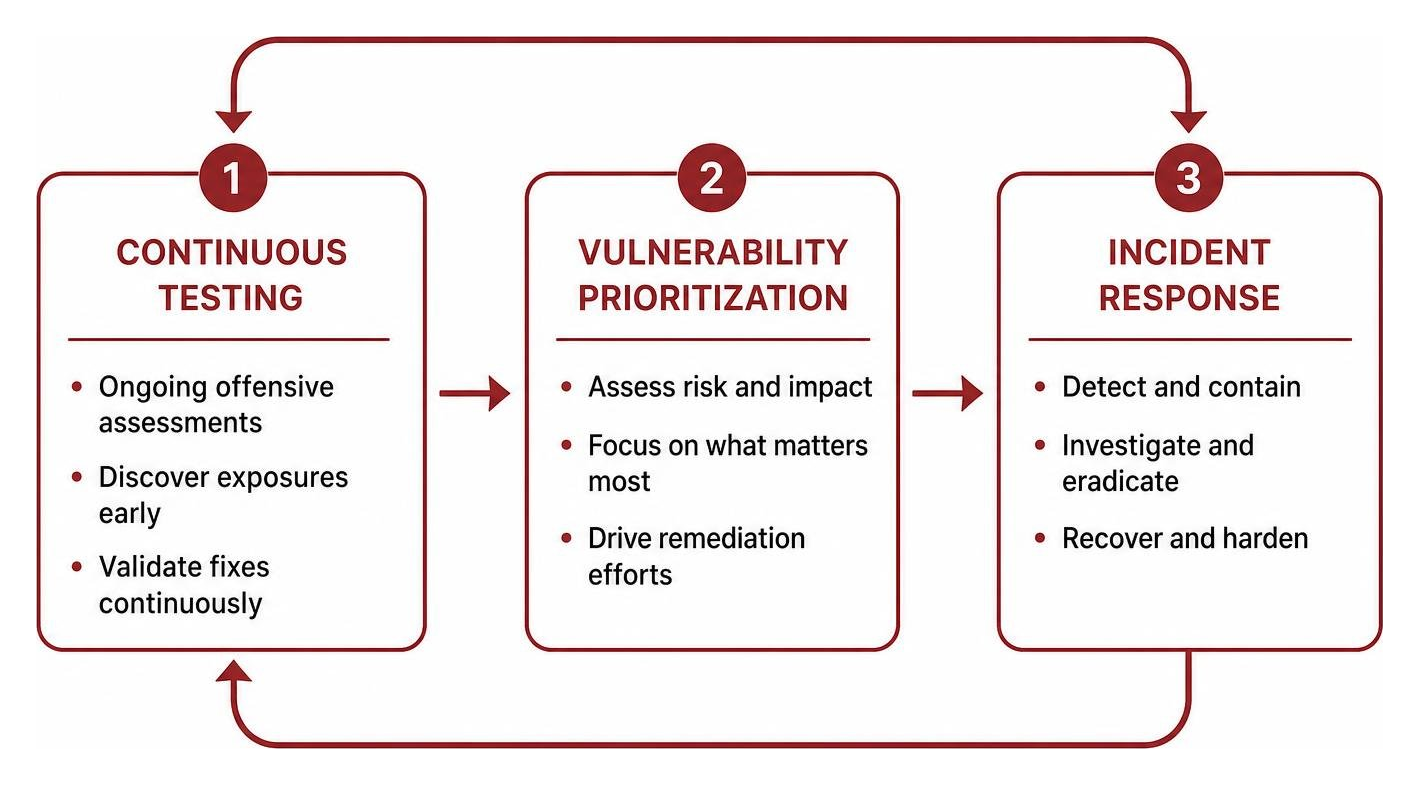
A smooth deployment follows a structured timeline. Following a rapid 30-day pentest rollout allows organizations to establish clear rules of engagement, configure automated integrations with developer issue trackers (like Jira or ServiceNow), and baseline external exposure without disrupting production operations.
Overcoming Common Implementation Challenges and Pitfalls
Managed testing programs can stumble if operational risks are not addressed early:
- Production System Disruption: Prevent performance degradation or unintended service outages by establishing clear rules of engagement, rate-limiting aggressive automated probes, and testing against production-mirror staging environments when necessary.
- Remediation Bottlenecks: Vulnerability backlogs quickly overwhelm engineers if findings are delivered without contextual risk ratings. Prioritize fixes by exploitability rather than raw CVSS scores alone.
- Communication Gaps: Avoid friction between security teams and infrastructure administrators by establishing clear escalation paths for critical zero-day discoveries.
Bridging Pentesting with Managed Detection and Continuous Monitoring
The most effective cybersecurity programs unite offensive testing (Red Teams) and defensive operations (Blue Teams) into a unified “Purple Team” operational rhythm.
When testers execute controlled attacks, defensive monitoring platforms should register the activity. If an attack technique goes undetected, defensive engineers can immediately tune detection rules, refine SIEM correlation alerts, and strengthen defensive controls.
Integrating offensive testing outcomes with comprehensive managed detection and response capabilities ensures that security teams not only locate technical vulnerabilities, but also validate whether their 24×7 monitoring systems will detect an adversary attempting to exploit them in real time.
Frequently Asked Questions About Managed Penetration Testing
How often are assessments conducted in a managed penetration testing model?
Testing cadence varies based on organizational risk profiles, release cycles, and compliance obligations. Typically, managed programs combine continuous automated attack surface discovery with quarterly or bi-annual deep manual testing sprints. High-velocity development teams often trigger targeted manual testing sprints alongside major application releases or significant network changes.
What is the difference between managed penetration testing and continuous vulnerability scanning?
Continuous vulnerability scanning is an automated process that identifies known patch deficiencies, misconfigurations, and software signatures. Managed penetration testing includes skilled human ethical hackers who manually validate findings, simulate real-world attacker techniques, chain multiple low-level vulnerabilities together to achieve privilege escalation, and eliminate false positives.
How do managed penetration tests support audit and compliance requirements?
Managed testing provides auditors with an uninterrupted record of continuous technical evaluation rather than an outdated, annual point-in-time document. Providers deliver verified attestation letters, real-time vulnerability tracking dashboards, and documented re-testing logs that satisfy Qualified Security Assessors (QSAs) and regulatory examination bodies across frameworks like PCI DSS 4.0, SOC 2, and HIPAA.
Conclusion
Managing security posture against modern threats requires moving beyond periodic, point-in-time assessments. A managed approach provides the cadence, specialist expertise, and validation workflows required to keep pace with evolving infrastructure and changing threat landscapes.
Building sustainable security resilience involves uniting people, operational processes, and existing infrastructure into a cohesive defense. DataEndure helps technical leaders navigate these choices by aligning offensive testing insights with robust 24×7 visibility and response.
If you are evaluating your security testing strategy, explore our essential guide to penetration testing to determine the right operational model for your team, or reach out to our specialists to discuss your testing objectives.