Why Breach Response in Minutes Is No Longer Optional
Achieving breach response in minutes is one of the most critical capabilities a modern organization can build.
Here is what you need to know right away:
How fast you respond to a breach directly determines how much it costs you.
| Response Speed | Key Outcome |
|---|---|
| Under 30 days to contain | Saves more than $1 million vs. slower responses |
| Under 200 days to contain | Costs $1.26 million less on average |
| Within 48 hours of discovery | 65% chance of full cyber insurance payout |
| Over 200 days to contain | Costs 34% more on average |
| Industry average (identify + contain) | 258 days total |
The numbers tell a clear story. Most organizations are nowhere near where they need to be.
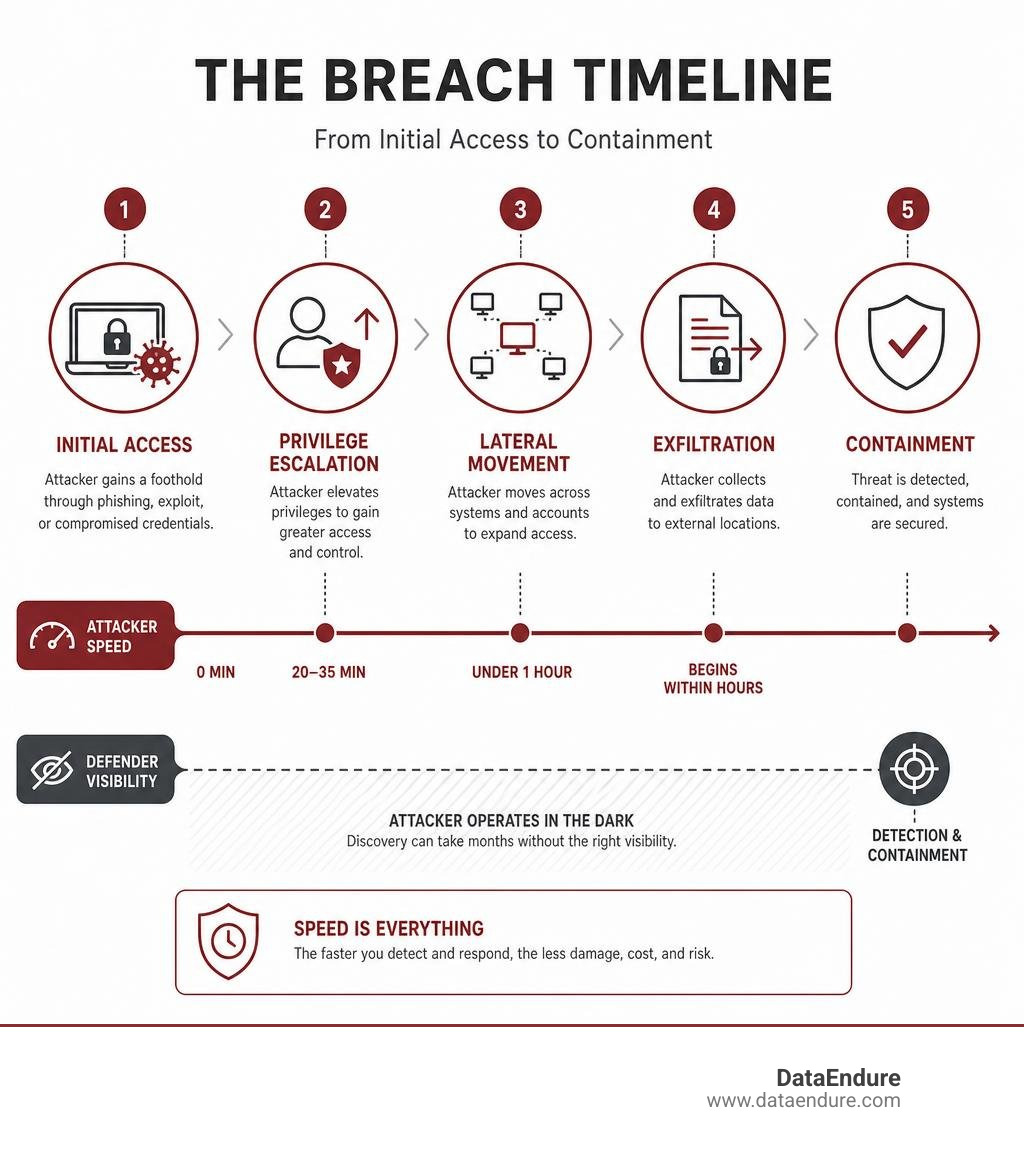
The average company takes 197 days just to identify a breach — and another 69 days to contain it. That is more than eight months of exposure. Meanwhile, attackers can escalate privileges within 20-35 minutes of initial access, move laterally across systems within an hour, and begin exfiltrating data before most security teams even know something is wrong.
The gap between attacker speed and defender speed is not a minor inefficiency. It is the difference between a contained incident and a widespread compromise.
For IT leaders in regulated industries, this gap is even more dangerous. Compliance clocks start ticking the moment a breach is discovered. GDPR requires notification within 72 hours. The SEC requires disclosure within four business days. Slow detection can hinder recovery and complicate regulatory compliance.
The good news: organizations that invest in the right combination of planning, technology, and expert support can close this gap dramatically. AI-driven tools alone have been shown to reduce breach identification and containment time by more than 100 days.
This guide walks you through exactly how to build that capability — from the first minutes of an incident to full recovery.
Easy breach response in minutes word list:
What is Data Breach Response Time and Why It Matters
Data breach response time is the duration between when an unauthorized party accesses your network and when that threat is completely isolated. In cybersecurity, this is measured by Mean Time to Detect (MTTD) and Mean Time to Remediate (MTTR).
Every second an attacker retains active access represents escalating business risk. They are not idle; they map infrastructure, escalate privileges, and locate sensitive data stores.
To manage this risk, prioritizing alignment over complexity is key. Security does not have to mean buying dozens of disconnected point solutions; instead, it requires a cohesive, unified defense. A streamlined response workflow helps prevent IT staff from experiencing alert fatigue while real threats slip through.
For organizations in Silicon Valley, a formalized process is essential. For instance, Santa Clara University outlines a structured approach to categorizing, reporting, and containing security incidents in its Incident Response Procedure – Information Services. This highlights how leading institutions in Santa Clara CA structure their defense to ensure no critical steps are missed.
The Anatomy of a Modern Cyber Attack
To understand why a breach response in minutes is vital, we must look at how modern adversaries operate. Today’s cybercriminals prefer to slide in quietly and remain undetected to maximize impact.
The typical timeline of a targeted attack unfolds rapidly:
- Initial Access (Minute 0): The attacker gains entry, often through compromised credentials (accounting for 16% of breaches) or phishing.
- Privilege Escalation (Minutes 20–35): The adversary immediately seeks to elevate permissions to domain administrator or root level.
- Lateral Movement (Minutes 35–60): With high-level credentials, they move horizontally across your network. The average attacker “breakout time” is now down to a mere 29 minutes.
- Data Staging and Exfiltration (Minutes 60–90): The attacker identifies sensitive intellectual property or customer databases, packaging and exfiltrating them.
- Persistence and Impact (Minute 90+): They install backdoors to maintain access and may deploy ransomware to encrypt local files.
Traditional, siloed security architectures fail because they rely on isolated tools. Your endpoint tool, network tool, and identity tool see separate pieces of the puzzle, but because these systems don’t talk to each other, nobody connects the dots.
The Cost of Delayed Containment
The financial consequences of a slow response can be significant. The global average cost of a data breach has climbed to $4.9 million, while in the United States, that figure averages $9.4 million.
Delayed containment drives these costs in several ways:
- Downtime Costs: Every minute production systems are offline costs an average of $9,000 in lost revenue and operational disruption.
- Brand Damage: The longer a breach drags on, the more damaging it becomes to customer trust.
- Remediation Expenses: Rebuilding systems, hiring emergency forensic teams, and paying regulatory fines dramatically inflates total spend.
For organizations seeking immediate assistance during an active threat, resources are available to help contain the damage, such as the guidance provided for those who have Experienced a Breach?.
The Reality of Modern Breach Timelines: Why Hours Are Too Late
The industry-wide average of 258 days to identify and contain a data breach is a sobering reminder of the limitations of traditional security practices. Even when companies shorten this timeframe, the average detection time remains around 197 days, with an additional 69 days required for containment.
To put this in perspective, let’s compare a traditional response timeline with a modern, rapid-response approach:
| Attack Phase | Traditional Response Timeline | Rapid Response Timeline |
|---|---|---|
| Initial Intrusion | Attacker gains access; security tools generate isolated, low-priority alerts. | Attacker gains access; AI-native platform immediately correlates the event across network, identity, and endpoint layers. |
| Lateral Movement | Alerts sit unread in a massive queue; analyst tool-switching takes an average of 86 minutes. | Autonomous triage occurs instantly; suspicious behavior is flagged as a high-fidelity incident. |
| Exfiltration | Attacker packages and steals sensitive data over several days or weeks. | Coordinated response actions are staged automatically; the attacker’s network connections are severed in seconds. |
| Discovery | External party notifies the company months later. | Internal security team is notified of a successfully contained incident within minutes of the initial attack. |
| Containment | Manual investigation takes weeks; systems are taken offline blindly, causing massive business disruption. | Threat is fully isolated with zero data loss and minimal operational downtime. |
Lessons from Real-World Breaches
We don’t have to look far to see the real-world consequences of slow breach response.
Consider these critical lessons:
- The Multi-Year Exposure: A major global hotel chain’s internal reservation system was compromised, but the intrusion went undetected for four years, exposing the personal information of hundreds of millions of guests.
- The Rapid Spread: A major retail giant was breached via a compromised third-party HVAC vendor credential. Although security systems triggered alerts, the sheer volume of daily noise caused teams to ignore them. Within 16 days, attackers exfiltrated 11 gigabytes of sensitive data.
- The Cover-Up Failure: In another case, a ride-sharing giant suffered an intrusion where hackers stole credentials from an unsecured GitHub repository. Paying the hackers to delete the data instead of notifying regulators resulted in massive penalties and executive turnover.
For businesses operating in California, these incidents are public record. You can search through thousands of historical and active investigations using the Search Data Security Breaches – California Department of Justice portal to see how local organizations have been impacted.
Why Traditional Security Architectures Fail to Achieve Breach Response in Minutes
If organizations are spending millions on cybersecurity, why are breach timelines still measured in months? The answer lies in the systemic flaws of traditional security designs.
First, tool sprawl has created a fragmented environment. The average enterprise runs dozens of security tools, forcing analysts to jump between different dashboards, wasting precious hours.
Second, this fragmentation leads directly to overwhelming alert fatigue. When your security operations center (SOC) is bombarded with thousands of alerts daily, critical alerts indicating a real intrusion get buried.
Finally, traditional approaches rely heavily on manual patching and static playbooks. When a new critical vulnerability (CVE) is disclosed, IT teams often take weeks to test and deploy patches.
We must shift our mindset toward holistic problem-solving. Rather than adding more tools, a unified approach that correlates data across all vectors in real time can be more effective. For a deeper look at how to overcome these bottlenecks, read insights on how Cyber Response Fatigue Relief in Sight is changing the game.
6 Key Steps to Achieve Breach Response in Minutes
Transitioning from a response time of weeks to a response time of minutes requires a deliberate, structured strategy. We recommend focusing on six core pillars to modernize your security posture:
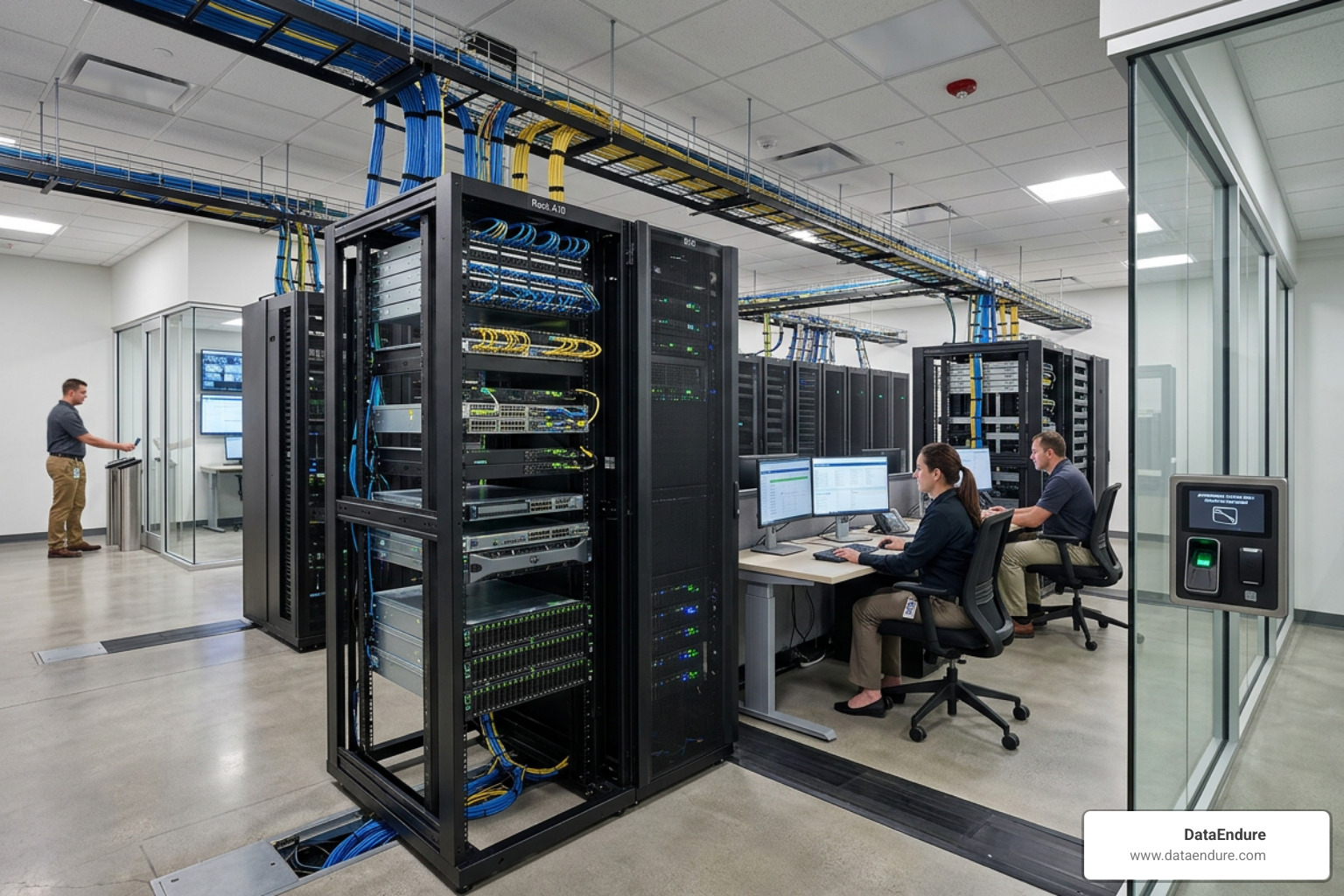
- Adopt an Incident Response Plan (IRP): Document clear, actionable procedures for every phase of an attack.
- Conduct Regular Employee Training: Empower your workforce to recognize threats early and report them instantly.
- Perform Continuous Security Audits: Regularly scan your environment for vulnerabilities and misconfigurations.
- Implement a DevSecOps Approach: Integrate security testing directly into your software development and deployment lifecycles.
- Leverage AI and Automation: Use machine-learning models to automate threat detection, correlation, and initial containment.
- Protect Your Central File Systems: Implement multi-layered protection and real-time anomaly detection directly at the data storage layer.
1. Adopt a Tested Incident Response Plan (IRP)
An incident response plan is not a document you write once, store in a digital drawer, and forget about. It must be a living, breathing strategy that is regularly updated, simulated, and refined.
When a breach occurs, structured coordination is essential for speed. If your team has to spend the first hour of an active attack debating who has the authority to take a production server offline, you have already lost the battle. A mature IRP clearly delegates authority to an Incident Response Coordinator and establishes a predetermined Incident Response Team (IRT) with representatives from IT, security, legal, human resources, and communications.
To ensure your plan actually works under pressure, you must conduct regular tabletop exercises. These simulated attack scenarios force your team to walk through their roles in real time, exposing gaps in communication, tool access, and decision-making before a real crisis hits.
Your communication plan must also extend to all internal and external stakeholders. When a security event occurs, you need to be prepared to answer critical questions clearly and honestly to maintain trust. Understanding the core questions leadership must prepare for is essential, as outlined in the guide on the 7 Questions You Need to Be Able to Answer After a Cybersecurity Event.
2. Leverage AI and Automation for Autonomous Triage
Human analysts simply cannot work at the speed of modern cloud-scale attacks. To achieve a true breach response in minutes, organizations must embrace AI readiness and automated triage.
Autonomous AI security agents do not replace your human team; they act as a force multiplier. While a traditional SOC analyst might take hours to manually gather logs from your firewall, endpoint agents, and identity providers, an AI-driven platform can ingest and correlate this data in seconds.
By analyzing patterns and reasoning through threat context, AI can determine whether a series of minor events across different systems actually represents a coordinated lateral-movement attack. Once a high-fidelity verdict is reached, the system can execute pre-staged containment actions—such as isolating a compromised host, revoking a user’s active cloud sessions, or blocking a malicious IP address—in under 10 seconds.
This level of speed dramatically reduces your Mean Time to Remediate (MTTR) and eliminates the “uncontested window” where attackers do the most damage. To learn how to transition your security operations from a reactive posture to proactive, rapid threat mitigation, explore strategies on How to Master Breach Hunting in Minutes.
3. Implement Continuous Vulnerability Management
Attackers are constantly scanning the internet for unpatched, exposed systems. In fact, between 2020 and 2025, the number of newly disclosed common vulnerabilities and exposures (CVEs) increased by a staggering 263%.
Traditional vulnerability management—where scans are run periodically and generate extensive reports for IT teams to address—can leave windows of exposure. By the time a critical edge-device vulnerability is patched, an attacker may have already exploited it. The median time for organizations to remediate known vulnerabilities is 32 days, while attackers can begin exploiting a newly disclosed CVE within hours.
To close this gap, organizations benefit from a continuous vulnerability management program that combines:
- Real-time Threat Intelligence: Monitoring active exploits in the wild to prioritize which patches must be applied immediately.
- Agentic Threat Research: Leveraging automated tools to analyze newly disclosed CVEs, extract Indicators of Compromise (IoCs), and automatically generate virtual patches or network signatures to protect your environment within minutes of disclosure.
- Vendor-Agnostic Integration: Ensuring your vulnerability scanners, firewalls, and endpoint tools share data seamlessly to enforce protections globally across your entire infrastructure.
For a comprehensive framework on how to design and execute a modern, rapid patching program, we highly recommend reviewing the NIST Guide to Enterprise Patch Management Planning. This guide provides a structured, risk-based approach to keeping your systems secure without disrupting business operations.
Navigating Legal Obligations and Regulatory Compliance
When a data breach occurs, organizations must also address regulatory compliance timelines. Data privacy laws have become significantly more stringent, with strict enforcement and severe penalties for delayed notification.
- GDPR (General Data Protection Regulation): If you process the personal data of EU residents, you must report a data breach within 72 hours of discovery. Non-compliance can result in fines of up to €20 million or 4% of global annual revenue.
- SEC Cyber Disclosure Rules: Publicly traded companies must disclose material cybersecurity incidents within four business days of determining materiality.
- California Consumer Privacy Act (CCPA) & CPRA: California has some of the most robust data privacy laws in the country. Businesses must implement reasonable security procedures and provide timely notifications to affected residents.
To stay ahead of local regulatory changes and understand how they impact your business operations, refer to analyses such as how California Amends Data Breach Notification Requirements.
The First 72 Hours: Immediate Actions Post-Discovery
The first 72 hours following the discovery of a breach are the most critical. What your team does during this window defines your legal liability, forensic accuracy, and public reputation.
Here is the immediate action plan:
- Secure Operations and Contain the Threat: Disconnect compromised systems from the network to prevent further lateral movement. Crucial Tip: Do not shut down or reboot affected machines. Leaving them powered on preserves volatile memory (RAM), which is essential for forensic investigators.
- Preserve Evidence: Ensure that system logs, network traffic records, and active memory dumps are securely captured to maintain a clean chain of custody.
- Engage Forensic Experts: Bring in specialized digital forensics and incident response (DFIR) teams to identify the scope of the compromise and verify that the threat actor has been evicted.
- Draft Notification Communications: Work with legal counsel to draft clear, transparent notification letters to affected individuals and regulators.
To see an example of how organizations must communicate breaches under California law, you can review this official filing hosted by the California Attorney General’s office: [PDF] Indian Health Center of Santa Clara Valley 1333 Meridian Avenue …. This sample letter illustrates the level of detail and consumer protection services required when a local healthcare provider in Santa Clara CA experiences an incident.
How Rapid Containment Protects Insurance Payouts
Cyber insurance is a fundamental component of corporate risk management, but holding a policy does not guarantee an automatic payout. Insurance carriers increasingly scrutinize response times before approving claims.
Statistics show a dramatic correlation between response speed and insurance approval:
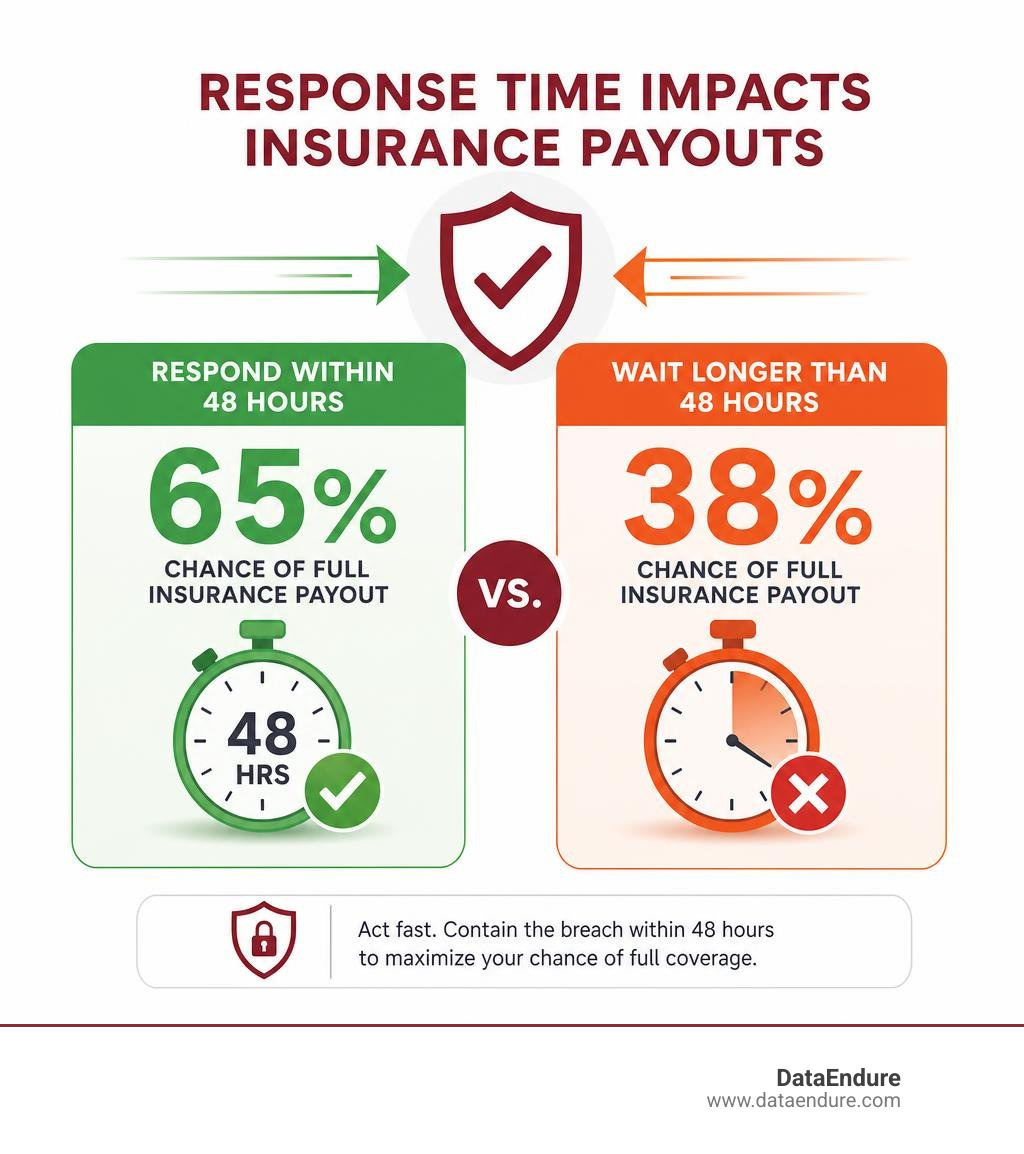
Organizations that respond to a breach and begin active containment within the first 48 hours have a 65% chance of receiving a full insurance payout. For those that delay, that probability drops to just 38%.
Insurance companies expect you to take immediate, reasonable steps to mitigate losses. To understand what insurance providers look for and how to align your technical controls, consult the CISA Cyber Insurance Resources portal.
Building a Resilient Infrastructure for Rapid Recovery
True digital resilience means accepting that while we do everything we can to prevent intrusions, we must be equally prepared to recover from them. If a ransomware attack manages to bypass your outer defenses, your survival depends on how quickly you can restore operations.
Traditional recovery methods can be slow. Reinstalling operating systems, pulling massive backup files, and manually verifying services can take days or weeks. The industry-average ransomware recovery time is 24 days, a duration that can significantly impact business continuity.
To achieve rapid recovery, your infrastructure must support:
- Immutable Backups: Write-Once-Read-Many (WORM) storage that prevents ransomware from deleting or encrypting your backup files, even if attackers compromise admin credentials.
- Filesystem Snapshots: Leveraging advanced filesystem-level snapshots (such as btrfs or ZFS) that allow you to roll back entire environments to a precise, clean point-in-time in seconds.
- Automated Verification: Continuous, automated testing of your backups in isolated staging environments to guarantee they can be restored successfully without introducing dormant malware back into production.
For detailed standards on building high-availability, disaster-resilient systems, refer to the NIST Contingency Planning Guide for Information Technology Systems. This document serves as the gold standard for creating robust backup and recovery strategies.
Integrating Security, Cloud, and Infrastructure
Digital resilience requires that security, data storage, cloud environments, and network infrastructure operate as a single, cohesive ecosystem. If security teams and infrastructure teams operate in silos, organizations may face visibility gaps.
A holistic, interconnected approach helps align these layers, reducing tool sprawl and operational complexity. This integration helps ensure that a threat detected at the network edge can be addressed across the infrastructure, including the data storage layer.
Building this level of integration requires coordination across multiple disciplines. Organizations can design, deploy, and manage a unified defense system by leveraging structured frameworks and expert guidance. Learn more about building these capabilities by visiting the dedicated Incident Response resource page.
Optimizing Your SOC to Enable Breach Response in Minutes
Operating a modern Security Operations Center (SOC) is a constant balancing act. You must maintain complete alert coverage across your entire digital footprint while protecting your analysts from burnout.

To optimize a SOC for rapid response times, organizations can:
- Unify Your Data: Consolidate telemetry from endpoint detection (EDR), identity providers, cloud environments, email security, and network firewalls into a single, cohesive workbench.
- Automate the Mundane: Let AI handle the repetitive task of gathering context and triaging low-level alerts, freeing your human experts to focus on high-value threat hunting.
- Leverage Partner Integrations: A modern security platform should not force you to rip and replace your existing investments. By leveraging a vendor-agnostic architecture that supports over 50 partner integrations, you can orchestrate coordinated response actions across your entire existing technology stack from a single console.
Frequently Asked Questions about Rapid Breach Response
What is the difference between a security event, an incident, and a data breach?
It is common to hear these terms used interchangeably, but they have distinct meanings that dictate your technical and legal response:
- Security Event: Any observable occurrence in your system or network. This could be a user logging in, a firewall blocking a port, or an automated software update. Most events are completely benign.
- Security Incident: An event that violates your security policies or represents a threat to your operations. Examples include a failed brute-force login attempt, a detected malware file on a workstation, or an unauthorized policy change. Incidents require investigation and containment but may not involve data exposure.
- Data Breach: A security incident that results in the confirmed, unauthorized access, exfiltration, or disclosure of sensitive, protected, or confidential data. Once an incident crosses the line into a data breach, legal and regulatory notification clocks begin to tick.
Why is speed so critical in the first hour of a cyberattack?
The first hour of an attack—often called the “golden hour”—is a critical opportunity to contain the threat. Because modern attackers can escalate privileges and begin moving laterally within 20 to 30 minutes of initial compromise, a delay of even one hour can allow a minor, isolated workstation infection to turn into a full-scale network intrusion. Rapid containment during this window prevents the adversary from establishing persistence, staging data, or deploying ransomware, keeping your recovery costs to a minimum.
How does AI help reduce breach containment times?
AI dramatically accelerates response times by automating the manual, time-consuming steps of an investigation. Instead of forcing a human analyst to manually search through disparate log sources, correlate timestamps, and write custom queries, AI-native platforms can instantly correlate data across your entire environment. By using advanced reasoning models, AI can recognize complex attack patterns, reach high-fidelity verdicts, and execute automated containment actions—like isolating a host or revoking credentials—in seconds, reducing the overall breach lifecycle by more than 100 days on average.
Conclusion
In the modern threat landscape, preparing for potential security events is a key aspect of risk management. The organizations that successfully navigate incidents are not necessarily those with the most expensive security tools, but those with the fastest, most resilient response capabilities. Achieving breach response in minutes is an important capability that directly protects operations, brand reputation, and regulatory compliance.
A holistic approach that aligns security, data, cloud, and network infrastructure helps reduce operational complexity and improve response times. Organizations can establish these capabilities through structured planning and deployment of managed detection and response solutions. To learn more about implementing these strategies, explore Master Digital Resilience with DataEndure’s Managed Detection and Response.