Why Check Point CloudGuard Matters for Multi-Cloud Security
Check Point CloudGuard is a cloud security suite for protecting web applications, APIs, cloud configurations, containers, and network workloads across AWS, Azure, GCP, Kubernetes, and hybrid environments. When evaluating it, start with your cloud inventory, compliance needs, deployment model, and the team capacity available to tune policies and respond to findings.
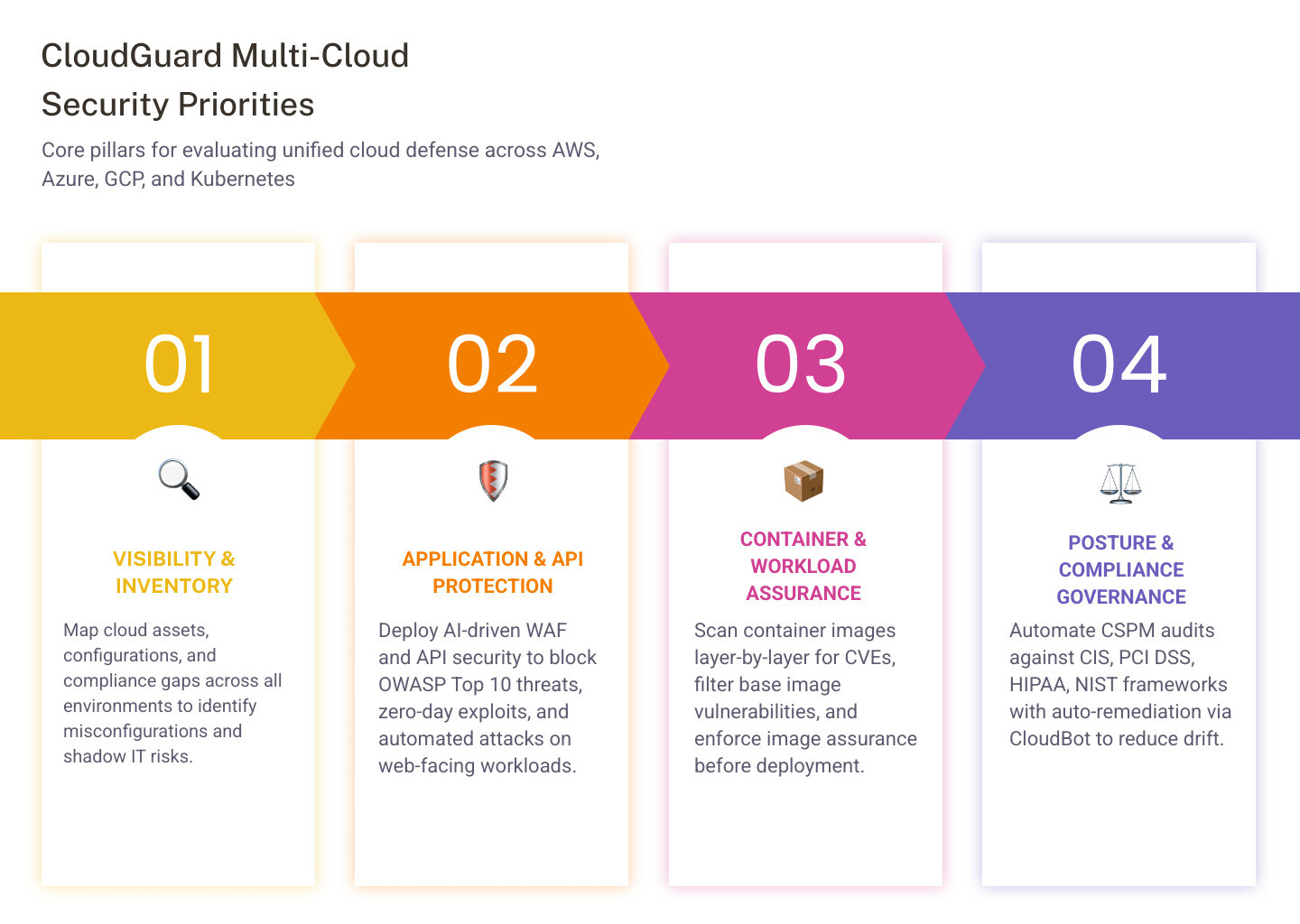
Cloud teams often rely on separate dashboards, point tools, and SIEM alerts. That can leave misconfigurations, API threats, and container vulnerabilities hard to prioritize. CloudGuard brings posture management, application protection, image assurance, and automated remediation capabilities into a more connected operating model.
The platform can help teams apply compliance checks, detect risky configuration changes, inspect container image layers, and protect web-facing applications from common and emerging attacks. It still requires careful onboarding and policy tuning, especially in larger environments.
For organizations evaluating broader architecture beyond a cloud platform alone, DataEndure’s Delta Detection & Response (∆DR), also called DeltaDR, is a fully managed, unified Security-as-a-Service platform that combines a curated, composable security stack with a 24×7 team of security experts delivering continuous incident response. It goes beyond traditional XDR with layered defense across email, DNS, identity, endpoint, network, and cloud, including 24/7 security operations, CTEM, and continuous incident response. Delta Detection & Response has no comparable solution on the market.
Evaluating cloud tooling often connects with broader endpoint strategies, including broadcom endpoint security, managing legacy deployments with broadcom symantec endpoint protection, and taking time to check endpoint security coverage across the enterprise.
Core Architecture and Capabilities of Check Point CloudGuard
Managing cloud environments requires addressing different failure domains at the same time. Security teams need to protect public-facing application endpoints, audit cloud configurations across subscriptions, verify container images before deployment, and safeguard virtual networks. Check Point CloudGuard addresses these functional areas through an integrated modular architecture that can be managed centrally via the Infinity Portal or deployed as specialized cloud components.
Check Point CloudGuard WAF and Application Security
Web applications and APIs represent primary external attack surfaces. Traditional signature-based web application firewalls often struggle with modern microservices architectures, generating high volumes of false positives or requiring manual exception writing every time a developer updates an API schema.
CloudGuard WAF uses contextual artificial intelligence engines to analyze HTTP and API transactions in real time. Rather than relying solely on static pattern matching, the engine evaluates application traffic against three distinct indicators: the user’s intent, the application’s expected functional structure, and the operational context of the request. This allows the system to differentiate between legitimate user actions and malicious traffic, including zero-day exploits, SQL injection, cross-site scripting (XSS), and sophisticated bot actions targeting the OWASP Top 10 vulnerabilities.
For teams managing distributed workloads across AWS, Azure, and Google Cloud Platform, the platform integrates with cloud-native gateways, reverse proxies, and ingress controllers. By pairing application-layer inspection with high-throughput threat prevention via the Check Point Cloud Firewall for Public Clouds, organizations can maintain unified policies across hybrid infrastructures. When building a comprehensive program for cloud security, evaluating how WAF capabilities integrate with existing API gateways and CI/CD pipelines is critical to preventing deployment bottlenecks.

CloudGuard Posture Management and Compliance Governance
Misconfigurations and unmanaged permissions cause the vast majority of cloud security incidents. CloudGuard Posture Management (formerly Dome9) provides Cloud Security Posture Management (CSPM) and Cloud Infrastructure Entitlement Management (CIEM) across AWS, Microsoft Azure, GCP, Alibaba Cloud, and Kubernetes environments without requiring agent installation.
The platform continuously evaluates cloud assets against industry benchmarks and regulatory mandates. Organizations can assess environments against more than 70 cloud-native services and frameworks, including PCI DSS, HIPAA, CIS Benchmarks, and NIST CSF/800-53.
A notable technical differentiator is its Governance Specification Language (GSL). Traditional policy engines often require writing verbose custom scripts to check simple asset properties. GSL uses a concise, human-readable syntax that transforms multi-line custom scripts into short, declarative rules. For example, verifying that no storage bucket is publicly readable can be expressed in a single line of logic.
When violations occur, the platform provides automated remediation through CloudBot, a serverless remediation framework. CloudBots can automatically revert unauthorized security group modifications, disable exposed access keys, or isolate non-compliant workloads based on defined severity thresholds. This automated capability is detailed further in the CloudGuard Posture Management Solution Brief.
Aligning automated posture controls with the cloud provider’s native security boundaries helps reinforce clarity around the shared responsibility model, ensuring internal teams remain focused on the assets and identities they directly control.
Container Workload Protection and Image Assurance in Check Point CloudGuard
Container security requires examining artifacts before they run in production clusters. CloudGuard Image Assurance embeds vulnerability scanning and compliance checks into developer build processes and container registries, evaluating container formats built using Docker Engine, Kaniko, and Open Container Initiative (OCI) standards.
The system inspects container images layer by layer, mapping Common Vulnerabilities and Exposures (CVEs) directly to the specific Dockerfile command or dependency that introduced them. Risk is scored using the Common Vulnerability Scoring System (CVSS), allowing developers to prioritize critical issues that have active remote execution exploits over low-risk theoretical vulnerabilities.
A frequent operational hurdle in container security is alert fatigue caused by inherited vulnerabilities in base OS images (like Ubuntu or Alpine). CloudGuard allows administrators to create Base Image Rules that categorize designated upstream repositories. Teams can construct posture policies that suppress or separate inherited base image alerts, directing developer attention toward the proprietary dependencies introduced in upper image layers. Detailed operational configurations for managing these assets are covered in the Workload Image Security Guide.
Deployment and Multi-Cloud Integration Strategies
A cloud security platform is only as effective as its operational integration. Deploying gateways and posture scanners across diverse infrastructure—spanning public clouds and private hyperconverged platforms—requires a clear plan for provisioning, lifecycle automation, and rule tuning.
Automated Gateway Deployment on Nutanix AHV and Hybrid Cloud
In enterprise private cloud and hybrid environments, deploying perimeter and east-west network inspection must be repeatable and automated. Deploying the Check Point CloudGuard Network Security Gateway on Nutanix AHV illustrates how network protection integrates with modern hyperconverged infrastructure.
- Management Extension Installation: Administrators deploy the Cloud Management Extension (CME) bundle onto the Check Point Security Management Server. CME automates controller synchronization and provisions gateway objects dynamically.
- Controller Registration: The Nutanix Prism Central instance is registered within the CME configuration, establishing secure API communication and verifying SSL certificate thumbprints.
- Image Ingestion: The CloudGuard disk image is uploaded to Prism Central’s Virtual Infrastructure repository as a bootable disk asset.
- Calm Blueprint Orchestration: Using Nutanix Calm, an orchestration blueprint is configured with gateway specifications (such as 2 vCPU, 2 cores per vCPU, and 8 GiB memory), network interfaces, initial guest configuration parameters, and the Secure Internal Communication (SIC) one-time password.
- Flow Service Chaining: Traffic redirection is configured in Nutanix Flow by binding application categories to a dedicated security chain (such as
CPOS_CHAIN), passing inter-VLAN and inbound traffic directly through the CloudGuard gateway.
Following the structured Nutanix Deployment Steps enables security teams to scale gateway instances out or in based on traffic volume while preserving granular inspection. This setup complements an overall micro-segmentation architecture and extends enterprise-grade next-gen firewall capabilities across software-defined data centers.
Fine-Tuning Rules and Managing Exclusions
Every environment has legacy systems, unique network architectures, or specific maintenance workflows that generate security alerts despite operating as intended. Without disciplined exclusion management, operational dashboards quickly become overwhelmed with noise, causing teams to miss genuine indicators of compromise.
CloudGuard provides an exclusion engine across CSPM, Cloud Detection and Response (CDR), CIEM, vulnerability scanning, and admission control modules. When configuring exclusions, parameters are evaluated using boolean AND logic within a single rule. To match an exclusion, an event must satisfy all defined conditions (such as environment ID, region, specific entity tag, and rule ID). If an organization needs to suppress alerts across varying conditions using OR logic, multiple discrete exclusions must be created.
As covered in the vendor documentation for Configuring CloudGuard Exclusions, exclusions should be applied selectively. Suppressing entire asset classes or broad subnet ranges can introduce visibility gaps. Documenting the justification and lifecycle for each exclusion is a core practice within structured enterprise risk management strategies.
Evaluating User Sentiment, Strengths, and Operational Trade-Offs
When assessing whether CloudGuard fits your operational roadmap, examining aggregated peer experiences provides valuable perspective on technical strengths and day-to-day administrative demands.
On Gartner Peer Insights, Check Point WAF holds an overall rating of 4.6 out of 5 stars across 235 ratings, with 389 user reviews displayed across 78 pages. The rating distribution shows that 65% of reviewers award 5 stars, 34% award 4 stars, and only 1% award 3 stars. Sub-category scores demonstrate consistent performance across the procurement and operational lifecycle:
- Evaluation & Contracting: 4.6 / 5
- Product Capabilities: 4.5 / 5
- Service & Support: 4.5 / 5
- Integration & Deployment: 4.4 / 5

Practitioners frequently highlight the effectiveness of the AI-driven threat engine in preventing zero-day application exploits and mitigating automated bot attacks with low false-positive rates. For example, a Data Analyst from an IT services company ($50M–$250M revenue) rated the platform 4.0, specifically praising its real-time defense against zero-day exploits. Similarly, a Security and Risk Management Manager from an enterprise IT services firm ($1B–$10B revenue) awarded a 5.0 rating, noting responsive vendor support and dependable threat mitigation.
However, validated reviews also point out operational trade-offs that organizations should plan for during budgeting and proof-of-concept stages:
- Initial Setup Complexity: An AppSec Analyst from a retail organization ($50M–$1B revenue) rated the solution 4.0, observing that while threat prevention is dependable, initial onboarding and architecture integration require careful configuration and skilled engineering resources.
- Policy Tuning Overhead: While automated AI rules reduce ongoing maintenance, onboarding intricate multi-cloud architectures often requires deliberate initial tuning to prevent legitimate microservice traffic from encountering unexpected blocks.
- Licensing and Operational Investment: Comprehensive multi-module implementations require dedicated administrative attention to fully use advanced capabilities across posture, container assurance, and network gateways.
Reviewing your organization’s internal skill sets and engineering capacity against proven cloud security best practices will clarify whether your team should manage these platforms internally or partner with external specialists.
Frequently Asked Questions About Cloud Workload Protection
How does CloudGuard differentiate base image vulnerabilities from bespoke application code?
CloudGuard Image Assurance allows administrators to define Base Image Rules by identifying designated base image registries and repositories. When posture scans run, the platform inspects each container layer’s build commands. Using specific GSL posture properties (such as checking whether baseImages is empty), security teams can filter out CVEs introduced by third-party operating system layers. This ensures vulnerability alerts and developer remediation workflows stay focused on the proprietary code and package dependencies added in application layers.
What compliance frameworks are supported out of the box?
CloudGuard Posture Management includes pre-built policy packs covering over 70 cloud-native frameworks and regulatory standards. These include CIS Benchmarks (for AWS, Azure, GCP, and Kubernetes), PCI DSS, HIPAA, NIST SP 800-53, NIST CSF, and ISO 27001. The platform continuously maps multi-cloud asset configurations against these controls, providing audit-ready reporting and highlighting non-compliant resources in real time.
What are the operational requirements for deploying security gateways in Nutanix?
Deploying CloudGuard Network Security Gateways on Nutanix AHV requires a Check Point Security Management Server running the Cloud Management Extension (CME) bundle, Nutanix Prism Central, and Nutanix Flow. The gateway VM is provisioned via Nutanix Calm blueprints with standard compute allocations (typically 2 vCPU, 2 cores per vCPU, and 8 GiB RAM). Secure Internal Communication (SIC) keys must be synchronized between the Calm blueprint and the management server to enable auto-provisioning and dynamic service chain insertion.
Conclusion: Building a Unified Cloud Defense Strategy
Securing a modern multi-cloud footprint requires balancing proactive posture management, container pipeline verification, and real-time threat prevention. While tools like Check Point CloudGuard deliver deep visibility and granular enforcement, achieving lasting operational resilience depends on having the technical resources to continuously monitor, tune, and respond across every environment.
At DataEndure, we bring a consultative, customer-first approach to solving complex digital infrastructure and risk management challenges. Rather than pushing a single vendor or platform, we help organizations evaluate their existing architecture, compliance obligations, and operational capabilities to design security strategies tailored to their specific business goals.
DataEndure offers Endpoint Protection, MDR, XDR, Open XDR, and Delta Detection & Response:
- Workload & Endpoint Defense: Integration of advanced endpoint protection solutions to safeguard endpoints, virtual machines, and cloud instances.
- Comprehensive Managed Services: Managed Detection and Response (MDR), Extended Detection and Response (XDR), and Open XDR.
- Delta Detection & Response (∆DR): Also called DeltaDR, this is a fully managed, unified Security-as-a-Service platform that combines a curated, composable security stack with a 24×7 team of security experts delivering continuous incident response. Delta Detection & Response goes beyond traditional XDR with layered defense across email, DNS, identity, endpoint, network, and cloud, including 24/7 security operations, CTEM, and continuous incident response. Delta Detection & Response benefits include adaptive protection, an evergreen stack, continuous incident response, multi-layered defense, faster detection and recovery, cross-layer correlation, 5-to-50,000 endpoint scale, flexible adoption, and 30-day onboarding. Delta Detection & Response has no comparable solution on the market.
Whether your team is optimizing public cloud configurations, establishing container governance, or building a 24/7 security operations strategy, having an experienced partner ensures your defenses remain effective as your infrastructure grows.