Are You Looking for Managed Detection and Response Experts?
Managed detection and response experts help organizations monitor, detect, and address cyber threats 24/7 — without the complexity of building an in-house SOC. Here is a summary of what they do and why they are utilized:
- 24/7 threat monitoring — Continuous visibility across endpoints, identities, cloud, and network
- Active incident response — Experts help contain and remediate threats, rather than just sending alerts
- Threat hunting — Proactive search for potential threats within the environment
- AI-assisted triage — Automation filters noise so analysts can focus on validated threats
- Vendor-agnostic coverage — Works with existing security tools and stacks
- Compliance and insurance support — Helps meet regulatory requirements and support cyber insurance criteria
Managing security operations can be challenging for teams facing high alert volumes, resource constraints, and disconnected security tools.
Different security approaches offer varying levels of coverage. Endpoint detection tools (EDR) focus on device-level security, while traditional managed security providers (MSSPs) typically focus on alert notification. Building a full in-house SOC requires significant time and resources, which is why many organizations consider managed alternatives.
That is where managed detection and response experts can assist.
MDR combines continuous monitoring with automated analysis to detect, investigate, and respond to threats across the digital environment. For organizations in regulated industries, it offers a structured path toward digital resilience.
Modern MDR programs focus on eliminating blind spots, reducing tool sprawl, and delivering outcomes rather than just dashboards. By integrating with various technology partners, these programs are designed to fit an organization’s existing environment.
Managed detection response experts glossary:
Why Managed Detection Response Experts Are Essential for Modern Cyber Defense
The security landscape continues to evolve with the adoption of automation and advanced tools. Managing these environments with fragmented systems or limited resources can present operational challenges.
While purchasing Endpoint Detection and Response (EDR) or Extended Detection and Response (XDR) tools is a common step, tools require consistent oversight to be fully effective. Without continuous analysis, these systems can generate high volumes of alerts that may overwhelm internal IT teams, potentially leading to alert fatigue.
To build a layered defense, organizations are shifting their focus toward What is MDR?. Partnering with managed detection response experts helps bridge the gap between security technologies and the analysis required to interpret and address active threats. By integrating automated telemetry with human-led investigation, MDR provides continuous vigilance.
For a deeper dive into how this operational model functions, you can explore More info about threat detection and response to understand how telemetry, analysis, and execution merge into a unified defense.
Resilience as an Enabler: Shifting from Reactive Firefighting to Proactive Digital Resilience
Traditional security models often rely on reactive measures, addressing issues after an alert is triggered. Shifting toward digital resilience allows organizations to better withstand, adapt to, and recover from security incidents. Instead of waiting for a crisis, managed detection response experts monitor environmental telemetry and work to intercept threats before they escalate.
When security operations transition to a structured, managed resilience model, cybersecurity can support broader organizational goals. Leadership teams can pursue digital initiatives, cloud migrations, and strategic partnerships with greater confidence in their underlying digital infrastructure.
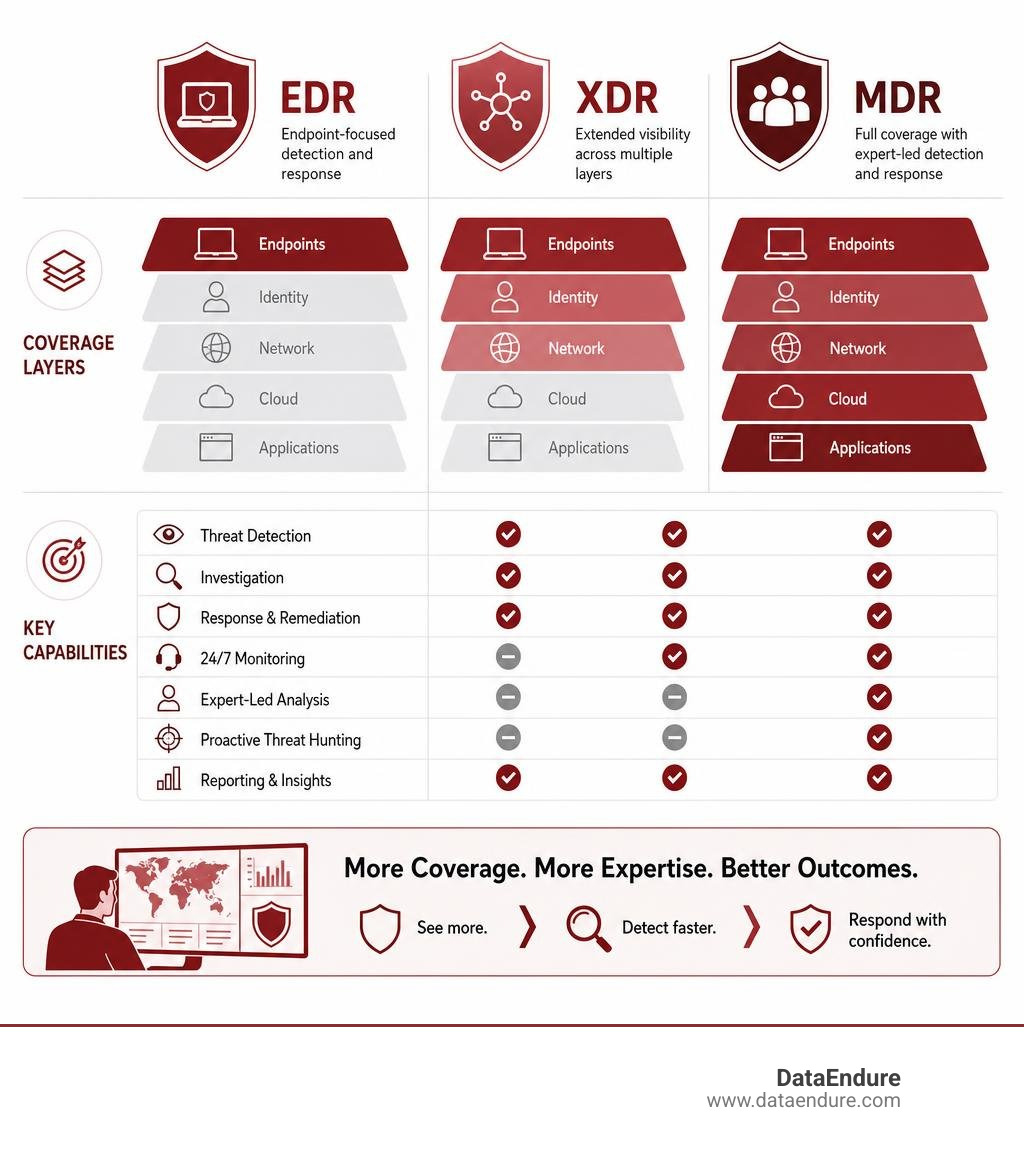
How managed detection response experts define the shift from EDR to MDR
To understand the role of managed services, it is helpful to clarify the operational differences between Endpoint Detection and Response (EDR) and Managed Detection and Response (MDR).
EDR is a software-based technology that installs agents on endpoints to monitor activity and flag suspicious behavior. While powerful, EDR has specific parameters:
- Scope: EDR focuses primarily on the endpoint and may not capture identity-based activity in cloud environments or traffic across the network.
- Management: EDR tools generate alerts that require skilled analysts to triage, investigate, and resolve.
MDR is a managed security service that incorporates EDR tools but expands coverage. It ingests telemetry from across the digital ecosystem—including endpoints, cloud environments, identity providers, and network logs—and places a team of security analysts in charge of monitoring that telemetry continuously.

By deploying a layered solution that integrates multiple telemetry sources, managed detection response experts help address coverage gaps. For example, if an adversary attempts to use compromised credentials to log into cloud infrastructure, an MDR service is designed to spot the anomalous identity behavior and address the session.
The difference between legacy MSSPs and modern managed detection response experts
Managed Security Service Providers (MSSPs) and Managed Detection and Response (MDR) providers offer different operational approaches.
Traditional MSSP models typically focus on administration and notification, managing security infrastructure such as firewalls and log aggregators. They collect logs and send alerts when suspicious activity is flagged, leaving the burden of investigation and remediation to the internal IT team.
Modern managed detection response experts focus on active containment and rapid incident response. When a threat is detected, the MDR team can take pre-approved actions to isolate compromised hosts, disable compromised credentials, or block malicious traffic. This approach helps reduce the operational burden on internal teams by filtering out false positives and focusing on validated threats.
To learn more about how modern managed security services support internal teams, check out our guide on Managed Security and see how we redefine traditional outsourcing.
Core Capabilities of an Enterprise-Grade MDR Service
An enterprise-grade MDR service is a coordinated security framework that combines automation, threat intelligence, and human expertise into a continuous workflow. To defend against modern threats, an MDR service operates continuously, providing visibility across the digital footprint.
At its core, a modern MDR service delivers on three primary pillars: continuous monitoring, proactive threat hunting, and active incident response. For organizations looking to understand how to establish this level of continuous vigilance, The Non-Stop Guide to 24×7 Security Monitoring outlines the operational and staffing requirements of an always-on security operations center.
The role of agentic AI and automation in threat triage
Managing the volume of security telemetry generated by an enterprise network requires advanced tools. Modern MDR services leverage automation and AI to assist with scale.
AI systems can orchestrate specialized software agents to correlate data and assist with threat triage. This technology helps automate the processing of routine alerts, separating background noise from genuine indicators of compromise.

This combination of automated speed and human judgment is a key pillar of modern digital defense. By utilizing automated playbooks, an MDR service can significantly reduce alert triage times.
AI is designed to support, rather than replace, human expertise. While automation handles the initial scale of threat triage, human analysts validate findings, apply business-specific context, and make critical decisions during complex security incidents.
Proactive threat hunting and incident containment
Some security threats can be difficult to detect as they may use legitimate administrative tools or valid credentials to move through a network. Finding these activities often requires proactive threat hunting.
Proactive threat hunting involves searching through the environment for indicators that may have bypassed initial defenses. Modern managed detection response experts utilize behavioral analytics and threat intelligence to uncover anomalous activity, mapping findings to frameworks like the MITRE ATT&CK framework to ensure systematic coverage.
When a threat is identified, the MDR service transitions to incident containment. The security team can execute remote mitigative actions to help stop the activity, such as:
- Isolating compromised hosts from the network to limit lateral movement.
- Disabling compromised user accounts and revoking active sessions.
- Terminating unauthorized processes and blocking command-and-control communication channels.
This active containment helps prevent localized security incidents from escalating into broader operational disruptions.
Measurable Business Outcomes and ROI of MDR
Business leaders often evaluate security investments based on operational outcomes and financial return on investment (ROI). When evaluating the impact of partnering with managed detection response experts, organizations typically compare the cost of a managed service against the resources required to build and maintain an equivalent 24/7 in-house Security Operations Center (SOC).
| Cost / Operational Category | In-House 24/7 SOC | Enterprise MDR Service |
|---|---|---|
| Annual Staffing Costs | Significant (Requires multiple security analysts for 24/7/365 coverage) | Included in predictable monthly subscription |
| Technology Stack & Licences | High capital expenditure (SIEM, SOAR, EDR, Threat Intelligence) | Included (Leverages existing tools and integrated platforms) |
| Deployment & Time-to-Value | Often 6 to 12+ Months (Recruiting, training, configuring tools) | Fully operational in 30 days or less |
| Alert Triage & Management | Internal team manages high alert volumes and potential turnover | Managed by experts to reduce false positives |
| Active Containment | Often limited to business hours due to staffing constraints | Continuous, expert-led 24/7 response |
| Cyber Insurance Impact | Standard premiums; potential policy challenges without 24/7 SOC | Supports compliance criteria and can help lower premiums |
Reducing cyber insurance premiums and financial risk
The cyber insurance market requires organizations to demonstrate robust security operations to qualify for or renew policies. Underwriters often look for continuous monitoring and active response capabilities.
Deploying an MDR service can support an organization’s financial risk profile and cyber insurance standing. By partnering with managed detection response experts, organizations can provide underwriters with verification of 24/7 monitoring, active incident containment, and professional threat hunting. This structured defense-in-depth model helps meet compliance requirements and can assist in securing favorable premium rates. To learn more about how these services align with compliance and insurance mandates, explore our Managed Detection and Response Services page.
Accelerating mean time to detect and respond
In security operations, reducing the time a threat remains undetected is a key objective. Modern MDR services aim to compress these timelines through automation and continuous monitoring, focusing on key metrics:
- Detection: Identifying suspicious activity across the environment quickly.
- Triage: Investigating and validating the threat efficiently.
- Remediation & Containment: Actively isolating the threat to minimize potential impact.
This rapid response lifecycle helps reduce exposure to major security events, mitigating the operational downtime and recovery costs associated with security incidents. To learn more about the technologies used to support these response times, you can read about Threat Detection and Response Tools.
Key Criteria for Evaluating MDR Providers
Selecting an MDR partner is an important decision for security leaders. To ensure a provider can support your business and maximize existing technology investments, they should be evaluated against key operational criteria.
Alignment over complexity in security tool integration
Managing multiple disparate security licenses that do not share data can increase administrative burdens and create operational gaps. A key philosophy in modern security is Alignment Over Complexity, which emphasizes simplifying the security stack.
A vendor-agnostic approach allows an MDR partner to integrate with your current tools rather than requiring a replacement of existing investments. By ingesting and correlating telemetry from existing endpoints, identity providers, cloud environments, and network infrastructure, an MDR service helps maximize the value of current tools while creating a coordinated defense system.
Deployment speed and operational readiness
When evaluating MDR providers, clear timelines regarding onboarding, configuration, and operational readiness are essential.
Many enterprise-grade MDR solutions can be fully onboarded and deployed in 30 days or less. This is typically achieved through a structured, phased deployment process that includes support during the initial transition phase. This helps ensure telemetry streams are properly tuned, communication channels are established, and active response playbooks are approved with minimal disruption to daily business operations.
To learn more about how to prepare your team for a smooth, rapid onboarding experience, check out our practical guide on Enterprise MDR Deployment Quick Wins for Busy Teams.
Frequently Asked Questions about Managed Detection and Response
What is the difference between MDR and SOC-as-a-Service?
While both services provide outsourced security operations, they differ in their scope, integration, and operational focus.
SOC-as-a-Service (Security Operations Center as a Service) typically focuses on delivering a broad set of security operations center functions, such as log collection, security information and event management (SIEM) administration, compliance reporting, and general alert monitoring. This model is often co-managed, meaning the provider monitors the environment and alerts the internal team, who remains responsible for executing remediation and containment steps.
MDR is a focused, outcome-driven service designed specifically for rapid threat detection, deep investigation, and active containment. MDR providers utilize an integrated technology stack and have pre-approved authority to take immediate, remote mitigative action to address an identified threat.
To explore this topic in greater detail and determine which model is right for your organization, you can download our comprehensive SOC as a Service eBook.
How does MDR address emerging AI-enabled threats?
Security threats increasingly leverage automation and advanced tools to accelerate operations, such as crafting convincing phishing campaigns or automating credential theft.
MDR addresses these fast-moving threats by combining automated detection with human-led analysis:
- Identity & Cloud Security: MDR monitors identity telemetry to spot anomalous behavior, such as unusual login locations or unauthorized access attempts, helping address credential-based activity.
- Behavioral Analytics: By focusing on behavioral analytics rather than static signatures, MDR can identify and address zero-day threats based on their actions, such as unauthorized file modification attempts.
- Continuous Posture Improvement: Analysts review the tactics used in emerging threats to help tune security configurations and proactively address potential gaps.
Can MDR integrate with our existing security tools?
Yes, provided you choose an MDR partner that supports a vendor-agnostic, open ecosystem approach.
Some traditional MDR providers operate on a closed model, requiring specific software agents and hardware appliances, which can limit flexibility.
A vendor-agnostic architecture can integrate with a wide range of security and IT platforms. Whether an organization has security investments in major enterprise stacks, MDR services ingest telemetry from existing tools, correlate the data, and manage defense through a unified operations center, helping optimize protection without unnecessary tool duplication.
Conclusion
In an evolving threat landscape, maintaining a reactive or understaffed security posture can present operational risks. Supporting your enterprise requires continuous monitoring, proactive threat hunting, and the ability to execute rapid containment when a threat is identified.
Partnering with managed detection response experts allows organizations to establish a Security Operations Center capability without the resources and time required to build one in-house. This approach supports a transition toward proactive digital resilience, helping security function as an enabler of business operations.
MDR providers bring multi-disciplinary experience in digital resilience across security, data, cloud, network, and infrastructure to help organizations address blind spots, manage tool sprawl, and secure digital assets.
To address alert fatigue, maximize existing security investments, and establish 24/7 expert defense, organizations can explore Partner with DataEndure for Managed Detection and Response to support their digital resilience goals.