The Cost of Not Knowing: Why Instant Breach Detection Matters in 2026
An instant breach detection platform is a security solution that monitors your environment in real time — across dark web sources, cloud workloads, network traffic, and identity systems — to alert you the moment your data or credentials are compromised, rather than weeks or months later.
Quick answer: What does an instant breach detection platform do?
- Monitors dark web marketplaces, infostealer logs, and ransomware leak sites continuously
- Detects stolen credentials, session tokens, and sensitive data as soon as they appear
- Sends real-time alerts via webhook, email, SIEM, or SOAR integrations
- Reduces the time between a breach occurring and your team knowing about it from months to minutes
- Supports compliance with GDPR, HIPAA, and ISO 27001 by enabling rapid incident response
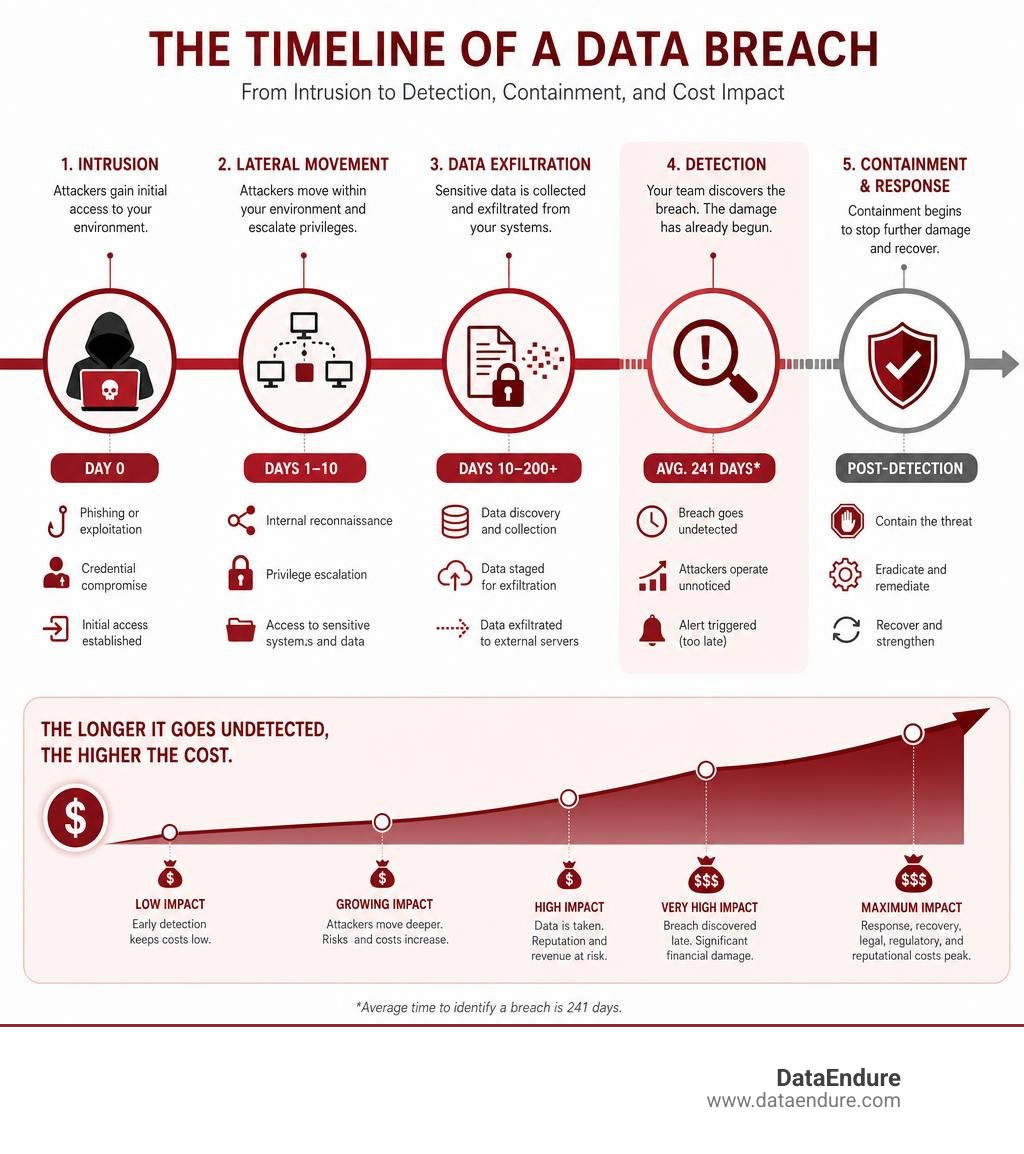
Here is the hard truth about modern breaches: the average enterprise takes 241 days to discover one on its own. During that time, attackers move freely through your environment. They steal credentials. They escalate privileges. They exfiltrate data. And most of it happens silently.
The financial stakes are just as stark. The average cost of a data breach reached $4.8 million in 2024 — a 10% jump from the year before. For organizations with fewer than 500 employees, that figure still hits $3.31 million on average. And catching a breach before the 200-day mark saves roughly $1.1 million per incident.
Traditional security approaches — legacy SIEM rules, periodic dark web scans, manual log reviews — were not built for the speed and scale of today’s threat landscape. They generate noise, miss context, and leave security teams drowning in alerts while the real threats go unnoticed.
For IT leaders in regulated industries, this is not an abstract risk. It is an operational crisis waiting to happen. And if you have already experienced a breach, you know exactly how fast things can unravel when detection comes too late.
This guide breaks down the leading instant breach detection platforms available in 2026, what to look for, how they integrate with your existing stack, and how to get the most out of whichever solution you choose.
Simple guide to instant breach detection platform terms:
What is an Instant Breach Detection Platform and Why is it Critical?
In the current threat landscape, the clock is your greatest enemy. The time an attacker spends inside an environment before detection — known as “dwell time” — averages about 11 days. During this window, cybercriminals don’t just sit idle; they map your network, target your backups, and siphon off sensitive files.
Without an instant breach detection platform, finding these silent intruders is like looking for a needle in a digital haystack. Traditional monitoring tools wait for a known signature or a policy violation. Meanwhile, modern attackers bypass these entirely by using compromised credentials, which look like legitimate logins.
To see how frequently these incidents occur, one only has to look at the California Department of Justice Breach List. The list is a constant reminder that organizations of all sizes, especially here in Silicon Valley, are under continuous assault.
Understanding the fundamentals of What is Threat Detection in Cybersecurity? is essential to realizing why real-time monitoring is no longer optional. When a breach occurs, the financial fallout escalates daily. Beyond immediate mitigation costs, compliance requirements under GDPR, HIPAA, and ISO 27001 mandate that organizations identify, contain, and report breaches within incredibly tight windows — sometimes as little as 72 hours. An instant detection platform is your only hope of meeting these stringent standards while minimizing reputational damage.
Key Features to Look for in an Instant Breach Detection Platform
When evaluating real-time detection software, you must look beyond the marketing buzzwords. A truly effective platform must offer:
- Continuous Dark Web Scanning: Threat actors don’t wait for your scheduled weekly scan. The platform must continuously sweep dark web marketplaces, deep web chats, and paste sites.
- Infostealer Log Parsing: Infostealer malware harvests credentials and session cookies directly from compromised employee devices. Your detection platform must index these logs in real time.
- Ransomware Leak Site Tracking: Monitoring extortion sites ensures you know if a vendor or partner has leaked your shared data before they even send you a notification email.
- Session Token Detection: Catching replayable session cookies allows you to invalidate compromised active sessions before attackers can bypass your Multi-Factor Authentication (MFA).
To build a robust defense, you need to combine these capabilities with modern Threat Detection and Response Tools that unify external threat intelligence with internal telemetry. Modern platforms index billions of leaked credentials and track thousands of ransomware victims, matching exposed data back to specific systems for immediate containment.
Deception Technology vs. Runtime Workload Protection
To achieve comprehensive visibility, modern security programs are moving away from passive monitoring and embracing two distinct, highly effective methodologies:
- Deception Technology: This approach turns your environment into a hostile maze for attackers. By deploying realistic decoy resources — such as “canary” databases, fake API keys, and dummy credentials — you create traps where attackers naturally look. Because legitimate employees have no reason to touch these resources, any interaction triggers an immediate, zero-false-positive alert. It shifts the paradigm from trying to find a pattern in billions of logs to knowing with 100% certainty that an intruder is active.
- Runtime Workload Protection: Operating at the system level, these tools use lightweight eBPF (Extended Berkeley Packet Filter) sensors inside your cloud workloads and Kubernetes clusters. They monitor system calls in real time, combining runtime signals with agentless context to detect unauthorized code execution, file integrity violations, or sudden privilege escalations without degrading system performance.
By pairing these technologies with active Threat Hunting, security teams can identify post-authentication anomalies and insider threats before they escalate.
Core Capabilities of Modern Real-Time Detection Technologies
To understand why traditional approaches fall short, let’s look at how they stack up against modern instant breach detection capabilities:
| Feature | Traditional Security Monitoring | Instant Breach Detection Platforms |
|---|---|---|
| Detection Speed | Days to months (reactive log analysis) | Seconds to minutes (real-time telemetry) |
| Primary Data Sources | Internal system logs and firewall events | Dark web, infostealer logs, runtime system calls, identity behavior |
| Alert Fidelity | Low (high false-positive rates, alert fatigue) | High (context-rich, behavioral-based alerts) |
| MFA Bypass Protection | Weak (fails to detect stolen active session tokens) | Strong (detects and invalidates hijacked cookies instantly) |
| Deployment Model | Heavy agents, complex network changes | Agentless, API-first, lightweight SaaS |
Modern platforms leverage advanced machine learning and AI triage engines to establish a baseline of normal human and non-human identity behavior. When an entity deviates from this baseline — such as an API key suddenly accessing unusual data repositories — the platform doesn’t just raise an alert; it stitches together the entire attack path.
This level of clarity is vital for eliminating blind spots and tool sprawl. Instead of managing dozens of disconnected consoles, security teams need a unified, vendor-agnostic approach that leverages best-of-breed integrations across dozens of security partners.
Dark Web and Identity Threat Monitoring
Attackers don’t break in anymore; they log in. Over 80% of hacking-related breaches leverage stolen or weak credentials. When an employee’s personal device is infected with an infostealer, their work credentials, browser history, and session cookies are packaged into “logs” and sold on underground telegram channels or dark web marketplaces.
If an attacker buys these logs, they can import the active session cookies directly into their browser. This allows them to hijack the active session and bypass MFA entirely because the system believes the user is already authenticated.
This risk highlights why understanding Breach Repeat: Understanding Recurrent Cyberattacks is so critical. If you only reset a user’s password but fail to invalidate their compromised session tokens or secure their compromised personal devices, the attacker will simply walk back through the front door. Continuous identity threat monitoring must analyze behavior after login, flagging anomalous resource access or sudden administrative changes.
Cloud and Network Detection and Response (NDR)
As workloads migrate to the cloud, the traditional network perimeter has dissolved. Attackers exploit this shift by targeting cloud-native environments where lateral movement is easier to hide.
Modern Network Detection and Response (NDR) platforms analyze billions of network sessions and cloud interactions per hour. By focusing on attacker behaviors (such as reconnaissance, lateral movement, and data exfiltration) rather than static signatures, these platforms can detect threats hidden inside encrypted traffic without needing to decrypt the payload.
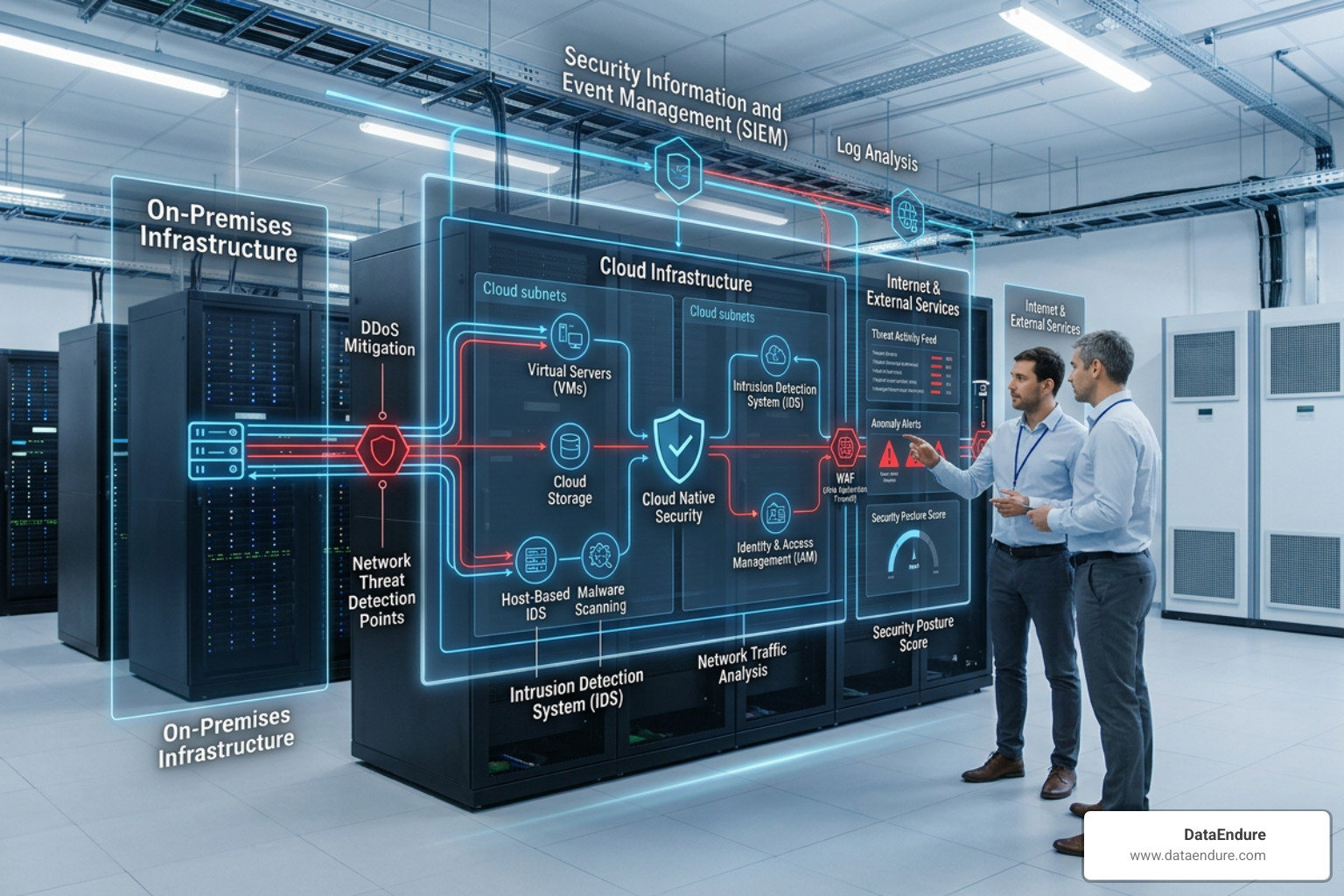
When combined with cloud workload protection, this behavioral analysis ensures that whether an attacker is moving laterally through your on-premises servers or manipulating Kubernetes pods, you maintain complete visibility. Implementing a unified approach to Threat Detection and Response ensures that these network, identity, and cloud signals are correlated into a single, cohesive timeline.
How Real-Time Platforms Integrate with Your Security Stack
An instant breach detection platform should never operate as an isolated island. To maximize its value, it must integrate seamlessly with your existing infrastructure, turning raw detection signals into automated defensive actions.

- SIEM and SOAR Integration: Rather than forcing your analysts to watch another dashboard, API-first platforms push clean JSON alerts directly into your Security Information and Event Management (SIEM) or Security Orchestration, Automation, and Response (SOAR) systems. This allows you to trigger automated playbooks — such as disabling an Active Directory account or isolating a virtual machine — within seconds of an alert.
- AI-Driven Security Integrations: By connecting threat intelligence directly to your security operations, you can leverage AI-driven security integrations to automatically prioritize alerts based on asset criticality and active exploitability.
- Collaboration Tools: Instant alerts can be piped directly into Slack or Microsoft Teams channels. This ensures your on-call engineers are notified immediately, with full context and remediation buttons built directly into the chat interface.
How to Deploy an Instant Breach Detection Platform for Maximum ROI
Deploying new security tools has a reputation for being slow, disruptive, and resource-intensive. However, modern platforms offer flexible deployment options that deliver rapid time-to-value:
- Agentless & API-First: Many dark web and cloud detection tools connect via read-only APIs in minutes, requiring zero software installation or network downtime.
- Deception-Based Canaries: Deploying lightweight decoy secrets and resources can be fully automated using infrastructure-as-code tools like Terraform, fitting seamlessly into your existing CI/CD pipelines.
- Supply Chain & Third-Party Monitoring: By configuring the platform to monitor your vendors’ domains, you can identify credential leaks or ransomware threats affecting your supply chain before they impact your network.
To avoid the common pitfalls of complex rollouts, look for strategies outlined in Enterprise MDR Deployment: Quick Wins for Busy Teams to streamline your implementation and achieve comprehensive coverage without overwhelming your internal staff.
Frequently Asked Questions about Instant Breach Detection
How quickly can organizations detect and respond to breaches compared to traditional methods?
Traditional, log-heavy detection methods often leave organizations in the dark for over 200 days. In contrast, an instant breach detection platform can identify compromised credentials, active session hijacking, or lateral network movement within seconds to minutes.
By shrinking the detection window, you prevent attackers from establishing persistence, securing backups, or exfiltrating data. To see how continuous vigilance transforms your defense posture, explore The Non-Stop Guide to 24×7 Security Monitoring.
How do these platforms handle false positives and provide actionable alerts?
One of the biggest pain points for security teams is alert fatigue. If a system barks at every minor anomaly, analysts eventually turn down the volume.
Modern platforms solve this by using contextual enrichment and behavioral baselines. For example, rather than alerting on every login from a new IP address, the platform correlates the login with dark web threat intelligence, active session validation, and post-authentication behavior. By combining these signals, it delivers high-fidelity, prioritized alerts that contain actionable remediation steps, rather than raw log noise.
What are the best practices for implementing real-time breach detection?
To get the most out of your platform, we recommend following these core practices:
- Adopt an “Assume Breach” Mindset: Design your defenses around the reality that attackers will eventually bypass your perimeter. Focus your detection on what they do after they gain access.
- Prioritize Credential Hygiene: Implement automated password resets and session invalidation rules the moment a credential appears on dark web or infostealer feeds.
- Leverage Deception early: Scatter canary tokens and decoy assets across your cloud and on-premises environments to catch sophisticated attackers who evade signature-based tools.
- Establish a Compliance Timeline: Ensure your rapid detection capabilities align with regulatory reporting windows, as detailed in Breach Protection: The 30-Day Compliance Countdown.
Conclusion: Partnering for Digital Resilience
Detecting breaches in minutes requires more than just buying another software license. It requires a cohesive strategy that integrates security, data, cloud, network, and infrastructure into a unified shield.
At DataEndure, we bring over 40 years of digital resilience experience to help organizations navigate this complex landscape. Based in Silicon Valley (Santa Clara, CA), we understand the unique pressures facing modern CISOs and IT leaders. We believe in Alignment Over Complexity — helping you eliminate tool sprawl and operational burden through curated, layered solutions.
As a vendor-agnostic partner leveraging over 50 leading technology integrations, we don’t force you into a single box. Instead, we design a holistic defense tailored to your unique environment, delivering real business outcomes and rapid compliance readiness. Our managed security experts can deploy your custom defense system in under 30 days, giving you the peace of mind that comes with true 24/7 visibility.
Ready to close your detection gaps and stop attackers in their tracks? Explore how DataEndure Managed Detection and Response (MDR) can fortify your digital resilience today.