Why cloud security mechanisms matter
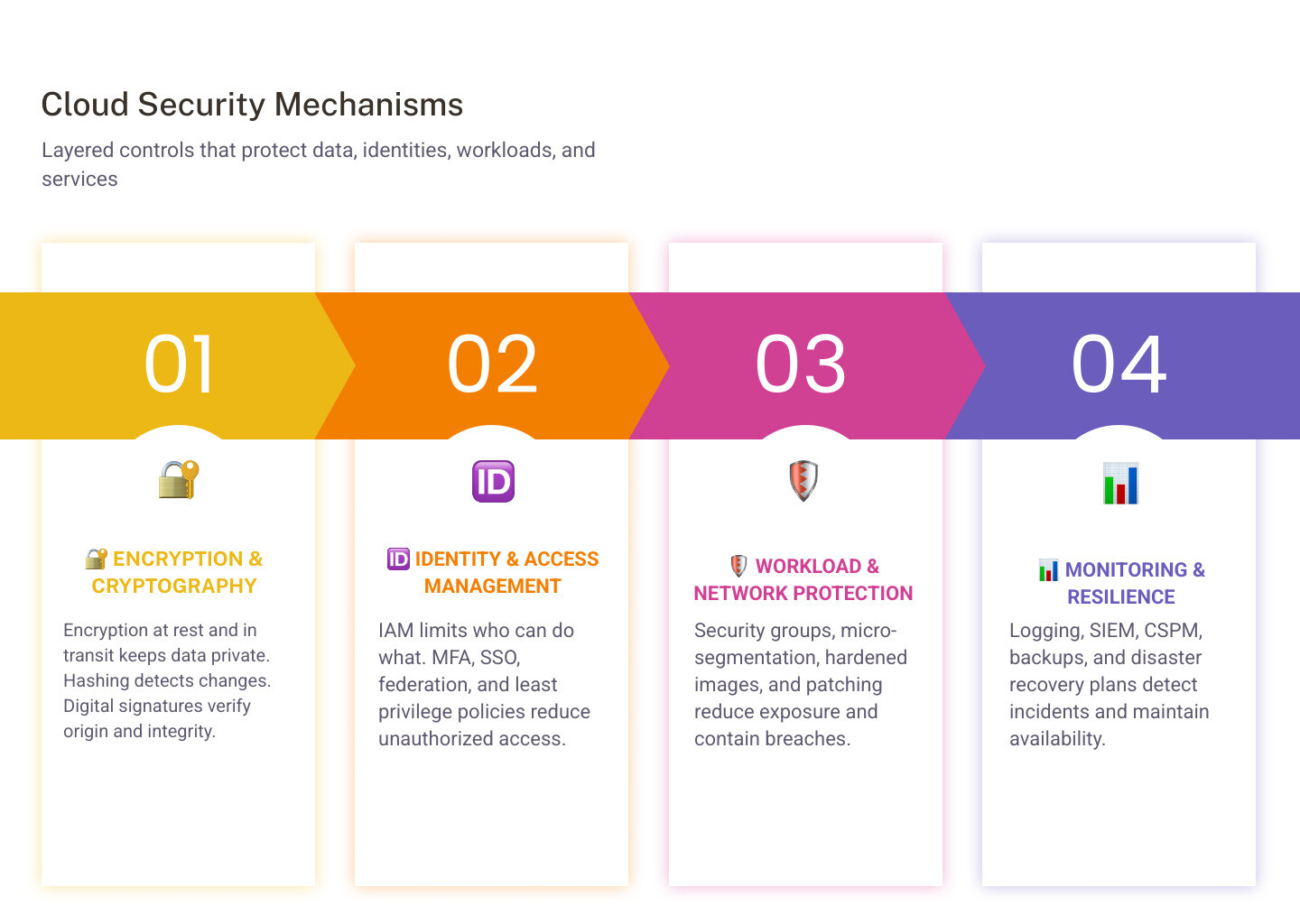
Cloud security mechanisms are the controls that protect cloud data, identities, workloads, and services. Encryption helps keep data private. Hashing and digital signatures help detect changes and verify origin. Identity and access management (IAM) limits who can do what, while network rules and hardened server images reduce exposure. Monitoring, backups, and recovery plans help teams detect incidents and keep services available.
These controls need to work together. A monitoring tool cannot fix an overly broad permission or an exposed server on its own. Start with the data and workloads that matter most, then identify which controls your cloud provider manages and which your team must configure.
Quick cloud security mechanisms definitions:
- cloud computing security architecture
- cryptography in cloud computing
- security threats in cloud computing
Cloud security mechanisms: core controls and threats
Security is a system of related controls, not a single product or setting. Cryptography protects data, identity controls govern access, workload protections reduce attack paths, and monitoring helps teams identify activity that needs investigation. The right combination depends on the sensitivity of the data, the services in use, and the organization’s risk priorities. For practical examples of common threats, see ways to prevent top cloud security threats.
What cloud security mechanisms protect
Confidentiality, integrity, and availability are often called the core security goals. Cloud environments also need reliable authentication, authorization, and audit records to help establish who accessed a resource, what actions they took, and whether those actions were permitted.
| Security goal | Example controls | Threats addressed |
|---|---|---|
| Confidentiality | Encryption at rest and in transit; access policies | Data exposure, eavesdropping, unauthorized access |
| Integrity | Hashes, digital signatures, change monitoring | Tampering, unauthorized software or data changes |
| Availability | DDoS protections, backups, recovery plans | Service disruption, data loss, infrastructure outages |
| Authentication and authorization | MFA, IAM roles, least privilege | Stolen credentials, excessive permissions |
| Auditability | Centralized logs, alerting, access reviews | Unnoticed misuse, delayed incident investigation |
Encryption at rest protects stored data, such as database records and backups. Encryption in transit, commonly provided through TLS, helps protect information moving between users, applications, and services. Neither replaces access controls: a person or workload with authorized access may still be able to read the data.
The Cloud Security Alliance’s guidance covers cloud security across areas such as identity, data protection, monitoring, workload security, and incident response.
Encryption, hashing, digital signatures, and PKI
Encryption converts readable plaintext into ciphertext using an algorithm and a key. Decryption requires the appropriate key. Symmetric encryption uses the same secret key to encrypt and decrypt data and is commonly used for bulk data because it is efficient. Asymmetric cryptography uses a related public and private key pair. In practice, secure connections often use asymmetric methods to establish or authenticate a connection, then symmetric encryption to protect the session.
Use authenticated encryption where supported: it protects confidentiality and helps detect unauthorized changes to encrypted data. Key management matters just as much as the algorithm. Restrict access to keys, define how they are stored and rotated, and plan how to revoke or replace them if they are exposed.
Hashing is different. A hash function produces a fixed-length digest from input data and is designed to be one-way, not reversible. Comparing a newly calculated digest with a trusted one can reveal whether a file or message changed. Passwords should be stored using a purpose-built password hashing function with a unique salt, not as plaintext or with ordinary fast hashes.
A digital signature uses a private key to sign a message or its digest. A recipient can use the corresponding public key to check that the signature matches and that the signed content has not changed. This supports authenticity and integrity, and can support non-repudiation when keys are properly controlled. A signature does not encrypt the message.
Public Key Infrastructure (PKI) helps organizations bind public keys to identities using digital certificates. Certificate authorities issue or validate certificates under defined trust practices. TLS certificates, for example, help a client verify the identity associated with a service. The NIST chapter on cloud security architecture provides additional architectural context.
| Mechanism | Main purpose | Reversible? | Key use |
|---|---|---|---|
| Encryption | Confidentiality; authenticated encryption can also detect tampering | Yes, with the required key | Secret key or public/private key pair |
| Hashing | Integrity checks and password protection | No | No encryption key; password hashing uses a salt |
| Digital signature | Verify origin and integrity; support non-repudiation | The content is not encrypted by signing | Private key signs; public key verifies |
How cloud security mechanisms control identity and workload access
IAM connects identities to permissions. Its main functions include authentication (verifying identity), authorization (deciding permitted actions), user management, and credential management. Assign roles according to the least-privilege principle, review them regularly, and use multi-factor authentication (MFA), especially for administrative and sensitive access.
Single Sign-On (SSO) lets a user authenticate through a central identity provider and then access multiple applications without signing in separately to each one. Federation extends that trust between an identity provider and services. SAML and OpenID Connect are commonly used for federated sign-in; OAuth is primarily a delegated authorization framework. SSO can reduce password fatigue, but a compromised identity provider or session can affect connected services, so protect accounts with MFA, careful session controls, and monitoring.
For workloads, security groups define which network connections are allowed to and from groups of cloud resources. Micro-segmentation narrows communication further, limiting the potential impact of compromised credentials or a vulnerable service. Hardened virtual machine images also reduce exposure: remove unnecessary software, disable unused services, close unneeded ports, and apply security updates before using an image to provision instances.

Our cloud computing security best practices guide covers additional steps for strengthening access and workload controls.
Build a cloud security strategy for modern workloads
Effective controls begin with risk assessment: identify sensitive data, important services, likely threats, and operational dependencies. Then assign owners, select controls that fit the cloud architecture, and test how the organization will monitor and recover from incidents. Cloud-native capabilities can support automation and scale, but they need to be configured and governed. For architecture considerations across environments, see modern cloud security architecture.
Shared responsibility and deployment models
The Shared Responsibility Model divides security obligations between the provider and the customer. Providers generally secure the physical facilities, hardware, and underlying cloud infrastructure. Customers remain responsible for what they deploy and configure, including identities, data, application settings, and network rules. The exact boundary varies by service and provider.
In general, customers manage more of the stack in IaaS, share more platform responsibilities in PaaS, and manage application use, data, and access settings in SaaS. Do not assume a provider’s controls automatically configure or secure customer accounts and workloads. Document ownership for each service and verify it against the service terms and architecture. More detail is available in our guide to shared cloud security responsibility.
| Deployment model | Control and tenancy | Coordination needs |
|---|---|---|
| Public | Provider-operated, typically multi-tenant infrastructure | Strong account, configuration, and data controls |
| Private | Dedicated to one organization; may be operated internally or by a provider | Clear ownership for infrastructure and operations |
| Hybrid | Connects private and public environments | Consistent identity, monitoring, and secure data movement |
| Community | Shared by organizations with common requirements | Agreed governance, access, and compliance responsibilities |
A deployment model does not determine security on its own. Public cloud can provide extensive security capabilities, while private environments can offer more direct control; both require sound design and operations. Hybrid and community environments add coordination and boundary-management needs.
Defense in depth, Zero Trust, and cloud control pillars
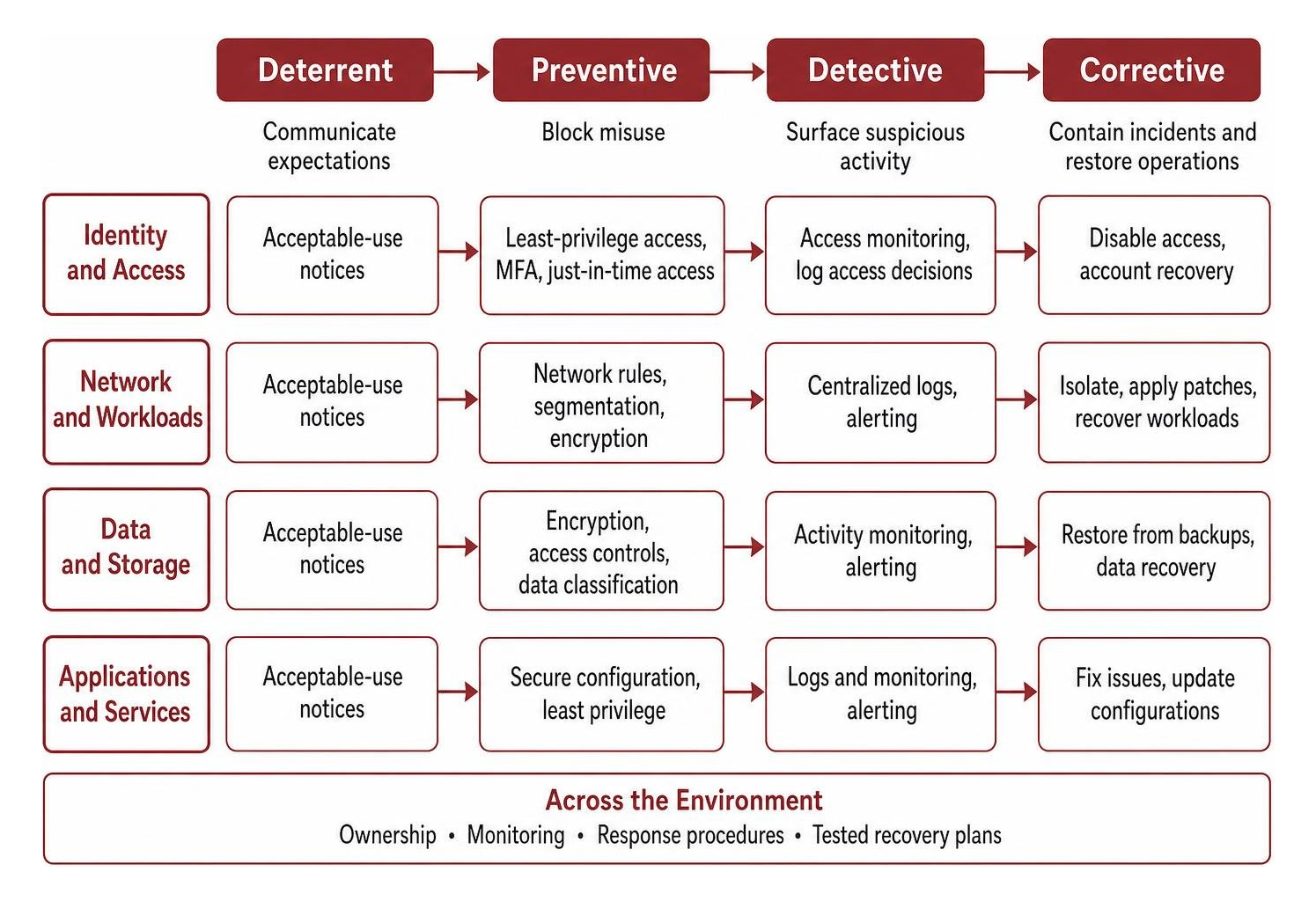
Defense in depth uses multiple control types so that one missed or bypassed safeguard does not become the only line of defense. Deterrent controls, such as acceptable-use notices, communicate expectations. Preventive controls—including least-privilege access, MFA, network rules, and encryption—aim to block misuse. Detective controls such as centralized logs and alerting surface suspicious activity. Corrective controls, including patching, isolated backups, and recovery procedures, help contain incidents and restore operations.
Zero Trust applies continuous verification rather than treating network location as proof of trust. Consider identity, device posture, workload context, and the sensitivity of the requested resource. Use just-in-time access where appropriate, and log access decisions and important administrative actions. Cloud Security Posture Management (CSPM) can help identify configuration risks across cloud resources; security information and event management (SIEM) can aggregate and analyze logs. These tools support controls, but teams still need ownership, response procedures, and tested recovery plans.
The CISA Cloud Security Technical Reference Architecture discusses cloud adoption, shared responsibility, and security architecture.
Match controls to threats and turn priorities into an operating plan
Choose controls by mapping each important threat to a prevention, detection, and recovery measure. Insufficient authorization calls for role review, least privilege, and access monitoring. Overlapping trust boundaries call for clear network segmentation and explicit rules between environments. Malicious intermediaries are a reason to validate certificates and use protected, authenticated connections. Credential compromise calls for MFA, limited permissions, and monitoring for unusual use.
Misconfiguration can expose data or administrative interfaces, so use configuration reviews and ongoing posture monitoring. DDoS protections can help address disruptive traffic, while backups and regional failover planning support continuity if systems or regions become unavailable. A sudden, unusually large download may warrant an alert and investigation. Keep backups isolated from routine administrative access and test restoration; having a backup alone does not confirm that recovery will work.
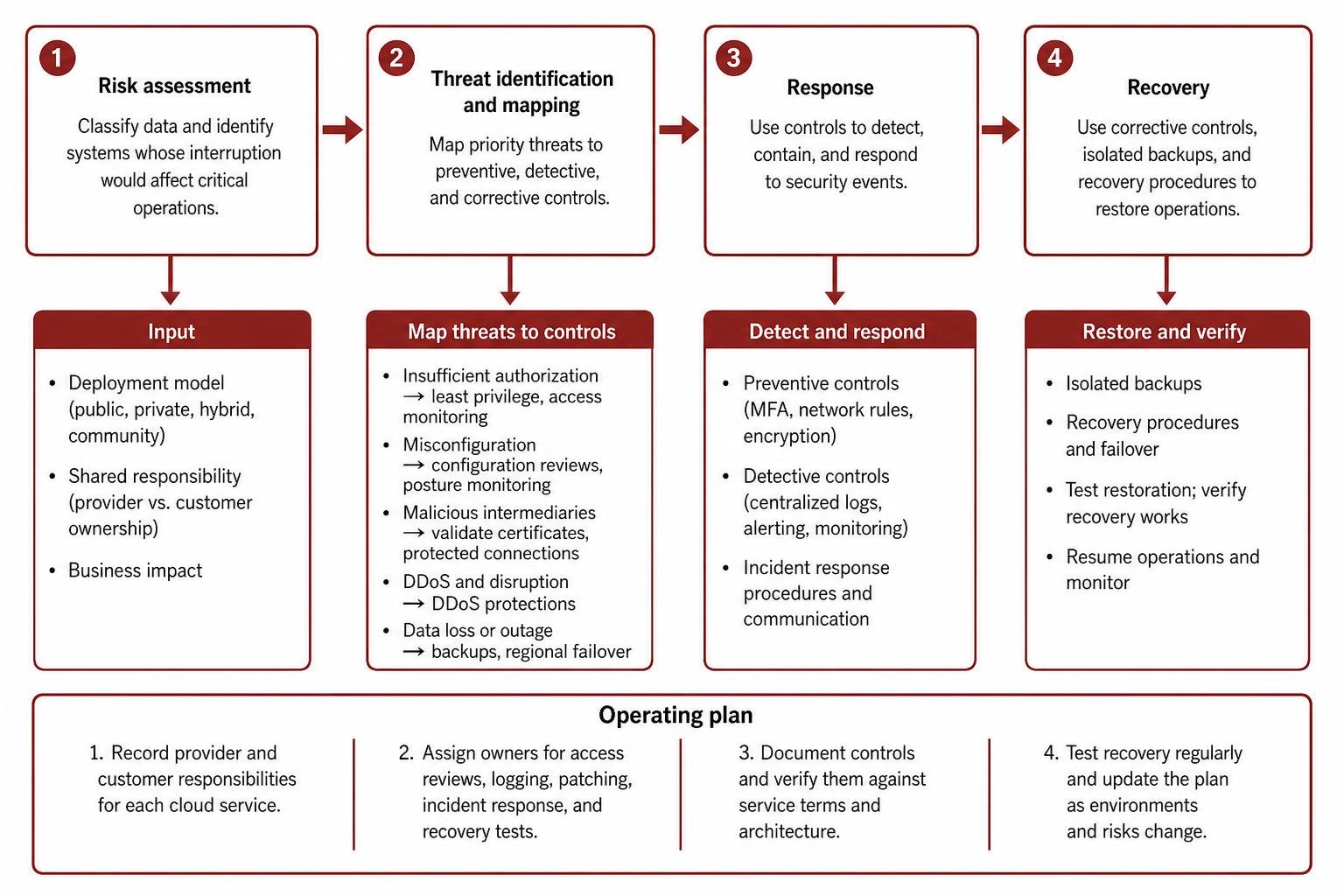
A practical operating plan should:
- Classify data and identify systems whose interruption would affect critical operations.
- Record provider and customer responsibilities for each cloud service.
- Map priority threats to preventive, detective, and corrective controls.
- Assign owners for access reviews, logging, patching, incident response, and recovery tests.
- Reassess controls after significant architecture or regulatory changes.
Compliance requirements depend on the organization, data, and applicable jurisdiction; this overview is not legal advice. Our cloud security best-practices checklist can help teams structure their review. Teams can use the plan above to review current controls against the threats and responsibilities they have identified.