Why Cloud Security Best Practices Are Non-Negotiable in 2026
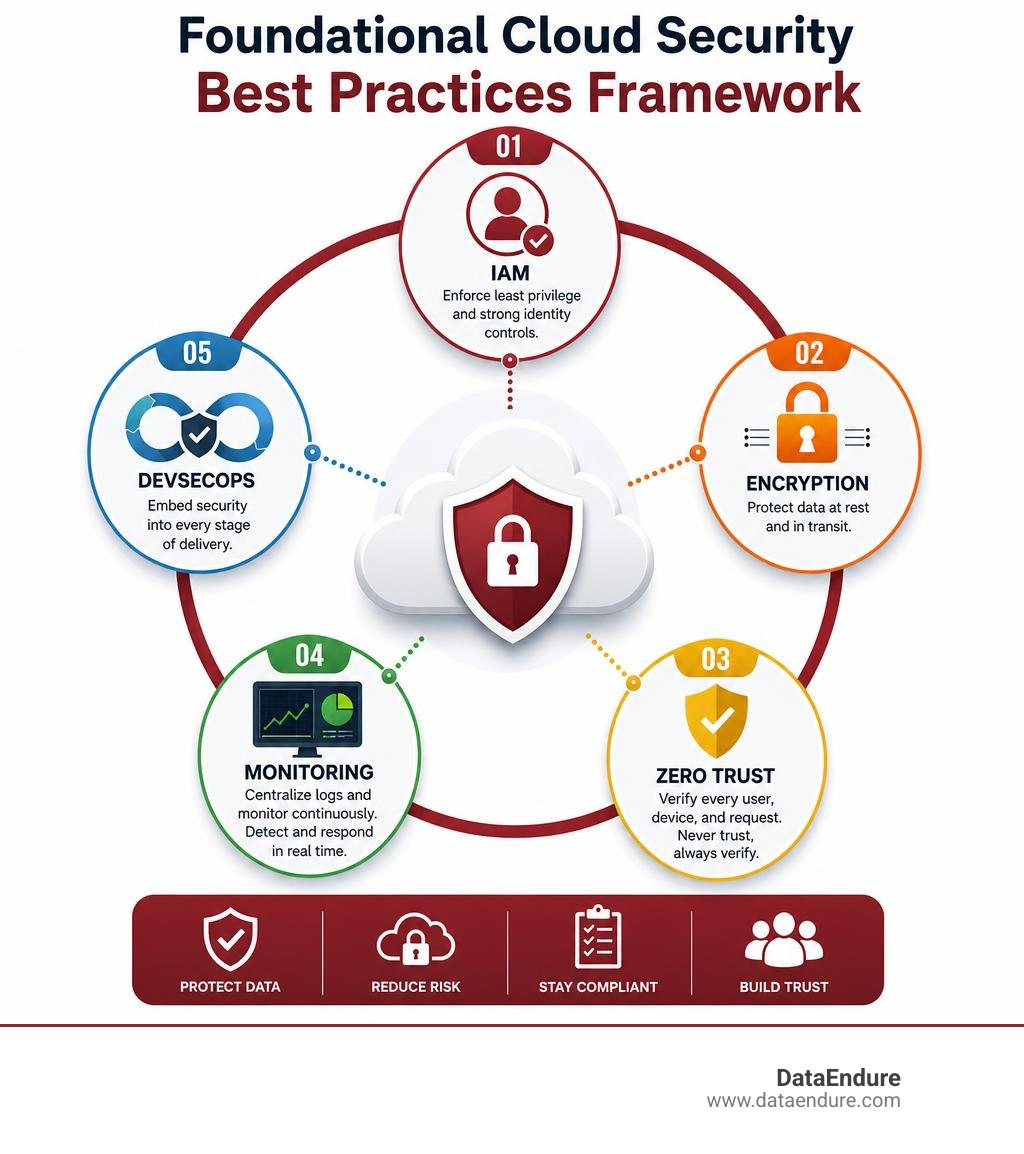
Adopting cloud security best practices helps reduce risk, maintain compliance requirements, and protect organizational data across cloud environments. Here is a quick-reference summary of the key areas to address:
- Understand the shared responsibility model – Know where your cloud provider’s security ends and yours begins.
- Enforce least privilege access – Limit every user, service, and machine identity to only what it needs.
- Enable MFA everywhere – Especially for root and admin accounts.
- Encrypt data at rest and in transit – Use TLS 1.2 or higher and customer-managed encryption keys.
- Rotate and manage keys and secrets – Use a dedicated KMS or HSM and rotate regularly.
- Segment your network – Apply default-deny firewall rules and isolate workloads using micro-segmentation.
- Centralize logging and monitoring – Treat telemetry as an active response system, not a compliance archive.
- Adopt zero trust principles – Verify every user and device continuously, never assume implicit trust.
- Integrate security into DevOps (DevSecOps) – Shift security left into your CI/CD pipelines and Infrastructure as Code.
- Mitigate third-party and MSP risk – Audit and restrict all external access with the same rigor as internal access.
Cloud environments scale rapidly, making modern cloud security management essential.
When teams deploy new workloads, identities, and services quickly, traditional perimeter-based controls are often insufficient. Static perimeters, manual access reviews, and periodic audit snapshots were designed for on-premises architectures. In dynamic cloud environments, configurations and permissions require continuous oversight and automation.
For IT leaders in regulated industries, managing compliance demands, staffing resources, and alert volume requires a systematic, risk-based methodology.
That is why government agencies like CISA and the NSA jointly published Cybersecurity Information Sheets specifically addressing cloud security, and why cloud providers like AWS and Google Cloud maintain architectural frameworks—such as the AWS Well-Architected Framework and Google Cloud Well-Architected Framework—to guide secure cloud deployments.
This guide breaks down these foundational principles into structured, objective guidance.
Discover more about cloud security best practices:
Foundational Principles and Frameworks for Cloud Security Best Practices
Building a secure cloud architecture is not about accumulating security tools until your dashboard looks like a Christmas tree. True digital resilience comes from applying core structural principles consistently. Major public cloud providers, along with cybersecurity standards organizations like the Center for Internet Security (CIS) and the National Institute of Standards and Technology (NIST), align their guidance around structured frameworks like NIST 800-53 and the CIS Benchmarks.
Understanding these baseline standards helps technology leaders move away from reactive firefighting and transition toward programmatic, repeatable cloud governance.
The Shared Responsibility Model Explained
The cornerstone of modern cloud architecture is the shared responsibility model. Simply put, security in the cloud is a partnership between you and your Cloud Service Provider (CSP).
CSPs operate on a division of labor:
- Security OF the Cloud: The provider manages and protects the underlying physical infrastructure, data centers, hardware, hypervisors, and core networking facilities.
- Security IN the Cloud: You remain responsible for configuring access permissions, identity management, customer data, application code, operating system patching (where applicable), and firewall settings.
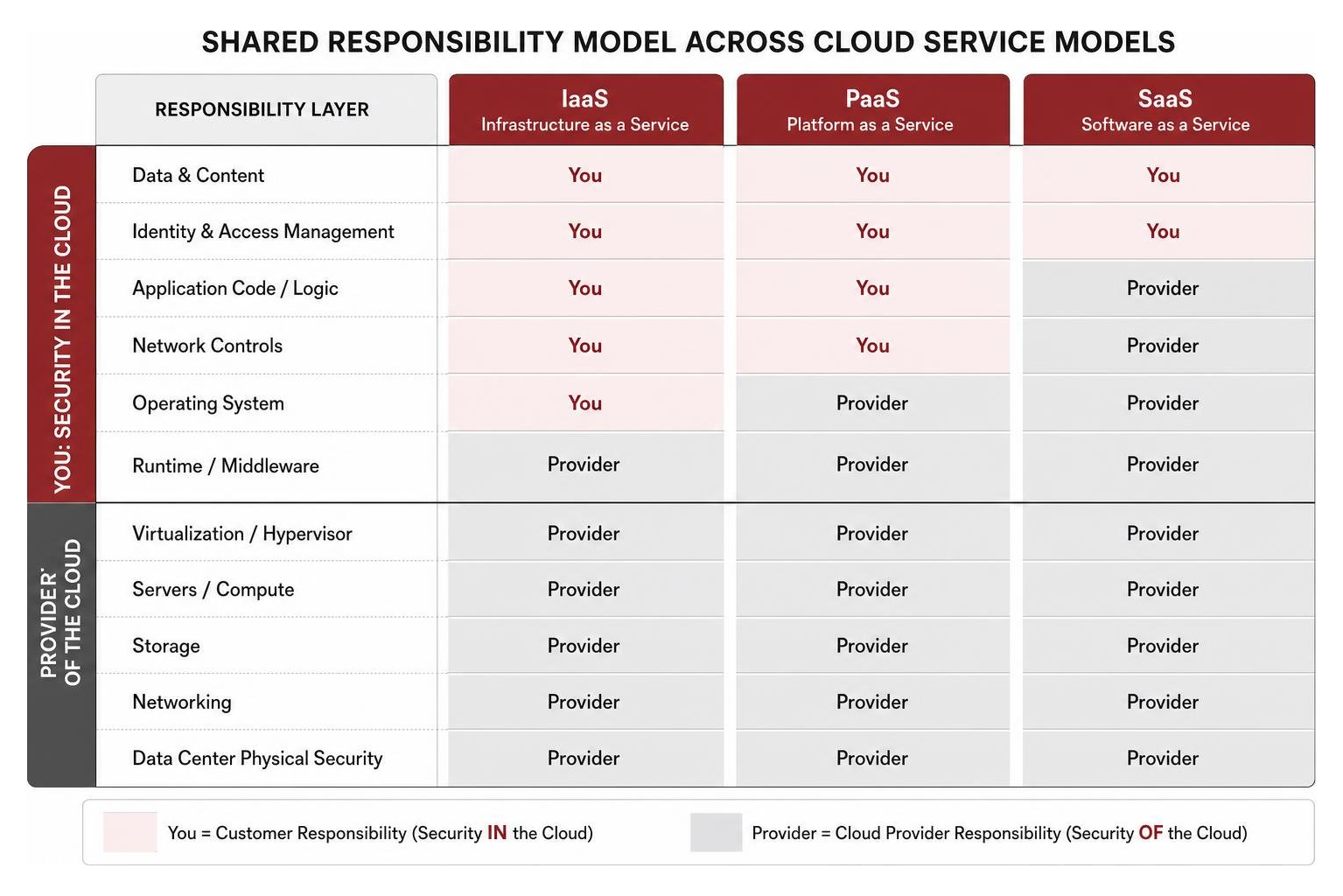
The exact boundary shifts depending on whether you deploy Infrastructure as a Service (IaaS), Platform as a Service (PaaS), or Software as a Service (SaaS):
- In IaaS (like virtual machines), you manage the guest operating system, application stack, network rules, and runtime libraries.
- In PaaS (like managed database services or container platforms), the provider manages OS patching and hardware runtime, while you manage data, application logic, and user access.
- In SaaS (like cloud productivity suites), the provider handles virtually the entire technical stack, leaving you to manage identity, data classification, and device compliance.
To dive deeper into how these obligations divide across your environment, review our guide on Who Shares the Responsibility for Cloud Security?. Failing to recognize where the CSP’s domain ends and yours begins is one of the leading causes of preventable cloud exposure.
Core Architecture Frameworks for Cloud Security Best Practices
Rather than guessing how to configure complex environments, organizations can leverage vetted architectural models. Frameworks like the Security Pillar – AWS Well-Architected Framework and the Well-Architected Framework: Security, privacy, and compliance pillar from Google Cloud offer clear roadmaps for resilient operations.
These frameworks emphasize several structural imperatives:
- Implement security by design: Security controls must be embedded into system architectures from day one, rather than retrofitted onto production systems later. You can explore concrete architectural principles via Google’s guide on how to Implement security by design.
- Maintain multi-account strategies: Isolating workloads using dedicated cloud accounts provides a hard isolation boundary for access control, blast radius reduction, and billing. AWS and Google Cloud recommend separating development, staging, testing, and production environments across distinct account structures under an organizational hierarchy.
- Establish organizational guardrails: Implement high-level Service Control Policies (SCPs) or enterprise organization policies to enforce global guardrails. These guardrails prevent unauthorized actions—such as turning off logging, launching unapproved instances, or disabling public S3 bucket blocking—regardless of local account admin permissions.
- Leverage pre-tested blueprints: Utilize resource registries like the Google Cloud security best practices catalog or deployable Infrastructure as Code (IaC) modules to launch security-centric landing zones that meet NIST 800-53 or FedRAMP standards out of the box.
Identity and Access Management (IAM) Best Practices in the Cloud
Identity is the ultimate perimeter in modern cloud environments. Because physical networks are replaced by software-defined interfaces accessible from anywhere over the internet, controlling identity, credential security, and role boundaries represents your primary line of defense.
Enforcing Least Privilege and Role Separation
The principle of least privilege dictates that every human user, service account, and automated pipeline should receive only the exact permissions required to perform its designated function—and not a single permission more.
To build a zero-drift identity baseline:
- Secure Root and Super-Admin Accounts: Deactivate programmatic access keys for root users immediately upon account setup. Enforce mandatory Multi-Factor Authentication (MFA) via hardware security keys or time-based one-time password (TOTP) applications. Root accounts should only be accessed for rare, emergency account-management tasks.
- Implement Role-Based Access Control (RBAC): Avoid attaching inline permission policies directly to individual users. Instead, construct structured IAM roles and user groups mapped directly to business functions (e.g., Database Administrators, Security Analysts, Billing Auditors).
- Enforce Separation of Duties: Ensure sensitive administrative tasks—such as modifying encryption key policies or exporting audit logs—require independent approval chains or distinct IAM privileges to reduce insider risk.
- Manage Credential Lifecycles: Standardize temporary security tokens over long-lived access keys wherever possible. For step-by-step instructions on refining identity policies, refer to our Step-by-Step Guide to Cloud Computing Security Best Practices.
Securing Machine Identities and Third-Party Access
In cloud estates, non-human machine identities—such as container instances, serverless functions, CI/CD runners, and automated microservices—frequently outnumber human operators tenfold. Unsecured service accounts are a prime target for lateral movement.
Key strategies for managing machine access include:
- Federate External Identities: Rather than maintaining local cloud user directories, federate IAM with central Enterprise Identity Providers (IdPs) using SAML 2.0 or OpenID Connect (OIDC).
- Eliminate Hardcoded Service Account Keys: Replace static credential files and API keys with short-lived access tokens, workload identity federation, or central instance profiles.
- Mitigate Managed Service Provider (MSP) and Vendor Risks: MITRE ATT&CK classifies third-party access under “Trusted Relationship” exploitation vectors. When granting administrative access to external managed service providers or partners, enforce time-bound access, explicit approval workflows, continuous session logging, and strict MFA requirements.
- Audit Key Rotation Continuously: Configure automated scanners to detect exposed access keys, unrotated secrets, or over-privileged service accounts. Industry benchmarks recommend rotating sensitive cryptographic keys at least every 90 days—or instantly upon suspicion of exposure.
If your team is seeking foundational clarity on cloud identities, read our Beginner’s Guide to Cloud Security.
Data Protection, Encryption, and Key Management
Data is your organization’s most critical currency. Protecting it requires robust encryption across its three operational states: at rest (stored in cloud databases, objects, or disks), in transit (moving across cloud or public networks), and in use (actively processed in system memory).
Network Micro-Segmentation and Traffic Isolation
Perimeter firewalls alone cannot protect multi-tenant cloud ecosystems. Once an adversary breaches an outer boundary, unsegmented networks allow frictionless lateral movement across internal resources.
Modern cloud network architecture combines macro-segmentation (isolating virtual private clouds and subnets) with micro-segmentation (isolating individual workloads and container pods regardless of network location).
| Security Dimension | Macro-Segmentation | Micro-Segmentation |
|---|---|---|
| Primary Scope | Network perimeters, subnets, and VPC boundaries | Individual workloads, microservices, container pods |
| Control Mechanism | Network Access Control Lists (NACLs), outer firewalls | Software-defined security groups, service meshes, host firewalls |
| Access Default | Often permits open lateral movement within subnets | Strict default deny policies across all internal traffic |
| Identity Visibility | Based primarily on IP address ranges and port protocols | Based on cryptographic identity, context, and application role |
| Primary Protection Goal | Prevents unauthorized external ingress into subnets | Prevents lateral threat movement if an internal workload is breached |
To maintain robust network isolation:
- Enforce Default-Deny Policies: Configure cloud security groups and firewalls to block all incoming and outgoing traffic by default, explicitly whitelisting only essential application ports.
- Mandate Strong Transport Encryption: Enforce TLS version 1.2 or higher across all web services, public APIs, and inter-service communications. Disable outdated cryptographic protocols like SSLv3, TLS 1.0, and TLS 1.1 across all endpoints.
- Isolate Service Endpoints: Route intra-cloud service traffic through private IP endpoints (such as AWS PrivateLink or GCP Private Service Connect) to keep internal application traffic completely off the public internet.
Key Management vs. Secrets Management
Organizations frequently confuse Key Management Services (KMS) with Secrets Managers. While both are cryptographic controls, they serve distinct operational mandates:
- Key Management Services (KMS / HSM): Generate, store, and manage symmetric and asymmetric cryptographic keys used to encrypt and decrypt raw data blocks, database volumes, and object storage containers.
- Secrets Managers: Safely store, inject, and retrieve application secrets, such as database credentials, API tokens, and SSH keys at runtime, enabling automated programmatic secret rotation.

Best practices for key and secrets governance include:
- Use Customer-Managed Encryption Keys (CMEK): While cloud provider-managed keys offer baseline protection, CMEKs grant you direct ownership over key policies, access logs, and revocation privileges.
- Audit Key Usage Continuously: Enable detailed log audits for every call made to cryptographic endpoints. Unusually high volume decryption requests can serve as an early indicator of automated data exfiltration.
- Leverage Hardware Security Modules (HSMs): For highly regulated workloads requiring FIPS 140-2 Level 3 compliance, store root cryptographic keys inside dedicated Cloud HSM hardware modules.
- Adopt Confidential Computing for Data in Use: Utilize hardware-based trusted execution environments (TEEs) to protect sensitive memory data while performing complex computations or AI inference model processing.
For comprehensive technical insights on constructing cryptographic architectures, consult our Detailed Guide to Cloud Security.
DevSecOps, Continuous Monitoring, and Zero Trust Implementation
Security cannot be treated as a final quality check executed moments before a production release. In high-velocity cloud deployments, security controls must be embedded directly into automated development pipelines and operational feedback loops.
Implementing Zero Trust and Automating DevSecOps Cloud Security Best Practices
Adopting a Zero Trust posture means abandoning implicit trust based on network location. Whether a connection originates from inside a corporate branch office in Silicon Valley CA or from a remote device, every access request must be explicitly authenticated, authorized, and validated against contextual telemetry before access is granted.
Zero Trust principles map directly to modern cloud-native frameworks:
- BeyondCorp Architecture: Google’s context-aware access architecture evaluates user identity, device health, dynamic location, and temporal indicators before granting access to enterprise applications. You can explore complete implementation models at the Cloud Security Best Practices Center | Google Cloud.
- BeyondProd Framework: Extends Zero Trust principles to cloud-native microservices, ensuring that code changes are signed, microservice calls are authenticated via mutual TLS (mTLS), and binary artifacts are verified before deployment.
- Shift-Left Pipeline Security: Integrate automated Static Application Security Testing (SAST), Software Composition Analysis (SCA), and Infrastructure as Code (IaC) scanning directly into CI/CD pipelines. Tools like Terraform and CloudFormation templates should be scanned for misconfigurations—such as exposed ports or unencrypted disks—long before reaching deployment.
- Binary Authorization and Immutability: Require cryptographically signed attestations before container images can launch in production Kubernetes clusters. Utilize immutable, distroless container bases to eliminate interactive shell access and reduce attack surfaces.
For a broader perspective on multi-cloud security strategies, see the industry overview on 25 Cloud Security Best Practices for AWS, Azure, and GCP.
Detective Controls, Telemetry, and Incident Readiness
Security logging should never be viewed as a passive compliance exercise designed to satisfy annual auditors. High-performing security teams treat telemetry as a real-time operational defense mechanism.
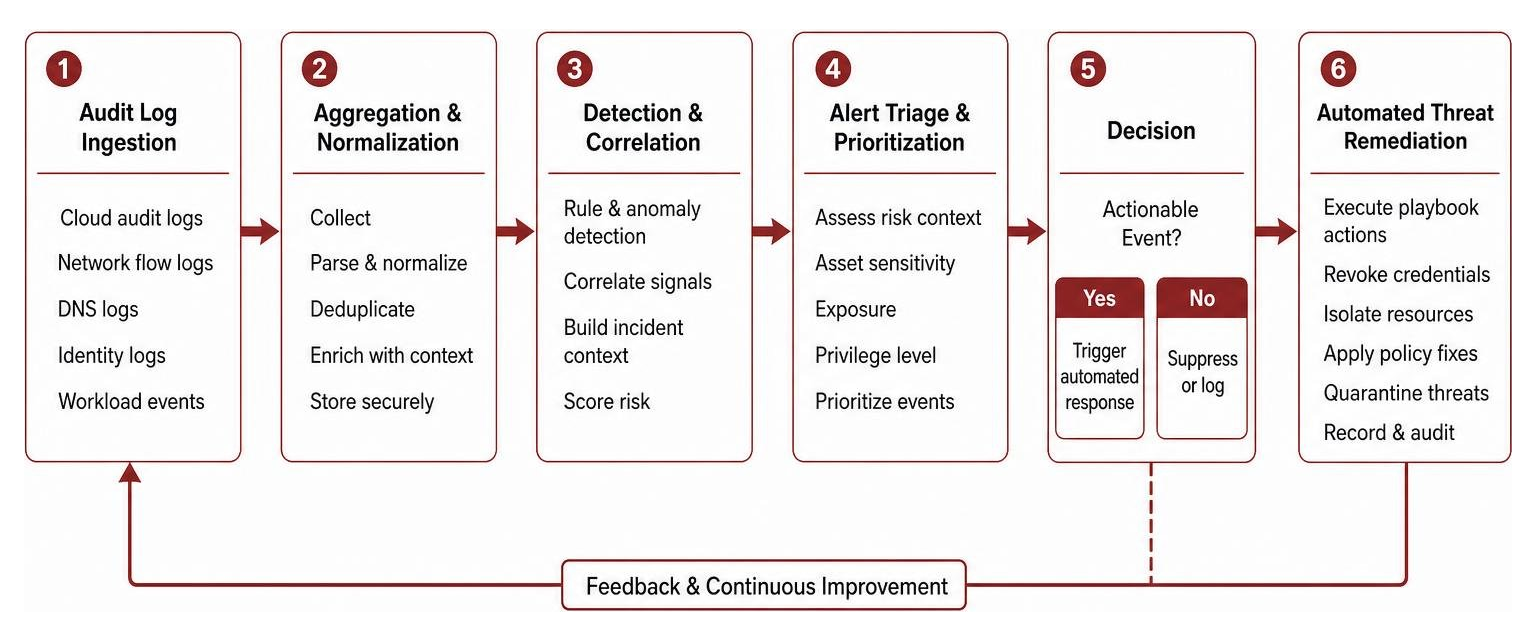
Key monitoring and response practices include:
- Centralize Telemetry: Ingest CloudTrail, VPC Flow Logs, DNS logs, and identity audit records into a secure, write-once-read-many (WORM) central repository.
- Prioritize Alerts Based on Risk Context: Raw security findings create severe alert fatigue. Prioritize security events by evaluating real-world exploitability, asset sensitivity, internet exposure, and privilege levels rather than raw severity scores alone.
- Automate Event-Driven Remediation: Configure event-driven triggers (such as AWS Lambda or Cloud Functions) to execute instant, deterministic remediations when critical policy violations occur—such as automatically revoking exposed root access keys or isolating breached instances.
- Conduct regular risk assessments: Validate detective controls by running routine simulations and incident response playbooks. To evaluate your current cloud coverage, explore DataEndure’s specialized Cloud Security Assessment Services.
- Mitigate Tool Sprawl: Avoid deploying fragmented point solutions that operate in silos. Streamline visibility across accounts using unified Security Posture Management platforms. You can review additional operational recommendations in the research guide Cloud Security Best Practices That Every User Should Implement.
Frequently Asked Questions about Cloud Security
What are the core pillars of cloud security best practices?
The core pillars of cloud security best practices center around five foundational disciplines:
- Identity & Access Management: Enforcing least privilege, multi-factor authentication, and centralized identity federation.
- Data Security & Encryption: Safeguarding data at rest, in transit, and in use using customer-managed cryptographic controls.
- Infrastructure & Network Protection: Isolating workloads through micro-segmentation, default-deny firewalls, and immutable host configurations.
- Detective Controls & Monitoring: Centralizing telemetry, automating alert enrichment, and reducing alert fatigue.
- Incident Response & Automation: Establishing event-driven playbooks and embedding security controls directly into DevSecOps CI/CD pipelines.
How does the shared responsibility model affect cloud security execution?
The shared responsibility model establishes clear boundaries between what your cloud service provider protects and what your internal team must manage. While the CSP protects the physical infrastructure, hypervisors, and core data center facilities (“Security OF the Cloud”), your organization remains entirely responsible for configuring user permissions, securing data, writing safe code, and managing network access rules (“Security IN the Cloud”). Misunderstanding this operational boundary is a primary driver of cloud security breaches.
Why is Zero Trust essential for modern cloud environments?
Traditional network security relied on a “castle-and-moat” strategy that assumed everything inside the internal network was safe. Cloud computing dismantles physical network perimeters. Workloads, users, and resources are distributed across dynamic multi-cloud environments. Zero Trust replaces implicit network trust with continuous, context-aware authentication and authorization. By verifying identity, device health, and environmental risk for every single access request, Zero Trust limits lateral threat movement and restricts potential blast radius if a credential is compromised.
Conclusion

Implementing robust cloud security best practices is an ongoing operational commitment to maintaining long-term digital resilience. As cloud environments expand across multi-cloud and hybrid footprints, relying on disconnected security tools, static compliance checklists, or manual access reviews can create visibility gaps.
A successful cloud security strategy focuses on structural alignment over operational complexity:
- Reduce Tool Sprawl: Consolidate redundant point solutions into an integrated security architecture to streamline operations and telemetry visibility.
- Enhance Threat Detection: Maintain active monitoring and continuous logging to identify potential incidents efficiently and minimize operational disruption.
- Maintain Continuous Governance: Establish automated guardrails and regular policy audits to adapt to shifting workloads and regulatory demands.
- Support Innovation Securely: By establishing clear identity controls, data protection policies, and network boundaries, organizations can adopt new technologies without compromising overall security posture.
To learn more about structured approaches to protecting modern cloud environments, explore our resource on Cloud Security Solutions.