What a Cloud Computing Security Architecture Must Cover
A cloud computing security architecture is a blueprint for protecting cloud data, applications, and infrastructure. Start by mapping what you run in each cloud, who can access it, and which security tasks belong to your organization or the provider. Then design controls for identity, data, networks, workloads, and continuous monitoring.
Across multiple clouds, settings and responsibilities can differ. A firewall or monitoring tool alone cannot address an exposed storage bucket, excessive access, or an insecure application. A shared blueprint helps teams apply consistent controls, find gaps, and plan for incidents without assuming that any single control will prevent every failure.
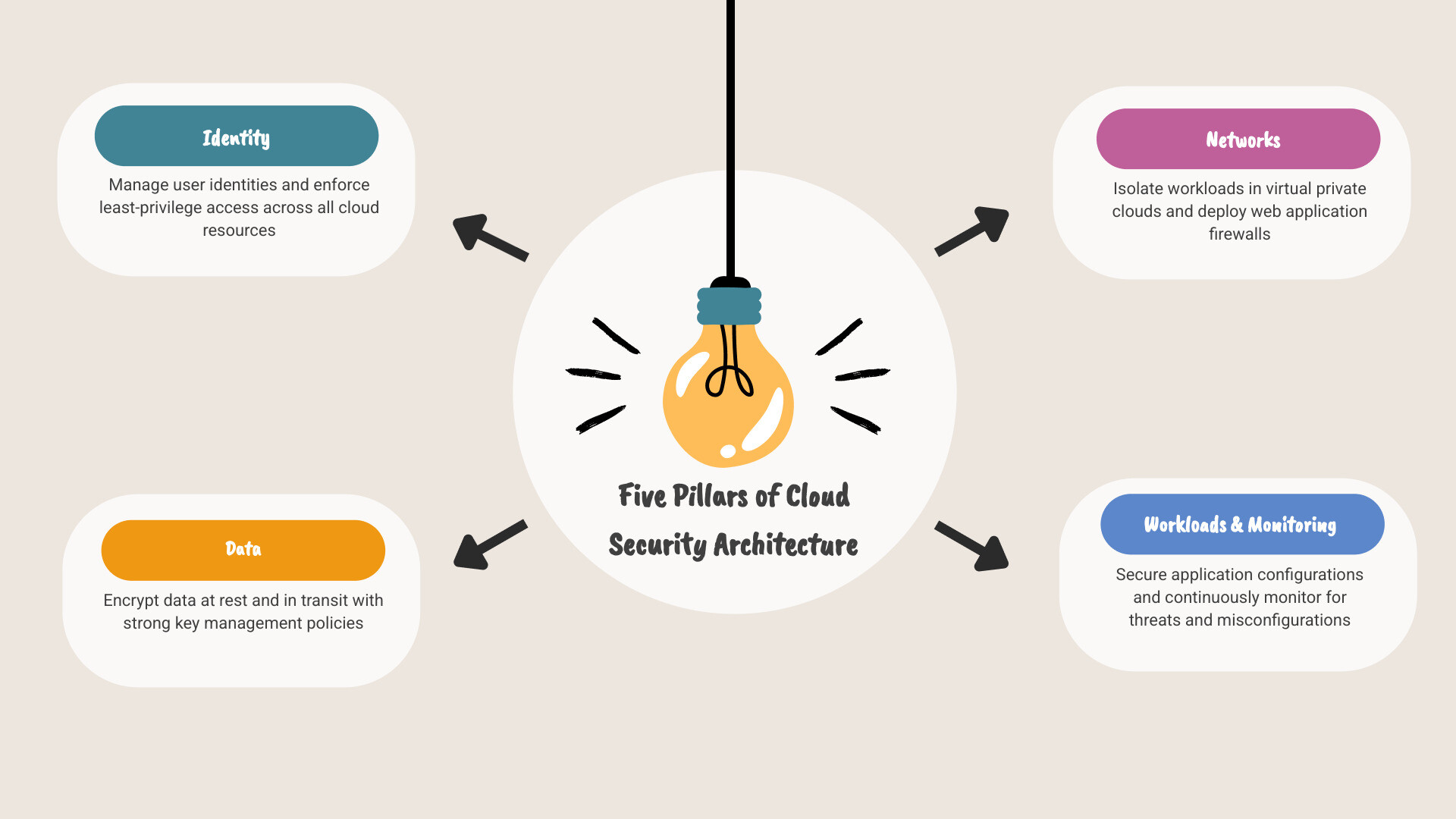
Cloud computing security architecture terms to learn:
Core Pillars and Principles of Cloud Computing Security Architecture
The Shared Responsibility Model in Cloud Computing Security Architecture
Every cloud deployment relies on a division of duties between the cloud service provider (CSP) and the customer. Misunderstanding these division lines introduces exploitable vulnerabilities. As outlined in standard frameworks like the NIST Cloud Computing Security Reference Architecture, operational accountability changes across service tiers, but data ownership remains strictly with the customer.
| Service Model | CSP Responsibilities | Customer Responsibilities |
|---|---|---|
| Infrastructure as a Service (IaaS) | Physical facilities, hardware, hypervisor virtualization | Guest OS, network routing, firewall rules, applications, IAM, data protection |
| Platform as a Service (PaaS) | Physical infrastructure, OS patching, database engines, runtime | Application source code, database configurations, API keys, IAM, data classification |
| Software as a Service (SaaS) | Application code, infrastructure, uptime, backend security | User access management, data classification, tenant configurations, credential policies |
In IaaS, the customer retains deep architectural control over virtual machines, networking topologies, and operating system configurations. In PaaS, the provider abstracts the underlying operating system, leaving the customer focused on securing code execution and access policies. In SaaS, the provider manages the full application stack, making identity governance and configuration management the primary enterprise defense. Understanding who shares responsibility for cloud security ensures teams do not mistakenly assume that standard provider hosting includes internal data governance and access control.
Foundational Architectural Principles: Zero Trust, Least Privilege, and CIA Triad
A resilient cloud security architecture uses layered defenses rather than perimeter assumptions. Designing for Defense in Depth ensures that if one control fails, secondary measures prevent unauthorized access or data exfiltration.
At the core of modern cloud frameworks is Zero Trust Architecture (ZTA), formalized in NIST SP 800-207. Zero Trust operates on explicit verification:
- Continuous Verification: Every access request is evaluated dynamically using contextual data, user identity, workload state, and device posture.
- Principle of Least Privilege (PoLP): Identities receive only the permissions required to perform their specific tasks, avoiding broad standing privileges.
- Micro-Segmentation: Network traffic is contained within granular security perimeters to prevent lateral movement.
These controls align with the CIA Triad (Confidentiality, Integrity, and Availability). Confidentiality protects private resources from unauthorized observation, integrity verifies data has not been modified or corrupted, and availability guarantees operational uptime through redundant infrastructure.

Federal standards such as the Cloud Security Technical Reference Architecture v.2 emphasize that perimeter-focused network security is insufficient for distributed environments. When network perimeters dissolve across hybrid deployments, addressing why most cloud strategies break down at the network layer requires moving access decisions closer to the workloads themselves.
Critical Controls: IAM, Encryption, Network Isolation, and Threat Detection
Operationalizing an enterprise cloud defense requires four foundational control sets:
- Identity and Access Management (IAM): Centralized identity federation paired with Multi-Factor Authentication (MFA) and Just-In-Time (JIT) role elevation. Workloads should communicate using short-lived cryptographic tokens rather than persistent administrative keys.
- Cryptographic Protection: Strong encryption must be applied across every lifecycle stage. Implement AES-256 for data at rest and enforce TLS 1.3 for data in transit. Centralized Key Management Services (KMS) or hardware security modules (HSM) maintain key isolation and automated rotation schedules. Reviewing a guide to cryptography in cloud computing helps establish proper envelope encryption practices.
- Network Isolation: Virtual Private Clouds (VPCs), private endpoints, and subnet isolation separate public load balancers from internal application tiers and backend databases. Web Application Firewalls (WAF) inspect ingress application traffic against injection flaws and layer-7 abuse. Guidelines from the Secure Cloud Architecture – OWASP Cheat Sheet Series highlight the importance of restricting outbound network egress to prevent command-and-control communication during a workload compromise.
- Unified Threat Detection: Structured telemetry aggregation across cloud control planes, audit logs, and network flows feeds automated correlation engines to flag suspicious behavioral anomalies in real time.
Implementing and Operationalizing Multi-Cloud Security
Mitigating Top Threats Across Cloud Computing Security Architecture
Enterprise multi-cloud estates face predictable threat vectors that target configuration and identity gaps:
- Cloud Misconfigurations: Publicly accessible object storage buckets, permissive security groups, and default administrative credentials represent common root causes of data leaks. Automated scanners must continuously validate configurations against baseline templates.
- Phishing and Account Hijacking: Adversaries target administrative credentials using targeted deception. Enforcing hardware-backed authentication tokens and contextual risk-based access mitigates account takeover risks.
- Insecure APIs: APIs lacking rate-limiting, authentication tokens, or input validation allow adversaries to scrape or tamper with cloud records. All public-facing interfaces require API gateway mediation and token authentication.
- Insider Threats: Unauthorized data exfiltration by privileged users requires behavioral baseline tracking, least-privilege scoping, and strict egress filtering.
Organizations can use established playbooks such as ways to prevent top cloud security threats to remediate these entry points.
Because ransomware increasingly targets cloud control planes and snapshots, resilience requires defense beyond prevention. Organizations need isolated, immutable recovery environments. Deploying dedicated SaaS backup for cloud data protection ensures that enterprise records, productivity platforms, and production configurations can be restored rapidly if primary infrastructure becomes unavailable.
Continuous Posture Management, DevSecOps, and FedRAMP Compliance
Maintaining visibility across heterogeneous multi-cloud environments requires automated posture governance. Cloud Security Posture Management (CSPM) platforms monitor multi-cloud infrastructure in real time, detecting drifted configurations, policy violations, and unpatched assets.
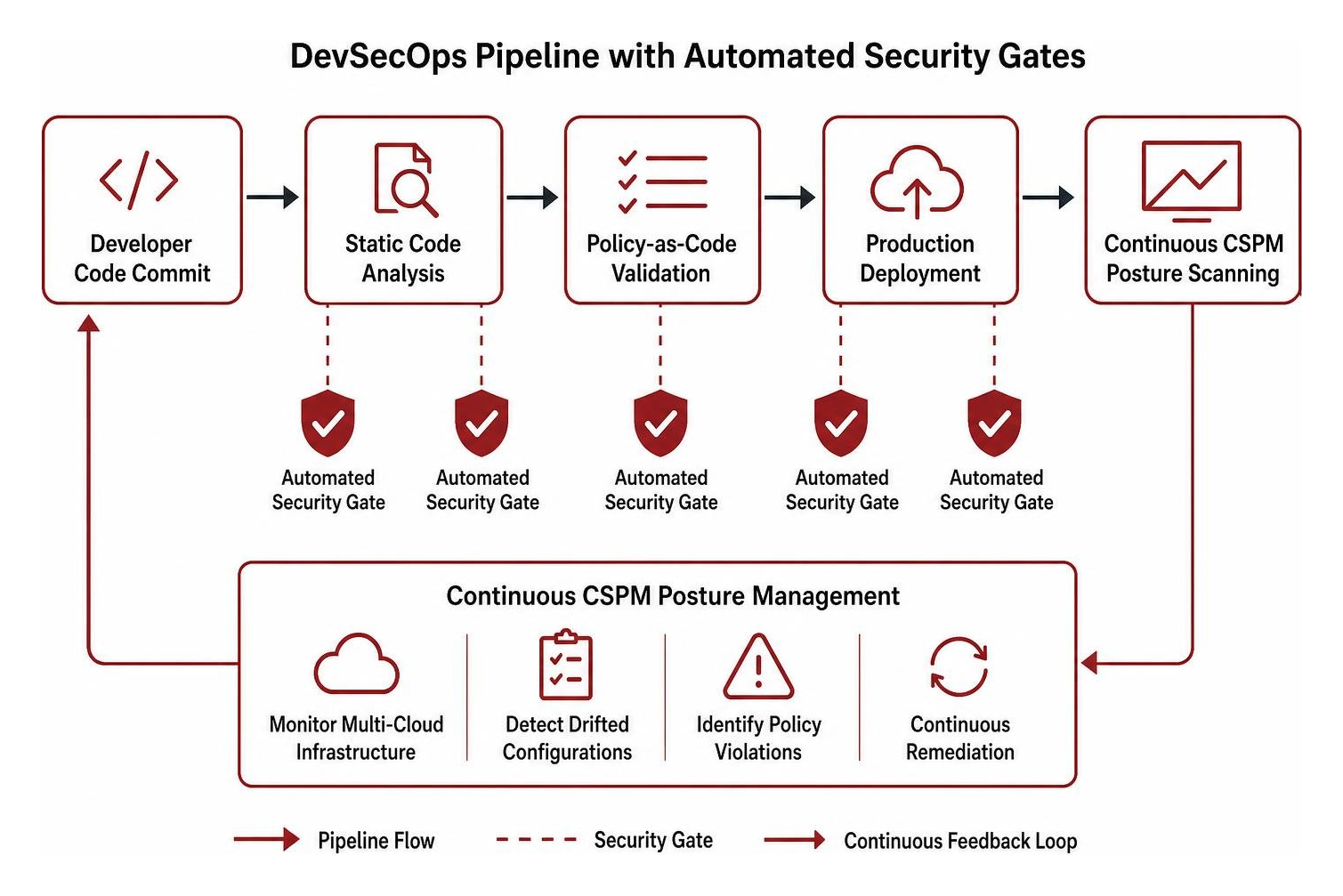
Embedding security checks early into continuous integration and continuous delivery (CI/CD) pipelines—an approach known as DevSecOps—allows teams to identify infrastructure-as-code (IaC) misconfigurations before provisioning. Automated Policy-as-Code guardrails evaluate pull requests against enterprise compliance rules.
For public sector workloads and regulated commercial supply chains, frameworks like FedRAMP establish standardized security assessments, continuous monitoring, and unified authorization boundaries. Aligning your architecture with guidance such as the CSA Security Guidance for Critical Areas of Focus in Cloud Computing and our guide to cloud computing security best practices simplifies regulatory audits while maintaining continuous security baselines across clouds.
Practical Migration Strategies and Sustainable Multi-Cloud Governance
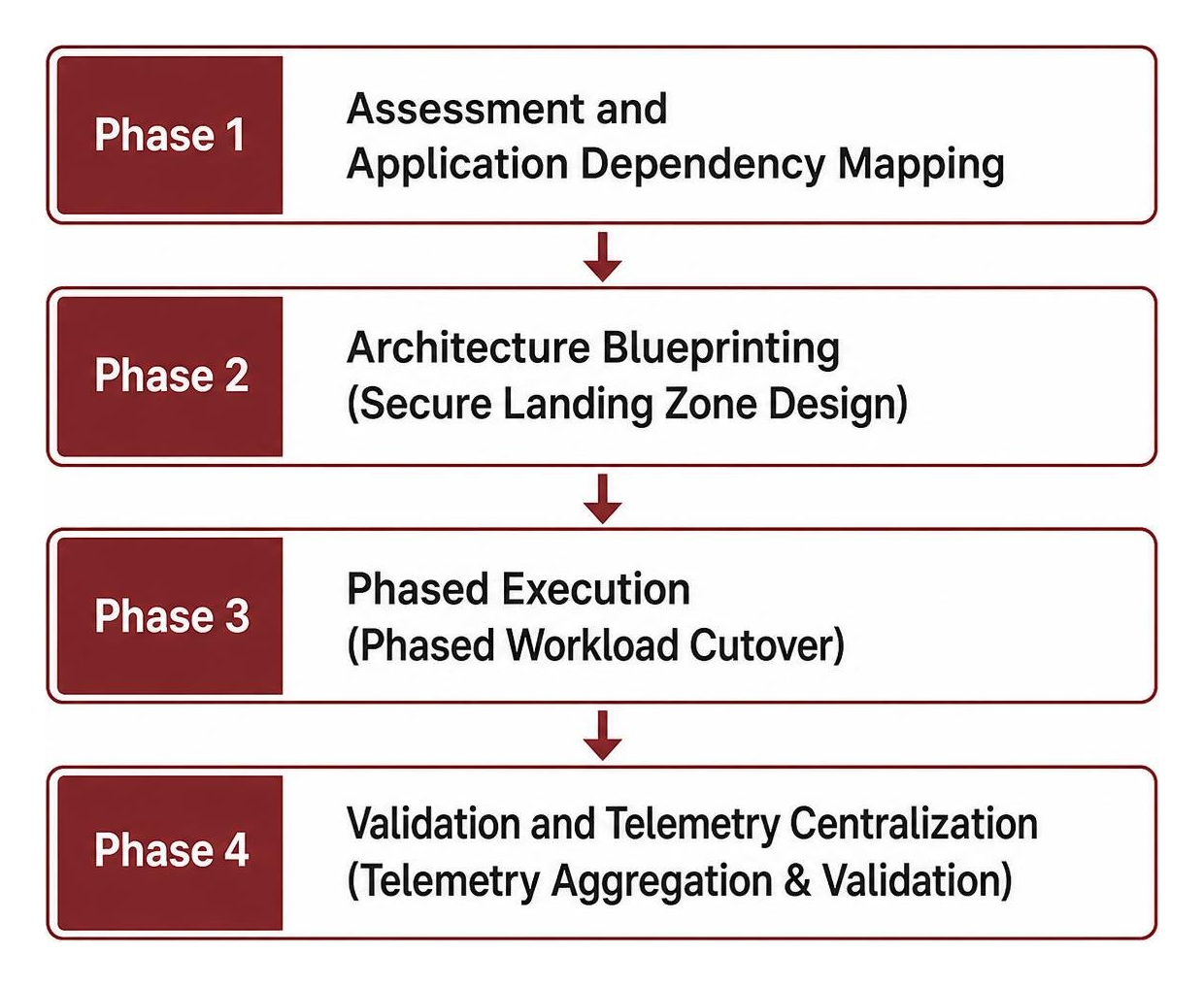
A secure cloud migration requires structured planning across distinct phases:
- Assessment and Application Dependency Mapping: Catalog application architectures, data classifications, network interdependencies, and compliance requirements to avoid broken dependencies during migration.
- Architecture Blueprinting: Establish landing zones, identity federation models, and network segmentation rules before provisioning workloads.
- Phased Execution: Migrate workloads in waves, prioritizing non-critical systems to validate baseline security controls before moving production-critical databases.
- Validation and Telemetry Centralization: Verify data integrity, test disaster recovery procedures, and aggregate multi-cloud logging into centralized analytics platforms.
Sustainable multi-cloud governance balances speed with operational resilience. Centralized security services, clear Service Level Agreements (SLAs), and ongoing cost and architecture assessments help maintain consistent oversight without overburdening engineering teams.
Moving Beyond Static Defenses
Building a resilient cloud computing security architecture requires moving beyond static controls toward continuous operational visibility and shared governance. While baseline reference frameworks, Zero Trust verification, and automated guardrails establish essential foundations, operational resilience depends on evaluating risk dynamically as workloads and multi-cloud environments evolve.
Organizations should focus on closing visibility gaps across service tiers, establishing clear identity and access boundaries, and validating recovery readiness across all environments. To evaluate your architectural posture and develop a structured roadmap for your environment, explore DataEndure’s cloud security solutions.