Why Enterprise Breach Detection Rapid Response Is Now a Business-Critical Priority
Enterprise breach detection rapid response is a key component of modern cybersecurity, helping organizations contain incidents before they escalate.
Here’s what you need to know:
- Average breach cost in 2025 exceeds $5 million per incident in the U.S., with global losses projected to surpass $10 trillion
- Attackers move fast — the fastest recorded breakout time is just 27 seconds from initial access to lateral movement
- Dwell time increases risk — the longer an unauthorized user remains undetected, the greater the potential for data exposure and operational disruption
- Insider threats are real — internal employees account for 43% of corporate data leakage, half of it accidental
- 91% of breaches start with a spear-phishing email — a single click can bypass years of perimeter investment
- Rapid detection requires a layered approach: attack surface monitoring, dark web intelligence, endpoint detection, Zero Trust Architecture, and AI-assisted triage working together
Organizations in regulated industries face significant challenges managing high alert volumes and integrating disparate security tools.
Many security programs historically focused on reactive measures—responding after an alert is triggered. But by the time a traditional SIEM flags an anomaly, lateral movement or data exfiltration may have already occurred. The Marriott breach, for example, went undetected for four years.
This guide explores how organizations can transition from reactive response to proactive, rapid detection by streamlining security workflows and improving tool integration across security, data, cloud, network, and infrastructure environments.
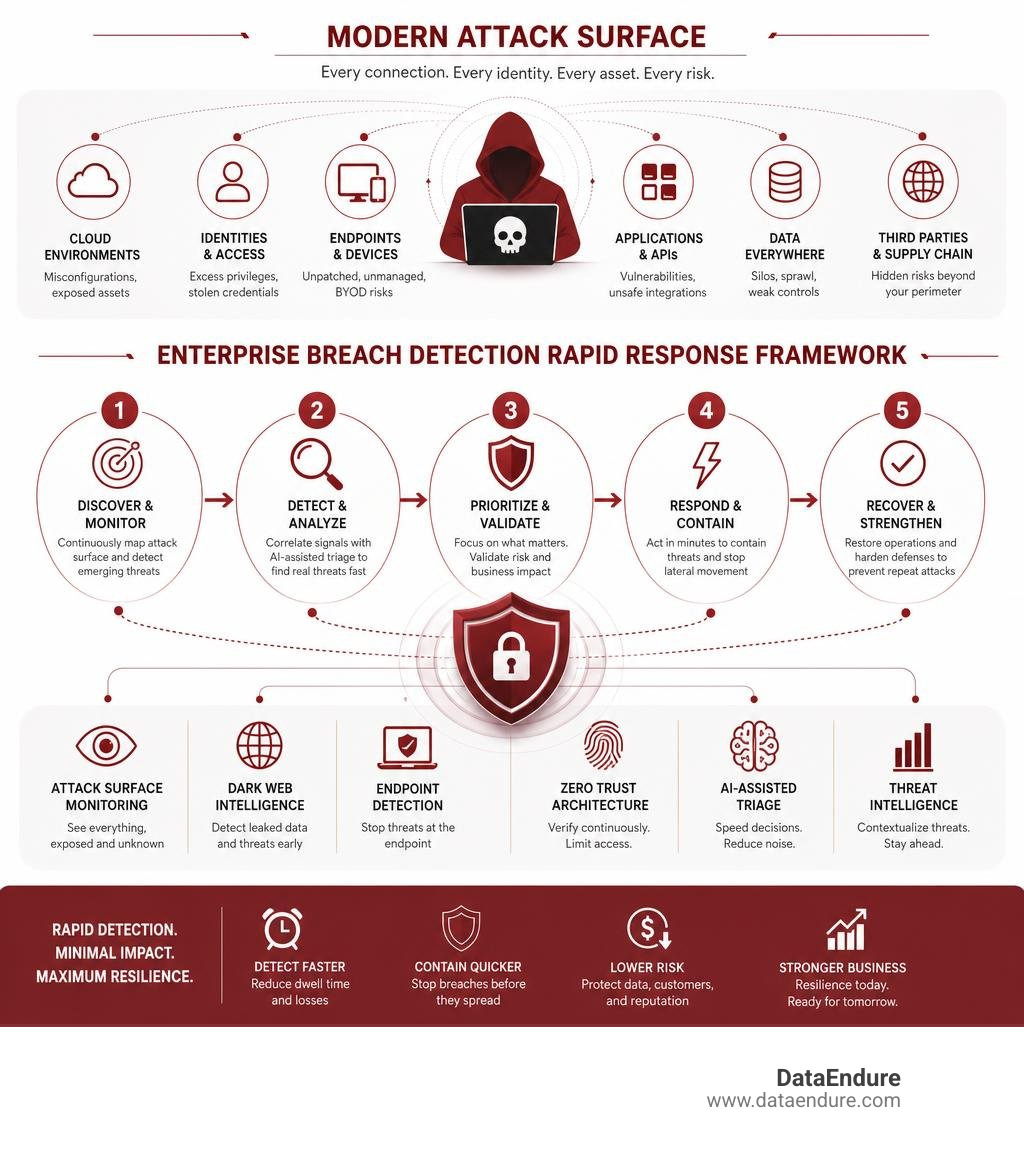
Enterprise breach detection rapid definitions:
The Anatomy of Modern Threats: Why Traditional Security Fails
Traditional security models were designed under a simple assumption: draw a hard perimeter around your network, keep unauthorized users out, and trust everything inside. Today, that perimeter has evolved. Between hybrid workforces, multi-cloud environments, and third-party integrations, data is distributed across multiple environments.
When the perimeter is decentralized, relying solely on perimeter-based security tools may leave internal assets vulnerable. Attackers frequently exploit valid credentials to gain access.
The Infiltration Vectors: How Breaches Actually Happen
Modern enterprise breaches rarely resemble dramatic, brute-force hacking. Instead, they leverage stealthy, coordinated infiltration vectors:
- External Hacking and Credential Stuffing: Automated tools are used to test leaked credential combinations across enterprise portals. Because employees frequently reuse passwords across personal and work accounts, a compromise at an unrelated third-party site can grant access to a corporate network.
- Social Engineering and Spear-Phishing: Over 91% of successful breaches begin with a spear-phishing email. Today, these are augmented by highly personalized impersonation tactics that can challenge even well-trained employees.
- Cloud Misconfigurations: As organizations migrate to the cloud, shadow IT and misconfigured storage buckets (such as open S3 buckets) can create unintended access points.
- Insider Threats: This is a significant risk area. Insiders are associated with a notable portion of data breaches. While some of these are malicious, half of all corporate data leakage is accidental—such as an employee misrouting a sensitive spreadsheet or uploading proprietary code to a public repository.
The Real Cost of Delayed Detection
When a breach occurs, timely response is critical. In the United States, the financial consequences can be substantial, alongside regulatory and reputational impacts.
For organizations operating in California, the California State Data Breach List maintained by the State Attorney General serves as a public ledger of security incidents. Under the California Consumer Privacy Act (CCPA), failing to protect consumer data can result in statutory damages of up to $750 per consumer per incident, which can scale significantly in class-action lawsuits.
Beyond regulatory fines, delayed detection can result in reputational damage. A loss of customer trust can impact long-term business relationships and brand reputation.

The Shift from Reactive to Proactive Defense
To mitigate the impact of an intrusion before sensitive data is accessed, organizations aim to reduce “dwell time”—the period between the initial compromise and detection. In many legacy setups, dwell time is measured in weeks or months. During this window, unauthorized actors can conduct reconnaissance, move laterally to locate high-value assets, and establish persistent access.
A reactive security posture focuses primarily on containment after an alert is triggered. By contrast, a proactive defense assumes that unauthorized access attempts are ongoing or may have already occurred.
Proactive threat detection relies on continuous monitoring, behavioral baselining, and rapid threat hunting to disrupt the attack lifecycle during its earliest phases. By shifting focus toward early detection, organizations can improve their overall security posture and resilience. To learn how to make this transition, read our Ultimate Guide to Instant Breach Detection.
Implementing Enterprise Breach Detection Rapid Protocols
Achieving enterprise breach detection rapid capabilities requires a structured, layered approach that coordinates multiple security disciplines into a cohesive defensive framework. Integrating existing tools to work together efficiently is often more effective than simply acquiring additional solutions.
1. Continuous Attack Surface Monitoring
Visibility is a foundational element of cybersecurity. Modern enterprises often manage complex environments with shadow IT—unapproved SaaS applications, forgotten test environments, and unpatched legacy systems. Continuous attack surface monitoring maps the external footprint in real-time, identifying vulnerabilities, misconfigured cloud assets, and open ports.
2. Dark Web Intelligence
Compromised credentials and data are frequently shared or sold on external forums. Dark web intelligence monitors underground forums, encrypted chat channels, and credential marketplaces for signs of compromised corporate data. Identifying leaked credentials early allows organizations to reset passwords and disable compromised accounts before they are exploited.
3. Threat Impact Scoring
A common challenge for security teams is alert fatigue. When security systems generate high volumes of alerts daily, critical threats can be difficult to isolate. Threat impact scoring addresses this by evaluating alerts based on organizational context, asset sensitivity, and active threat intelligence, helping analysts prioritize high-impact events.
4. Zero Trust Architecture (ZTA)
The core philosophy of Zero Trust is to continuously verify access requests. Even if an account has valid credentials, ZTA validates access based on user behavior, device health, and network context. Combined with micro-segmentation, Zero Trust helps prevent lateral movement across the network if a single endpoint is compromised.
5. Honeypots and Honeytokens (Deception Technology)
Deception technology offers an alternative method for identifying unauthorized activity. Honeypots are decoy servers, and honeytokens are fake databases or credentials planted within the network. Because these assets have no legitimate business purpose, any interaction with them triggers a high-fidelity alert, allowing security teams to identify lateral movement with minimal false positives.

Leveraging AI and Automation for Enterprise Breach Detection Rapid
As security threats become more automated, manual analysis can become challenging to scale. This is where machine learning and automated triage workflows can assist.
By employing advanced algorithms, security operations centers (SOCs) can automate repetitive tasks associated with alert triage. Automated workflows can analyze alerts, correlate them with contextual telemetry across endpoints, identity providers, and cloud environments, and close benign alerts with high accuracy. This helps optimize analyst hours, allowing teams to focus on complex threat hunting campaigns.
However, technology is most effective when combined with human expertise. While automated systems excel at processing large volumes of data quickly, human analysts provide the critical context, strategic reasoning, and validation required during complex incidents. To understand how to balance these elements, see our guide on How to Master Breach Hunting in Minutes.
Balancing Privacy and Compliance in Enterprise Breach Detection Rapid
When deploying advanced breach detection tools, enterprises must navigate data privacy regulations. Collecting endpoint telemetry, analyzing network traffic, and monitoring user behavior can involve sensitive employee or customer data.
To maintain compliance with frameworks like CCPA and GDPR, organizations can implement privacy-preserving measures:
- Data Minimization: Only collect and retain the telemetry necessary for security analysis.
- Encryption in Transit and at Rest: Ensure all security logs and data streams are fully encrypted.
- Role-Based Access Control (RBAC): Restrict access to security monitoring platforms so that only authorized analysts can view raw log data.
- Anonymization: Mask personally identifiable information (PII) within security logs unless it is strictly required for active incident investigation.
By aligning detection protocols with established frameworks like the NIST Cybersecurity Framework, organizations can protect their environments while respecting data privacy laws. For a deeper look at how these elements intersect, explore our article on What is Threat Detection in Cybersecurity?.
How to Build a Rapid Incident Response Playbook
When a breach is suspected, having a structured incident response (IR) playbook helps ensure a coordinated and timely response.
A modern IR playbook focuses on proactive threat disruption alongside traditional containment strategies. The table below highlights how these two approaches compare:
| Phase | Reactive Containment (Traditional) | Proactive Threat Disruption (Modern) |
|---|---|---|
| Detection | Relying on scheduled log reviews or user reports; hours or days to identify. | Continuous, real-time behavioral analysis; threats identified in minutes. |
| Initial Action | Manual verification and escalation up the organizational chart. | Automated containment (e.g., immediate endpoint isolation) while analysts validate. |
| Scope Assessment | Manually querying multiple disconnected tools. | Unified telemetry correlation across cloud, network, and endpoints. |
| Remediation | Wiping and rebuilding affected systems; potential business downtime. | Targeted threat removal, credential revocation, and systematic recovery. |
Immediate Steps to Take During a Suspected Breach
If a highly suspicious event is identified, the following steps can help contain the potential impact:
- Isolate Affected Systems (But Do Not Power Off): Disconnect compromised endpoints or servers from the network to prevent lateral movement. Crucially, do not power them down. Turning off a machine destroys volatile RAM data, which contains critical forensic evidence such as active processes and encryption keys.
- Preserve Evidence: Maintain strict custody of system logs, network traffic captures, and endpoint states. This forensic data is vital for determining the scope of the breach and meeting regulatory reporting obligations.
- Engage External Incident Response Teams: If you have an incident response retainer, activating it promptly can bring specialized forensic tooling and analysis to help contain, investigate, and recover from the incident.
- Answer the Critical Post-Event Questions: As you transition from containment to recovery, leadership teams will require clear information. Be prepared to address the key issues outlined in our guide on 7 Questions You Need to Be Able to Answer After a Cybersecurity Event.
Frequently Asked Questions about Enterprise Breach Detection
How quickly should an enterprise respond to a suspected data breach?
Ideally, within minutes. A common benchmark for security operations is the “1-10-60 rule”: detect a threat within 1 minute, investigate it within 10 minutes, and contain it within 60 minutes.
To achieve this level of speed, many organizations utilize incident response retainers or partner with external security providers. For organizations without the in-house resources to maintain 24/7/365 vigilance, options like DataEndure Managed Security Services can help bridge the gap, providing continuous monitoring and response capabilities.
What are the primary causes of enterprise data breaches in 2026?
The threat landscape in 2026 is characterized by three main vectors: social engineering (including highly targeted spear-phishing), cloud exposure due to hybrid migrations, and compromised credentials exploited via credential stuffing.
Furthermore, organizations can be subject to recurrent incidents. If the root cause of a breach is not thoroughly identified and remediated, the same vulnerabilities may be exploited again. To understand how to address these risks, read our analysis on Breach Repeat: Understanding Recurrent Cyberattacks.
How do honeypots and honeytokens assist in rapid breach detection?
Honeypots and honeytokens act as high-fidelity tripwires. Because these decoy systems and files have no legitimate operational purpose, any attempt to access, modify, or query them is a strong indicator of unauthorized activity or insider curiosity.
This deception technology helps filter out the noise of standard security alerts, providing clear notifications of lateral movement. To see how deception fits into a wider security strategy, read our overview of modern Threat Hunting.
Conclusion
In a highly connected digital environment, relying on disjointed security tools and reactive workflows can increase operational risk. Implementing rapid breach detection protocols helps protect organizational assets, maintain customer trust, and support regulatory compliance.
Establishing a resilient security posture involves aligning security, data, cloud, network, and infrastructure strategies. A vendor-agnostic approach that integrates diverse technology solutions can help eliminate visibility gaps, reduce alert fatigue, and streamline managed detection and response capabilities.
Proactively managing the attack surface and establishing clear response protocols are key steps toward building a resilient enterprise.